-
Call Now
1800-102-2727


All About Chromoplasts- Location, Function & Importance

Explore the intriguing subject of chromoplasts, the organelles that paint nature's bright colours. Learn about their location, structure, various colours, how they affect fruits and flowers. The following article explores the fascinating relationship between chromoplasts and how people perceive beauty in the world of plants.
Table of Contents:
- Definition of Chromoplasts
- Location
- Types of Chromoplasts
- Structure
- Diagram
- Functions
- Difference between Chromoplast, Chloroplast, and Leucoplast
- Practice Problems of Chromoplasts
- FAQs of Chromoplasts
Definition of Chromoplasts
Chromoplasts, specialised plastids, are in charge of producing, storing, and displaying pigments, chiefly carotenoids. Chromoplasts display a spectrum of vivid colours, such as red, orange, and yellow, in contrast to chloroplasts, which are green because of chlorophyll. These pigments play a crucial role in luring pollinators and seed dispersers, contributing to the spectacular hues seen in fruits, flowers, and other plant structures.
Location of Chromoplasts
Chromoplasts are often located in particular plant tissues or cell types where they are needed for their unique roles. They are typically found in chromoplast-rich regions of plants like the petals, fruits, and some vegetative tissues.
For instance, chromoplasts are frequently found in the petals of flowers, which is how they acquire their distinctive and brilliant colours. Chromoplasts can be discovered in the fruit's flesh or peel, which helps to explain why mature fruits have such beautiful colours. It is significant to note that chromoplasts are not found in all plant cells but only in tissues where colouration is desired.
Types of Chromoplasts
Chromoplasts are heterogenous plastids, i.e., diverse pigmented plastids are found in plant cells. They are classified into four main types owing to the carotenoid bearing components:
1. Globular Chromoplasts: The presence of plastoglobuli bearing carotenoid pigments. They abundantly occur in the peripheral stroma.
For example, Citrus fruit- perianth, Capsicum- yellow fruits, Ranunculus repens– petals, etc.
2. Membranous Chromoplasts: The presence of carotene pigments in about 20 concentric membranes.
For example, daffodils, tulips, citrus sinensis– petals, etc
3. Tubular Chromoplasts: The presence of carotenoids in lipoprotein tubules.
For example, the hypanthium, rose, red fruits of capsicum, etc.
4. Crystalline Chromoplasts: The presence of pure carotene in the form of embedded crystals.
For example, Tomato fruits- lycopene, Carrot roots- ꞵ-carotene, etc.
Structure of Chromoplasts
Chromoplasts' structure includes a number of elements that support both their pigmentation and their specialised functions. Here is a thorough explanation of chromoplast structure:
Outer Membrane: An outer membrane serves as a protective barrier.
Inner Membrane: An inner membrane regulates the molecular movement in and out of the chromoplast.
Stroma: The stroma is the chromoplast's gel-like matrix. It includes a variety of proteins, enzymes, and other elements required for diverse metabolic activities.
Thylakoid Membranes: Chromoplasts, in contrast to chloroplasts, have fewer or no grana-organised thylakoid membranes. Instead, they might have a few plastoglobuli, which are thylakoid structures that are dispersed or modified. Lipid-rich structures called plastoglobuli have the capacity to store and alter lipid molecules.
Pigment Containing Structures: They have a variety of pigments, mostly carotenoids, which contribute to their red, orange, and yellow hues. These pigments, which are created and kept in the chromoplasts, are what give fruits, flowers, and other coloured plant structures their vivid colours.
Lipid Droplets: Plastoglobuli, or lipid droplets, are frequently found in chromoplasts. The lipid molecules that are crucial for a number of metabolic activities, including the creation of pigments, are stored and altered in these structures.
Depending on the plant species, tissue type, and developmental stage, chromoplast shape and content can change. In response to environmental and developmental factors, chromoplasts alter dynamically, switching from one kind of plastid to another or interconverting with other plastids depending on the needs of the metabolic process.
Diagram
The diagram given below shows the detailed structure of a chromoplast. Review the parts to get a better understanding.
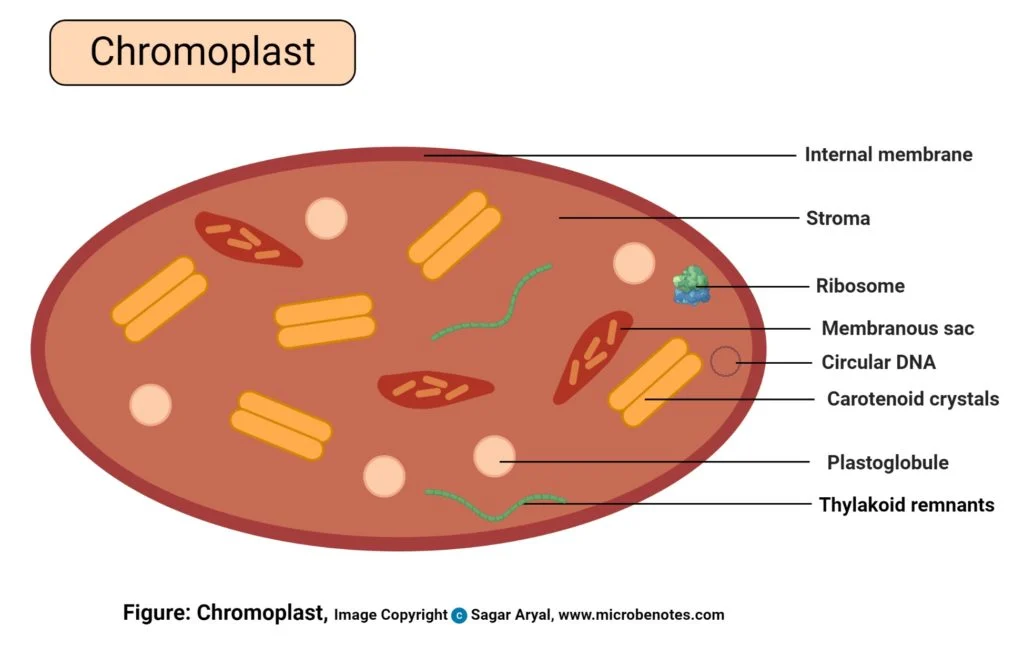
Image: Detailed Structure of Chromoplast
Functions
Chromoplasts are specialised plastids with unique functions related to pigmentation and the synthesis of pigments. The key functions of chromoplasts are as follows:
- Pigment Synthesis: Chromoplasts produce and store pigments, especially carotenoids, as their primary job. The various hues seen in fruits, flowers, and other pigmented plant structures are the result of these pigments. Enzymes and other substances required for the manufacture of carotenoids are found in chromoplasts.
- Colouration: Chromoplasts are essential for giving different plant tissues their brilliant colours. They aid in giving ripe fruits their alluring colours and drawing animals for seed dissemination. Chromoplasts in flowers improve their aesthetic appeal and support pollination by luring pollinators.
- Pigment Storage: Synthesised pigments can accumulate in particular plant tissues because chromoplasts store them. To ensure their accessibility to diverse biological processes and to respond to environmental stimuli, the pigments are hidden within specialised structures like plastoglobuli and lipid droplets.
- Nutrient Storage: Chromoplasts have the ability to retain additional essential nutrients and metabolites in addition to pigments. For instance, certain plants' chromoplasts house the lipids, starch granules, and other vital substances needed for metabolism and energy storage.
- Protective Role: In plants, chromoplasts can serve as a defence mechanism. Some pigments, including carotenoids, have antioxidant qualities that aid in scavenging dangerous reactive oxygen species produced during photosynthesis or under stressful circumstances. Chromoplasts' antioxidant action helps save plant cells from oxidative harm.
Difference between Chromoplast, Chloroplast, and Leucoplast
|
Chromoplasts |
Chloroplasts |
Leucoplasts |
|
Pigmented plastid (not green but yellow or red) |
Pigmented plastid (typically green) |
Colourless plastids |
|
Contain carotenoids and xanthophylls, not chlorophyll. |
Contain chlorophyll and some other carotenoids |
No pigments |
|
Impart distinct colour parts of plants. An important role in pollination and seed dispersal |
Perform photosynthesis No role in pollination. |
Storage of starch, proteins, and fat. |
|
No lamellar system Only remnants of thylakoids present |
Lamellar system present Ribosomes and thylakoids are also present |
Several nucleoids and uniform granular stroma present |
Practice Problems of Chromoplasts
Q1. Which pigment is commonly synthesised by and stored in chromoplasts?
A. Chlorophyll
B. Phycocyanin
C. Xanthophyll
D. Anthocyanin
Ans: C. Xanthophyll
Pigments, particularly carotenoids, are synthesised and stored by chromoplasts. The carotenoid pigment, xanthophyll, is frequently found in chromoplasts and is responsible for the yellow and orange hues seen in different plant tissues.
Q2. Which one is the key function of chromoplasts in fruits?
A. Storage of water
B. Synthesis of glucose
C. Pigmentation and colouration
D. Protection against pathogens
Ans: D. Pigmentation and colouration
Chromoplasts produce and store pigments like carotenoids, which are a part of the brilliant colours seen in ripe fruits.
Q3. Which cell organelle helps in converting chloroplasts into chromoplasts during the ripening of fruit?
A. Golgi apparatus
B. Nucleus
C. Endoplasmic reticulum
D. Mitochondria
Ans: A. Golgi apparatus
During fruit ripening, the Golgi apparatus is essential for the transformation of chloroplasts into chromoplasts. Chloroplasts are changed, becoming chromoplasts, which are designed specifically for the synthesis and storage of pigments.
Q4. Which of the following factors may influence a plant's chromoplast pigmentation?
A. Excessive light exposure
B. Low humidity
C. High-temperature
D. All of the above
Ans: D. All of the above
Several environmental factors may have an impact on a plant's chromoplasts' colouration. The synthesis and accumulation of pigments in chromoplasts can be impacted by extremes in temperature, humidity, and light exposure, potentially changing the colour of plant tissues.
Q5. Where are chromoplasts most abundant in plants?
A. Leaves
B. Stems
C. Fruits
D. Roots
Answer: C. Fruits
Chromoplasts impart vivid colours to ripe fruits, which lure animals for seed dispersion. Fruit chromoplasts produce and store pigments, mostly carotenoids, that are responsible for the appealing hues seen in many fruit species.
FAQs of Chromoplasts
Q1. Are chromoplasts present in non-photosynthetic plant tissues?
Answer: Yes, chromoplasts are found in non-photosynthetic plant tissues. Chromoplasts are found in the tissues where pigmentation is required, such as petals of flowers, fruits, and certain vegetative tissues.
Q2. Can the chromoplasts alter their colour?
Answer: Yes, chromoplasts can alter colour under specific circumstances. Environmental elements can affect the production and buildup of pigments in chromoplasts, including light intensity, temperature, and nutrition availability. For instance, exposure to increasing light levels may amplify the chromoplasts' colour, producing hues that are more vivid and distinct.
Q3. Are chromoplasts present only in plants?
Answer: Yes, chromoplasts are mostly found in plants, as they play a significant role in pigmentation and colouration. However, some non-photosynthetic organisms, including some bacteria and some types of algae, have organelles that resemble chromoplasts and contain pigments.

 Call Now
 Let's Chat
 Share
Share