


Cell - The Unit Of Life

The cell is the smallest unit and the building block of all living organisms. An organism is made up of one cell, like bacteria or trillions of cells, like humans. It is the basic unit of life. The structure of the cell contains various organelles that perform necessary functions.
Table of Contents:
- What Is A Cell?
- Cell Theory
- Prokaryotic Cells
- Eukaryotic Cells
- Cell Organelles
- Difference between Plant Cell and Animal Cell
- Practice Problems
- Frequently Asked Questions
What Is A Cell?
A cell is the structural and functional unit of all living beings. There are unicellular and multicellular organisms in the environment. All the cells are not similar. They are divided into plant and animal cells. The cell also varies in size and shape. The largest cell is the egg or the ovum. The smallest cell is the granule cell present in the human cerebellum. Cell Biology is the study structure, function and life history of a cell.
Cell Theory
The cell theory is formulated by Matthias Schleiden and Theodor Schwann. They proposed that:
- All living organisms are made up of cells and cell products.
- All the cells are formed from existing cells through cell division.
- The body of living organisms is made up of one or more cells.
Prokaryotic Cells
Prokaryotic cells are present in unicellular microorganisms. There are many types of prokaryotic cells, such as extremophiles and photoautotrophic, which can produce nutrients from the energy of the Sun. It is made up of single membrane-bound organelles; thus, all the reaction takes place within the cytoplasm of the cell. They are free-living organisms and found in the gut of other animals, such as ruminants of cows.
Eukaryotic Cells
Eukaryotic cells are present in multicellular microorganisms, and they come under Eukaryota. Eukaryotic cells have a membrane-bound nucleus. They are larger than prokaryotic cells. They have various organelles to perform various functions.
Cell Organelles
All eukaryotic cells contain different types of organelles to perform various functions of the cell. Some of the cell organelles are listed below:
- Cell or Plasma membrane
- Cell wall
- Mitochondria
- Plastids
- Ribosomes
- Cytoskeletons
- Centrosome
- Centrioles
- Nucleus
- Microbodies
- Cilia and Flagella
- Endomembrane
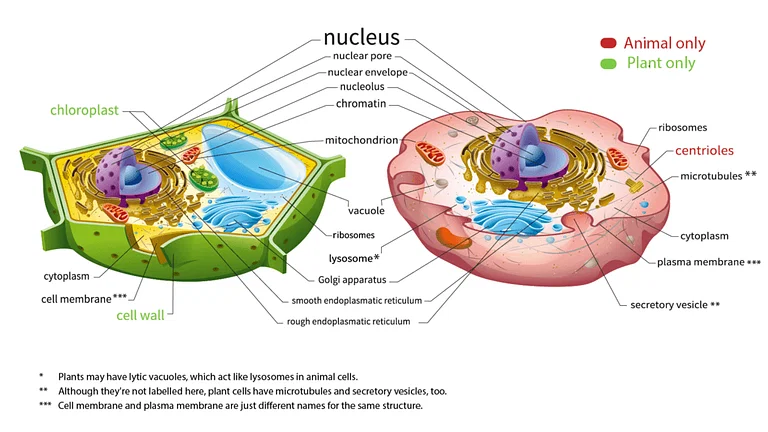
Image : EduRev
Difference between Plant Cell and Animal Cell
|
Plant Cell |
Animal cell |
|
The cell wall is present |
The cell wall is absent |
|
Centrioles are absent |
Centrioles are present |
|
Plastids are present |
Plastids are absent |
|
Have large vacuole |
Have small vacuole |
Practice Problems
Q1. Which of the following is absent in the animal cell?
A. Centrioles
B. Mitochondria
C. Cell wall
D. None of the above
Ans: C. Cell Wall
Animal cells, unlike plant cells, lack a cell wall and are surrounded by a plasma membrane, which works as a selective barrier, giving structure, protection, and preserving the cell's internal environment.
Q2. ______ is the basic unit of life.
A. Cell
B. Tissues
C. Plasma membrane
D. None of the above
Ans: A. Cell
Cells are vital life-sustaining elements in all living species, from simple single-celled organisms to complex multicellular animals. They carry out essential processes like nutrition uptake, reproduction, stimulus-response, and homeostasis.
Q3. Which of the following is absent in the plant cell?
A. Centrioles
B. Mitochondria
C. Cell wall
D. None of the above
Ans: A. Centrioles
Plant cells lack centrioles because plant cells have evolved other systems, such as Microtubule Organising Centres (MTOCs) and the cell plate, to achieve cell division and preserve the cell's fundamental activities.
Frequently Asked Questions
Q1. Why is Mitochondria called the ‘Powerhouse of the cell’?
Answer: Mitochondria are called the ‘Powerhouse of the cell’ because it generates chemical energy that is required for the cell's biochemical reactions.
Q2. What is the function of the Golgi apparatus?
Answer: The Golgi apparatus plays an important role in transporting, modifying and carrying out the proteins to vesicles to reach the targeted destinations.
Q3. What is Chloroplast?
Answer: The Chloroplast is the green-coloured plastids containing chlorophyll. It is a double membrane organelle present in the plant cell.
NEET Related Links
JEE MAIN Related Links
JEE Advanced Related Links
JEE Advanced Eligibility Criteria
JEE Advanced Chemistry Syllabus
JEE Advanced Registration Dates
CUET Related Links
Important Topics
Anemometer : Measurement of Wind Speed
Angular Acceleration Atomic Theory Audible and Inaudible Sound Average Speed and Average Velocity Average Velocity Avogadros Number Avogadros Hypothesis Azimuthal Quantum Number Balanced Force Bar Magnet Biconvex Lens Boyles Law Buoyancy Calorimeter Carnot Engine Celestial Bodies Centripetal And Centrifugal Force Concave and Convex Lenses Concave Convex Mirrors Contact and Non Contact Force Controlled Thermonuclear Fusion Convection Currents Convex Lens Convex Mirror Destructive Interference Difference Between Conduction Convection and Radiation Difference Between Electric Field and Magnetic Field Difference Between Heat And Temperature Difference Between Series And Parallel Circuits Differences Between Acceleration And Velocity Distance and Displacement Distance Time Graph Electrical Force : Electric Forces and Their Types Electromagnetic Waves : Definition, Equation and Properties of Electromagnetic Waves Electromagnetism Electron Spin Fluid Flow : Bernoullis Equation Derivation and Fluid Mechanics Fluid Friction : Types and Factors of Fluid Friction Frames of Reference : Inertial and Non- Inertial Frame of Reference Frequency and Wavelength Frictional Force Importance of Hydrosphere Instantaneous Speed and Velocity Introduction to Motion Kinetic and Potential Energy Difference Law Of Conservation of Energy Layers of the Earth Light Energy Light Sources List of physics scientists and Their inventionsLoudness of Sound
Magnetic Dipole Moment Magnetic Field Non - Contact Force Non - Renewable Energy Ohms Law Optics P Wave Physics Symbols Plane Mirrors Poissons Ratio Projectile Motion Properties of Water : Anomalous Expansion of Water Radius of Gyration Reflection of Light Reflection of Waves Relative Density Resonance Reverberation Rolling Friction Rotation and Revolution Screw Gauge Semiconductors and Insulators Sliding Friction Speed Time Graphs Static Friction Stefan Boltzmann Law Stress Tension Tension Force Thermometer: Clinical Laboratory Thermometer Types of Rocks Types of Waves Uniform Motion and Non Uniform Motion Unit of Voltage Uses of Convex Lens Uses Of Convex Mirror Uses of Electromagnet Uses of Optical Fibre Wave Wavelength of Light What is Scattering of Light Working of Electric Bell Conventional and Non-conventional Sources of Energy Buoyant Force Bulk Modulus of Elasticity Bernoulli’s Principle Angular Momentum Difference Between Speed And Velocity ForceUnit of Heat
Difference between Distance and Displacement Simple Microscope Derivation Of Equation Of Motion Thermometer: Clinical & Laboratory Thermometer Difference between Concave and Convex LensDerivation Of Lens Maker Formula
Unit Of Pressure Velocity Uses of Plane Mirror
Wave Theory of Light
Unit of Density Unit of Light Unit of Force Unit of Magnetic Field Unit of wavelength Unit of Viscosity Uses of Electroplating Young's Modulus
What is the Scattering of Light
Lenz Law Space Wave Propagation Schrodinger Wave Equation Relation between Fahrenheit and Celsius Refractive Index Potentiometer Working Pascal Law Oscillatory Motion Optical Instruments Newton's Laws of Motion - First Law Modulation and Demodulation Magnetic Flux Lens Formula and Magnification Kaleidoscope Faradays Law Epsilon Naught Value Energy Bands Electrostatics Electroscope AC Generator Unit of Current Lithosphere Bending Equation Derivation Difference Between Pound and Kilogram Semiconductor Devices OTEC - Ocean Thermal Energy Conversion Hall Effect Rectilinear Propagation of Light Difference Between Ammeter and Voltmeter Coefficient of Linear Expansion Ampere’s Law Cyclone and Thunderstorm Save The Environment From Pollution Particle Nature of Light Types of DC Motor Uses Of Transistor Derivation of Phase Rule Unit of Humidity

 Call Now
 Let's Chat
 Share
Share