-
Call Now
1800-102-2727


Blood Pressure: Definition, Measurement, Normal Range of Blood Pressure, Hypertension, Prevention of Hypertension, Practice Problems and FAQs

You must have visited a doctor while you were not well or someone in your family was not feeling well. Do you remember a band being wrapped around the arm and then the air being pumped into it while the doctor checks some reading on an instrument? Do you know what the doctor was trying to do?
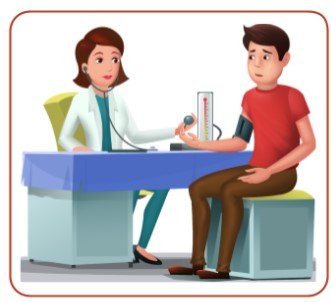
The instrument which the doctor uses is called a sphygmomanometer and it is used to measure the blood pressure of a patient. It is very important that the blood pressure remains normal, it is vital to life. Without this pressure or force exerted by heart, the blood will not be able to flow around the circulatory system.
For transport of oxygen, nutrients, waste products the flow of blood is important. However, if blood pressure becomes high it can become dangerous.
According to a study conducted in Washington, women have lower normal blood pressure range in comparison to men. This may also be harmful for women's health,
Table of content
- Blood pressure
- Calculating blood pressure in arteries
- Measuring the blood pressure
- Hypertension
- Preventing hypertension
- Practice Problems
- FAQs
Blood pressure
Blood pressure is the force exerted by blood against the walls of blood vessels. It drives the flow of blood from the heart through arteries and arterioles to capillary beds.
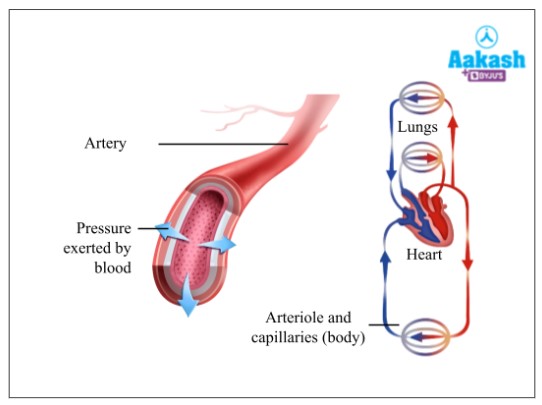
Fig: Blood Pressure
Calculating blood pressure in arteries
Blood pressure is only calculated in arteries because the blood pressure in the arteries is much higher than the veins. It is because after contraction the blood is transferred to the aorta (largest artery) directly after contraction.
Measuring the blood pressure
A sphygmomanometer is an instrument that is used to measure blood pressure. It consists of an armband - the cuff which is inflated by a pump (by hand or by machine). Once the cuff is inflated enough to stop the pulse, reading is taken by doctor either electronically or analog.
The reading is expressed in terms of the pressure it takes to shift mercury in the tube. This is the reason why blood pressure is being measured in millimetres of mercury or mm of Hg.
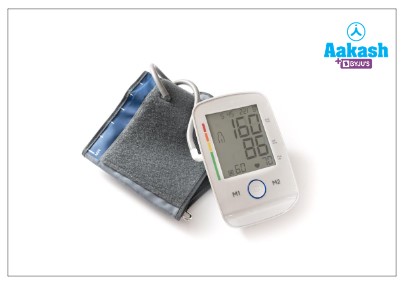
Fig: Sphygmomanometer showing blood pressure
Normal range of blood pressure
Normal blood pressure levels: 120 mm Hg/80 mm Hg.
What does the blood pressure numbers imply?
In this measurement, 120 mm Hg (millimetres of mercury pressure) is the systolic or the pumping pressure and 80 mm Hg is the diastolic or the resting pressure.
Systolic pressure refers to the maximum pressure within the large arteries when the heart muscle contracts to propel blood through the body. Diastolic pressure describes the lowest pressure within the large arteries during heart muscle relaxation between beating.
The table below shows how doctors interpret a person’s blood pressure :
|
Systolic (mm Hg) |
Diastolic (mm Hg) |
|
|
Normal |
Below 120 |
Below 80 |
|
Elevated (hypertension) |
120–129 |
Below 80 |
|
Stage 1 hypertension |
130–139 |
80–90 |
|
Stage 2 hypertension |
140 or above |
90 or above |
|
Hypertensive crisis |
Over 180 |
Over 120 |
Hypertension
If the blood pressure of an individual is more than 120/80 or higher, it means the person has a condition called hypertension or high blood pressure. Prolonged high blood pressure leads to various heart diseases and can also affect other organs in the body.
If the blood pressure ranges higher than 180/120 mm of Hg. It is considered hypertensive emergency or crisis and needs to be met immediately by health care professionals.
Preventing hypertension
One should maintain a good and healthy lifestyle inorder to have a healthy life.
- Try to do some physical activity everyday like 30 minutes in a day
- Do not smoke
- Maintain a proper and healthy diet
- Intake of more fruits and leafy vegetables
- Managing the consumption of alcohol
- Maintaining a healthy weight
- Do not take stress
- Do yoga or meditation
Even after maintaining the things, if you still think you or your family member or friends are suffering from high blood pressure then immediately meet a doctor. This way you can protect yourself and near and dear ones from various health related issues.
Practice Problems
1. Which of the following instruments is used by a doctor to hear the sounds of the heartbeat?
- Spirometer
- Thermometer
- Stethoscope
- Sphygmomanometer
Answer: A sphygmomanometer is an instrument that is used to measure blood pressure. It consists of an armband - the cuff which is inflated by a pump (by hand or by machine). Once the cuff is inflated enough to stop the pulse, reading is taken by doctor either electronically or analog.
The reading is expressed in terms of the pressure it takes to shift mercury in the tube.
2. In an adult human the ideal value of systolic and diastolic pressure in (mm of Hg) is
- 100/60
- 120/80
- 140/90
- 80/120
Answer: Systolic pressure refers to the maximum pressure within the large arteries when the heart muscle contracts to propel blood through the body.
Diastolic pressure is the lowest pressure within the large arteries during heart muscle relaxation between beating.
The blood pressure of an adult human is 120/80 mm of Hg.
3. Which of the following statements define a systole?
- Expansion of the heart chambers is called systole
- Contraction of the heart chambers is called systole
- Irregular beating of heart is called systole
- None of the above
Answer: The contraction of the heart chambers is called systole.
The expansion of the heart chambers is called diastole. The sequence of events that takes place in a cardiac cycle is atrial systole, ventricular systole,ventricular diastole and finally joint diastole.
4. When you are ill the doctor may put his fingers on your wrist. Which of the following do you think the doctor observes by doing this?
- The doctor listens to the heart beat by doing this.
- The doctor checks whether the blood is flowing properly to the hands
- The doctor checks the pumping activity of the left ventricle and measures the heart rate
- The doctor checks whether the blood is flowing from the hands to the heart
Answer: When we are ill the doctor puts his fingers on the wrist to check the pumping activity of the left ventricle and measures the heart rate. The rate of throb that is felt in the arteries due to the pumping activity is called pulse. The pulse is equal to the heartbeat that is felt on the wrist. The pulse rate may be influenced when we suffer from any disease.
FAQs
1. What causes high blood pressure
Answer: If the levels of arterial pressure is beyond 140 mm Hg (systolic) and 90 mm Hg (diastolic). It is known as high blood pressure or hypertension. The reasons for its cause are many but for most people it remains unclear. It could be be due to :
- Inactivity or lack of exercise
- Poor diet
- Obesity
- Increased cholesterol level
- Stress
- Smoking
- Kidney disorder
- Poor diet
- Old age
Sometimes it can be a combination of many reasons.
2. What problems can be associated with high blood pressure?
Answer: Several potential health risks are associated with high blood pressure :
- The coronary arteries are the blood vessels which transport oxygenated blood to the heart muscles. The blockage or narrowing of these arteries is called coronary artery disease or atherosclerosis. The major symptoms of coronary artery disease are the acute chest pain, pain in the upper arm and jaw.
- Heart failure is the condition in which the heart is unable to pump blood to the different parts of the body.
- High blood pressure can damage small blood vessels in the retina and cause damage to the eye.
- High blood pressure can damage the kidneys and hamper their functioning, filtering the waste from blood by damaging the blood vessels in the kidney as well as its filtering units.
- How can one know if he/she is suffering from high blood pressure?
Answer: Generally it is seen that high blood pressure does not have any specific symptoms. So it is usually diagnosed by a healthcare professional during a routine checkup. They will check the blood pressure with the pressure cuff and note the readings and accordingly they will proceed with the treatment.
In very extreme cases one may experience strong headaches, chest pain, difficulty in breathing. In case of such symptoms kindly meet a healthcare professional.
4. What is the treatment for high blood pressure?
Answer: Lifestyle changes are key to having a normal blood pressure in addition to drugs prescribed.
- Quit smoking
- Weight loss
- Eating healthy food and maintain diet
- Low amount of salt in diet
- Limit consumption of alcohol
- Reduce stress

NEET Related Links
JEE MAIN Related Links
JEE Advanced Related Links
JEE Advanced Eligibility Criteria
JEE Advanced Chemistry Syllabus
JEE Advanced Registration Dates
CUET Related Links
Important Topics
Anemometer : Measurement of Wind Speed
Angular Acceleration Atomic Theory Audible and Inaudible Sound Average Speed and Average Velocity Average Velocity Avogadros Number Avogadros Hypothesis Azimuthal Quantum Number Balanced Force Bar Magnet Biconvex Lens Boyles Law Buoyancy Calorimeter Carnot Engine Celestial Bodies Centripetal And Centrifugal Force Concave and Convex Lenses Concave Convex Mirrors Contact and Non Contact Force Controlled Thermonuclear Fusion Convection Currents Convex Lens Convex Mirror Destructive Interference Difference Between Conduction Convection and Radiation Difference Between Electric Field and Magnetic Field Difference Between Heat And Temperature Difference Between Series And Parallel Circuits Differences Between Acceleration And Velocity Distance and Displacement Distance Time Graph Electrical Force : Electric Forces and Their Types Electromagnetic Waves : Definition, Equation and Properties of Electromagnetic Waves Electromagnetism Electron Spin Fluid Flow : Bernoullis Equation Derivation and Fluid Mechanics Fluid Friction : Types and Factors of Fluid Friction Frames of Reference : Inertial and Non- Inertial Frame of Reference Frequency and Wavelength Frictional Force Importance of Hydrosphere Instantaneous Speed and Velocity Introduction to Motion Kinetic and Potential Energy Difference Law Of Conservation of Energy Layers of the Earth Light Energy Light Sources List of physics scientists and Their inventionsLoudness of Sound
Magnetic Dipole Moment Magnetic Field Non - Contact Force Non - Renewable Energy Ohms Law Optics P Wave Physics Symbols Plane Mirrors Poissons Ratio Projectile Motion Properties of Water : Anomalous Expansion of Water Radius of Gyration Reflection of Light Reflection of Waves Relative Density Resonance Reverberation Rolling Friction Rotation and Revolution Screw Gauge Semiconductors and Insulators Sliding Friction Speed Time Graphs Static Friction Stefan Boltzmann Law Stress Tension Tension Force Thermometer: Clinical Laboratory Thermometer Types of Rocks Types of Waves Uniform Motion and Non Uniform Motion Unit of Voltage Uses of Convex Lens Uses Of Convex Mirror Uses of Electromagnet Uses of Optical Fibre Wave Wavelength of Light What is Scattering of Light Working of Electric Bell Conventional and Non-conventional Sources of Energy Buoyant Force Bulk Modulus of Elasticity Bernoulli’s Principle Angular Momentum Difference Between Speed And Velocity ForceUnit of Heat
Difference between Distance and Displacement Simple Microscope Derivation Of Equation Of Motion Thermometer: Clinical & Laboratory Thermometer Difference between Concave and Convex LensDerivation Of Lens Maker Formula
Unit Of Pressure Velocity Uses of Plane Mirror
Wave Theory of Light
Unit of Density Unit of Light Unit of Force Unit of Magnetic Field Unit of wavelength Unit of Viscosity Uses of Electroplating Young's Modulus
What is the Scattering of Light
Lenz Law Space Wave Propagation Schrodinger Wave Equation Relation between Fahrenheit and Celsius Refractive Index Potentiometer Working Pascal Law Oscillatory Motion Optical Instruments Newton's Laws of Motion - First Law Modulation and Demodulation Magnetic Flux Lens Formula and Magnification Kaleidoscope Faradays Law Epsilon Naught Value Energy Bands Electrostatics Electroscope AC Generator Unit of Current Lithosphere Bending Equation Derivation Difference Between Pound and Kilogram Semiconductor Devices OTEC - Ocean Thermal Energy Conversion Hall Effect Rectilinear Propagation of Light Difference Between Ammeter and Voltmeter Coefficient of Linear Expansion Ampere’s Law Cyclone and Thunderstorm Save The Environment From Pollution Particle Nature of Light Types of DC Motor Uses Of Transistor Derivation of Phase Rule Unit of Humidity

 Call Now
 Let's Chat
 Share
Share