-
Call Now
1800-102-2727


Biodiversity And Its Conservation

The planet Earth is home to a vast ecosystem with a vast and fascinating biodiversity of animals and plants, including human beings. The protection of this biodiversity is necessary to maintain a healthy ecosystem. In recent years, due to the growth in human population and decrease in the land, exploitation of forests for human uses has adversely affected biodiversity.
Table of Content
- What is biodiversity conservation?
- Need for biodiversity conservation
- Methods for biodiversity conservation
- Ways to conserve biodiversity
- Practice problems
- FAQs
What is Biodiversity Conservation?
The practice of protecting, preserving, and managing biodiversity in order to keep it at its highest potential and gain long-term advantages for both current and future generations is referred to as the conservation of biodiversity. The conservation of biodiversity supports the safeguarding and maintenance of the diversity of species as well as the long-term sustainability of species and ecosystems.
Three primary objectives of the conservation of biodiversity are as follows:
- To preserve the variety of species
- Sustainable use of ecosystems and species
- To protect fundamental ecological procedures and systems that support life
|
Did you know? Andaman and Nicobar island have the largest biodiversity in India. |
Need for Biodiversity Conservation
Some of the reasons why we need to conserve biodiversity are as follows:
- It is necessary for maintaining the diversity of wildlife.
- Additionally, it contributes to the sustainable management and exploitation of ecosystems and species.
- The preservation of biodiversity plays an essential role in both economic growth and the decrease of poverty.
- The decline of biological diversity could result in an overall decrease in agricultural production because the agriculture industry depends extensively on it.
- The conservation of biodiversity may help maintain and protect ecosystems, including coral reefs, the tundra, streams and rivers, and grasslands.
- The forms, structure, sensations, and colours of the natural environment give people great joy and contribute to the cultural richness of society.
- Through biodiversity, atmospheric carbon dioxide and oxygen levels are kept in a stable ratio.
- Biochemical cycles depend on the presence of biological resources like forests and wetlands.
- Conservation of biodiversity preserves the decomposers necessary for the decomposition of organic waste. Decomposition is a necessary step in the food chain.
- Biodiversity controls and influences the preservation of the micro, local, and regional climate.
Methods for Biodiversity Conservation
There are majorly two methods of conservation of biodiversity: in-situ conservation methods and ex-situ conservation methods.
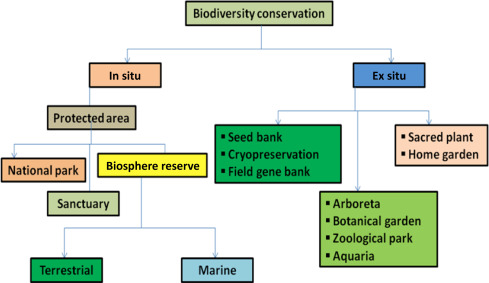
Image: Methods of conservation of biodiversity
In-situ Conversation
The maintenance and conservation of the species in their native environment is referred to as in situ conservation. It describes the maintenance of genetic diversity within wild populations of a certain plant or animal species. In-situ conservation is the preservation of biodiversity in a particular location, wherever it is present.
There are several ways of in-situ conservation, such as:
National Parks
These are small government-maintained reserves that are preserved for the protection of the environment and animals. National parks are only intended for the preservation of the local species and are completely free of any human activities. They are usually found in an area between 100 and 500 square kilometres. Its borders are well protected, and farming, grazing, forestry, and other human activities are prohibited. Examples: Gir national park, Kanha national park, etc.
Biosphere Reserves
Biosphere reserves are versatile, designated regions where native wildlife, regional traditions, and domesticated flora and animals are all preserved. Activities like tourism and research have been approved here. Examples: Sundarbans, Manas, Nanda Devi, etc.
Wildlife Sanctuaries
Wildlife Sanctuaries serve as protected places created specifically for the purpose of the preservation of wild animals. Certain human activities, like farming, wood collection, and gathering other byproducts of the forest, are permitted here. However, they must not get in the way of the preservation of the wildlife. These places permit tourist visits as well. Examples: Mudumalai wildlife sanctuary, Ghana bird sanctuary, etc.
Biodiversity Hotspots
Conservation zones that extensively maintain at least 1500 species of vascular plant life and have habitats that have lost 70% of their cover are known as biodiversity hotspots. These are protected regions where nature, indigenous ways of life, and cultivated plants and animals are preserved for a variety of reasons. Research and tourism-related activities are permitted.
Advantages of In-situ Conservation
Some of the advantages of in-situ conservation of biodiversity are as follows:
- It protects both animals and their natural environments.
- It protects a wide number of populations.
- It is a practical and cost-effective way to conserve.
- A species does not need to adapt to novel surroundings.
- The species can readily adapt to different environmental situations and evolve more effectively.
Ex-situ Conservation
Ex Situ conservation refers to the preservation of life away from its usual environment or habitat. It is an approach in which a vulnerable endangered species' whole population or a portion of it is removed from its natural habitat, and reproduction and maintenance of the species are carried out in man-made habitats. There are fewer survival challenges like lack of food, drinking water, or habitat in these conservation settings because of the improved living habitats.
The different ways of ex-situ conservation of biodiversity are as follows:
Zoological Parks
Zoos are settings in which animals are relocated from their native habitat for preservation and procreation. The general public is welcome to go there and see these wild creatures.
Botanical Gardens
It is a facility for the preservation of living plant species. It resembles a demonstration garden with many different plant varieties. They support the propagation, research, and preservation of endangered species of plants.
Gene Banks
They are organisations that keep inventories of healthy seeds (seed banks), live plants (orchards), tissue culture, and frozen germplasm with a wide range of genetic variation.
Advantages of Ex-situ Conservation
The advantages of ex-situ conservation of biodiversity are as follows:
- Life-sustaining necessities, including the environment, the availability of food, and veterinary care, may all be adjusted and remain under human oversight.
- Artificial breeding techniques can be used to successfully breed the species and produce many more offspring.
- Population control can be effectively implemented, and biodiversity might be protected from poaching.
- Genetic approaches can be used to enhance the population of the species, allowing it to be restored to the wild.
Ways to Conserve Biodiversity
Here are some of the ways by which we can conserve biodiversity:
- It is essential to preserve every variety of food, woodland plants, livestock, microorganisms, and farm animals.
- Identification and conservation efforts should be made for all economically significant organisms.
- It is fundamental to protect distinctive ecosystems.
- It's necessary to use the resources wisely.
- Wildlife poaching and hunting should be stopped.
- The reserves and conservation sites need to be properly maintained.
- Pollution levels in the environment must be lowered.
- There should be an enforced ban on deforestation.
- Environmental regulations must be closely adhered to.
- It is important to protect both natural and artificial habitats for valuable and endangered plant and animal species.
- It is important to raise public knowledge about biodiversity conservation.
Practice Problems
Q 1. Which of the following is an example of ex-situ conservation of biodiversity?
A. Biospheres
B. Seed Banks
C. Wildlife Sanctuary
D. Biodiversity Hotspots
Ans. B. Seed banks or gene banks are facilities outside the natural habitat of the animal or plant species where the genes and seeds are preserved.
Q 2. What is the most effective way of conserving biodiversity?
A. Remove predators
B. Relocating the species
C. Preserve natural habitats
D. Vaccination of the animals
Ans. C. Any animal or plant would thrive in their natural habitat. Thus, to converse biodiversity, we should maintain the natural habitats of animal and plant species.
Q 3. Which of the following methods of conservation does not permit human activities?
A. Wildlife Sanctuaries
B. Gene Banks
C. Botanical Gardens
D. National Parks
Ans. D. The national parks do not allow any human activities. They have strict boundaries which restrict human activities.
FAQs
Q1. What are the four types of biodiversity?
Answer : The four types of biodiversity are species biodiversity, genetic biodiversity, ecosystem biodiversity and global biodiversity.
Q2. What are the factors that affect biodiversity?
Answer : The factors that cause biodiversity loss are overexploitation of natural resources, pollution, climate change, habitat loss and invasive species.
Q3. Which country has the largest and lowest biodiversity?
Answer : Brazil has the largest biodiversity in the world. At the same time, San Marino is the least biodiverse country in the world.

 Call Now
 Let's Chat
 Share
Share