-
Call Now
1800-102-2727


Biochemical Pathways

Biochemical pathways and metabolic pathways are interchangeable words defining the chemical reactions that take place within the organism. Biochemical pathways are important to maintain an organism's homeostasis and keep them alive. The term metabolism was derived from the Greek word metabole, which signifies change.
Table of Contents
- What are Biochemical Pathways?
- Key Components of Biochemical Pathways
- Types of Biochemical Pathways
- Enzymatic Control of Metabolic Pathways
- Purpose of Biochemical Pathways
- Significance of Biochemical Pathways
- Practice Problems
- Frequently Asked Questions
What are Biochemical Pathways?
The pathways of complex chemical reactions carried out within living organisms are known as Biochemical pathways. These pathways regulate crucial processes like metabolism, energy production, and synthesis of essential molecules. Metabolic pathways or biochemical pathways involve stepwise biochemical reactions.
Biochemical pathways include a series of enzyme-activated reactions. Specific enzymes catalyse each step, transforming the substrate into a product. Biochemical pathways involve multistep, enabling regulation mechanisms to stimulate one pathway while inhibiting another.
Key Components of Biochemical Pathways
Biochemical pathways involve numerous key components. They are
-
Substrate
It is the initial reactant or molecule used to enter the biochemical pathway. As a first component, the substrate gets converted into products via a sequence of intermediate molecules, each catalysed by a distinct enzyme.
-
Enzyme
Enzymes play a crucial role in biochemical pathways by reducing the activation energy required for reactions to proceed. It occurs when an enzyme gets attached to the substrate provided, resulting in the breakdown of its chemical bonds. Due to the extreme specificity of an enzyme, they identify and interact with specific substrates.
-
Coenzymes
They are tiny non-protein molecules which promote and regulate the processes by collaborating with enzymes. Coenzymes transport particular functional groups or electrons, transferring them from one enzyme or reaction to another or within a pathway.
Types of Biochemical Pathways
In general, there are mainly three types of pathways. They are
1. Anabolic Pathways
In this, energy is needed to form the bonds. The collections of intermediates, reactants, and products are called metabolites. The goal of anabolic pathways is to accomplish the production of larger macromolecules from simpler macromolecules. The reaction requires energy in the form of adenosine triphosphate (ATP) or nicotinamide triphosphate (NADH), which further stores energy in the form of carbon-carbon bonds of larger molecules.
For Example,
- Photosynthesis involves the synthesis of glucose from CO2 and H2O
- Gluconeogenesis involves the breakdown of glucose from the sources of non-carbohydrate.
- Biosynthesis of protein
- Synthesis of fatty acid
- Glycogenesis includes the synthesis of glycogen from glucose, which occurs in muscle and liver.
2. Catabolic Pathways
The pathways that involve synthesising complex macromolecules into a simple form of micro-macromolecules involving the bond energy release in large amounts are called catabolic pathways. Energy is released in the form of carbon-carbon bonds held in covalent bonds. The pathway uses energy-storing molecules like glycogen and lipids to liberate energy and release ATP.
For Example,
- Beta oxidation of fatty acid includes dissociating fatty acid into acetyl-CoA.
- Urea cycle, which involves the removal of ammonia taken from the deamination of amino acids.
- Glycogenolysis, which includes the synthesis of glycogen into glucose.
- Glycolysis includes oxidation or synthesis of glucose compounds.
- Oxidative phosphorylation. It involves the removal of electrons released by the Tricarboxylic acid (TCA) cycle or via the process of glycolysis.
3. Amphibolic Pathways
When the anabolic and catabolic pathways are involved, it is called amphibolic pathways. Respiration involves an amphibolic pathway.
For Example,
- Kreb’s cycle (called the TCA or citric acid cycle) involves acetyl-CoA oxidation.
- Glycolysis.
Enzymatic Control of Metabolic Pathways
Several enzymes can regulate biochemical pathways. Some examples are the following.
- In controlling the citric acid cycle. Pyruvate dehydrogenase is stopped by its products, i.e., acetyl-CoA and NADH.
- In the glycolysis cycle, glycolysis is governed at three locations, i.e.,
- Hexokinase is stopped by glucose-6-phosphate.
- Free fatty acids, alanine, ATP and acetyl-CoA hinder pyruvate kinase.
- ATP and citrate inhibit phosphofructokinase.
- In Gluconeogenesis, pyruvate carboxylase regulates the flow of the cycle. Acetyl-CoA activated the enzyme showing plenty of intermediates of the TCA cycle, resulting in the decline of the use of glucose.
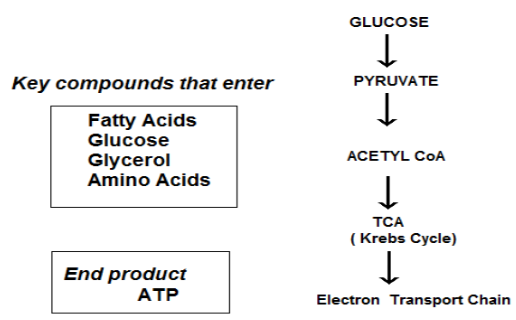
Image : Basic biochemical pathways
Purpose of Biochemical Pathways
The main purpose of biochemical pathways occurring in living organisms are for the following purposes,
- To obtain or release energy at a cellular level for biological processes.
- Utilising food as a building block source is required to create biomolecules like protein, carbohydrates, nucleic acids and lipids.
- To eliminate harmful materials and waste.
Significance of Biochemical Pathways
Biochemical pathways are significantly important for biological beings because of the following
- Help in the survival and proper functioning of living organisms
- Allow effective use of resources and energy production.
- Plays a key role in advancing distinct fields like biotechnology, medicine, pharmaceuticals, etc.
- Researchers may develop or modify the target therapies.
- Help us to recognise the evolutionary relationship between distinct life forms.
- Aid in the study of distinct species and their ancestral history.
- To acknowledge the effects of numerous mechanisms of action at cellular and molecular levels.
Practice Problems
Q1. The major components required for biochemical pathways are
A. Enzyme
B. Substrate
C. Coenzymes
D. All of the above
Answer : D. All of the above.
Substrate, enzyme and coenzyme are together required for the biochemical pathways.
Q2. Homeostasis is ____ by biochemical pathways.
A. Maintained
B. Ruptured
C. Declined
D. None of the above
Answer : A. Maintained
Biochemical pathways aid in maintaining homeostasis.
Q3. The breakdown of glycogen into glucose occurs in
A. Glycolysis
B. Urea cycle
C. Glycogenolysis
D. Oxidative phosphorylation
Answer : C. Glycogenolysis.
Glycogenolysis involves the synthesis of glycogen into glucose.
Frequently Asked Questions
Q1. Is biochemical pathway important to learn for NEET examination?
Answer :Yes. The syllabus of NEET includes biochemical pathways, which is an integral part of chemistry and biology.
Q2. Can I get marks by making a flowchart of the cycle?
Answer :Yes. The flowchart of the biochemical pathways indicates your clear understanding of the details. It is advisable to make a flowchart for each pathway cycle.
Q3. What is biochemistry?
Answer :Biochemistry is a subject that combines chemistry and biology, explaining distinctly that chemical reactions are linked with biological processes. It helps us to understand the mechanism of an organism.

 Call Now
 Let's Chat
 Share
Share