-
Call Now
1800-102-2727


Application Of Biotechnology

Baking sourdough bread, making dosa or turning milk into curd are just a few simple applications of the amazing field of biotechnology. Biotechnology is a growing field of science that has year by year advanced itself to create better and more innovative products using living organisms. Biotechnology has opened gates of opportunities to create novel products for the betterment of mankind.
Table of Content
- What is biotechnology?
- Applications of biotechnology
- Practice problems
- FAQs
What is Biotechnology?
Agricultural engineer Karoly Ereky first used the term "biotechnology" in 1919. It is the branch of biology that is researched both technologically and biologically; therefore, it focuses on the use of living things and their constituents to produce, evolve, and offer beneficial goods for the benefit of mankind.
Biotechnology is a fascinating science that plays an integral role in the production of groundbreaking products. These goods are derived from various biological systems or living species. The foundation of biotechnology is genetic engineering, and it is built on fundamental techniques. It alters the genetic structure of the organism and causes alterations that come into play.
Applications of Biotechnology
There are several applications of biotechnology in various fields, such as agriculture, pharmaceuticals, environment and industry.
Agricultural Applications
Genetically Modified Organisms (GMOs)
Genetically Modified Organisms (GMOs) are any plants, bacteria, fungi, or animals that have had their genes altered. GM plants have a variety of uses. Genetic engineering in plants has helped in the following ways:
- Increased the ability of crops to withstand environmental stresses like cold, drought, saltwater, and heat.
- Reduced the dependence of crops on chemical pesticides (pest-resistant crops).
- Facilitated reducing post-harvest losses.
- An enhanced capacity of plants to use minerals, preventing the soil's fertility from being depleted too quickly.
- Food with increased nutritional value, such as golden rice, which is vitamin 'A' enriched rice.
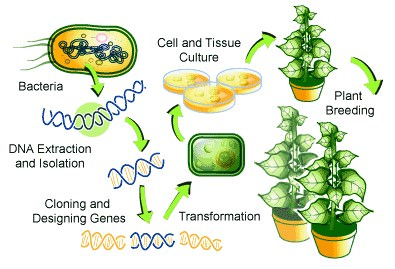
Genetically modified crops
Bt crops
Bacillus thuringiensis (Bt) is a bacteria that produces the Bt toxin. Certain Bacillus thuringiensis strains create proteins that are toxic to several insects, including dipterans (flies, mosquitoes), coleopterans (beetles), and lepidopterans (tobacco budworm, armyworm). During a specific stage of their growth, B. thuringiensis produces protein crystals. The resulting crystals carry a poisonous insecticidal protein.
The bacteria's Bt toxin gene was successfully extracted and expressed in plants, thus providing them with insect resistance without the use of insecticides. Some of the popular examples of genetically modified Bt crops are Bt cotton, Bt corn, rice, tomato, potato, and soybean.
Environmental Applications
To make our ecosystem and earth cleaner, environmental biotechnology combines the concepts of science and bioengineering. Here are some of the applications of biotechnology for environmental improvement:
- Biomonitoring is a kind of environmental assessment technique that measures the overall quality of the soil, water, and air.
- The process of bioremediation is implemented to reduce the contamination of water and soil. This technique uses biological agents like fungi and plants that reduce the number of toxic chemicals and heavy metals.
- Further utilisation of biotechnology to effectively detoxify the environment involves waste management by making good use of bacteria and other living organisms.
- Bioproducts like spider silk, which degrades naturally and will not negatively impact the environment, may be used in both construction works and military applications.
- The manufacture of biofuels like biodiesel emits less pollution than burning traditional fossil fuels. Biodiesel is generated by combining alcohol with organic oil or fat in addition to a catalytic agent.
- Biosensors incorporate a biological component with a transducer. The biosensors detect chemical compounds such as heavy metals and pesticides through a biochemical modification in the biosensor's framework.
Medical Applications
There are several uses for biotechnology in the medical industry. The following are a few medical applications of biotechnology:
Gene Therapy
Gene therapy is utilised for the treatment of genetic disorders by inserting a normal gene or corrected gene to repair a faulty or inactive gene into a human being using vectors which include viruses like adenovirus, retrovirus and herpes simplex virus.
The functioning gene takes the place of the damaged or inactive gene. When administered early in life, the therapy offers the best potential of producing a long-lasting cure.
Pharmacogenomics
Pharmacogenomics has resulted in the development of medications that are most appropriate to a person's genetic makeup. It can be used to treat illnesses like cancer, depressive disorders, HIV, asthma, and other conditions.
Recombinant Insulin
Diabetes is treated using the hormone insulin. It was originally obtained from the pancreas of pigs and calves. However, this extraction process was harming the pigs and cattle and thus decreasing the number of pigs to produce the necessary amounts of insulin. As a result, the human insulin gene was cloned.
The exact gene sequence that codes for human insulin was introduced into the E.coli bacterium. The gene sequence changed the E. coli cells genetic framework. A number of E. coli bacteria with the recombinant human insulin gene were developed in less than 24 hours. The recombinant human insulin was obtained from E.coli cells.
|
Did you know? The first recombinant human insulin using E.coli was produced by an American company Eli Lily in 1983. |
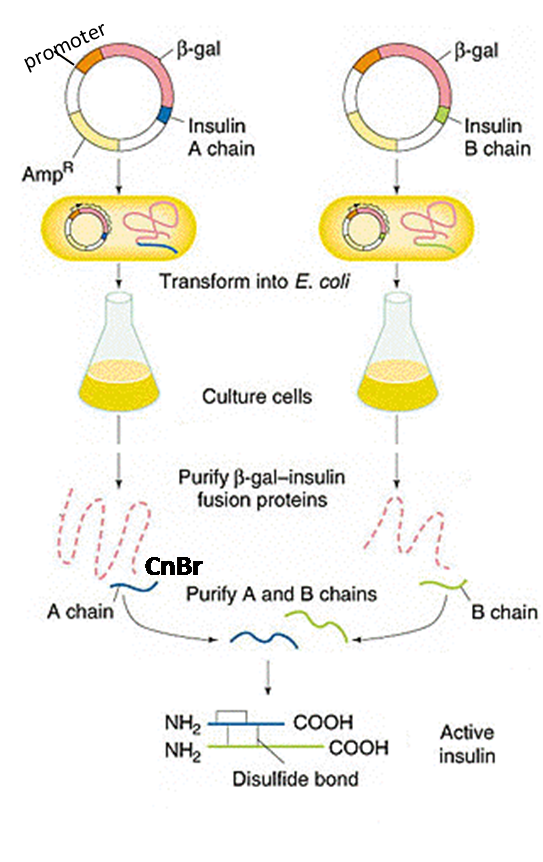
steps for production of recombinant human insulin
Medical Diagnosis
Another use of biotechnology in the medical field is medical diagnostics. Sometimes, The pathogen concentration tends to rise by the time the health issue is detected. Therefore, early diagnosis and understanding of pathophysiology are important for successful therapy. Some of the widely used techniques are:
- PCR is a technique for rapidly amplifying genes or DNA. Millions of copies are produced for analysis. This method is used to identify any DNA traces, bacteria, or viruses in the early stages of infection before even signs of infection have appeared.
- ELISA depends on antigen-antibody responses. Infections can be discovered using glycoproteins found on antigens or antibodies produced in reaction to the antigens.
- Monoclonal antibodies can be used in the diagnosis of cancer. They are created by implementing the well-known hybridoma method, which combines myeloma or cancer cells with B lymphocytes or B cells. These cells are later fused using electric pulses or chemical inducers.
Edible Vaccines
Vaccines are produced in cell cultures and animals. These vaccinations contain pathogens that have been inactivated. Transgenic plants have the ability to create antigens that could be used as edible vaccines. Antigenic proteins of several pathogens have been generated in plants, including tomatoes and bananas.
Practice Problems
Q 1. The first-ever human hormone produced by recombinant DNA technology was
A. Testosterone
B. Progesterone
C. Insulin
D. Estrogen
Ans. B. Insulin - Insulin was the first human hormone produced using recombinant technology in E.coli bacteria.
Q 2. Genetically modified brinjal has been produced for
A. Longer shelf life
B. Drought resistance
C. Enhanced mineral content
D. Insect resistance
Ans. D. Insect resistance - The genetically modified brinjal is one of the Bt crops which were produced for insect resistance.
Q 3. “Golden rice” is enriched with
A. Vitamin B
B. Vitamin K
C. Vitamin A |
D. Vitamin D
Ans. C. Vitamin A - The genetically modified rice crop named Golden Rice is rich in Vitamin A.
FAQs
Q1. What are the applications of biotechnology in the food industry?
Answer : Application of biotechnology in the food industry includes the production of a thick sauce called mayonnaise using catalase enzyme, the use of chymosin in cheese making and the use of protease in dairy products.
Q2. What are the types of biotechnology?
Answer : There are five major types of biotechnology: red (medical) biotechnology, white (industrial) biotechnology, grey (environmental) biotechnology, green (agriculture) biotechnology and gold (computational biology) biotechnology.
Q3. What was the first biotechnology plant?
Answer : The first biotech plant was produced in 1982; it was a tobacco plant with antibiotic resistance.

 Call Now
 Let's Chat
 Share
Share