-
Call Now
1800-102-2727



Acraniata/Protochordata
Introduction:
- Exclusively marine animals.
- They contain pharyngeal gill slits throughout their life which helps them in respiration.
- Notochord is present in them throughout their life.
- Brain, skull and vertebral column are absent.
- These are chordates but are not included under vertebrates because their notochord persists throughout their life and is not replaced by vertebral column.
- Protochordates are divided into two subphylums -
1. Subphylum Urochordata
2. Subphylum - Cephalochordata - Subphyla Urochordata and Cephalochordata are also referred to as Acraniata (without cranium)
Topics covered
- Urochordata
- Cephalochordata
Urochordata
Introduction:
- Also known as Tunicata as the body of adults is enclosed within a tunic or test or coat made up of tunicin (cellulose-like organic substance).
Detailed explanation
General characteristics of subphylum Urochordata
Habit and habitat
- Exclusively marine.
- Adults are usually sedentary (fixed to substratum) while larvae are free swimming.
Level of organisation
- Organ-system level of organisation.
Symmetry
- Bilaterally symmetrical larval stage ,though adults turn asymmetrical due to the tunic.
Germ layers
- Triploblastic animals
Body plan
- Tube-within-tube body plan
Notochord
- The notochord is only present in the tail of the larva and disappears during metamorphosis
- It is absent in adults.
Dorsal tubular nerve cord
- It is found only in the larval stage.
- In adults, it gets replaced by neural ganglion.
Pharyngeal gill clefts
- It is found in both adults as well as larval stage.
Digestion
- Digestive system is complete.
- Their pharynx is perforated by numerous apertures called stigmata which are formed by the larval gill slits.
- The stigmata opens into an ectoderm lined cavity, the atrium.
- These are ciliary feeders.
Excretion
- Excretion takes place by a supra neural gland/pyloric gland and nephrocytes.
Circulatory system or blood vascular system
- Circulatory system is of open type, consisting of a heart which is situated at the ventral surface of the body.
Reproductive System
- Reproduction is commonly sexual
- Most of the animals are bisexual.
- Fertilization is external and mostly by cross fertilization.
Development
- Development is mostly indirect.
- A free swimming larva like the tadpole larva of frogs is formed in this group.
Special characteristics of phylum Protochordata
- Retrogressive metamorphosis - During this metamorphosis, the well developed free swimming larva is changes into less developed adults
- Endostyle, homologous to the thyroid gland of mammals, helps in the absorption of iodine from water.
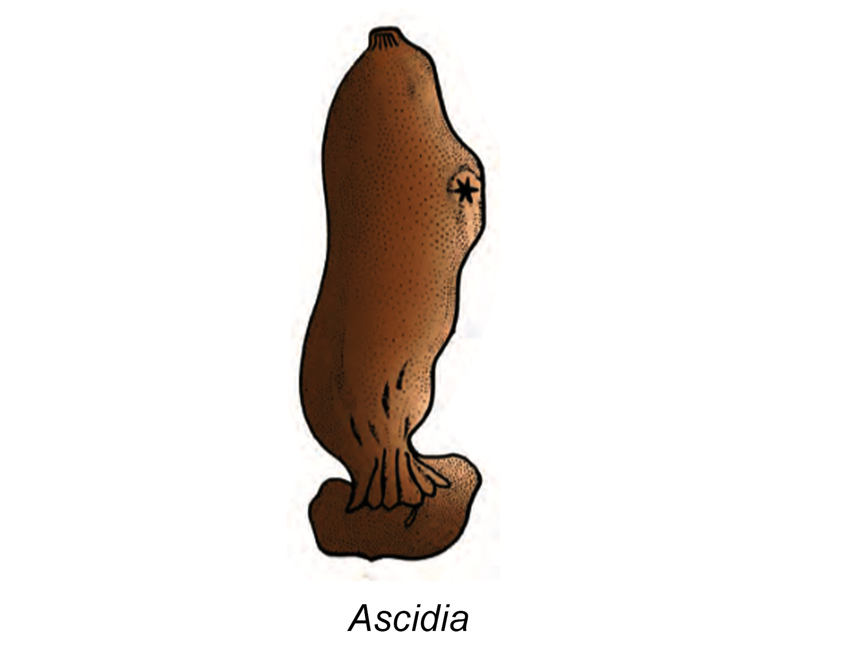
Common examples of subphylum Urochordata
1.Herdmania (commonly known as sea potato or sea squirts)
2.Ascidia
3.Doliolum
4.Salpa
Cephalochordata
Introduction
- The animals belonging to sub phylum Cephalochordata are considered as the first complete chordates.
Detailed explanation
General characteristics of subphylum Cephalochordata
Habit and habitat
- Exclusively marine
- Found in the shallow sea water.
- Both adults and larvae are free swimming forms.
- Form burrows in sand and are nocturnal.
Level of organisation
- Organ-system level of organisation.
Symmetry
- Bilaterally symmetrical.
Germ layers
- Triploblastic animals
Body form
- Segmented, laterally compressed bodies like a fish.
Notochord
- The notochord is extended from anterior to tail region.
- It is present in all body forms.
- Present throughout life.
Dorsal tubular nerve cord
- The dorsal tubular nerve cord is extended from anterior to tail region.
Pharyngeal gill clefts
- It is found in both adults as well as larval stage.
- They are more in number and are better developed than Urochordates
Body plan
- Tube-within-tube body plan.
Digestion
- Digestive system is complete.
- Their buccal opening is covered by an oral hood and it is completely called the “ Wheel organ” or “Ciliated organ of Muller”.
- This wheel organ helps in the ingestion of food by producing currents in water.
- These are ciliary feeders.
Excretion
- Excretion takes place by protonephridia or flame cells.
- Hatscheck's nephridium is also found in them which helps in excretion
Circulatory system or blood vascular system
- Circulatory system is of closed type consisting of a heart which is situated at the ventral surface of the body.
Reproductive System
- Reproduction is sexual
- These are uisexual.
- Fertilization is external.
Development
- Development is indirect i.e larval stages are formed
- It shows progressive metamorphosis as the less developed larva is developed into the more developed adult.
Common examples of subphylum Cephalochordata
1.Branchiostoma or Amphioxus (Lancelet)
Frequently asked questions (FAQ’s)
Q1. Why are Protochordates not included under subphylum Vertebrata ?
Ans :
- They are chordates but are not included under vertebrates because their notochord persists throughout their life and is not replaced by vertebral columns.
Q2. Why are Urochordates also known as Tunicates ?
Ans :
- Urochordates are also known as Tunicata as the body of adults is enclosed within a tunic or test or coat made up of tunicin (cellulose-like organic substance).
Q3. Define retrogressive metamorphosis.?
Ans :
- Retrogressive metamorphosis is a process in which the well developed free swimming larva is changes into less developed adults.
Q4. What is the common name of Herdmania ?
Ans :
- The common name of Herdmania is sea potato or sea squirt.
Q5. What is the function of endostyle in Protochordates ?
Ans :
- Endostyle, homologous to the thyroid gland of mammals, helps in the absorption of iodine from water which is essential for metamorphosis.
Q6. Which is the excretory organ of Cephalochordates ?
Ans :
- Excretion in Cephalochordates takes place by protonephridia or flame cells.
Q7. Define Progressive metamorphosis ?
Ans :
- Progressive metamorphosis is a process in which less developed larva developes into the more developed adult.
Q8. What is the common name of Amphioxus ?
Ans :
- Lancelet is the common name of Amphioxus.
Q9. What is cross fertilization ?
Ans :
- Cross fertilization is the fusion of male and female gametes of different individuals of the same species.
Q10. Define nocturnal animals.
Ans :
- Nocturnal animals are those animals which are active during night time.

 Call Now
 Let's Chat
 Share
Share