-
Call Now
1800-102-2727


4 Phases Of Cell Cycle: Interphase and M phase

You must have witnessed the covering up of wounds with skin, the increase in the size of leaves and flowers, and the spread of green-coloured algae with the passing days. It is obtained by increasing the number of cells that take up space and are similar to pre-existing ones. The mechanism behind them has taken years of research to understand. The increase in cell number occurs through cell division, which is a cycle procedure constituting four phases. Let us have a more detailed explanation of the above-stated phenomena.
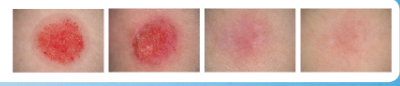
Figure: Wound healing
Source: Elastoplast
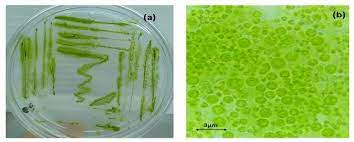
Figure: Algae growth
Source: ResearchGate
Table of Contents
- What is a Cell Cycle?
- Phases of Cell Cycle
- Practice problems
- FAQs
What is a Cell Cycle?
The cell cycle is composed of a predetermined and universally conserved sequence of events that lead to the generation of new cells. The daughter cells comprise similar genetic material as that of the parents and the structural composition of the cell, including cell organelles.
Phases of Cell Cycle
The cell cycle initially comprises two phases according to the type of processes taking place for division. These are interphase and mitosis. Interphase is further segregated into three different phasesG1, , S, and G2 . Mitosis, or M phase, is also divided into two phases, karyokinesis and cytokinesis. The interphase is associated with the preparation of the cell, making them ready for division, while mitosis is actually associated with division. Overall, the four phases of the cell cycle constitute, G1, S, G2 and M phases. Let us dive into the actual mechanisms occurring in every four cell cycle phases.
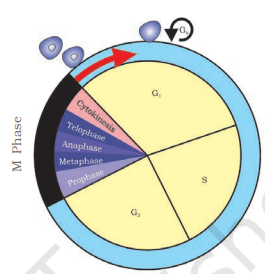
Figure: Phases of cell cycle
Source: NCERT
G1 Phase
- G1 or gap is the initial phase that marks the beginning of the cell cycle. The cells may also be pres in the quiescent phase or resting stage marked as G0 phase, which is the inactive phase of cells such as neurons. The presence of specific signals or stimuli in certain conditions transitions the cell from the resting phase to the interphase, where it resumes its journey of growth and development.
- The cells G1 in phase are metabolically hyperactive. The phase is associated with decondensation of chromosomes, making them coiled, slender and stretched, allowing attachment of enzymes to begin the transcription for RNA and translation for protein synthesis. The proteins thus find a crucial role in the replication of DNA.
- It is the longest interphase phase that synthesises nitrogenous bases and accumulates energy for further stages of the cell cycle. The arrangement of proteins and enzymes occurs on DNA, waiting for the checkpoint to begin DNA synthesis.
S Phase
- S or synthesis phase witnesses the beginning of DNA synthesis or replication. The amount of DNA that was 2C in the previous phase will become 4C in the synthesis phase. The chromosome number, however, will remain the same. It interprets that the haploid cell will remain haploid, the diploid cell will remain diploid and so on.
- The DNA replication takes place in the nucleus while the centriole (present at the poles during cell division) duplication occurs in the cytoplasm. The mode of DNA replication is discontinuous and semi-conservative.
- The double content of each chromosome remains attached through the centromere.
G2 Phase
- G2 or gap 2 phase witnesses the reproduction of a few cell organelles and cytoskeleton dismantling. The latter is important for the attachment of spindle fibres due to the localisation of chromosomes in another compartment, the nucleus.
- It also continues the protein and enzyme synthesis for the next cell cycle phase. Post-completion of all such important processes, the cell is ready to enter the mitotic phase. The cell size and DNA content are some of the parameters checked to allow progress.
M phase
- M phase commonly refers to the mitotic phase. However, it is of two types, mitosis and meiosis. Mitosis is found in body cells requiring conservative DNA replication. Meiosis is found in reproductive cells requiring variety to carry on to the next generations.
- Mitosis is divided into Prophase, Metaphase, Anaphase and Telophase. Meiosis begins with Meiosis I, which introduces variation in genetic material and ends with meiosis II which marks the formation of haploid cells from diploid organisms.
- Prophase is the first stage of karyokinesis or nuclear division. It is also the first phase of the M phase, where chromosomal condensation begins making them more clearly visible. The centrosomes begin their movement to the opposite poles while radiating aster rays, which are microtubules. These form the spindle fibres. No cell organelles are visible at the end of prophase.
- Metaphase has spread and highly condensed chromosomes. These can be viewed for their simplest structures under the microscope, where two chromatids appear attached to the centromere. The centromeres comprise kinetochores where microtubules of spindle fibres connect, aligning them at the equator along the metaphase plate or equatorial plane of the cell.
- The cell now must cross the SAC or Spindle Assembly Checkpoint that confirms chromosome alignment and connection with spindle fibres. Passing it, the cell enters anaphase, where centromeres split to separate the chromosomes changing the cell’s ploidy. The chromatids begin moving to opposite poles, which will be the new cell with a copy of replicated genetic material. The centromere is attached to spindle fibres and hence is directed towards the poles while chromosomes are seen trailing behind.
- Telophase marks the final stage of karyokinesis and the decondensation of chromosomes. The chromosomes are unrecognisable and found clustered at spindle poles. The development of the nuclear envelope begins along with the reformation of cellular organelles like nucleolus, Golgi complex and endoplasmic reticulum.
- Cytokinesis is the cellular division that occurs distinctly in plant and animal cells. It occurs through cell plate formation in plant cells while cell furrow formation in animal cells.
- Cells with fate as heart cells or neurons enter the resting or non-dividing phase.

Figure: Stages of cell division
Practice problems
Q1. Which substage of meiosis is responsible for variation in DNA?
A. Anaphase II
B. Leptotene
C. Metaphase I
D. Pachytene
Answer: D Pachytene
The Pachytene stage in Prophase I of meiosis I is responsible for genetic variation. It witnesses genetic recombination through crossing over that produces modified DNA in the cell.
Q2. What will be the number of chromosomes in mice after the S phase if it originally contains 20 pairs of chromosomes?
A. 20 pairs
B. 40 pairs
C. 20
D. 10
Answer: A. 20 pairs
S or synthesis phase increases DNA content, but the number of chromosomes remains the same.
Q3. Where do spindle fibres attach to chromosomes?
A. SAT chromosomes
B. Telomeres
C. Kinetochore
D. Randomly on chromosome
Answer: C. Kinetochore
Spindle fibres attach to the disc-shaped kinetochore protein on the centromere.
FAQs
Q1. What is the length of each phase of the cell cycle?
Answer: The interphase lasts around 23 hours, and the M phase lasts an hour. The gap 1 phase is of 11 hours, the synthesis phase is of 8 hours, and the gap 2 phase is of 4 hours.
Q2. Which is the best phase to study chromosomes?
Answer: Metaphase has the most distinctly visible chromosomes with clear shape, number and size resolution. Hence, it is the most preferred stage of the cell cycle to study chromosomes.
Q3. How are chromatids different from chromosomes?
Answer: Chromatids are the replicated version of chromosomes. These are attached at the centromere available and visible after DNA replication. The chromatids available on single chromosomes are called sister chromatids due to being exact replicas of each other.

 Call Now
 Let's Chat
 Share
Share