-
Call Now
1800-102-2727


Understanding Geometric Mean

Imagine you are an investor analysing the performance of various stocks in your portfolio. How would you accurately determine the overall growth rate? This is where the geometric mean comes into play, serving as a powerful tool for calculating average values in situations involving multiplicative factors.
Table of Contents:
- What is Geometric Mean?
- Difference between Arithmetic Mean and Geometric Mean
- Relation between Arithmetic Mean, Geometric Mean and Harmonic Mean
- Properties of Geometric Mean
- Applications of the Geometric Mean
- Solved Problems on Geometric Mean
What is Geometric Mean?
The geometric mean of a set of n numbers is defined as the n-th root of their product. In other words, if we have n numbers  , then their geometric mean (GM) is given by:

Since,
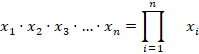
Thus, the geometric mean can be expressed as
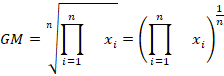
In terms of the logarithm, the geometric mean can be expressed as
 log GM =1nlog x1x2x3x4⋅…⋅xn
Or,

Difference Between Arithmetic Mean and Geometric Mean
The arithmetic mean of n numbers  can be expressed mathematically as:

The arithmetic and geometric mean are two different ways of measuring the central tendency of a data set. The arithmetic mean is the sum of the values divided by the number of values, while the geometric mean is the product of the values raised to the power of one over the number of values. The main difference between them is that the arithmetic mean is sensitive to outliers, while the geometric mean is not.
Outliers are extreme values that are much higher or lower than the rest of the data. For example, if we have a set of five numbers: 2, 4, 6, 8 and 100, then:
The arithmetic mean is 
The arithmetic mean is 
The arithmetic mean is skewed by the outlier 100, while the geometric mean is closer to the typical value of the data.
Another difference between them is that the arithmetic mean can be used for any type of data, while the geometric mean can only be used for data which are natural numbers only. This is because negative numbers do not have real roots, and zero would make the product zero. For example, if we have a set of numbers: -2, -4, -6, -8 and -10, we can calculate their arithmetic mean as follows:

But we cannot calculate their geometric mean.
Relation Between Arithmetic Mean, Geometric Mean and Harmonic Mean
The harmonic mean of n numbers can be expressed mathematically as:
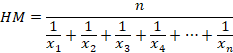
Or,

Multiplying the general formula of AM with that of HM, we get:

Or,
 ……(1)
……(1)
But the general formula of GM is:

In other words,
 ……(2)
……(2)
Comparing equations (1) and (2), we get:

Where n is the number of elements in the data set. So, if there are three numbers, then the relation between AM, HM and GM becomes:

Properties of Geometric Mean
- The geometric mean is always positive if all the values are positive.
- The geometric mean is always less than or equal to the arithmetic mean if all the values are positive.
- The geometric mean is equal to zero if any value is zero.
- The geometric mean is undefined if any value is negative.
- The geometric mean does not change if all the values are multiplied by a constant.
- The geometric mean does not change if all the values are raised to a constant power.
- The geometric mean does not change if their reciprocals replace all the values.
- The geometric mean does not change if all the values are replaced by their logarithms.
Applications of the Geometric Mean
- In finance, the geometric mean is used to calculate the average annual return of an investment or a portfolio over some time. It takes into account the compounding effect of interest and dividends.
- In biology, the geometric mean measures the growth rate of populations, bacteria, viruses, etc. It also helps to compare the sizes of different organisms or organs.
- In geometry, the geometric mean is used to construct geometric figures, such as squares, cubes, triangles, etc. It also helps to find the lengths of segments or angles in various shapes.
- In statistics, the geometric mean is used to calculate the mean of data that are skewed or have a large range. It also helps to reduce the effect of outliers or extreme values.
- In physics, the geometric mean is used to measure the average speed of an object that travels at varying speeds. It also helps to find the effective resistance of resistors connected in parallel or the effective capacitance of capacitors connected in series.
Solved Problems on Geometric Mean
Q1. The annual percentage of growth rate in a company's profit has been tabulated from 2018-2022. But the data for 2020 is missing. It is known that the geometric mean of the annual percentage of growth rate in the profit is 69.53. Find the growth rate percentage for the year 2020.
|
Year: |
2018 |
2019 |
2020 |
2021 |
2022 |
|
Growth Rate: (in %) |
55 |
74 |
- |
80 |
96 |
Solution:
We are given that, GM = 69.53
Let the growth rate of 2020 be x %. Then, by GM formula, we get:

Solving, we will get:

Q2. A factory produces screws of 5, 15, 25, 30 and 35 centimetres every day. At the end of the day, the number of defective screws is counted and kept aside. Below is the table depicting the number of defective screws from each size. Calculate the geometric mean of the data.
|
Size (in cm) |
5 |
15 |
25 |
30 |
35 |
|
No. of defective screws |
5 |
8 |
11 |
4 |
15 |
Solution:
The grouped data in this question is discrete. For grouped data, the formula for geometric mean is:

Reforming the table with the necessary data:
|
xi |
fi |
log xi |
fi log xi |
|
5 |
5 |
0.699 |
3.495 |
|
15 |
8 |
1.18 |
9.44 |
|
25 |
11 |
1.4 |
15.4 |
|
30 |
4 |
1.48 |
5.92 |
|
35 |
15 |
1.54 |
23.1 |
So,
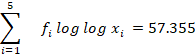
Therefore,

Q3. A test of 50 marks is conducted in a class of 50 students, and the below table is created. Find the geometric mean of the marks scored by the students.
|
Marks: |
0-10 |
10-20 |
20-30 |
30-40 |
40-50 |
|
No. of students: |
5 |
12 |
13 |
11 |
9 |
Solution:
|
Marks |
Mid-point xi |
fi |
log xi |
fi log xi |
|
0-10 |
5 |
5 |
0.699 |
3.495 |
|
10-20 |
15 |
12 |
1.18 |
14.16 |
|
20-30 |
25 |
13 |
1.4 |
18.2 |
|
30-40 |
35 |
11 |
1.54 |
16.94 |
|
40-50 |
45 |
9 |
1.65 |
14.85 |
|
|
|


We know that,

Practice Problems
Q1. Find the geometric mean of the data given below:
|
x: |
1 |
2 |
3 |
4 |
5 |
|
f(x): |
44 |
41 |
32 |
36 |
20 |
Q2. Find the geometric mean of the data given below:
|
Marks: |
10 |
19 |
22 |
27 |
30 |
|
No. of students |
4 |
10 |
23 |
9 |
4 |
Q3. Find the value of the approximate value of x if the geometric mean is 17.83.
|
Age: |
0-10 |
10-20 |
20-30 |
30-40 |
40-50 |
|
No. of people: |
10 |
5 |
12 |
10 |
x |
Frequently Asked Questions
Q1. What is the difference between HM and GM?
Answer: Harmonic mean is the reciprocal of the arithmetic mean of the reciprocals of the values, while the geometric mean is the nth root of the product of the values.
Q2. When should we use geometric mean instead of arithmetic mean?
Answer: Geometric mean is used instead of arithmetic mean in the following cases:
- The data are exponential, such as growth rates, interest rates, inflation rates, etc.
- The data have a large range or are skewed by outliers or extreme values.
- You want to measure the average rate of change or the average multiplicative factor of the data.
Q3. What is the HM-GM-AM inequality relationship?
Answer: According to HM-GM-AM inequality relationship, AM≥GM≥HM

 Call Now
 Let's Chat
 Share
Share