-
Call Now
1800-102-2727


Fehling's Solution

To detect aldehyde and the functional groups of aldehyde, we need to perform Fehling's test. The appearance of a red-coloured precipitate indicates the presence of the aldehyde and, thus, the positive result. Certain protocols and precautions are involved in preparing Fehling's reagent or solution discussed here.
Table of Contents:
- What is Fehling’s Solution?
- Preparation of Fehling’s Solution
- Fehling’s Test Procedure
- Reactions Involved in Fehling’s Test
- Applications of Fehling’s Reagents
What is Fehling’s Solution?
Fehling solution is used to detect the presence of aldehydes or groups that consist of the Aldehyde functional group -CHO. It is a deep blue alkaline solution. Tollen’s reagent is also used along with Fehling’s solution to distinguish between non-reducing and reducing sugars. Furthermore, water-soluble carbohydrates and a ketone group can also be detected through Fehling’s solution.
The substance to be tested is heated with Fehling's solution to carry out the test. As Fehling's solution gradually oxidises aldehydes, it may detect the existence of an aldehyde group by forming a brick-red precipitate.
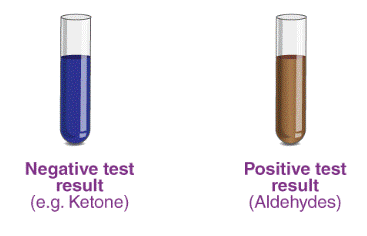
Image: Flehmig’s Test
Preparation of Fehling’s Solution
The preparation of Fehling's solution is fresh right before it is used. The methodology involves mixing equal volumes of two previously prepared solutions, i.e., a deep blue Fehling’s solution A and a colourless Fehling's solution B. Solution B consists of 350 grams of potassium sodium tartrate tetrahydrate which is popularly called Rochelle salt, and sodium hydroxide-100 grams per litre of solution. On the other hand, solution A contains 70 grams of cupric sulphate pentahydrate per litre of solution.
Fehling’s solution A’s rich blue colour originates from the Cu2+ bis tartrate complex. In the solutions, Rochelle salt works as a chelating agent. Both A and B solutions are prepared individually. Rubber stoppered bottles are used to store the solutions. Thus, Fehling's solution is often prepared in case of the requirement for the solution. An equal volume of the two mentioned solutions is combined in laboratories just before performing the test.
Fehling’s Test Procedure
In 1849, a German chemist, Hermann von Fehling, performed Fehling’s test for the first time. The test involves heating aldehyde with Fehling’s reagent or solution. A reddish-brown coloured precipitate will subsequently be prepared during the procedure. It occurs because the solution oxidises the aldehyde, forming a carboxylate anion. However, Fehling’s test does not generate any response to aromatic aldehydes and ketones. Therefore, by employing Fehling’s reagents, we can simply distinguish between aldehydes and ketones due to such properties. To carry out the test, we must follow the steps given below:
- Place the sample in a dry test tube, ideally 1 millilitre.
- Take distilled water as a control in a distinct test tue.
- Add Fehling’s solution in each test tube, preferably 1 millilitre of each solution, i.e., A and B.
- Keep the test tubes in a boiling water pot or bathtub.
- Observe and record the evidence if there is any sign of red precipitate formation.
In conclusion, the result indicates a positive result if there are signs of red-brown precipitate formation. In case there is no such change, the test concludes as negative. Solution A is CuSO4 solution, and Solution B is Rochelle salt.


While preparing the solution and carrying out the experiment, wearing safety goggles and protective gloves is advisable. It is because Fehling’s reagent is toxic and corrosive by nature.
Reactions Involved in Fehling’s Test
In Fehling’s solution, the reaction between aldehyde and copper (II) ions is determined as

Furthermore, by adding tartrate to the reaction, we get

The formation of copper (I) ions takes place by reducing copper (II) ions in a redox reaction. It is a red precipitate that tends to be insoluble in water. The formation of a red-brown precipitate indicates a positive outcome, leaving the solution with the sodium salt of the acid in the solution.
Applications of Fehling’s Reagents
There is a wide range of applications of Fehling’s Reagent or solution, and some are as follows.
- To detect aldehyde and ketone functional groups.
- To detect monosaccharides and other reducing sugars.
- Used as a medicine to detect glucose in urine.
- Dissociation of glucose syrups into maltodextrins.
Practice Problems
Q1. _______ provides a positive result for Fehling’s test.
a. Formic acid
b. Acetic acid
c. Ascorbic acid
d. None of the above
Ans. d. None of the above
Formic acid, acetic acid or ascorbic acid doesn’t have a positive result for Fehling's test as the characteristic red precipitate of copper(I) oxide is not seen.
Q2. Fehling’s test is utilised in medicine to detect
a. Diabetes
b. Asthma
c. Bronchitis
d. All of the above
Ans. a. Diabetes
Although an outdated method, Fehling's test can be used to detect Diabetes.
Q3. The positive result of Fehling’s test shows
a. Red-brown precipitate
b. Yellowish-green precipitate
c. Alkaline salt
d. All of the above
Ans. a. Red-brown precipitate
A positive result of Flehming’s test is indicated by the presence of the sign of a red-brown precipitate of copper(I) oxide.
Frequently Asked Questions
Q1. State the difference between aldehyde and ketone.
Answer: The organic compounds with the carbonyl functional group are called aldehyde and ketone. The difference is about the position and number of carbons attached. The carbonyl group is linked to at least one hydrogen atom at the end of the chain. On the other hand, a carbonyl group within the chain is linked with two carbon atoms in ketones.
Q2. State three examples of both aldehydes and ketones.
Answer: Aldehydes include formaldehyde, benzaldehyde and acetaldehyde. Ketones include cyclohexanone, methyl ethyl ketone, and acetone.
Q3. State applications of aldehyde and ketone
Answer: They can be widely used in numerous fields like preparing fragrances, flavours, pharmaceuticals, plastics and resins.

 Call Now
 Let's Chat
 Share
Share