-
Call Now
1800-102-2727


Young's double slit experiment, interference of light waves, types of interference, practice problems, FAQs

Maybe you played with the soap bubble in your childhood. When we see these bubbles in the sunlight a pattern of different color is observed on the surface of the bubble. Why is it happening? An optical phenomena interference of light is responsible for this. A soap bubble is a thin transparent layer made of the soap. When the sunlight falls on the surface of the bubble, it gets reflected from the top and bottom surface of the bubble. These reflected rays perform interference and this pattern is seen. Interference can be understood easily by Young's double slit experiment.
Table of content
- Interference of light
- Types of interferences
- Young’s Double Slit Experiment
- Practice problems
- FAQs
Interference of light
Interference is the phenomenon in which two coherent waves superimpose at a particular point in the medium, and the resultant displacement produced is the vector sum of the displacement produced by each wave.
Example of interference of light is the soap bubble which reflects a wide range of colors when illuminated by a light source. Let’s now see the types of interference.
Types of interferences
On the basis of resultant amplitude, Interference of light can be constructive interference or destructive interference.
- Constructive Interference: When the crest of the first wave falls on the crest of the second wave such that the amplitude of the resultant wave is maximum, this is called constructive interference. These waves are in the same phase.
- Destructive interference: When the crest of the first wave falls on the trough of the second wave such that the amplitude of the resultant wave is minimum, this is called destructive interference. These waves are not in the same phase.
Young’s Double Slit Experiment
Now let us consider that S is the point source of light which produces the spherical wavelets. An opaque sheet having the two tiny holes S1 and S2 separated by distance d, is placed in between the source and screen. The distance between sheet and screen is D.
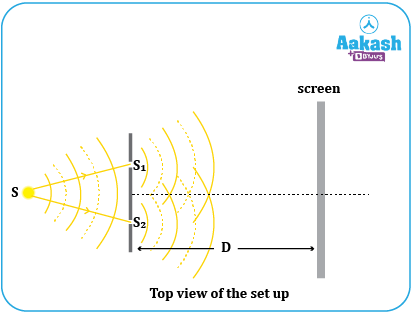
Now obeying Huygens’ principle, S1 and S2 act as the sources of secondary wavelets. The light waves from the sources (S1 and S2) interfere with each other (constructively and destructively) to produce the fringes on the screen.
The primary source of light S is placed symmetrically w.r.t the secondary sources of light S1 and S2 so that SS1=SS2. Therefore, no path difference is incorporated in this path of light.
OB is the central line. Thus,
Consider any arbitrary point P on the screen which makes an angle θ at point O w.r.t the central line. Assume that the distance PB=y.
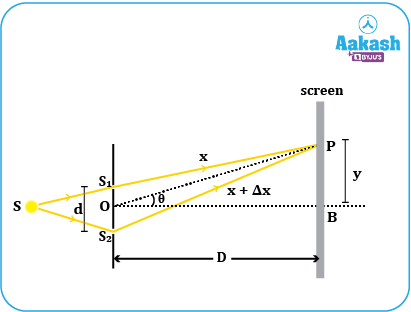
Let the distance of the path traveled by the wave from S1 to P is x. Thus, S1P=x. From the figure, we can say that S2P>S1P. Assume that S2P=x+x, where Δx is the path difference between S1P and S2P.
From the geometry of the figure, we can write:
Subtract eq (ii) from eq (i)
If d<<D and is small, then
Here x is the path difference between two waves interfering at distance y from the central axis on screen.
- Phase difference :
We know that, Phase difference = 2 Path difference
- Condition for constructive interference:
Constructive interference occurs when the path difference between waves is an integral multiple of wavelength λ , i.e., Δx=n.
We know the relation , So phase difference δ=2nπ
Now the path difference at distance y from the central axis on screen.
Putting n0,1,2, .....
We get
These are the positions on the screen where bright spots will occur.
- Condition for destructive interference:
Destructive interference occurs when the path difference between waves is odd multiple of 2
where n is an integer.
We know the relation,
So phase difference, δ=(2n+1)
Now the path difference at distance y from the central axis on screen.
Putting n0,1,2,3,.....
We get
These are the positions on the screen where dark spots will occur.
The fringe pattern on the screen is shown in figure.
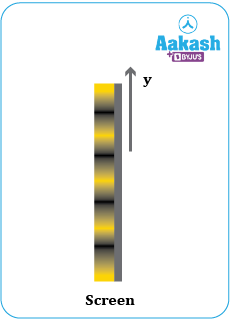
- Fringe width
Distance between two consecutive maxima or two consecutive minima is known as ‘Fringe width’ .
To find the fringe width let us consider brights.
The distance of nth bright fringe from the central axis is
The distance of (n+1)th bright fringe from the central axis is
Fringe width
This is the expression for the fringe width.
Practice problems
Q. In Young’s experiment, interference bands are produced on the screen placed at 1.5 m from the two slits 0.15 mm apart and illuminated by light of wavelength 6500 Å. Find the position of 6th bright fringe from the central maxima.
A. Distance between the slits and the screen: D=1.5 m
Distance between the slits: d=0.15 mm=1.5×10⁻⁴ m
Wavelength of the light: λ=6500 Å=6500×10-10 m
Position of bright fringe
For 6th bright fringe, put n=6
y=3910-3 m
y=39 mm Ans
Q. Bichromatic light is used in YDSE having wavelengths 1=400 nm and 2=700 nm. Find the minimum order of the bright fringe of 1 which overlaps the bright fringe of 2.
A. The light of wavelength 1 and 2 will form their individual fringe pattern which will be different from each other as their wavelength is different. Therefore, the position of the bright fringes on the screen for 1 and 2 will be respectively given by,
For n1=0 and n2=0 , both the lights will have a central maxima. Apart from this point, the bright fringe of both the lights will overlap with each other if:
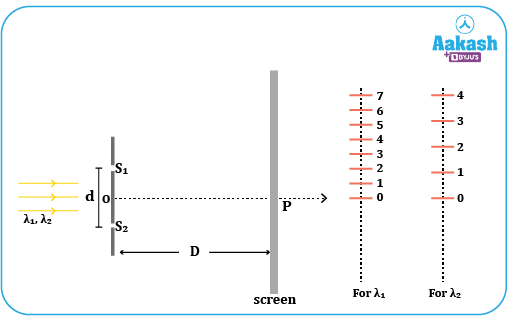
Whenever the ratio n1n2 becomes equal to 74 the fringes will overlap but the minimum order of the bright fringe of 1 which overlaps the bright fringe of 2 is n1=7.
Q. What is the fringe width in Young's experiment if the interference bands are produced on the screen placed at 1.5 m from the two slits 0.15 mm apart and illuminated by light of wavelength 6500 Å?
A. Given: D=1.5 m
d=0.15 mm=1.5×10⁻⁴ m
λ=6500 Å=6500×10-10 m
Therefore, the fringe width will be:
Q. A YDSE setup is immersed in water (w=1.33). It has slit separation 1 mm and distance between slits and screen is 1.33 m. Incident light on slits has a wavelength of 6300 Å. Find the fringe width on screen.
A. When the YDSE setup is immersed in water, the wavelength used for the experiment will change because of the variation of refractive index.
If λa=(6300 Å ) be the wavelength of the light in air and λw be the same in water, then,
Therefore, the fringe width will be:
Given
FAQs
Q. What is the coherent source of light?
A. Source emitting a light wave with the same frequency, wavelength and having constant phase difference with time is called a coherent source.
Q. If the distance between two slits of young experiment is increased what will happen to fringe?
A. The separation between interference between bright and dark fringes will decrease.
Q. Why is laser light used in a double slit experiment?
A. Because the Laser is a coherent source of light.
Q. Why can't we use two different light sources of light in a Young’s double slit experiment?
A. If we use two different sources of light then there will be difficulty to make them coherent because phase for any one might change. So two slits with a single source are used so that they act as two coherent sources of light.

 Call Now
 Let's Chat
 Share
Share