-
Call Now
1800-102-2727


Standing Longitudinal Waves - Closed organ pipe, Open organ pipe, practice problems, FAQs

Have you ever played the flute? If you observe the flute, it has a number of holes in it, but why? When a flute is played it works as an open organ pipe. When air is blown in a flute, a standing wave is produced in it. The holes situated at various distances along the length are used to control the length of the organ pipe, so that different kinds of voices can be produced. Let’s understand how this happens !
Table of content
- Introduction
- Organ pipe
- Standing wave in closed organ pipe
- Standing wave in open organ pipe
- Practice problems
- FAQs
Introduction
When a longitudinal wave hits a boundary, which may be rigid or flexible, it will bounce back to the original medium and interfere with the original wave. On interference, a pattern, which appears stationary, is formed which is called a standing wave or stationary wave.
Suppose a displacement equation of longitudinal wave is given as,
And the reflected wave is given as
The resultant wave given by the superposition principle
Now for pressure equation
And the reflected wave is given as
Similarly, the resultant wave
Hence the standing wave in terms of displacement wave and pressure wave is given as,
S= 2S0 sin t cos kx and P=2P0 cos t cos kx
Organ pipe
Organ pipes are musical instruments that are used to produce longitudinal sound waves by setting up standing waves in an air column. It can be of two types-
- Close organ pipe : In a closed organ pipe, one of the ends is closed. Open end acts as an antinode and closed end acts as a node for displacement waves.

- Open organ pipe : In an open organ pipe, both the ends are open and act as an antinode for displacement waves.

Standing wave in closed organ pipe
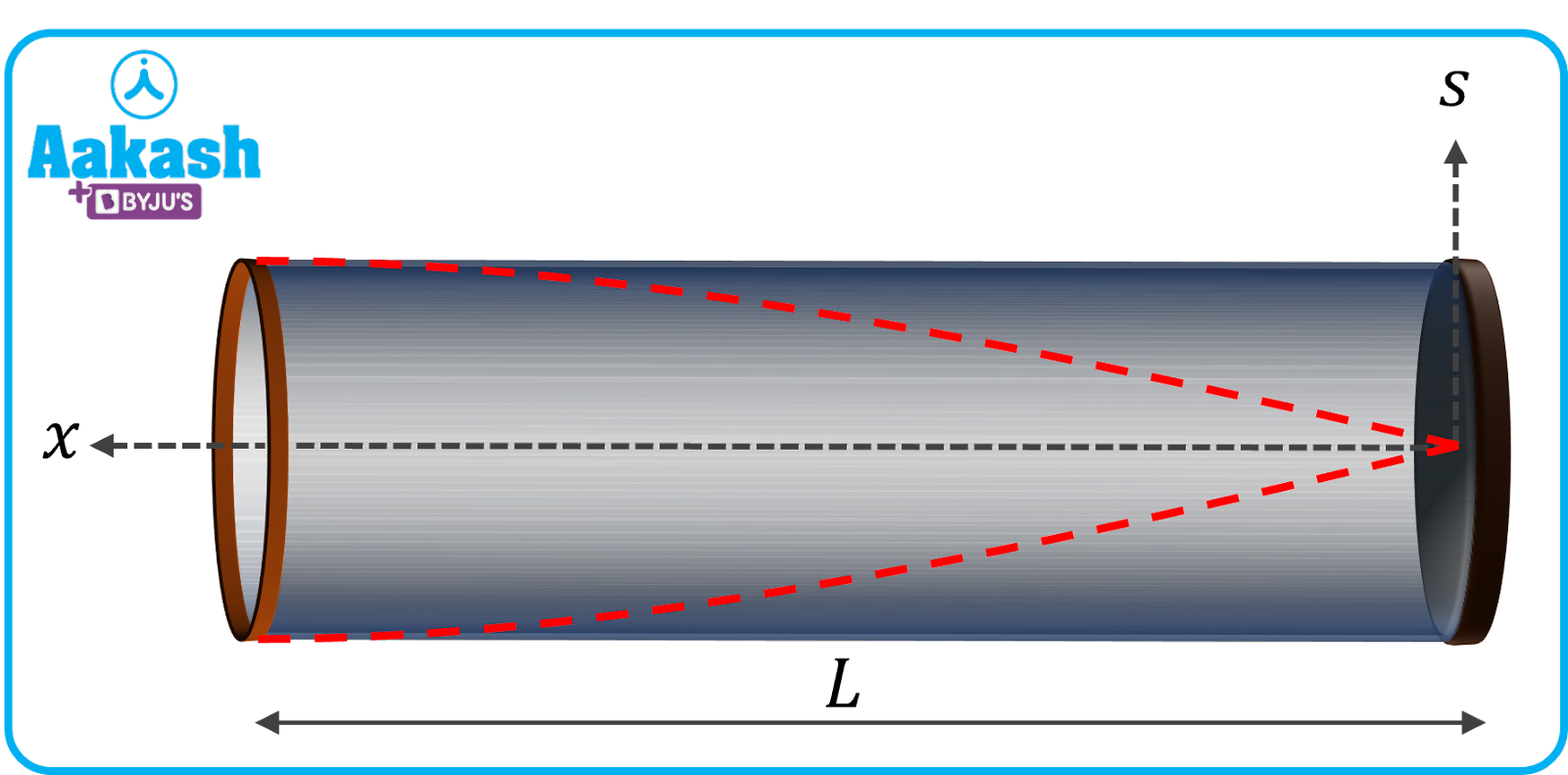
Consider a closed organ pipe whose one end is closed and the other one is open. At the open end, a source of sound waves is placed as shown in the figure.

Consider a wave emitted from the source that goes to the closed end and gets reflected.
Because of reflection through the close end, the phase difference due to reflection is, , and for the reflected wave that again gets reflected from the open end, the phase change due to reflection is,
Therefore, the total phase difference after two reflections of the wave is,
Now, let us consider two waves, one is just emitted from the source and the other is already double reflected and has traveled a path length of 2L.
As the wave has traveled through a distance 2L, so phase difference associated with this
The net phase difference between the two wave
If they interfere constructively, then,
Hence,
We know
Various modes in closed organ pipe
Harmonic - Frequencies that are integral multiples of the fundamental frequency are called harmonics.
Overtone - Any harmonic frequency greater than the fundamental frequency is called Overtone.
- Fundamental mode or first harmonic: By substituting n = 1 in equation (i) and equation (ii), we get,
and .
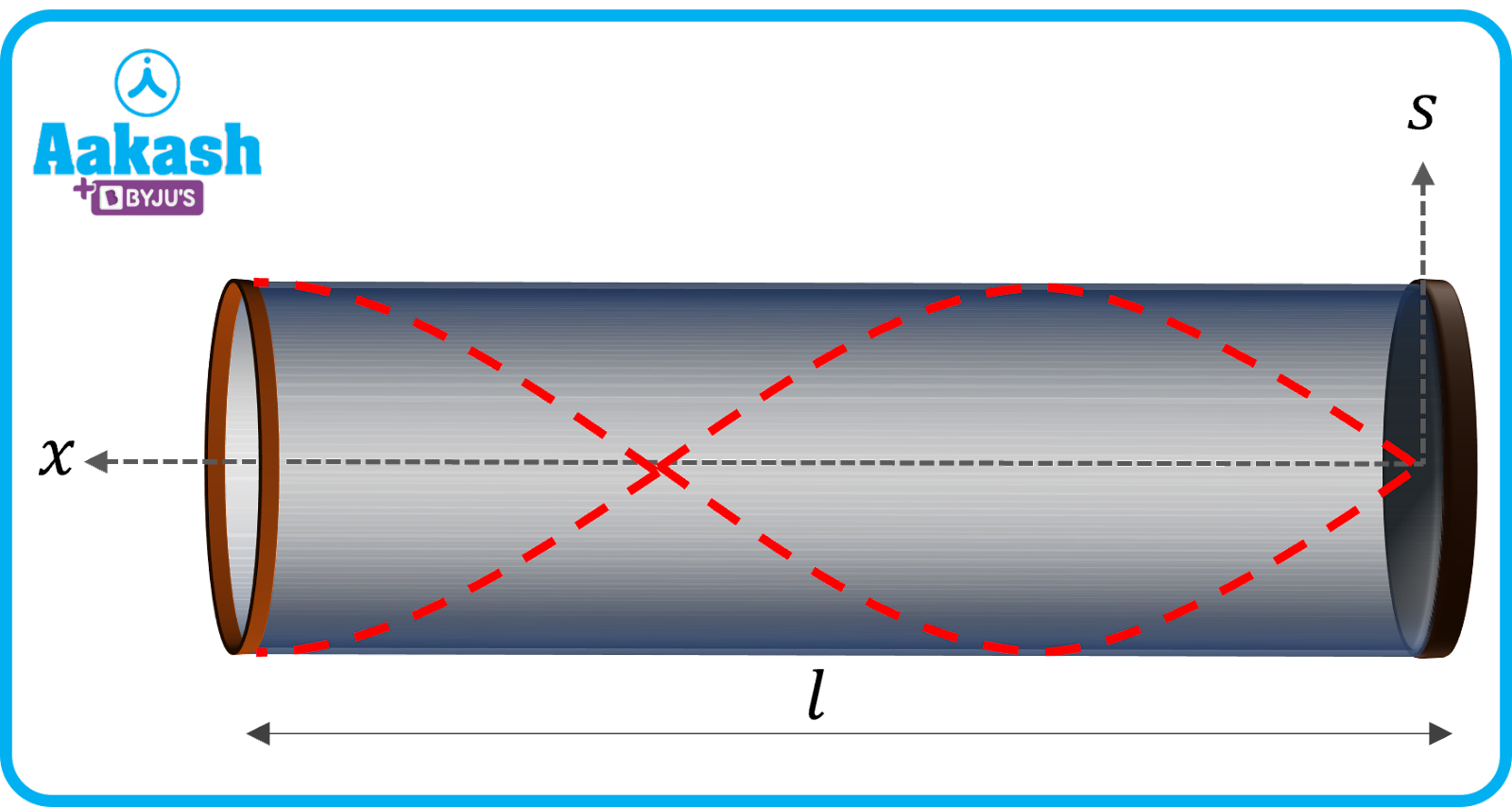
- First overtone or third harmonic: By substituting n = 2 in equation (i) and equation (ii), we get,
and
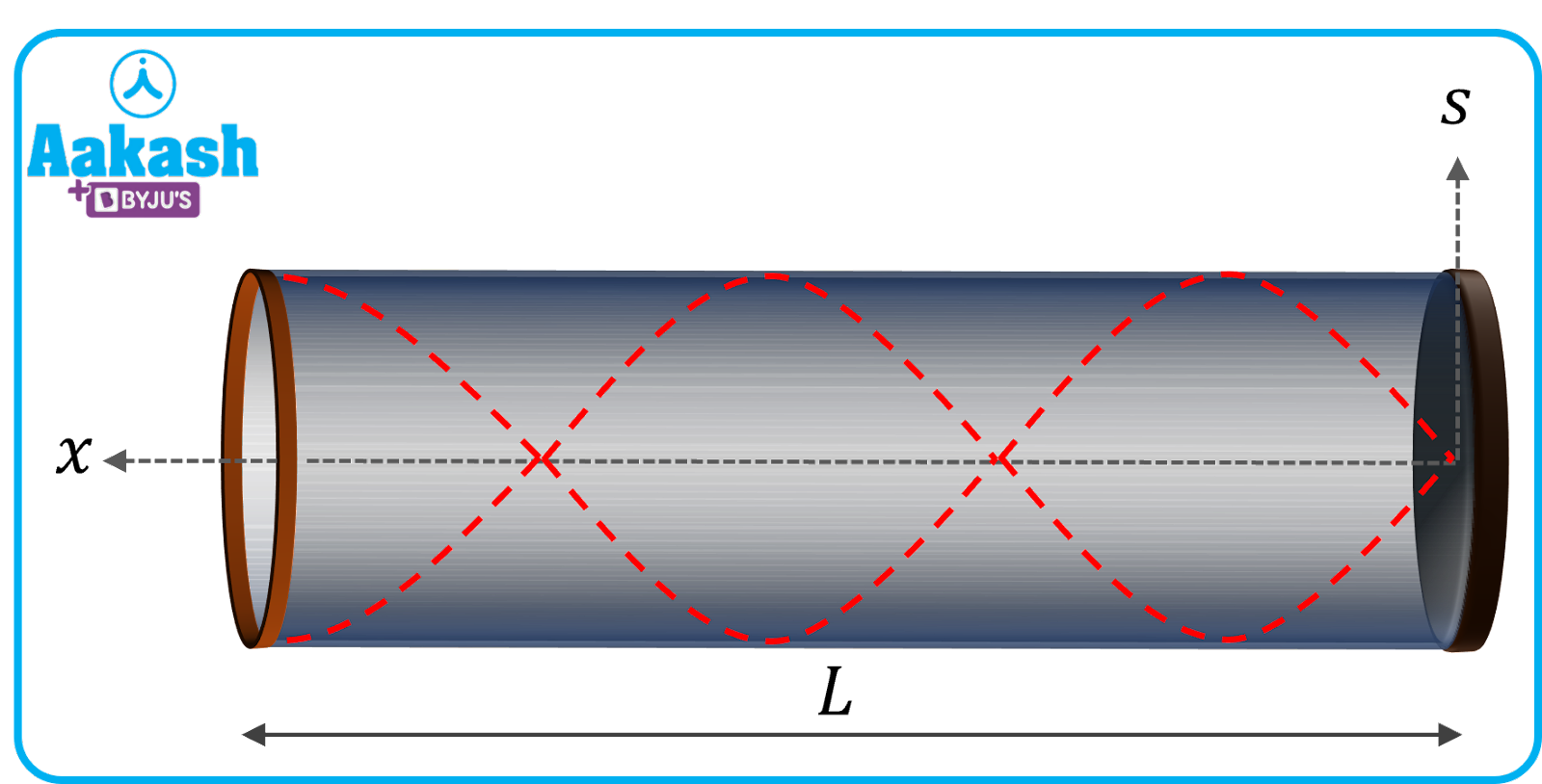
- Second overtone or fifth harmonic: By substituting n = 3 in equation (i) and equation (ii), we get,
and
- nth overtone or (2n + 1)th harmonic: Here, and hence, the frequency of this case is, where n =1, 2, 3,....
Hence from the above discussion we can say in a closed organ pipe only odd harmonics are present.
Standing wave in open organ pipe
In this case, both the ends are open. So, the wave emitted from the source goes to the open end and gets reflected from there. The reflected wave comes towards the source end and again gets reflected from the open end. Hence, in each reflection, there is a phase change of π. The total phase change will be , which is equal to one complete cycle. Therefore, there is no phase change .
Now, let us consider two waves, one is just emitted from the source and the other is already double reflected and has traveled a path length of 2L.
As the wave is traveled through a distance 2L, so phase difference associated with this
As there is no phase change due to reflections, so the net phase difference
If they interfere constructively, then,
Hence,
We know
Various modes in Open organ pipe
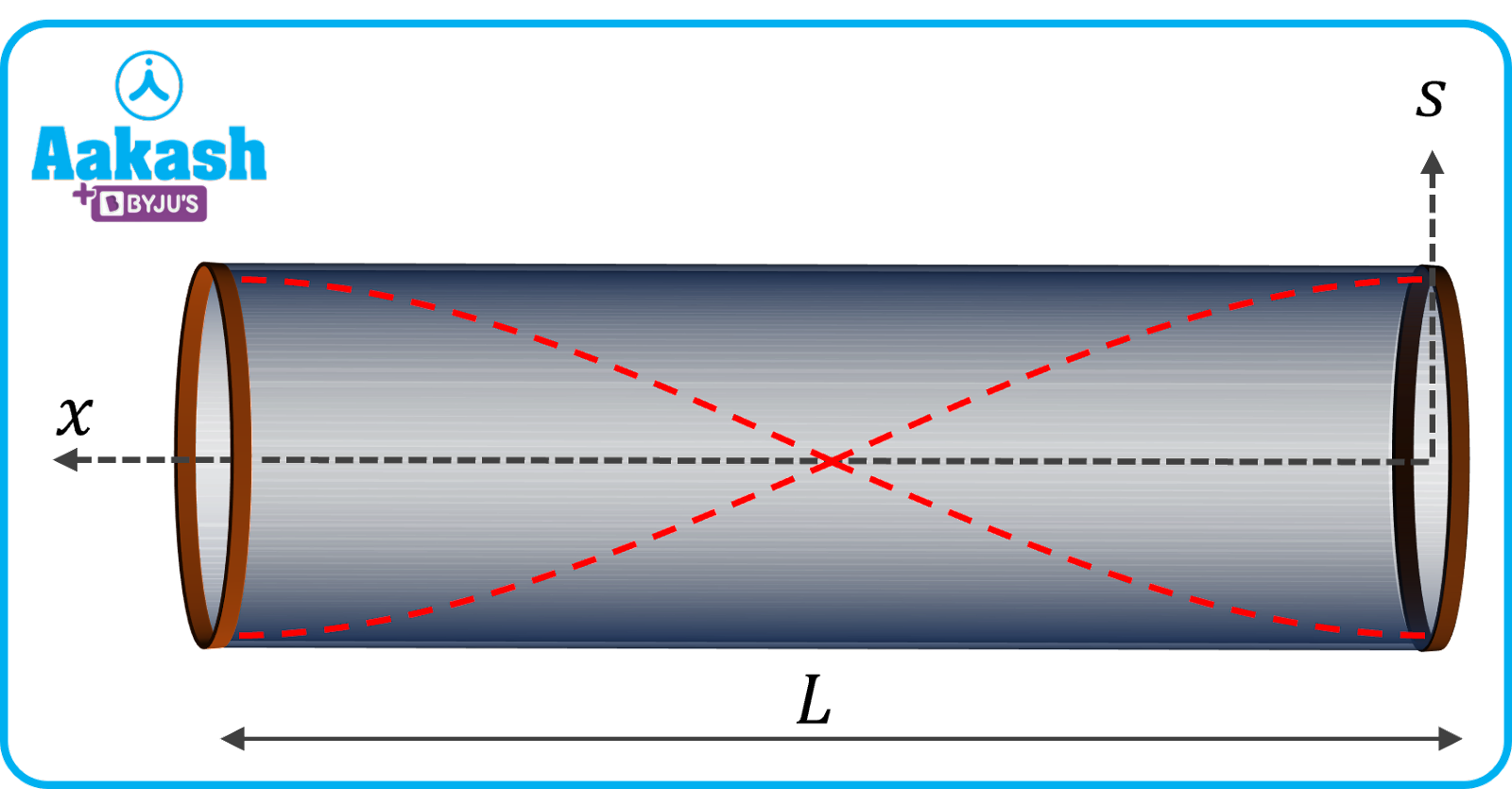
- Fundamental mode or first harmonic: By substituting n = 1 in equation (i) and equation (ii), we get,
and
- First overtone or Second harmonic : By substituting n = 2 in equation (i) and equation (ii), we get,
and

- Second overtone or Third harmonic : By putting n = 3 in equation (i) and equation (ii), we get,
and
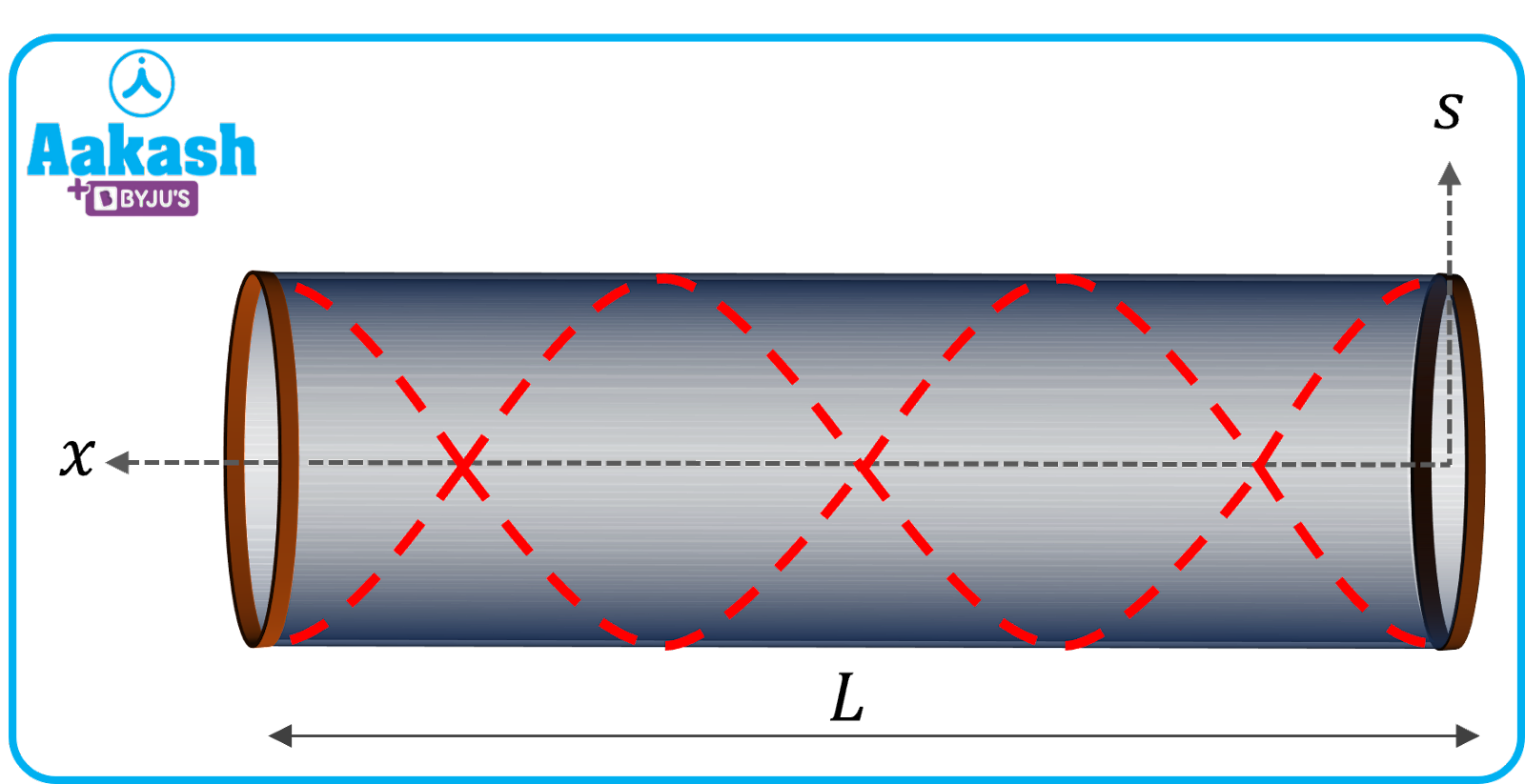
- nth overtone or (n + 1)th harmonic : Here and hence, the frequency of this case is, .
Hence from the above discussion we can say in an open organ pipe both odd and even harmonics are present.
Practice problems
Q1. If the clarinet sounds with frequency 316 Hz, find the 3 higher harmonic frequencies for which the clarinet will be tuned.
Answer. Given first harmonic f1=316 Hz
As the clarinet is a closed pipe, the frequency will be an odd multiple of the fundamental frequency.
Hence, Second frequency
Third frequency
Fourth frequency
Q2. If a flute sounds with the frequency of 295 Hz, find frequencies of the second, third, and fourth harmonics of this pitch.
Answer. Given first harmonic f1=295 Hz
As the flute is an open pipe,
So, Second harmonic
Third harmonic
Fourth harmonic
Q3. The fundamental frequency of a closed organ pipe is equal to the second harmonic of an open pipe. If the length of the closed organ pipe is 25 cm, find the length of the open organ pipe.
Answer. Let the length of closed organ pipe is Lc and open organ pipe is Lo
Then fundamental frequency of a closed organ pipe is
And, second harmonic of an open pipe
Given f1=f2 and Lc=25 cm
Lo=100 cm Ans
Q4. Two successive resonances occur at the length 30 cm and 90 cm in an air column of adjustable length. If the fundamental frequency of length is 256 Hz, find the velocity of sound.
Answer.
Given L1=30 cm and L2=90 cm
Frequency f=256 Hz
Velocity of sound
For closed organ pipe
Ans
FAQs
Q1. What are the conditions of standing waves?
Answer. The conditions of standing waves are that the frequency of two traveling waves should be the same and the waves should travel in opposite directions.
Q2.Do the standing waves transfer energy?
Answer. Unlike the traveling waves, the standing waves do not transport energy because the two waves which make them up are carrying equal energies in opposite directions.
Q3. Write the examples of a closed organ pipe.
Answer. Bottle, whistle, tube filled with water, etc.
Q4.What is the point called, where the amplitude of standing waves is always zero?
Answer. The point where the amplitude of standing waves is always zero is called a node.

 Call Now
 Let's Chat
 Share
Share