-
Call Now
1800-102-2727


Simple Microscopes, working, magnification, Practice problems, FAQs

Have your wrist watch ever been damaged and you visit the watch repairing shop? When the mechanic opens the watch there will be lots of small parts which are difficult to see through naked eye. Then the mechanic wears a device on one of his eyes and repairs the watch. The device is a simple microscope. It produces a magnified view of the small object. It is also used by jewelers to get the magnified view of fine parts of jewelry. Let's understand the simple microscope and its magnification in detail!
Table of content
- What is a simple microscope?
- Working principle of simple microscope
- Magnification of simple microscope
- Practice problems
- FAQs
What is a simple microscope?
A simple magnifier or microscope is a converging lens of small focal length. A hand lens and reading lens are examples of this kind of instrument.
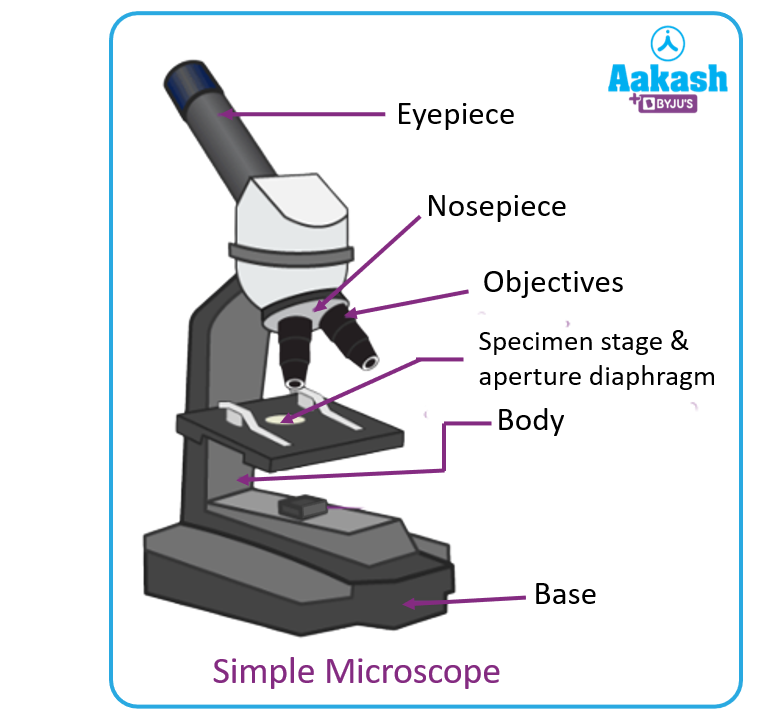
The figure below shows a simple microscope with its various important parts.
Working principle of simple microscope
The basic principle of a simple microscope is that when an object is kept near the lens, an image is produced, which is erect and bigger than the original object. It is a virtual image and cannot be projected on a screen like a real image.
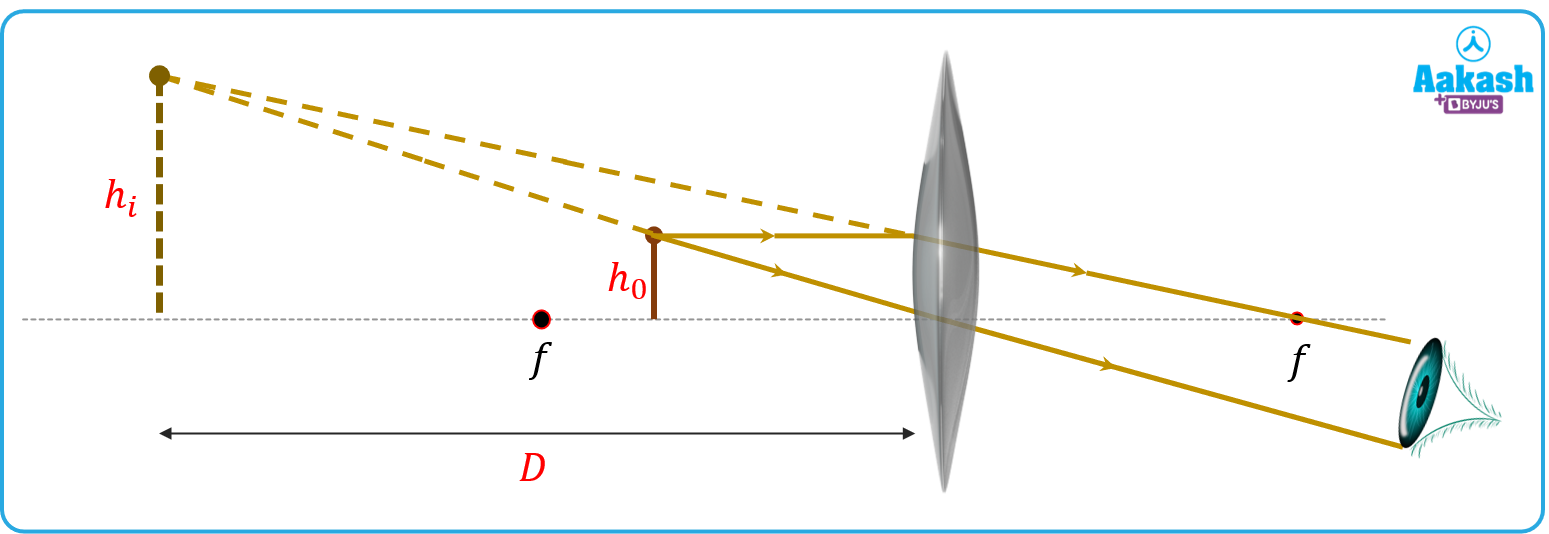
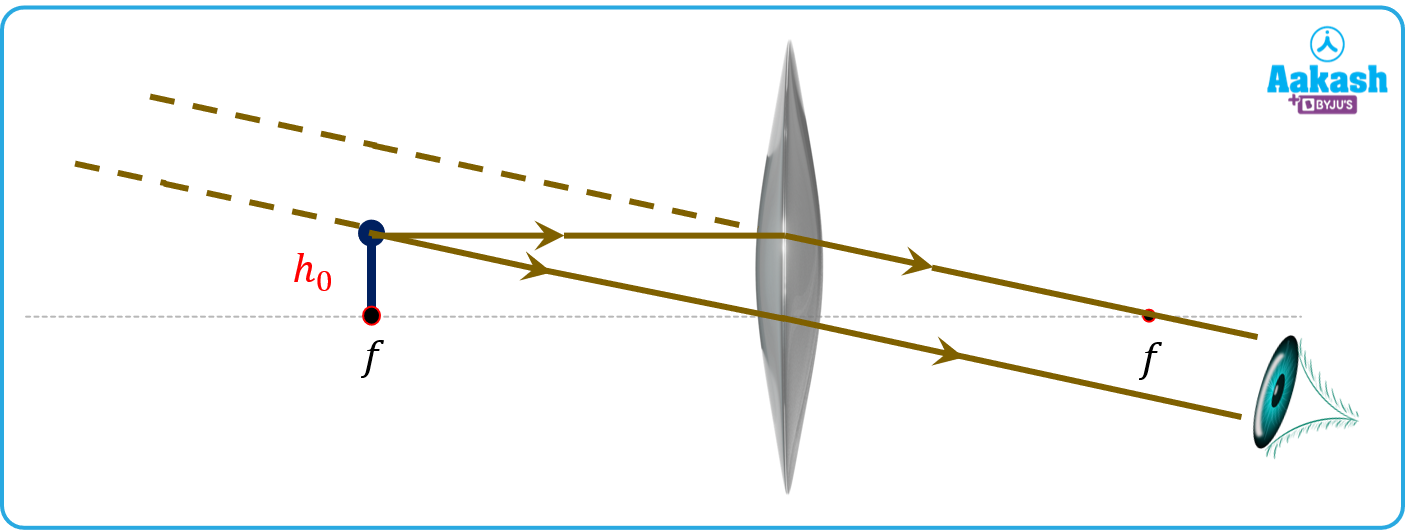
Now if the object is kept at the focal distance the image will form at infinity. Image formed at infinity is often considered most suitable for viewing by the relaxed eye.
Let's find the magnification of a simple microscope.
Magnification of simple microscope
Magnification is defined as a ratio of size of image to the size of object.
Mathematically,

Suppose an object is placed at near point (D=25 cm) and height observed by naked eye is h0 , then
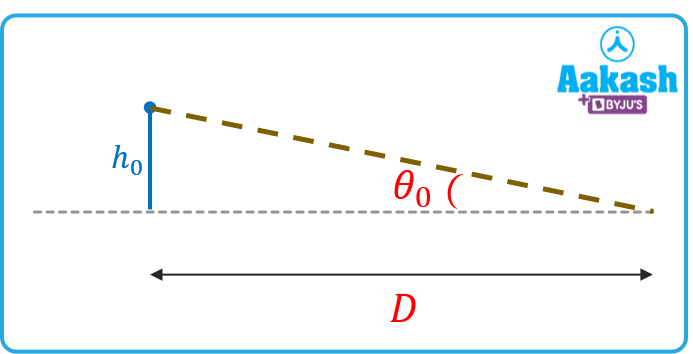

Where  is known as the angular size of the object. Now consider two cases,
- Case-1 When image is formed at near point
Here the object is placed at a distance less than the focal length such that the image is formed at near point and height of image observed is hi then


Now from eq (i),
Magnification 
Putting the values of  and
and from eq (ii) and eq (iii) respectively, we get

Now using the lens formula

Putting values with sign


From eq (iv)


Hence when an image is formed at a near point the magnification is given by the above formula.
- Case-2 When the image is formed at infinity
Here the object is placed at focal length and image is formed at infinity
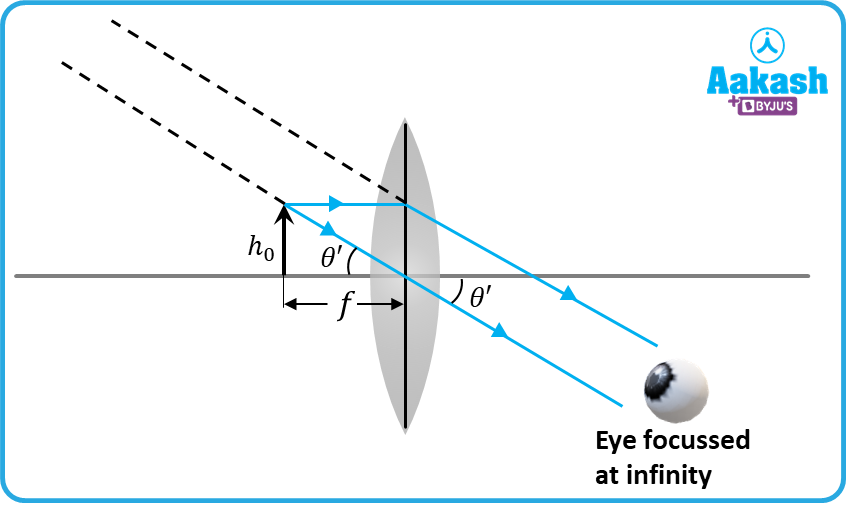
From figure we can say

From eq (iv)
Magnification 
Putting the values of 0 and ' from eq (ii) and eq (vii) respectively, we get

Now using the lens formula
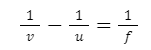

u=f
From eq (viii)

Hence when an image is formed at infinity the magnification is given by the
above formula.
Practice problems
Q1. A simple microscope has focal length 5 cm. What is magnification of a microscope at the least distance of distinct vision?
A. 2
B. 5
C. 4
D. 6
Answer: For simple microscope,
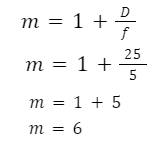
Hence, option (D) is correct.
Q2. The image of an object is produced at the least distance of distinct vision from the lens of a simple microscope. If the focal length is 2.5 cm, and magnifying power is 11, then find the distance of the near point?
A. 23 cm
B. 28 cm
C. 22 cm
D. 25 cm
Answer: Magnification of simple microscope is
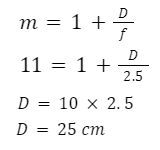
Hence option (D) is correct.
Q3. An object is seen through a simple microscope. The image is formed at the near point of the eye. If angular magnification produced is 3, then what is the focal length of a simple microscope?
A. 10 cm
B. 12.5 cm
C. 14 cm
D. 9 cm
Answer: When image is produced at Near point,
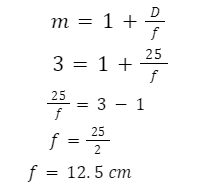
Hence option (B) is correct.
Q4. A simple microscope of focal length 10 cm is used to see an object. If the image is seen with a relaxed eye, find the magnification produced. The near point of the eye is 25 cm away from it.
Answer: Given f =10 cm D=25 cm
For an image to be seen by a relaxed eye it should be produced at infinity.
When image is produced at infinity,
Magnification 

m=2.5
Hence magnification is 2.5.
FAQs
Question 1. Why is the diaphragm used in a simple microscope?
Answer: Diaphragm is used to control the amount of light and shape of the light that travels through the condenser lens and eventually passes through the specimen by expanding and contracting the diaphragm blades that resemble the iris of an eye.
Question 2. What are the various parts of a simple microscope?
Answer: Eyepiece, Nosepiece, Objectives, Specimen stage, Base etc.
Question 3. Can we take a photograph of an image formed by a simple microscope?
Answer: Yes, photography through the microscope is called photomicrography.
Question 4. What are the limitations of a simple microscope?
Answer: Simple microscope has only one lens, so its magnification capacity is limited to just 10X. To overcome this we use compound microscopes.

 Call Now
 Let's Chat
 Share
Share