-
Call Now
1800-102-2727


Simple harmonic motion, Force law, practice problem, FAQs

Simple harmonic motion is the special case of Oscillatory motion. So we can say that all simple harmonic motions are oscillatory motion but inverse is not true. Consider the following motions: Motion of swing, motion of pendulum, motion of mass attached to string, Atomic vibration in molecules etc. all are examples of simple harmonic motion.
Have you seen the pendulum clock ? Have you thought about why that pendulum oscillates too and fro. Will this pendulum clock work in zero gravity and what kind of motion is that? Is it translatory or rotatory? So for all this curious question we have to study a special case of oscillation that is simple harmonic motion.
Table of content
- Simple Harmonic Motion
- Types of SHM
- Displacement Equation of SHM by force law
- Important Terminologies in SHM
- Practice problem
- FAQs
Simple Harmonic Motion
Simple Harmonic Motion or SHM is defined as a motion in which the restoring force is directly proportional to the displacement of the body from its mean position, and the direction of the restoring force is always towards the mean position.

Here, the restoring force, F=- kx, will act in a direction opposite to the displacement of the body and will always be directed towards the mean position (x = 0).
Example- The motion of spring-block system

- The mean position has been taken at the origin (x = 0) for simplicity and the maximum displacement of the block is A from the mean position on both sides; x = +A and x = -A are known as the extreme positions.
- The maximum displacement of the body from the mean position is known as the amplitude.
Types of SHM
- Linear SHM: It is when a particle undergoes to and fro motion about an equilibrium position along a straight line.
- Angular SHM: It is when a body/particle is free to rotate/oscillate about a given axis on a curved path.
Displacement Equation of SHM by force law
Consider a particle performing periodic and oscillating motions between -A to A as shown in the figure.

From the equation of SHM we know the that force is directly proportional to the displacement and the direction is towards the mean position ie. F-x
This is know as force law
Where k is the force constant.
If m is the mass of the particle, then equation (i) becomes,
k and m both are constant taking
Here a is the acceleration of SHM,
Consider at t=0 the particle is at x=xo and having velocity vo in right direction, Now let at time t=t the particle is at some potion x and having velocity v, Integrating above equation using these limits
Putting
This is the velocity of particle in SHM
Take
Where The initial phase of the particle depends upon the initial condition of the particle.
Thus, if the force on a particle varies as F ∝ - x (i.e., force is linear and restoring in nature), then the position of the particle varies as x=A Sin t+, where x is the displacement of the particle with respect to the mean position (O).
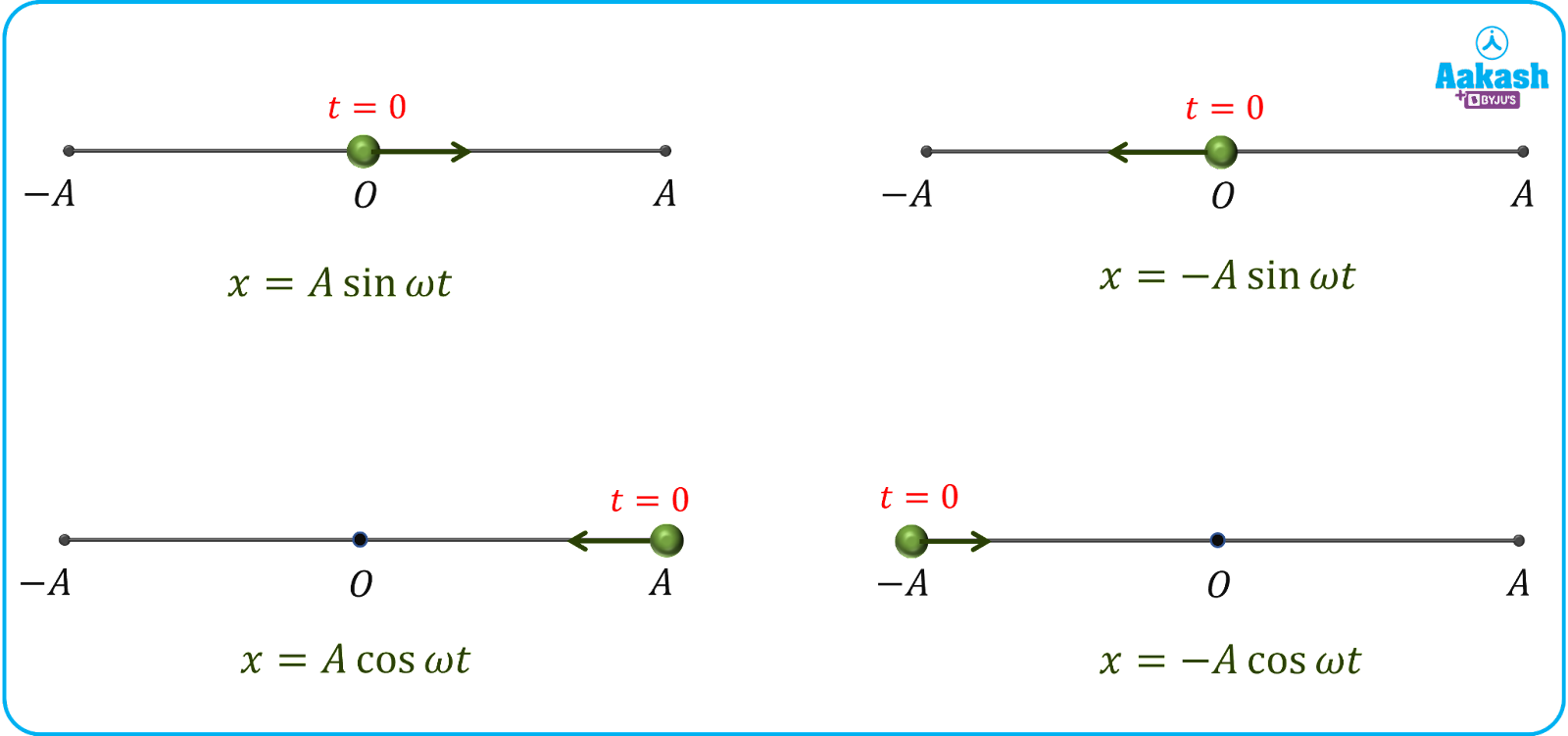
Now consider the following cases-
- Particles start at mean position: For this case, at t = 0, the displacement of the particle is, x = 0. We know that the general equation of displacement for a particle executing SHM is, x = A sin(ωt + ϕ). By putting t = 0 and x = 0 in the equation of displacement, we get,
0 = A sin 𝜙
𝜙=0 or
Both values of are possible depending on the situation
Now using the expression of velocity at t = 0, the velocity expression given by,
v = Aω cos ϕ
for ϕ = 0, the velocity of the particle will be, v = Aω and for ϕ = π, the velocity of the particle will be, v = - Aω.
Therefore if the particle is going from O to A the value of ϕ = 0 and the equation will be,
x = A sin(ωt + 0) = A sin ωt
and if the particle is going from O to -A the value of ϕ = and the equation will be,
x = A sin(ωt + π) = - A sin ωt
- Particle starts from an extreme position: For this case, at t = 0, the velocity of the particle is, v = 0 and the displacement of the particle is, x = ± A. the general equation of displacement for a particle executing SHM is, x = A sin(ωt + ϕ). By putting t = 0 and x = ± A in the equation of displacement, we get,
± A = A sin ϕ
𝜙=2 or 32
Thus, if the particle starts from + A, the equation will be,
x = A sin(ωt + 2) = A cos ωt
And if the particle starts from - A, the equation will be,
x = A sin(ωt + 32) = -A cos ωt
Important Terminologies in SHM
- Amplitude (A): It is the maximum displacement of the particle from the mean position. It is the distance between the mean position and the extreme position on either side.
- Phase angle (δ): If the displacement of the particle executing SHM is given by x = A sin(ωt + 𝜙), then the term (ωt + 𝜙) is known as the phase angle (δ)
- Angular frequency (ω): The rate of change of phase (𝛿) of SHM of a particle is known as the angular frequency of the SHM.
- Phase constant (𝜙) : It it a constant for a simple harmonic motion and depends upon the initial condition of the particle.
- Time period (T): It is the time taken to complete one oscillation.One oscillation is counted when the particle returns back to its initial position.

- Frequency (f): It is defined as the number of oscillations completed by the body per unit time.
f=1T
Its SI unit is Hz, when the period is in second (s).
Practice problem
Q. Find the given motion equation x=A eit is simple harmonic or not?
A. Given:
Differentiation with respect to
As we know
This is the required condition of SHM, hence given motion is simple harmonic
Q. The equation of a particle executing simple harmonic motion is x=5 Sin t+3 m. Write down the amplitude, angular frequency, time period and initial phase of SHM.
A. Given that the equation of the particle executing SHM is,
Comparing this equation with the general equation, x=A Sin t+, we get the following:
The amplitude of the particle is, A=5 m
The angular frequency of the particle is, = rad/s
The time period is,
The initial phase
Q. Write the equation of SHM for the given situation.

A. Let the equation of SHM of the particle be x = A sin(ωt + ϕ).
At t = 0, it is given that
Therefore, by putting this condition into the equation, we get,
Now At t = 0, the velocity expression given by, v = Aω cos ϕ
for ϕ = 6, the velocity of the particle will be, v = Aω32 which is positive and for ϕ = 56, the velocity of the particle will be, v =-Aω32 which is negative, means the particle is pointing towards the center. So the value of =56.
Hence, the equation of SHM of the given configuration will be,
Q. A particle starts from the positive extreme position and moves towards the negative extreme as shown in the figure. The time period of the SHM is 8 s. Find the distance covered by the particle in 1 s .

A. Since the particle starts from a positive extreme, so the equation of the SHM is
The time period of the particle is T = 8 s. Thus, the angular frequency of the SHM of the particle is,
Hence, the equation of the SHM is,
At time t = 1 s, position of particle,
x in the equation is the displacement of the particle measured from the mean position.
Therefore, is the distance OP, but the required distance is AP as shown in the figure.

Hence, the distance covered by the particle in 1 s is,
FAQs
Q. On which properties of system time period of Simple harmonic motion depends?
A. Time period depends upon Mass(m) and force constant(k) of the system.
Q. Is the motion of the pendulum simple harmonic?
A. Motion of the pendulum is not simple harmonic but for the small angular displacement it can be considered simple harmonic.
Q. What is epoch in Simple harmonic motion?
A. At time t=0 s the phase of is called epoch. It is also called the initial phase.
Q. What is force constant for spring in SHM?
A. For the spring force constant is defined as force per unit displacement i.e.

 Call Now
 Let's Chat
 Share
Share