-
Call Now
1800-102-2727


Potential Energy formula in SHM, Practice problems, FAQs

Have you seen the dams at electricity generation plants? A huge amount of water is stored in it to generate electricity. Does it mean that water generates electricity? If it is true, then the water in our bottle should also generate electricity. But it is not possible. There is some other factor which is responsible for electricity generation. The factor is the potential energy. The water in the plants is stored at some height and possesses potential energy. When this water falls, the potential energy of the water is converted into kinetic energy and it rotates the impeller. Let's learn about potential energy and its mathematical formulas!

Table of content
- Potential Energy
- Potential Energy of simple harmonic motion
- Potential Energy formula of simple harmonic motion
- Practice problems
- FAQs
Potential Energy
Potential energy is the energy caused by the position of an object with respect to other objects. For example, when we lift a mass from the ground to some height, the work done in lifting the object is stored in it as potential energy. Similarly when we stretch a rubber band or a spring, the work done in stitching it will be stored as the potential energy.
There are different kinds of potential energy such as gravitational potential energy, Elastic potential energy, Electric potential energy etc. The formula for potential energy is based on the kind of potential energy.
The formula of gravitational potential energy UG is given as
Where,
m= mass of the object
g= gravitation acceleration
h= height of the body from the ground
The formula of Elastic potential energy UE is given as
Where,
k= Force constant of the spring
x= elongation in the spring
The unit of potential energy is Joule.
Potential Energy of simple harmonic motion
A simple harmonic motion is the motion in which a body oscillates about a fixed point and the restoring force on the body is directly proportional to the displacement from the mean position.
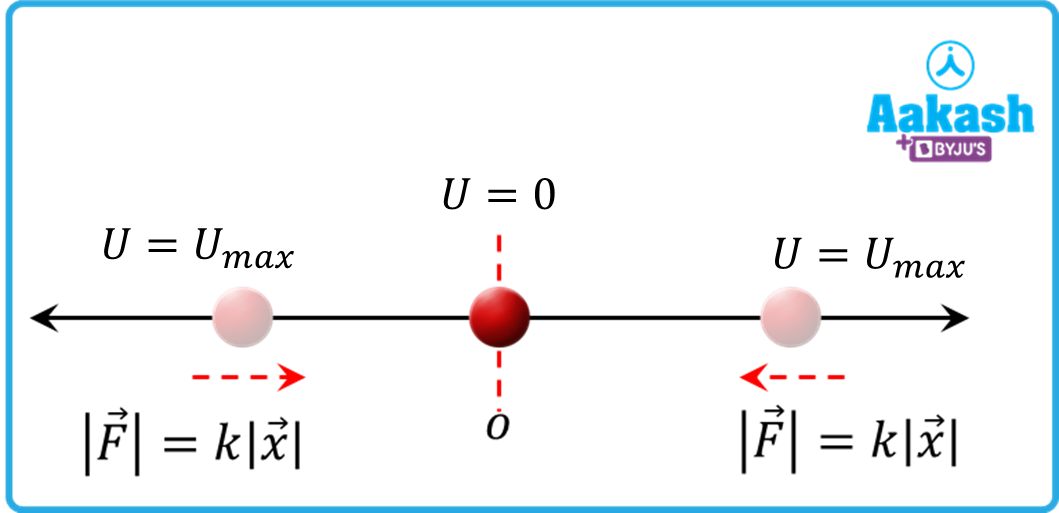
Now consider a particle at the origin O. To set this particle into a simple harmonic motion, we have to do some external work on the system against the restoring force. This work will be stored in the system as the potential energy of the system. When the particle is released the potential energy will keep changing into kinetic energy. And the velocity of the system will keep on increasing. At an instant the potential energy of the system will become zero and it has maximum kinetic energy. It is the mean position. Now due to its kinetic energy the particle keeps on moving and will do work against the restoring force. And the kinetic energy will be converted into potential energy.
From the above discussion we can say the potential energy of the system is maximum at the extreme position and zero at the mean position. Let's find it mathematically!
Potential Energy formula of simple harmonic motion
For simplicity, consider the simple harmonic motion of a spring block system. Let the mass of the block is m and the force constant of the spring is k

The restoring force on the block, if it is located at a distance x from its mean position, is,
The work done for displacing the particle infinitely small displacement dx
Total work required to move the particle from the mean position (x=0) to a distance of x is,
This work will be stored as potential energy of the system. And is given as,
If the angular frequency of the SHM is then we can write , so the potential energy is,
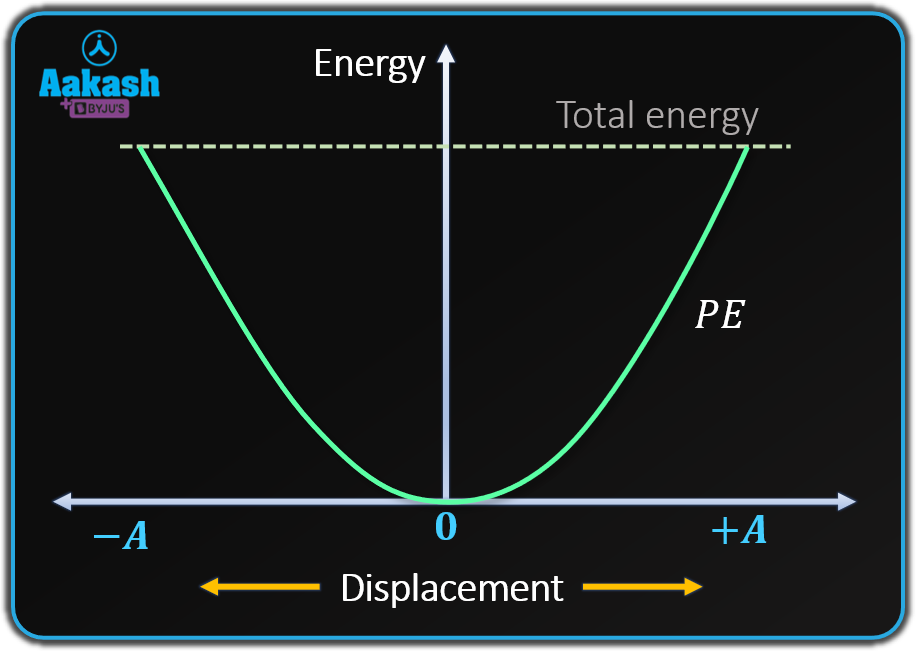
This formula can be used to find the potential energy of the block at a distance x from the mean position. The potential energy is proportional to the square of the displacement of the particle from the mean position. Graph of potential energy with respect to displacement is shown in the below figure.
Now if the displacement of the block is given by the equation , where A is the amplitude of the SHM
On substituting the x in the equation (iii) , we get,
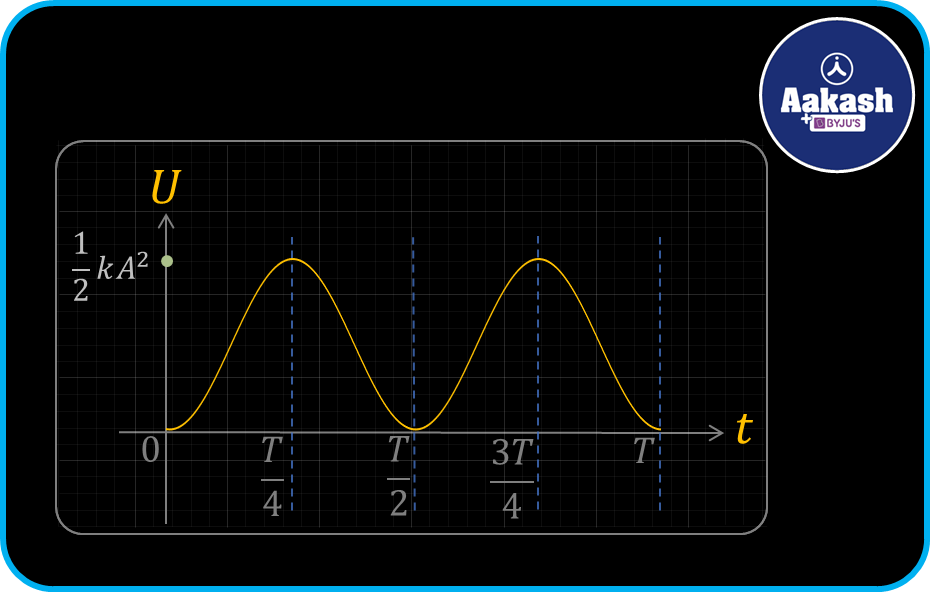
This is the relation of potential energy of SHM at time t. It is the square sine function of time. The graph of the potential energy with time is shown in the figure below.
Practice problems
Q1. Raman takes a book from its bookshelf which is at the height of 2.5 m from the ground and puts it on the table having the height 1 m from the ground. If the mass on the book is 1 kg then find the change in the gravitational potential energy of the book.
Answer: Given, and
Mass of the book m=1 kg
The change in the gravitational potential energy
The change in the gravitational potential energy is 14.715 J
Q2. A spring of force constant 150 N/m is stretched to a length of 2 cm from its natural length. Find the potential energy stored in the spring.
Answer. Given, and x=2 cm=0.02 m
The potential energy of the spring is
UE=0.03 J
The potential energy in the spring is 0.03 J.
Q3. A body of mass 15 kg executing simple harmonic motion with angular frequency rad/s and amplitude 1m . What is the maximum potential energy of the system?
Answer. Given m=15 kg
Angular frequency
And Amplitude A=1 m
The potential energy of the system will be maximum when it is at extreme position i.e. x=A=1 m
Maximum Potential energy
The maximum potential energy is 74 J
Q4. A block of mass 10 kg is attached with the spring of force constant 75 N/m and executing simple harmonic motion having angular frequency . If the maximum displacement of the block is 50 cm , find the Potential energy of the block at .
Answer. Given m=10 kg
force constant
Angular frequency
And Amplitude A=50 cm=0.5 m
The potential energy of the block can be determined as,
U=4.6875 J
Potential energy of the block at is 4.6875 J.
FAQs
Q1. Why does the potential energy of the system in simple harmonic motion become zero at the mean position?
Answer. At the mean position the total potential energy is converted into kinetic energy, because of this reason potential energy is zero at the mean position.
Q2. What is the total energy of the system in simple harmonic motion?
Answer. The total energy of the system in SHM is the sum of kinetic and potential energy. The kinetic and potential energy are interchangeable to each other but the total energy of the system remains constant.
Q3. Who gave the term potential energy?
Answer. Scottish engineer and physicist William Rankine first used the term potential energy.
Q4. What different kinds of potential energies are there?
Answer. The potential energies are of different type
- Gravitational potential energy
- Elastic potential energy
- Chemical potential energy
- Electrical potential energy
- Nuclear potential energy

 Call Now
 Let's Chat
 Share
Share