-
Call Now
1800-102-2727


Magnetization and magnetic intensity - magnetic susceptibility and permeability, practice problems, FAQs

You might have heard that different materials possess different magnetic properties. They find their applications depending upon the requirement. But have you ever wondered why do they possess different properties or why don’t they all behave the same? To go to depth of this question, you should first be aware of magnetization.
Table of contents
- Magnetization of materials
- Magnetization Vector ()
- Magnetic intensity ()
- Magnetic Susceptibility
- Magnetic Permeability
- Relative Permeability
- Practice problems
- FAQs
MAGNETIZATION OF MATERIALS
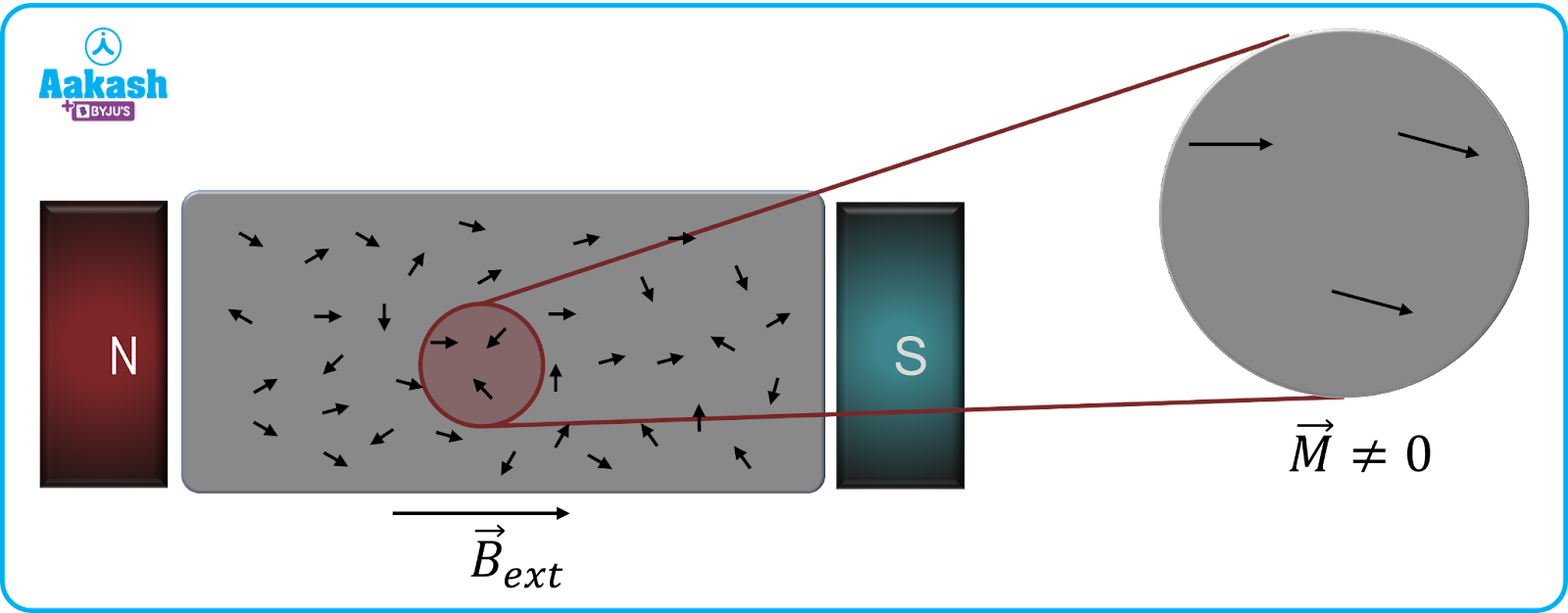
We know that if there exists unpaired electrons giving a net magnetic moment to an atom and the atoms are randomly distributed in the materials, the net magnetic moment of the material becomes zero.

If the same material is placed in an external magnetic field produced by a permanent magnet, then unpaired electrons behaving as magnetic dipoles will try to align themselves along the direction of the external magnetic field, as shown in the figure. Thus, the material now can show the magnetic properties.
Magnetization Vector ()
- Also known as intensity of Magnetization, the magnetization vector is defined as net magnetic moment per unit volume.
- As the temperature increases the randomness of motion of electrons in a material increases. The increase in randomness suggests the randomness in their alignment also.The orientation of unpaired electrons can lead to zero net magnetic moment. Thus, increase in temperature of magnetic material decreases magnetism of the material.
- depends on the nature of the material and temperature.
- The direction of intensity of magnetization is the same as that of induced dipole moment.
- SI unit of magnetization vector:
Consider a bar magnet having pole strength 𝑚, length 𝑙 and the cross-section 𝐴,

The magnetic moment is defined as
Therefore, intensity of magnetization,
Thus intensity of magnetization can also be defined as pole strength per unit cross sectional area.
Magnetic intensity ()
- It is the ability of an external magnetic field to magnetise a material medium.

- is also known as Magnetising Field Intensity
- Magnetic intensity can also be defined as the ratio of magnetising field and permeability of free space.
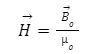
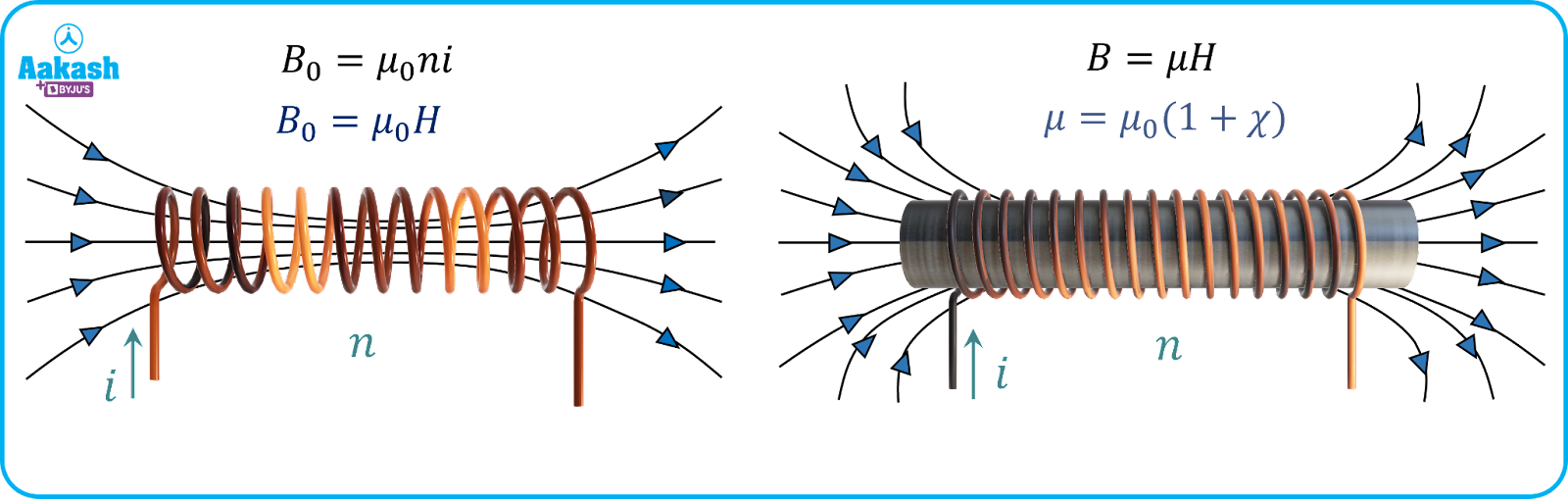
- For an air core solenoid,
Thus material of the core of solenoid does not influence its magnetic intensity.
- SI unit:
To magnetise a material, we apply an external magnetic field  to the material. Under influence of the external magnetic field, most of the atomic dipoles align themselves along the direction of and creates their own magnetic field
  inside the material.
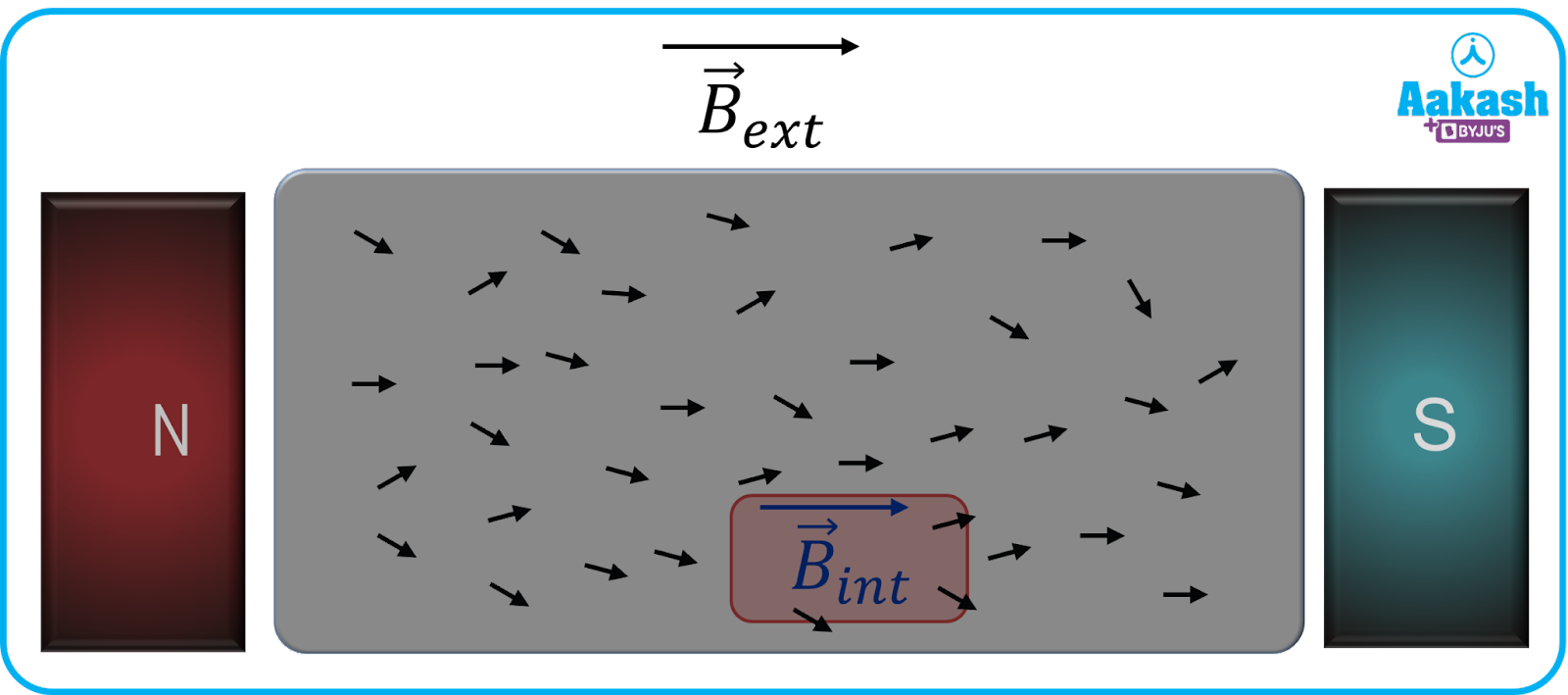
Net magnetic field inside matter:
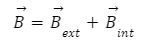
Internal factor: Due to alignment of dipoles (I), (Magnetization)
External factor: Magnetising field intensity
Net magnetic field, 
 is independent of nature of the medium as it measures the ability of an external magnetic field to magnetise a material medium.
- If no material is present (vacuum),

Magnetic Susceptibility
- Magnetic susceptibility is defined as the ratio of magnitude of intensity of magnetization and that of magnetic intensity.
- Experimental results show that intensity of magnetization
 is proportional to the magnetic intensity
𝜒 is used to represent magnetic susceptibility.
- Higher the value of 𝜒, more easily the material can be magnetised.
- No magnetization in vacuum, and hence 𝜒=0
- 𝜒 depends on the nature of material and temperature.
- Magnetic susceptibility is a dimensionless and unitless, scalar quantity.
Magnetic Permeability
It is the ratio of magnitudes of magnetic field and magnetic intensity inside a material.

- Units of magnetic permeability: Wb/Am
- Dimensions of magnetic permeability: [MLT-2A-2]
- It is a scalar quantity.
- Measures the extent of penetration of a magnetising field inside a given material.
Consider a material being placed in the influence of an external magnetic field as shown.

The net magnetic field is given by,
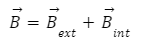
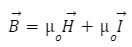
Since, magnetization 
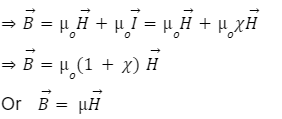
Where 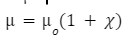 is Permeability of the material
If there is no material, 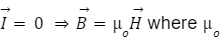 is the permeability of the vacuum.
Relative permeability: The relative permeability of a material is a factor by which magnetic field increases when a material is introduced.
- It can also be defined as the ratio of permeability of medium to the permeability of free space.
- It is a dimensionless and unitless quantity.

Practice problems
Q. A solenoid has a material of relative permeability 400. If solenoid has 1000 turns per metre and carries a current of 2 𝐴. Find
1) Magnetic intensity(𝐻)
2) Net magnetic field(𝐵𝑛𝑒𝑡)
3) Intensity of magnetization(I)
Answer.
⇒H=nI

I=𝜒H
Q. A 2 A current is flowing in the winding of a toroid. There are 950 turns and the mean circumferential length is . If the magnetic field inside the toroid is 4 T, then find the magnetic susceptibility of the core.
Answer.
Given:
Magnetic field inside a toroid,
Here, the mean circumferential length is,
Substituting values in equation (1),
The relative permeability will be
Using formula,
Q. Find the magnitude of magnetic field B at the centre of a bar magnet having pole strength 3.6 Am, magnetic length 12 cm and cross-sectional area 0.9 cm2.
A.
Given:
Pole strength of magnet, m=3.6 Am
Magnetic length, 2l=12 cm
Cross-sectional area, A=0.9 cm2
At the centre of the magnet, magnetic field can be written as
Here,
Magnetization of bar magnet can be calculated as,

Due to north pole magnetic intensity at the centre,
Similarly, magnetic intensity due to south pole at the centre is,

Resultant magnetic intensity,
[Towards the south pole]

Net magnitude of magnetic field at the centre, using the equation (1) can be obtained as:
towards North pole
Q. If the space inside a current carrying toroid is filled with aluminium, then find the increase in magnetic field in terms of percentage. The susceptibility of aluminium is .
A.
Given,
Susceptibility of aluminium,
Magnetic field in the absence of aluminium,
The magnetic field when the space within the toroid is filled with aluminium,

The increase in the field is,
The percent increase is,
FAQs
Q1. What is the relative permeability of a diamagnetic material?
Answer. The relative permeability of a diamagnetic material is less than 1 since diamagnetic materials repel the external magnetic field lines. Magnetic field lines inside these materials are comparatively lesser than the free space.
Q2. What is the physical significance of magnetic susceptibility?
Answer. The ease with which the material can be magnetised when subjected to external magnetic fields is represented by magnetic susceptibility.
Q3. A steel rod is located at the north magnetic pole of the earth. It is partially embedded into the ground. The rod acquires magnetic properties after a long time, then -
- End of the steel rod embedded inside the ground will become the North Pole
- End of the steel rod embedded inside the ground will become the South Pole
- Cannot be predicted
- None of the above
A. (b)

Consider the magnetic field lines around the Earth.
These lines will enter the rod through the end embedded into the ground and exit through its other end, which is above the ground.
Therefore, the upper end of the rod which is outside the ground becomes the North pole and the part of rod inside the ground acquires the South pole.
Hence, option B is correct.
Q4. A plane parallel to the magnetic axis of a bar magnet cuts it into two equal halves. What happens to the intensity of magnetization?
Answer. Intensity of magnetization is a property which depends on the nature of the material and is given by formula,
Here, magnetic moment, (since pole strength becomes half) and volume,
Therefore, the intensity of magnetization remains unaffected.

NEET Related Links
JEE MAIN Related Links
JEE Advanced Related Links
JEE Advanced Eligibility Criteria
JEE Advanced Chemistry Syllabus
JEE Advanced Registration Dates
CUET Related Links
Important Topics
Anemometer : Measurement of Wind Speed
Angular Acceleration Atomic Theory Audible and Inaudible Sound Average Speed and Average Velocity Average Velocity Avogadros Number Avogadros Hypothesis Azimuthal Quantum Number Balanced Force Bar Magnet Biconvex Lens Boyles Law Buoyancy Calorimeter Carnot Engine Celestial Bodies Centripetal And Centrifugal Force Concave and Convex Lenses Concave Convex Mirrors Contact and Non Contact Force Controlled Thermonuclear Fusion Convection Currents Convex Lens Convex Mirror Destructive Interference Difference Between Conduction Convection and Radiation Difference Between Electric Field and Magnetic Field Difference Between Heat And Temperature Difference Between Series And Parallel Circuits Differences Between Acceleration And Velocity Distance and Displacement Distance Time Graph Electrical Force : Electric Forces and Their Types Electromagnetic Waves : Definition, Equation and Properties of Electromagnetic Waves Electromagnetism Electron Spin Fluid Flow : Bernoullis Equation Derivation and Fluid Mechanics Fluid Friction : Types and Factors of Fluid Friction Frames of Reference : Inertial and Non- Inertial Frame of Reference Frequency and Wavelength Frictional Force Importance of Hydrosphere Instantaneous Speed and Velocity Introduction to Motion Kinetic and Potential Energy Difference Law Of Conservation of Energy Layers of the Earth Light Energy Light Sources List of physics scientists and Their inventionsLoudness of Sound
Magnetic Dipole Moment Magnetic Field Non - Contact Force Non - Renewable Energy Ohms Law Optics P Wave Physics Symbols Plane Mirrors Poissons Ratio Projectile Motion Properties of Water : Anomalous Expansion of Water Radius of Gyration Reflection of Light Reflection of Waves Relative Density Resonance Reverberation Rolling Friction Rotation and Revolution Screw Gauge Semiconductors and Insulators Sliding Friction Speed Time Graphs Static Friction Stefan Boltzmann Law Stress Tension Tension Force Thermometer: Clinical Laboratory Thermometer Types of Rocks Types of Waves Uniform Motion and Non Uniform Motion Unit of Voltage Uses of Convex Lens Uses Of Convex Mirror Uses of Electromagnet Uses of Optical Fibre Wave Wavelength of Light What is Scattering of Light Working of Electric Bell Conventional and Non-conventional Sources of Energy Buoyant Force Bulk Modulus of Elasticity Bernoulli’s Principle Angular Momentum Difference Between Speed And Velocity ForceUnit of Heat
Difference between Distance and Displacement Simple Microscope Derivation Of Equation Of Motion Thermometer: Clinical & Laboratory Thermometer Difference between Concave and Convex LensDerivation Of Lens Maker Formula
Unit Of Pressure Velocity Uses of Plane Mirror
Wave Theory of Light
Unit of Density Unit of Light Unit of Force Unit of Magnetic Field Unit of wavelength Unit of Viscosity Uses of Electroplating Young's Modulus
What is the Scattering of Light
Lenz Law Space Wave Propagation Schrodinger Wave Equation Relation between Fahrenheit and Celsius Refractive Index Potentiometer Working Pascal Law Oscillatory Motion Optical Instruments Newton's Laws of Motion - First Law Modulation and Demodulation Magnetic Flux Lens Formula and Magnification Kaleidoscope Faradays Law Epsilon Naught Value Energy Bands Electrostatics Electroscope AC Generator Unit of Current Lithosphere Bending Equation Derivation Difference Between Pound and Kilogram Semiconductor Devices OTEC - Ocean Thermal Energy Conversion Hall Effect Rectilinear Propagation of Light Difference Between Ammeter and Voltmeter Coefficient of Linear Expansion Ampere’s Law Cyclone and Thunderstorm Save The Environment From Pollution Particle Nature of Light Types of DC Motor Uses Of Transistor Derivation of Phase Rule Unit of Humidity

 Call Now
 Let's Chat
 Share
Share