-
Call Now
1800-102-2727


Kepler's laws: Kepler's first law, Kepler's second law, Kepler’s third law, Practice problems, FAQs

We know that all the planets in our solar system revolve around one big star and that is “the Sun”. But do you know these planets do not revolve in a circular orbit? Yes, they do not revolve in a circular orbit rather they revolve around the Sun in an elliptical orbit. This concept was given by the German astronomer Johannes Kepler. Kepler observed that while revolving around the Sun, the planets follow some certain law that describes the motion of the planet. These laws are Kepler’s laws of planetary motion. And we are going to discuss Kepler’s laws of planetary motion in this topic.
Table of contents
- Kepler's laws of planetary motion
- Kepler’s first law (Law of orbits or law of elliptical orbits)
- Kepler’s second law (Law of equal areas)
- Kepler’s third law (Harmonic law or law of time periods)
- Distance of aphelion and perihelion from the Sun
- Practice problems
- FAQs
Kepler's laws of planetary motion
The scientific laws that describe the planetary motion of the planets of our solar system are known as Kepler’s laws of planetary motion. There are three laws of planetary motion which explain how the planets are revolving around the Sun in their orbits, how the time period varies with the distance from the sun, etc.
The laws of planetary motion proposed by Kepler are
- Kepler’s first law (Law of orbits or law of elliptical orbits)
- Kepler’s second law (Law of equal areas)
- Kepler’s third law (Harmonic law or law of time periods)
These laws are explained in detail below.
Kepler’s first law (Law of orbits or law of elliptical orbits)
This law gives information about the type of path that a planet follows while it revolves around the Sun. This law states that
“All the planets that are revolving around the Sun in an elliptical orbit having the Sun at one of the foci of the elliptical orbit of the planet”.
The line joining the two farthest points is known as the major axis and the line joining the two nearest points is called the minor axis in an ellipse. Then the extreme points of the major axis are known as the Aphelion and perihelion of the elliptical orbit of the planet.
Aphelion is the extreme point on the major axis of the elliptical orbit that is farthest from the foci at which the Sun is present in our consideration. Whereas perihelion is the extreme point on the major axis of the elliptical orbit that is closest to the foci at which the Sun is present.
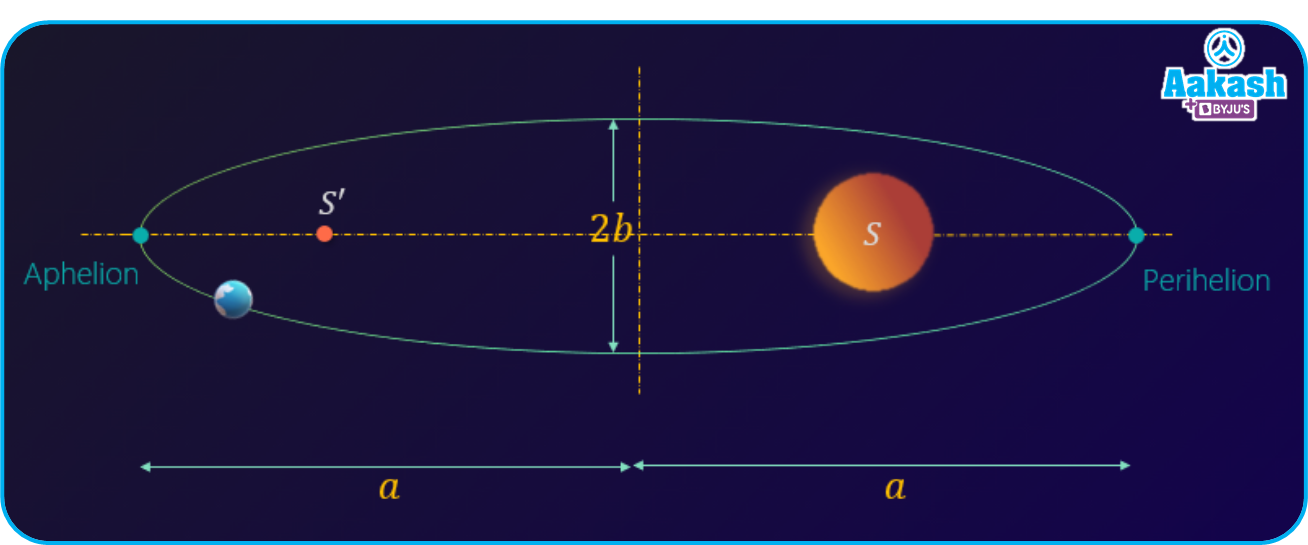
Explanation:
Take into account that a planet is rotating counterclockwise around the sun and that its velocities at points 1, 2, and 3 are, respectively, v1, v2, and v3, as shown in the figure. Let the length of the major axis is 2a and the length of the minor axis is 2b. Let the two foci of the elliptical path are S and S'. The Sun is kept at the foci S as shown in the figure below.
Now the velocity vectors v1, v2, and v3 can be resolved into two components that are mutually perpendicular. A component that is along the line connecting the sun and the planet is responsible for the separation between The Sun and the planet at a point. This component will become zero at the aphelion and the perihelion.
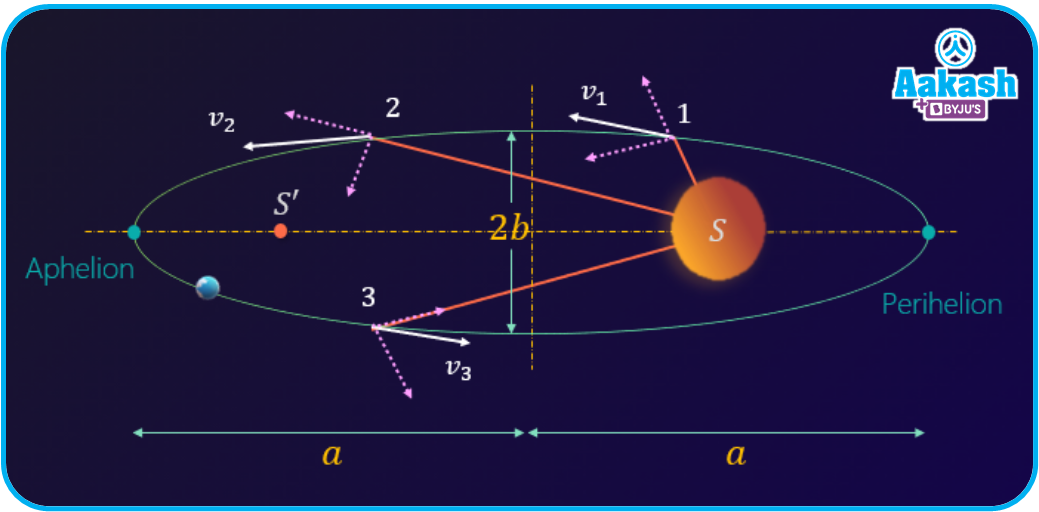
If the radial distance between the sun and the planet is r. Then for the aphelion and the perihelion, we can write that,
Therefore at the aphelion and the perihelion, the velocity of the planet will be the vertical component of the velocity.
Kepler’s second law (Law of equal areas)
Kepler’s second law basically tells us that the speed of the planet that revolves around the Sun is not constant. It states that
“The Areal velocity of the planet revolving around the Sun in the elliptical orbit is constant.”
It means that the area covered by the planet while revolving around the Sun will be constant for the same interval of time.
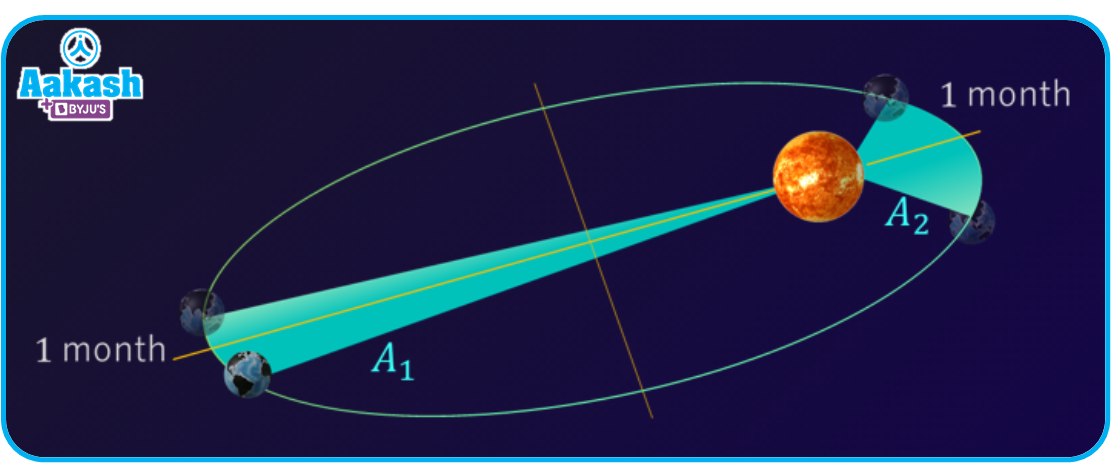
As seen from the above diagram,
Or,
Therefore, in order to have a constant aerial velocity, the speed must be changed.
Proof: Consider a planet revolving around the Sun in its elliptical orbit and moving from point P to P'. Let the Sun is placed on one of the foci of the elliptical orbit S and the area covered during this motion is dA. d is the angle covered to move from point P to P'
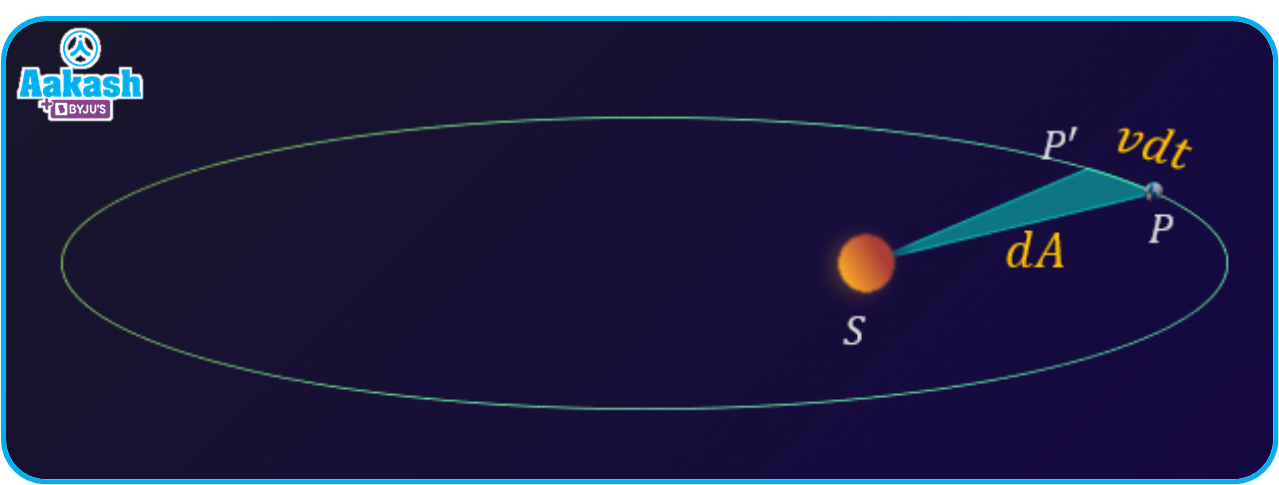
If the radius vector at point P is r and the velocity vector at point P is , then the distance covered by the planet from point P to P' in the dt time interval will be vdt.
Now focusing on the area dA then the velocity and radius vector is shown in the figure below,
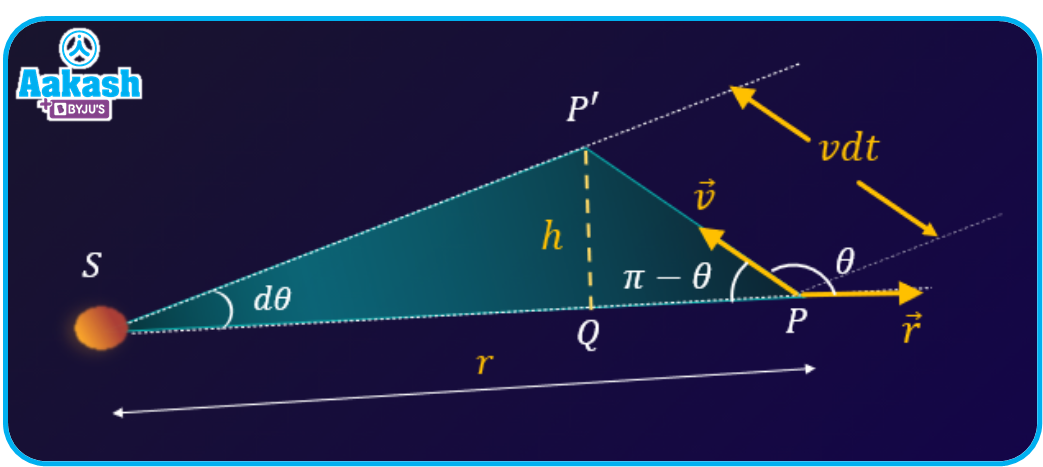
As seen from the △QPP,
Now from the equation (i), the area covered by the triangle △SPP' will be,
Now substituting the value of h from equation (ii),
Since the angular momentum of any object moving in a curved path is,
Where, the linear momentum of the object
By putting into the equation (iii),
Since the gravitational force on the planet due to the Sun will be along the radius vector (anti-parallel), therefore the angle between and will be 180°.
The torque acting on the planet will be,
Hence the torque acting on the planet during the elliptical motion is zero, therefore from the principle of conservation of angular momentum, the angular momentum will be constant.
Now in the equation (iv), the mass of the planet is constant and the angular momentum is also constant. Therefore,
Hence it is proved that the areal velocity of a planet revolving around the sun is constant, keeping in mind that the linear momentum of the planet will keep on changing (because the speed is changing) but the angular momentum will be constant.
Kepler’s third law (Harmonic law or law of time periods)
This law shows the relation between the time period and the mean distance from the sun. Since the planets are revolving around the Sun in an elliptical orbit, therefore, the distance between the Sun and the planet will not be the same all the time.
In this situation, Kepler’s third law stated,
“The square of the time period of a planet is directly proportional to the cube of the semi-major axis of the elliptical orbit of the planet”
Where T= Time period of the planet
a= Semi-major axis of the elliptical orbit of the planet
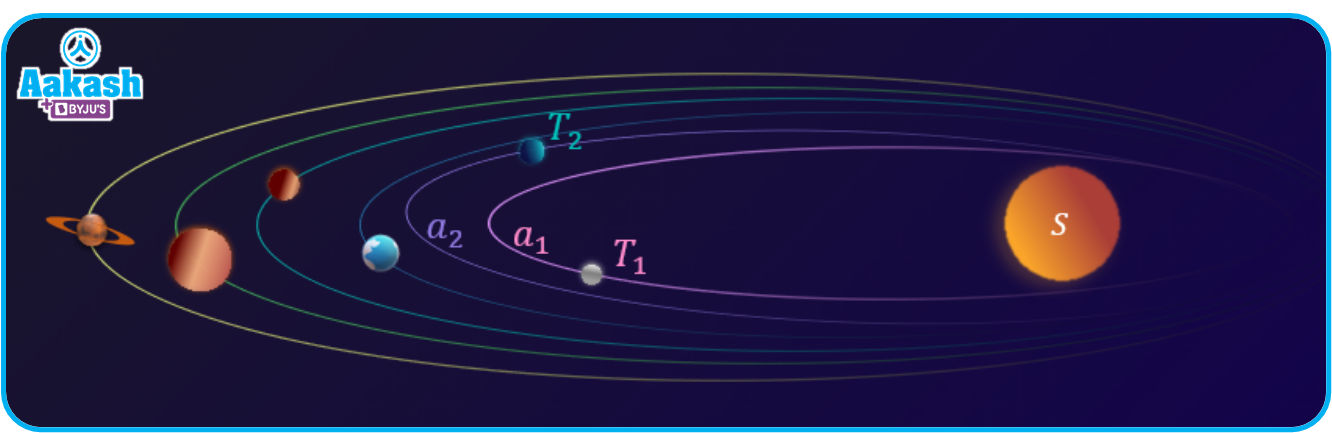
If the time period and semi-major axis of one planet are T1 and a1. And the time period and semi-major axis of another planet is T2 and a2, then as per Kepler’s third law,
Distance of aphelion and perihelion from the Sun
From Kepler's first law, we know the path followed by any planet around the Sun is elliptical, which is also known as the elliptical orbit of that planet. The Sun will be placed at one of the foci of the elliptical orbit. Let the Sun is placed at the foci S and the distance of perihelion and aphelion from the Sun is r1 and r2 as shown in the figure,
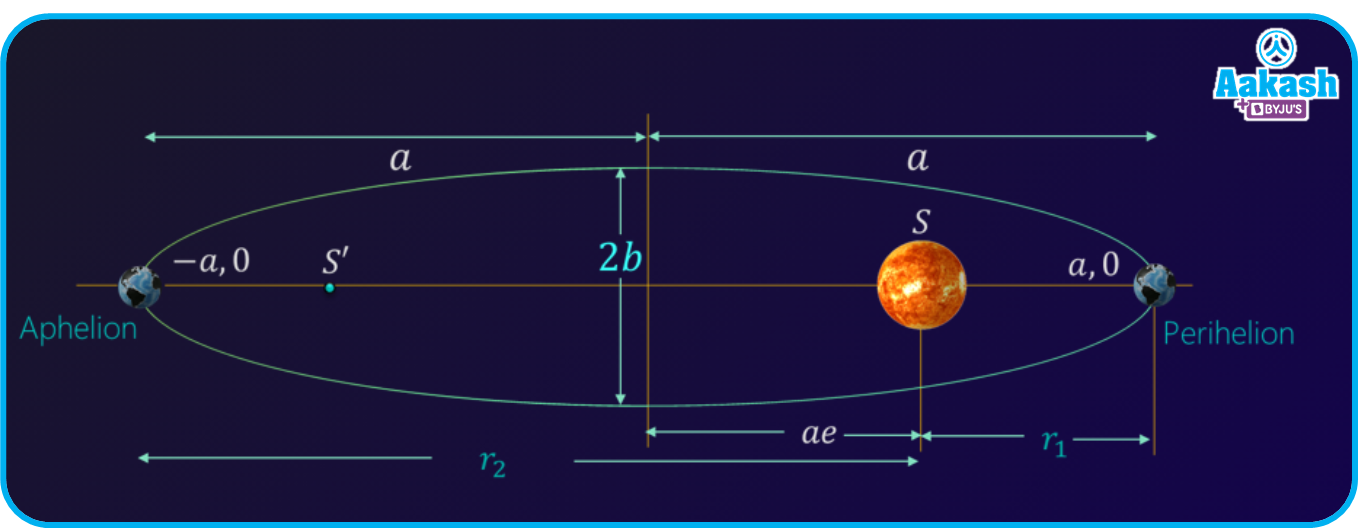
As seen from the above figure, the distance between the Sun and perihelion is,
Similarly, the distance between the Sun and aphelion is,
Practice problems
Q1. Determine the speed of a planet at the aphelion and perihelion of its elliptical orbit while revolving around the Sun.
Answer. Let the distance between the sun and perihelion is r1 and the distance between The sun and aphelion is r2. Let the speeds at the perihelion and aphelion are v1 and v2 respectively.
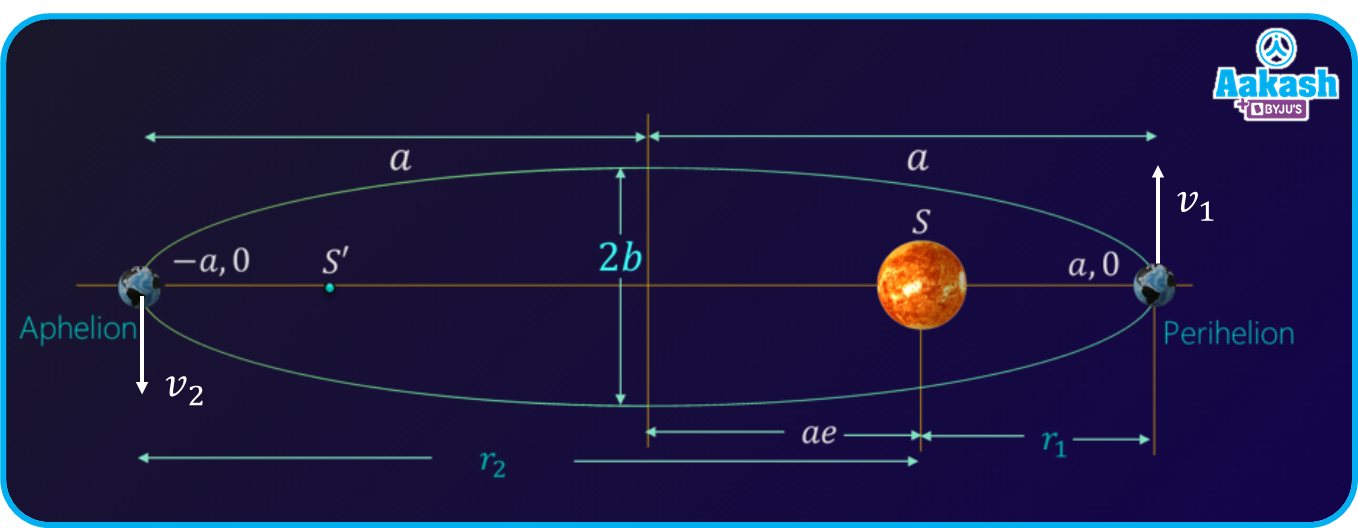
Then r1 and r2 will be written as (from the figure)
Now from Kepler’s second law, the angular momentum is constant during the motion of the planet, then the angular momentum at the perihelion and aphelion will be equal.
Now as seen from the given figure, the angle between r1 and v1, and the between r2 and v2 is 90°. Therefore from equation (i),
Now substituting the values of r1 and r2 in the equation (ii),
Now we know that the gravitational force is a conservative force and we can apply the principle of conservation of energy at perihelion and aphelion.
Therefore,
Total energy at perihelion of the orbit = Total energy at aphelion of the orbit
Where U= Gravitational potential energy
And K= Kinetic energy of the planet
Let the mass of the Sun is Ms and the mass of the planet is m, then
Substituting the value of v2 (velocity at aphelion) from equation (ii),
After solving the above equation we will get the speed of the planet at perihelion,
Now if we will put v1 in the equation (iii), we will get the speed of the planet at aphelion,
Q2. A planet is revolving around the Sun (mass M) in a circular orbit at a distance r from the centre of the Sun. Find the time period of the planet to complete one revolution and check if Kepler’s law is valid or not.
Answer. Let the mass of the planet is m and it is moving in orbit with a velocity v.
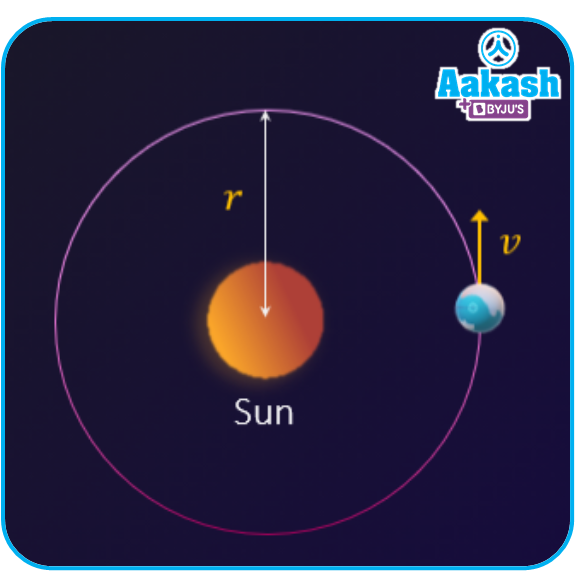
Then in order to revolve the planet around the Sun,
FG=FC
Where FG is the gravitational force and FC is the centripetal force.
Now the time taken by the planet to complete one revolution can be written as,
The above expression is the time period of the given planet to complete one revolution around the Sun in its circular orbit.
Now squaring equation (ii) on both sides,
In the above expression, we know G is the gravitational constant which is fixed. Also the mass of the Sun is constant, therefore,
Hence, Kepler’s third law or law of harmonics is valid for the planet revolving around the Sun in a circular orbit.
Q3. A satellite is orbiting around the Earth in an elliptical orbit. The maximum distance between the satellite and the Earth is 4R and the minimum distance between the satellite and the Earth is 2R. R is the radius of the Earth. If the mass of the Earth is M then find the maximum and minimum speeds of the satellite.
Answer. Given, the maximum distance covered by the satellite (aphelion), rA=4R
Minimum distance covered by the satellite (perihelion), rP=2R
Mass of the Earth =M
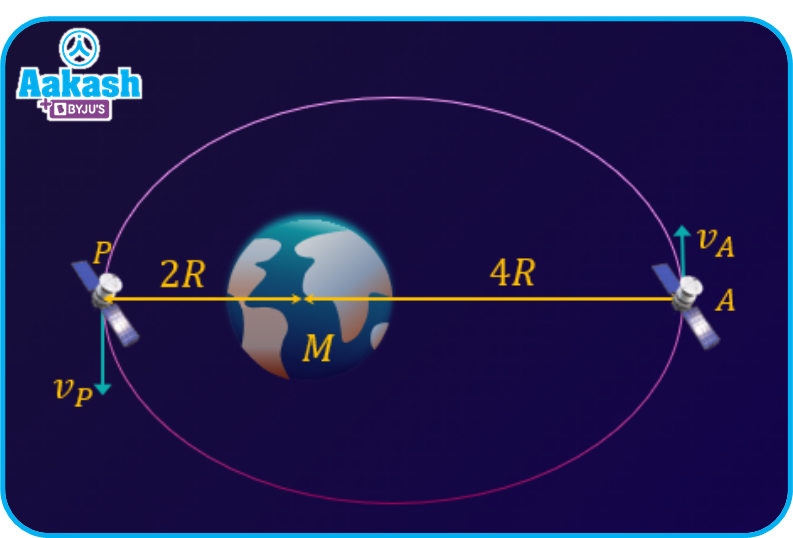
In the above figure, points A and P represent aphelion and perihelion. Let the velocity of the satellite at point A is vA and the velocity of the satellite at point P is vP.
Now we know that the angular momentum of the planet or satellite is constant while revolving around the Sun or around another planet.
Therefore at points A and P,
principle of conservation of energy at points A and P,
Substituting the value of vP (velocity at perihelion) from equation (i),
Substituting the value of vA (velocity at aphelion) in equation (i),
Therefore the maximum and minimum velocity of the satellite will be,
and
Q4. A planet takes 460 days to complete one revolution around the Sun. If the distance between the Sun and the planet becomes half of its current value then the number of days to complete one revolution would be,
(a) 90 (b) 576 (c) 160 (d) 330
Answer. From Kepler’s third law, we know that
T2 ∝ r3
Where r is the separation between the Sun and the planet.
Now it is given that, and T1=460 days
T2=162.63 days
In the given option 160 days is the closest number, then the option (c) is correct.
FAQs
Q1. What is areal velocity?
Answer. Aerial velocity is the area swept by a planet in unit time while revolving around the sun. In other words, it is the rate at which the planet sweeps the area when it travels in its elliptical orbit.
Q2. What is the corollary of Kepler’s second law?
Answer. The corollary of Kepler’s second law is that, when a planet revolves around the sun due to gravitational attraction, the angular momentum of the planet remains constant but the linear momentum is not constant as the speed keeps changing.
Q3. What are aphelion and perihelion?
Answer. When a planet revolves around the Sun in our solar system in an elliptical orbit, the farthest point of the orbit is known as the aphelion of the orbit and the closest point of the orbit is referred to as the perihelion of the orbit.
Q4. How does a planet cover the same area in an equal time when it revolves around the Sun?
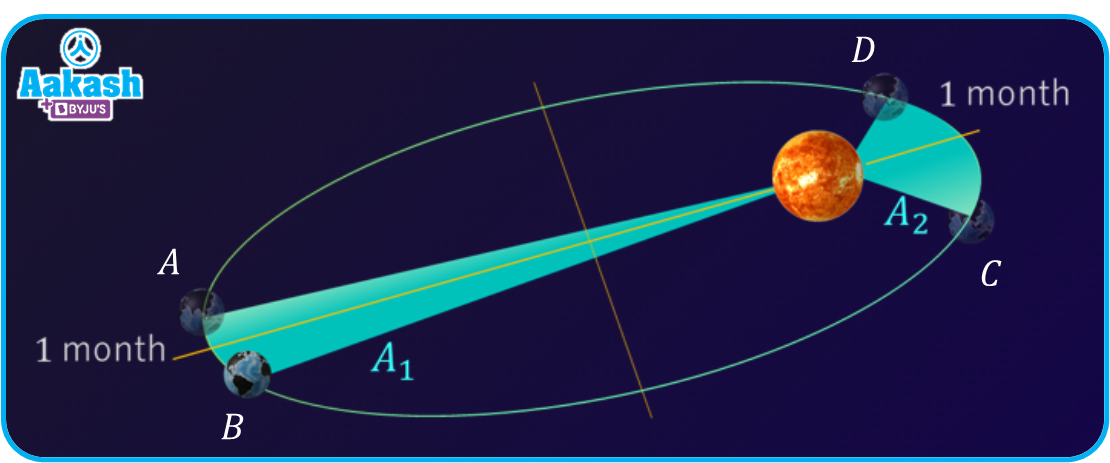
Answer. From Kepler’s second law, we know that the area swept by the planet while revolving around the Sun is equal in equal intervals of time. Let’s consider a planet that revolves around the Sun. Then the planet sweeps an area A1 in 1 month when it moves from point A to B and sweeps an area A2 in 1 month when it moves from the point C to D. Let’s say the planet travels with a velocity v1 when it moves from point A to B and it travels with a velocity v2 when it moves from point C to D. From the figure, we can see that less distance is travelled by the planet from the point A to B as compared to the distance travelled from C to D. Now in order to keep the aerial velocity constant (as per Kepler’s second law), the planet has to travel faster from point C to D. Therefore v2 will be greater than v1.

 Call Now
 Let's Chat
 Share
Share