-
Call Now
1800-102-2727


Hydraulic Machines - Lift, Brakes, Practice Problems, FAQs

Have you ever thought how garage mechanics manage to transport unfathomably big cars or bicycles? They use hydraulic lifters, which can move objects that are too heavy for us to lift with just our hands but weigh several thousand kg. A piston applies pressure to the fluid, which is then evenly delivered. The way hydraulic brakes work is as follows. Have you ever seen a hydraulic press being used to bend or pierce metal objects at a steel mill? To evenly convey pressure to a die that compresses the metal that comes into contact, it is constructed of a piston and an oil-like fluid. Let’s learn more about this concept here!
Table of Contents
- Pascal’s Law
- Hydraulic Machines
- Hydraulic Lift
- Hydraulic Brakes
- Practice Problems
- FAQs
Pascal’s Law
Pascal’s law states that the pressure applied to an incompressible, enclosed fluid is transmitted undiminished to every portion of the fluid, as well as to the walls of the container. Take the following example of a liquid filled in a container up to a height h upon which a lid of weight W and area of cross section A. A small hole is made at the top of the container. The liquid has a density . Now the liquid is acted upon by three different pressures
- Atmospheric pressure P0. One can imagine this to be the pressure exerted by the gas molecules of the atmosphere. The container experiences atmospheric pressure due to the hole on the top.
- Pressure exerted by the lid
- Pressure exerted by the liquid column ,gh. Here acceleration due to gravity is denoted by g.
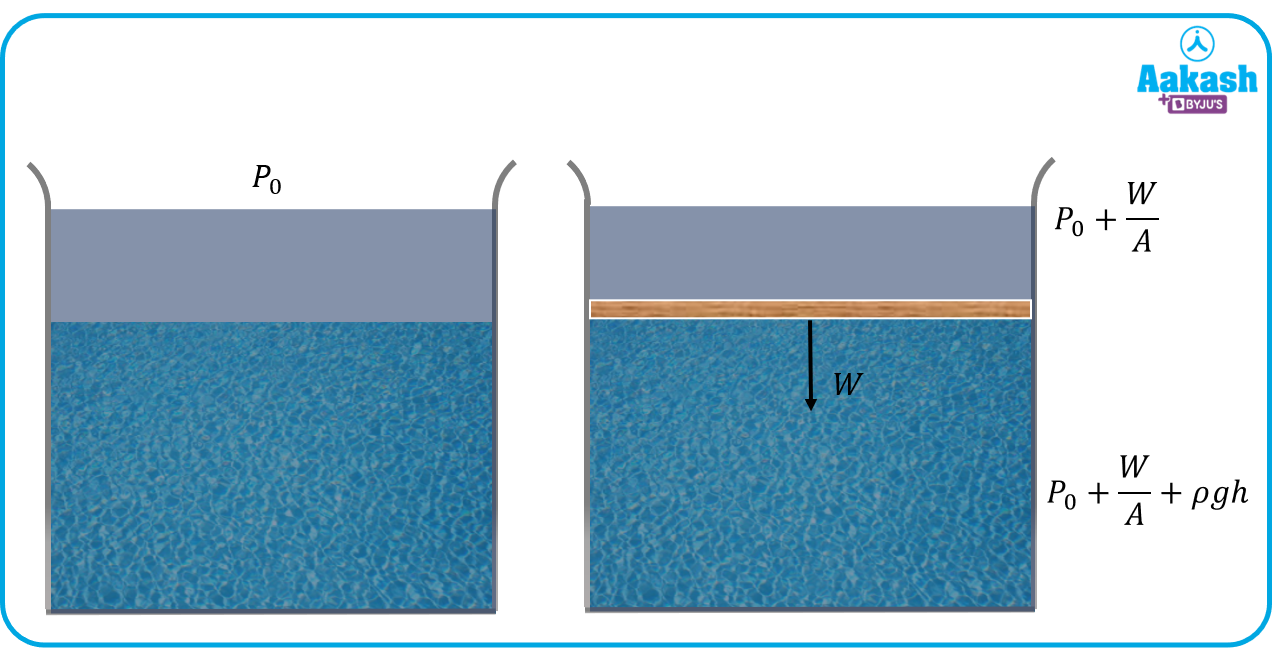
Fig shows three pressures experienced by the liquid
Now according to Pascal’s law, the pressure exerted at the bottom of the container can be written as
Hydraulic Machines
Tools and machinery classified as hydraulic employ fluid power to operate. Through tiny tubes and hoses, a significant quantity of fluid is transported in these machines. Here, fluid is moved throughout the machine to hydraulic cylinders and motors, where it is pressurised and then moved through tubes and control valves to the end effectors.
Hydraulic Lift
The hydraulic lift works on the principle of Pascal’s law. It consists of two pistons with different areas of cross sections A1 and A2. The heavy object to be lifted is placed on the piston with bigger cross sectional area A2. A force F1 is exerted on the piston having area A1. Now,the pressure exerted on the first piston is ratio of the force to its cross sectional area .i.e.,
This pressure is equally transmitted in all directions towards the second piston where the car to be lifted is placed on. If P2 is the pressure on the second piston, then
By pascal’s law,
What does this mean? The hydraulic lift is a force multiplier. Whatever force we apply at the piston of the shorter cross section area gets multiplied; this enables us to lift heavy objects like trucks placed on the bigger piston.
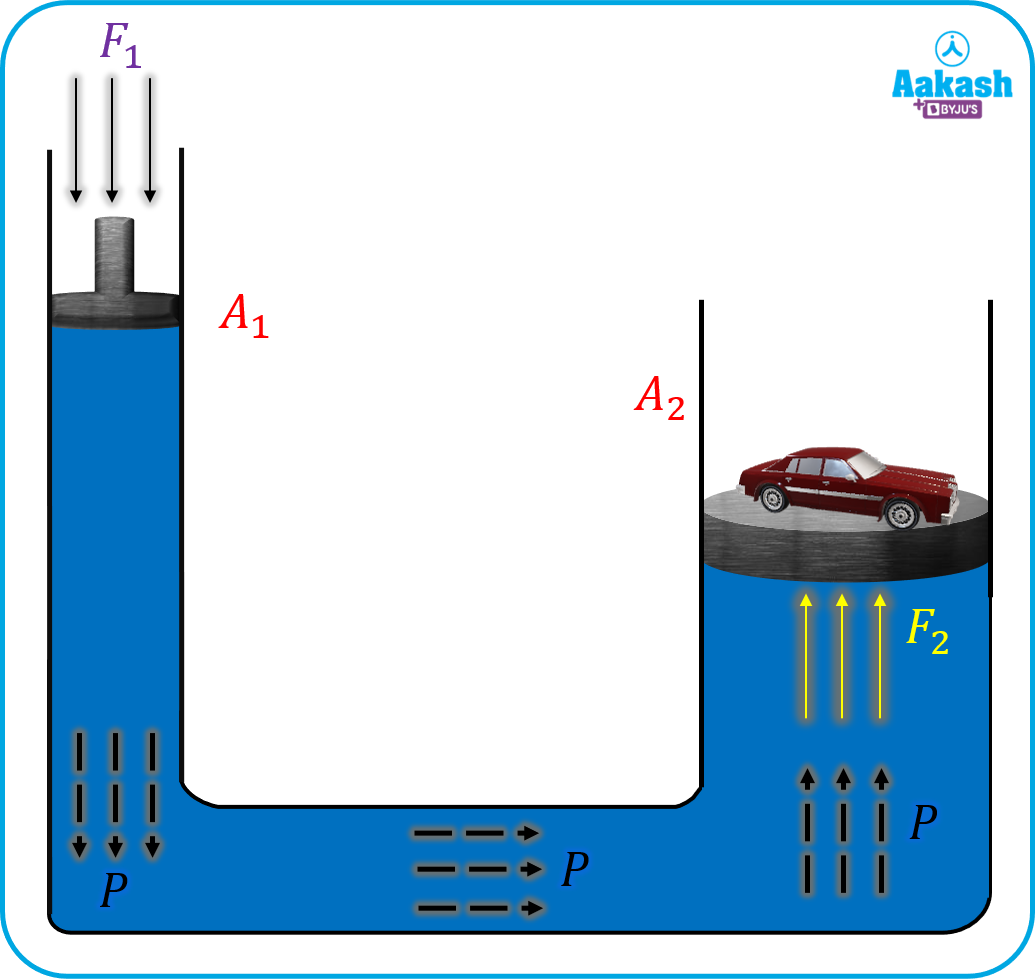
Fig shows hydraulic lift having two pistons of areas of cross section A1 and A2 (A2 >>A1)
Hydraulic Brakes
Hydraulic brakes also work on the principle of Pascal’s law. It consists of a master cylinder fitted with a pipeline that contains the fluid. When the driver manning the vehicle depresses the pedal, the oil flows into the second cylinder which presses the brake pads (also known as brake callipers) against the wheel.
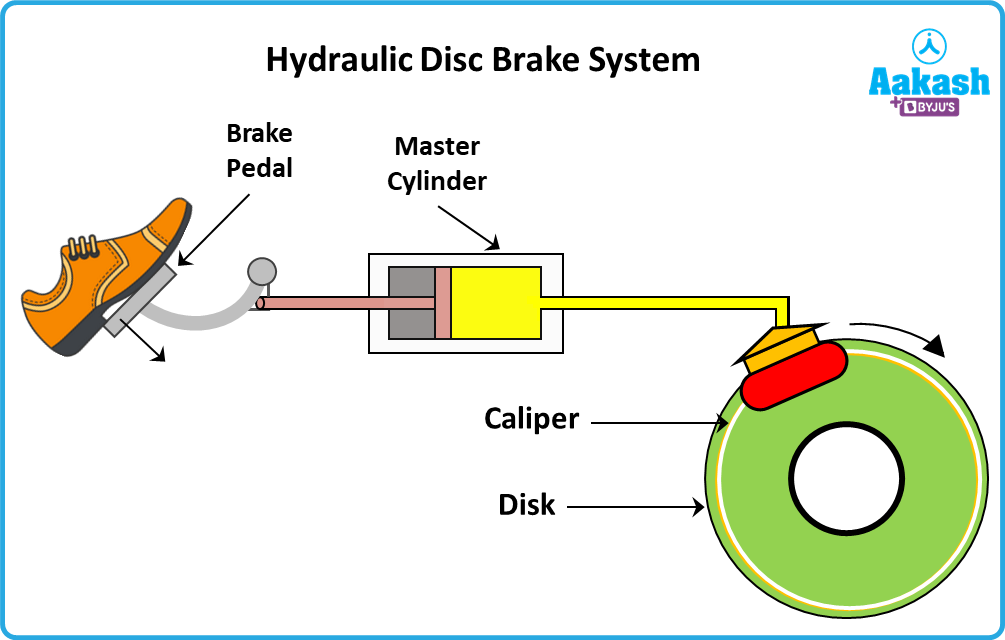
Fig shows working of a hydraulic brake system. The master cylinder transmits pressure evenly so that it reaches the calliper
Practice Problems
Q. A hydraulic machine has two pistons with diameters of 4 cm and 40 cm. On the smaller piston, a 100 kg wt weight is placed. What is the force applied to the larger piston?
A. Area of the smaller piston
Area of the larger piston
According to Pascal’s law;

Q. Two pistons of cross sectional areas 5 cm2 and 2 cm2 are fitted to both ends of a hydraulic lift. When a force of 20 N is applied on the smaller piston, how much force is experienced by the larger piston?
A. Here A2=5 cm2
Q. Water is filled in airtight container up to a height of 10 cm. What is the force experienced by the base of the container? (Take g=10 ms-2)
A. As we know that, total pressure = hg
Total pressure
Q. A cylindrical container is filled with water up to height of 10 m upon which a lid of mass 750 Kg is kept. Find the force on the bottom surface if area of cross section is 2 m2?
A.
FAQs
Q. Why is Pascal's law not applicable for compressible fluid?
A. Density of compressible fluid varies because of applied pressure, so Pascal’s law is not valid for compressible fluid.
Q. Is Pascal’s law valid for accelerated fluid?
A. Yes, Pascal’s law is applicable for accelerated fluid.
Q. A U-tube manometer has a liquid filled with density up to a height h. What is the pressure exerted by the liquid on the bottom of the manometer?
A. The pressure exerted by the liquid on the bottom of the manometer is P=hg.
Q. Will pressure at the same level always be the same?
A. Not always, pressure at the same level will be the same only if fluid is incompressible and static.

 Call Now
 Let's Chat
 Share
Share