-
Call Now
1800-102-2727


Electric Field at a point due to a dipole on the axis, equatorial line, at any general point, practice problems, FAQs

Dipole is an interesting phenomenon because of an electrically un-symmetric nature of objects or molecules when they possess the coupled system of negative and positive ends, separated by some distance. As there are charges in a dipole system it ought to make some electric field around. Have you ever thought about the variation of electric field around it? Ever thought how this electric field will change with the distance and with the orientation of the dipole?
Dipole creates an uneven electrical field around it. This electric field because of the dipole varies with the position under consideration. If the dipole is much smaller, this variation in electric field becomes a function of the distance of the point from the centre of the dipole and the orientation of the dipole with respect to the position of the point.
Table of content
- Electric Field at a point due to a dipole on the axis of the dipole
- Electric field at a point due to a dipole on the equatorial line
- Electric Field due to a dipole at any general point x >> a
- Practice Problems
- FAQs
Electric Field at a point due to a dipole on the axis of the dipole
Let us consider an electric dipole whose midpoint is at the origin. The length of the dipole is 2a. The magnitude of the charges is q. So, the magnitude of the dipole moment is, p = 2qa
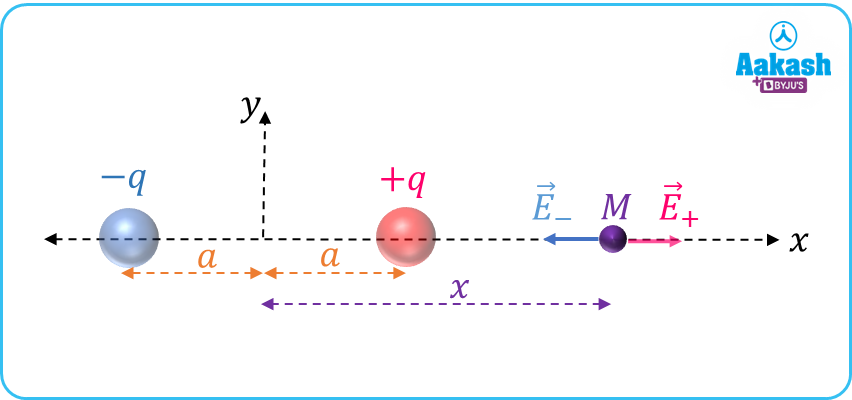
The direction of the dipole moment vector is always along the line joining the end from negative charge towards the end with positive charge.
Let’s find the electric field at a point, M which is x distance away from the origin.
The electric field at M due to +q charge is,
Electric field at point M due to -q charge is,
The net field is,
Electric field at a point due to a dipole on the equatorial line
Let’s consider an electric dipole whose midpoint is at the origin. The length of the dipole is 2a. The magnitude of the charges at the ends is q. So, the magnitude of the dipole moment is, p = 2qa
The direction of the dipole moment vector is along the axis of the dipole from negative charge to positive charge. Here it is along the positive x-axis.
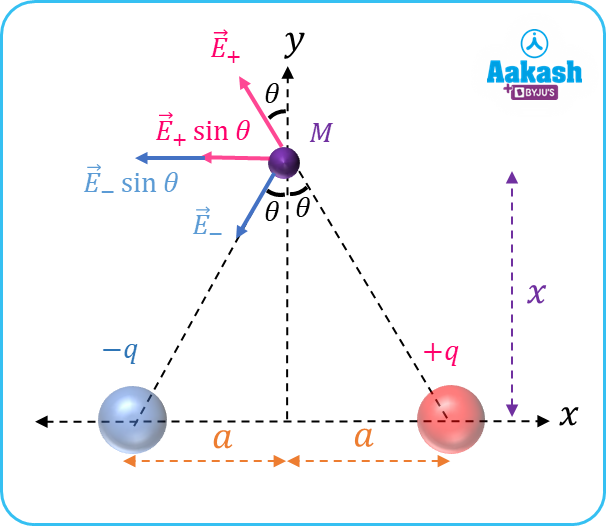
We are to find the electric field at a point on the equatorial line. Let’s take the point as M which is at a distance x away from the midpoint of the dipole i.e. the origin.
The magnitude of the electric field at the point, M due to the charge -q is,
The magnitude of the electric field at the point, M due to the charge +q is,
So,
The vertical components of E+ and E- cancel each other and the horizontal components add up.
So,
Electric Field due to a dipole at any general point x >> a
Let’s find the electric field at point M which makes an angle with the dipole of dipole moment p. The point is at a distance of x from the centre of the dipole. We can resolve the dipole moment vector into two components as shown. The point under consideration M becomes the point in the axial position for the dipole moment pcos and the point in the equatorial position for the dipole moment psin .
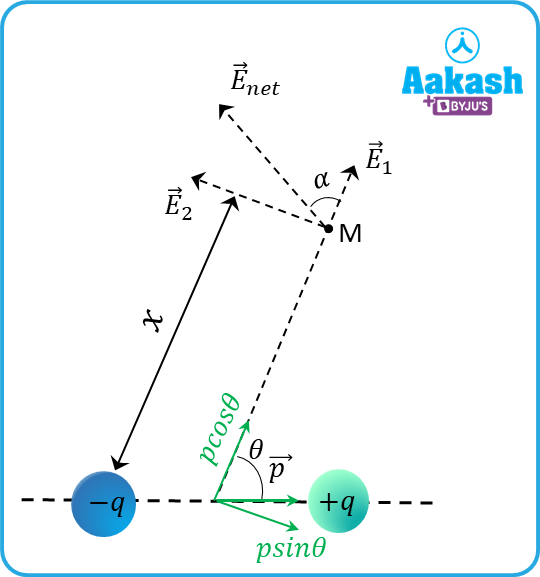
We are to calculate the field at a point which is at a distance x from the dipole, where a << x (field at a far point)
The magnitude of the electric field at point M due to pcos is,
[∵ the point M is at axial position w.r.t the dipole moment pcos ]
The magnitude of the electric field at point M due to psin is,
So,
Here
So, the net electric field Enet makes an angle (θ + α) with the dipole moment vector p.
Practice Problems
Q. Prove that the electric field due to a dipole at a far-away point at its axial position is inversely proportional to the cube of the distance of that point from the axis of the dipole.
A. The electric field at a point on the axial position of an electrical dipole is given by,
Where p is the dipole moment, x is the distance of the point from the centre of the dipole, a is the half length of the electrical dipole.
For a point far away from the centre of the dipole, xa,
So,
Hence it is proved that the electric field due to a dipole at a long distance away, along the axis is
Q. Prove that the electric field due to a dipole at a far-away point on its equatorial line is inversely proportional to the cube of the distance of that point from the axis of the dipole.
A. The net electric field at a distance x from the centre of the dipole, on the equatorial line is given as
Where p is the dipole moment, x is the distance of the point from the centre of the dipole, a is the half length of the electrical dipole.
For a point far away from the centre of the dipole, xa,
Now,
So,
Hence it is proved that the electric field at a point due to a dipole at a long distance away, along the equatorial plane is
Q. There is a dipole system with a -5 μC charge at the origin and another charge 5 μC at (1 m , 1 m). Then calculate the magnitude and direction of electric field at (5 m, 5 m).
A.
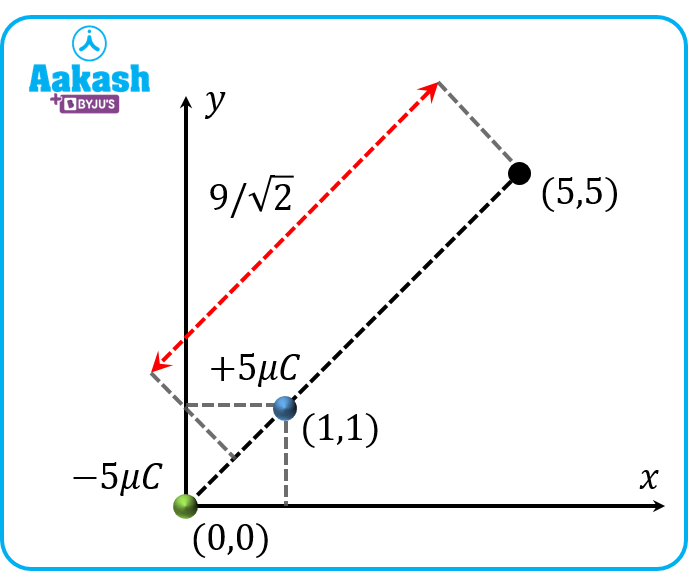
The dipole moment for the system can be derived as,
From the understanding of geometry we can understand that we are to find the electric field at a point which lies on the axis of the dipole.
The point under consideration is at a distance of 52-22=92 m from the midpoint of the dipole.
The net field is,
Q. There is a dipole system with a -5 μC charge at the origin and another charge 5 μC at (1m , 1m). Then calculate the magnitude and direction of electric field at a point which is on the equatorial plane of the dipole at a distance of 312 m .
A.

The dipole moment for the system can be derived as,
From the understanding of geometry, we can understand that we are to find the electric field at a point which lies on the equatorial axis of the dipole.
FAQs
Q. How does an atom or a molecule behave as a magnetic dipole?
A. The electrons in an atom revolve around the nucleus in closed orbits. These orbits are like current loops because the electrons are negatively charged particles. The direction of the current in the loop is in the opposite direction of the revolving electrons. For example, when electrons revolve in clockwise direction, the current flows in the counterclockwise direction. These movements of electrons in the orbits create a field which is the same as south pole and north pole as in the atom behaving as magnetic dipole.
Q. What is the direction of the electric field along the axis of an electric dipole?
A. Along the axis of an electric dipole, the direction of the net electric field is always parallel to the direction of the electric dipole moment.
An electrical dipole along x axis with +q and -q charges, with the -q is at a distance 2a from the +q, the dipole moment is given by 2aq i
For such type of system, the net electric field at a distance x from the centre of the dipole is given as
So, the direction of Enet is proportional to (p x) which implies it is parallel to p in case the x is positive and anti-parallel when the value of x is negative.
Q. What is the direction of the electric field at a point on the equatorial line of an electric dipole?
A. Along the equatorial line of an electric dipole, the direction of the net electric field is always anti-parallel to the direction of the electric dipole moment.
An electrical dipole along x axis with +q and -q charges with the -q is at a distance -2a from the +q, the dipole moment is given by 2aq i
The net electric field at a distance x from the centre of the dipole, on the equatorial line is given as
So, the direction of Enet is proportional to -p which implies it is anti-parallel to p always.
The negative sign indicates that the electric field vector is in the opposite direction to the dipole moment vector.
Q. Do water molecules have a dipole? Explain why or why not in brief?
A. A water molecule is a dipole. It is because it is not symmetrical. There are more electrons on the oxygen side than on the hydrogen side due to the electronegativity of oxygen.

 Call Now
 Let's Chat
 Share
Share