-
Call Now
1800-102-2727


Conservative and Non conservative forces - definition, practice problems, FAQs

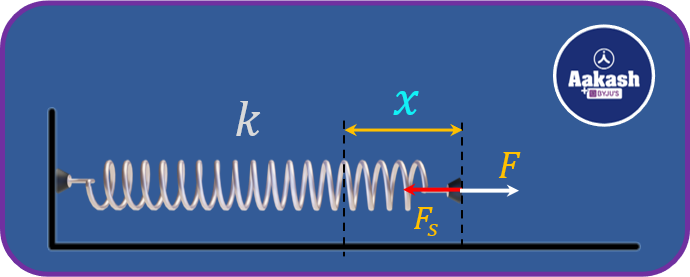
We say that work is done whenever a force acting on a body displaces it from one place to another. Imagine you are playing with a spring, and you stretch the spring by a distance x.The work done by the spring depends only upon the initial and final orientation of the spring, and not upon the path taken by the spring.
Let us try to understand the above statement with an example: imagine a block of mass m raised through a height h. It moves through a small distance dr as shown in the figure–which is resolved into dr cos along the horizontal and dr sin along the vertical.

Now the dot product of mg and drcos would be zero and that of mg and dr sin would be mgdr sin (g-acceleration due to gravity). Now the net work done is the integration mgdr sin=mgh. Here we can see that work done is not dependent on path - it only depends on height.
But do you think it is the same when the same block is taken on a rough surface where frictional force fr is acting? The answer is no. Depending upon the path taken, work done varies since force fr and displacement dr are antiparallel i.e and therefore W here is path dependent.
Table of contents
- Work done by conservative forces
- What are conservative forces?
- What are non conservative forces?
- Work done by non conservative forces
- Practice problems
- FAQs
Work done by conservative forces
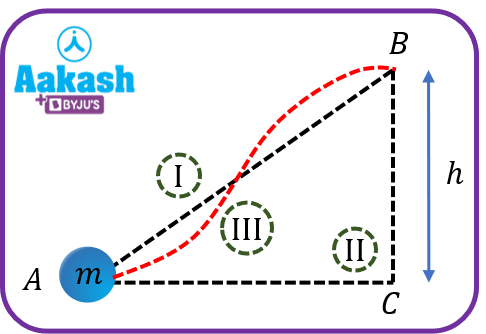
In the following diagram, a body of mass m is moved from A to B along three different paths I,II,III. Let WI, WII, WIII denote work done along the three paths. Then
where -mgh denotes the work done by gravity.
Work done by conservative forces is equal to -ve of the potential energy change.
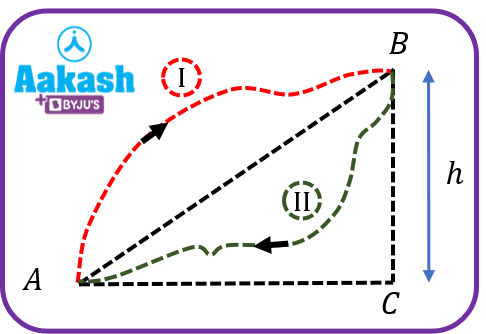
The sum of work done by conservative forces along a closed path is zero. Let (Wg)I denote the work done along path I and (Wg)II denote work done along path II.
Then,
What are conservative forces?
- The work done by a conservative force only depends on the initial and final positions of the body upon which the force acts, and not upon the path followed by the body.
- Gravitational force, spring force, electric field force are conservative forces.
- Work done by conservative forces can be called state functions.
What are non conservative forces?
- If the work done by force depends upon the path taken by the body, then the forces acting are said to be non conservative.
- Such forces are also called dissipative forces, because they dissipate heat.
- Non-conservative forces are path functions.
Work done by non conservative forces
Let KE indicate change in Kinetic energy of a body and PE indicate the potential energy change in the body when work is done on it. Then net work done by all non-conservative forces acting on the body is
If there are no non-conservative forces or their work done is 0, then
Practice problems
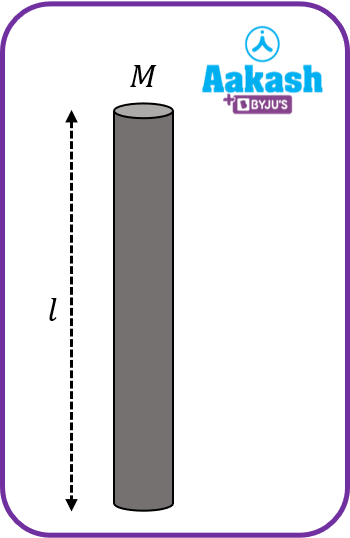
1) Calculate the potential energy of a uniform vertical rod of mass M and length l.
Solution)
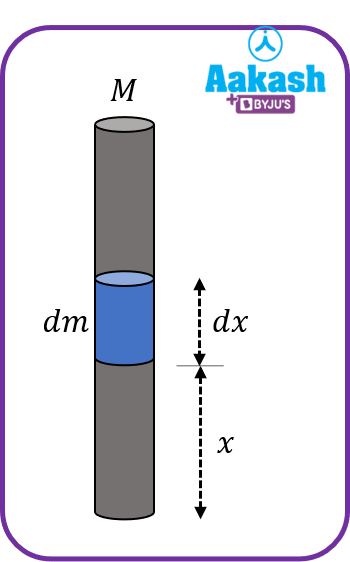
Given, mass of the rod=M
Length of the rod=l
Let dm be an infinitesimally small element dx located at a distance x. Then,
Mass of the element,
Let dU be the potential energy of the rod element, then
2) A spring with a stiffness constant of 800 N m-1 has a natural length of 5 cm. The work done in stretching it from 5 cm to15 cm is ?
(a)8 J (b) 16 J (c) 24 J (d) 18 J
Solution) a
Given,
Energy stored in a spring
12800(0.152-0.052)=8 J
3) A block of mass 0.2 kg is dropped from a height of 2 m on to a spring which compresses the spring by a distance of 50 cm before coming to momentary rest. The stiffness constant of the spring is(Take g=10 ms-2) ?
(a) 20 Nm-1 (b) 40 Nm-1 (c) 30 Nm-1 (d) 60 Nm-1
Solution) b
Given , m=0.2 kg ; d=0.5 m ; h=2 m
Solving, we get k=40 Nm-1
4) A spring of natural length L and force constant k, is first pulled to a length l. It is further stretched to obtain an extension l1. The work done during the second extension is?
(a)(b)(c) (d)
Solution) a
After the first part, energy stored,
After the second part;
Energy stored
FAQs
Q. Do non-conservative forces produce potential energy?
Ans) Non-conservative forces are dissipative in nature and therefore do not allow energy to store in the form of potential energy.
Q. What are central and non-central forces?
Ans) Central forces like gravitational, electrostatic or spring forces, depend purely on the distance between the line joining the center of two bodies. On the other hand, non central forces do not use the line joining as a guide to act along. Friction is an example for a non-central force.
Q. Do conservative forces abide by the law of conservation of energy?
Ans) Yes, the sum of the work done by all forces along a closed path, given the object is taken slowly, is zero in the case of conservative forces. This means that the total mechanical energy is conserved. On the other hand, in non conservative forces, there is always energy dissipation–meaning there is no mechanical energy conservation.
Q. Why is work done by conservative forces also called state function?
A. Work done by conservative forces is said to be state functions, since work done by them depends only upon the initial and final states of the object that is in question. The work done in pushing a box up a smooth inclined plane depends only on the height of the incline - not on the path taken by the box. So, work done by gravitational force here is a state function.

 Call Now
 Let's Chat
 Share
Share