-
Call Now
1800-102-2727


Head on collision - Elastic and inelastic collision, line of impact, coefficient of restitution, practice problems, FAQs

Oblique collision - Elastic and inelastic collision, line of impact, coefficient of restitution, practice problems, FAQs
When you strike a billiard ball with a stick and allow it to impinge on another billiard ball such that there is some non zero angle between the velocities of the two balls, such a collision is called two dimensional oblique collision. The reason being that their velocities are directed only along two directions - x and y. Similarly, in a few nuclear reactions, like fission of a uranium nucleus to form an alpha particle and thorium nucleus, we need two different velocity components to completely understand in which direction the particles are flying off. Such a type of collision in which the velocities are at an angle to the original direction is called an oblique collision.
Table of contents:
- Definition of collision
- Line of impact
- Types of collision in one dimension
- Oblique collision
- Practice problems
- FAQs
Definition of collision?
Collision is said to have occurred when two objects coming in contact for a short period of time, exert forces on each other. There may or may not be energy losses in collision.
Note:
- Momentum before and after collision are conserved when there are no external forces acting.
Line of impact(LOI)
The common line joining the center of the two bodies is called Line of Impact.
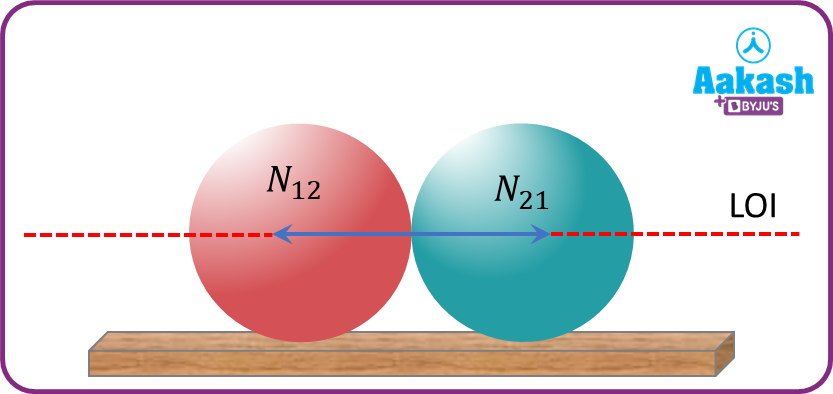
Types of collision in one dimension:
Based on energy conservation, collision is divided into two types - elastic and inelastic collision
1)Elastic collision:
In this type of collision, both momentum and kinetic energy is conserved. Let us consider two bodies of masses m1 and m2 moving with velocities u1 and u2, in the same direction(u1>u2). After collision, their velocities are v1 and v2.
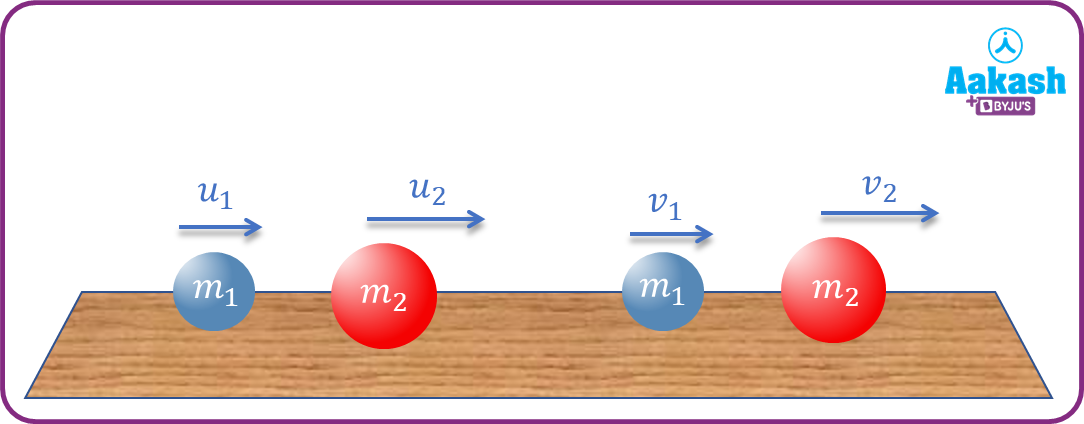
Conserving momentum,
m1 u1+ m2u2 = m1v1+m2v2
Conserving Kinetic energy
The ratio of relative velocity after collision to the relative velocity before collision is called the coefficient of restitution(e)
e=0 for a perfectly inelastic collision
e=1 for a perfectly elastic collision
0<e<1 for an inelastic collision
2)Inelastic collision: In an inelastic collision, only momentum is conserved, but due to dissipative forces during impact, the total kinetic energy is not conserved. Let us take two blocks of masses m1 and m2 initially moving with velocities u1 and u2. After colliding, they move together with common velocity us.
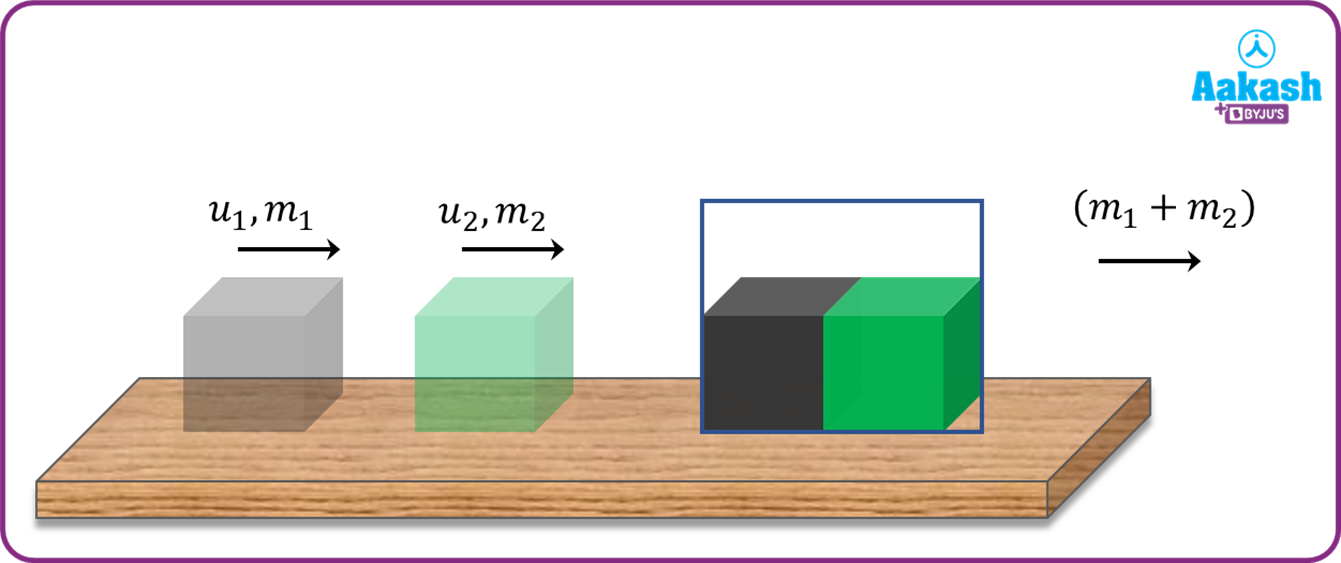
Applying conservation of momentum, we get
Oblique collision
In an oblique collision, a pair of equal and opposite impulses act along the common normal direction. The net momentum of the particles is conserved along each direction. Let us consider two particles of masses m1 and m2, moving with velocities u1 and u2. u1 makes an angle along the LOI and makes an angle of . After collision, their velocities become v1 and v2.
v1 makes an angle with the LOI and v2 makes an angle .
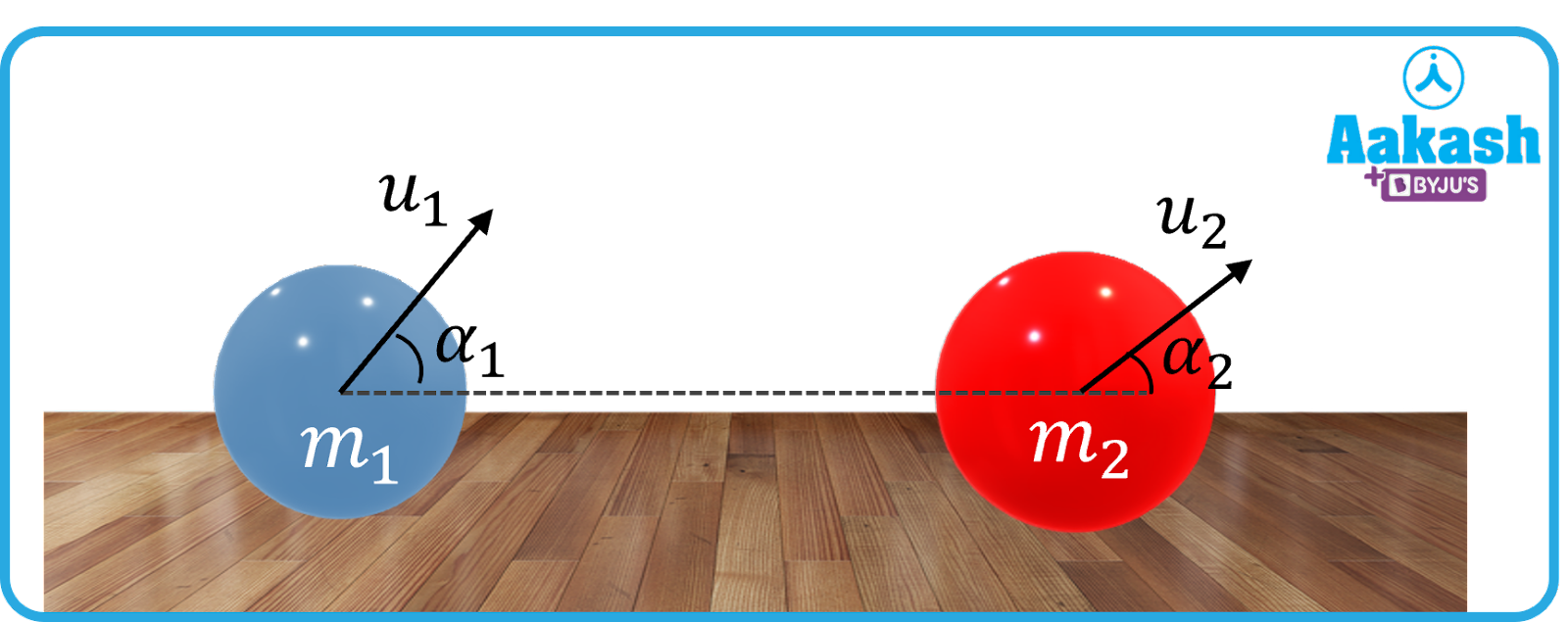
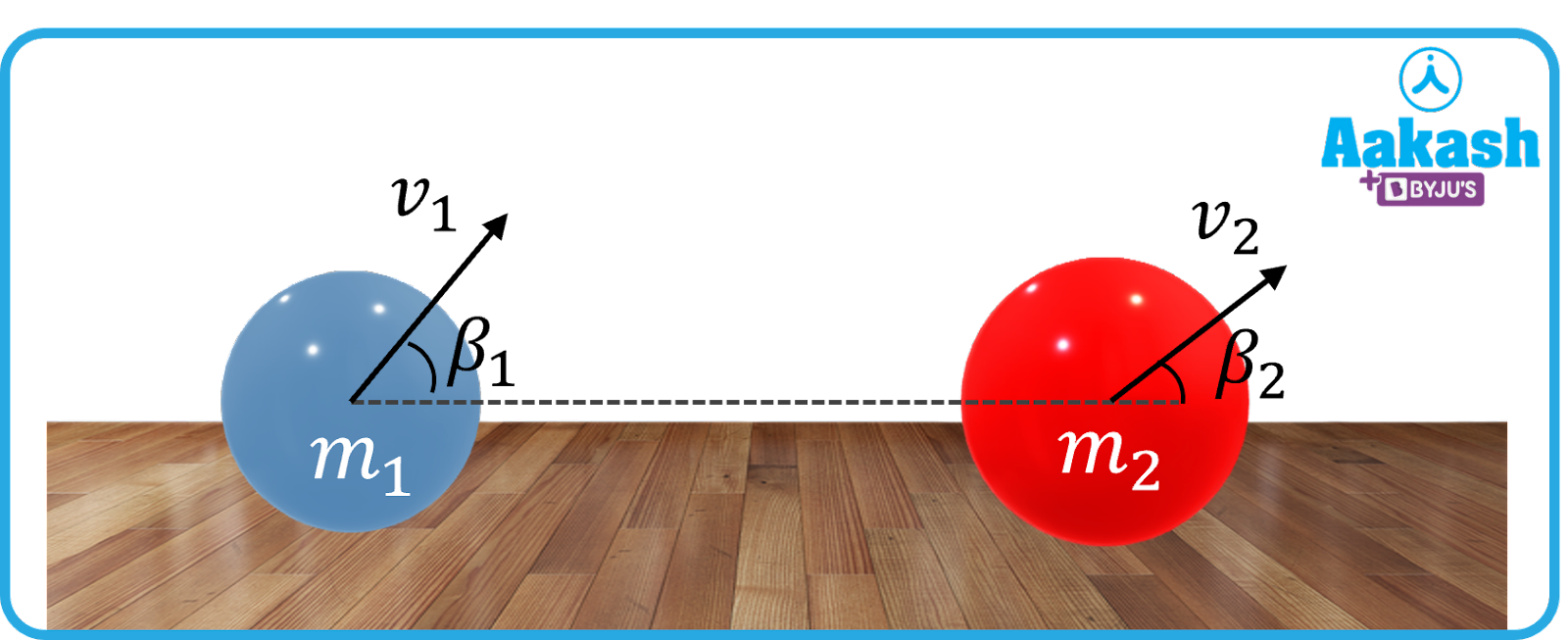
Conserving momentum along the line of impact, we get
Conserving momentum along the perpendicular direction,
v1
v2
Practice problems
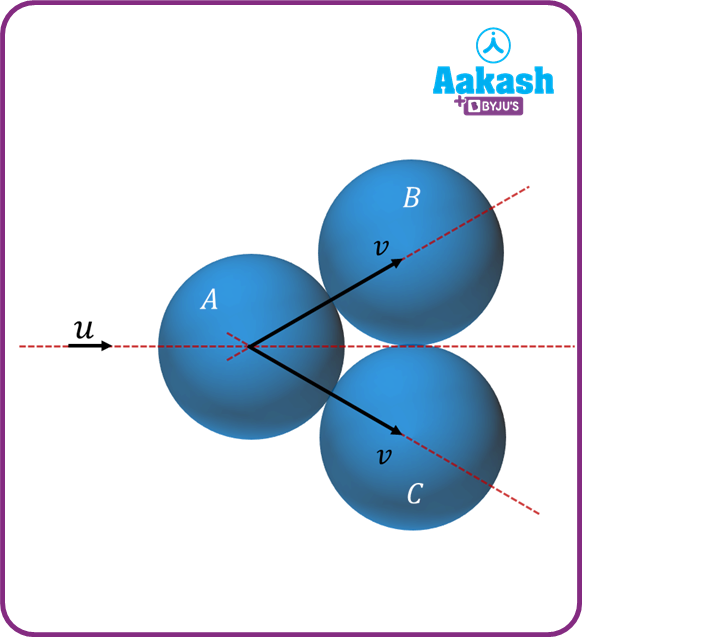
Q1)Two equal spheres of mass m are in contact on a smooth horizontal table as shown in the figure . A third identical sphere impinges on them symmetrically and is brought to rest. Prove that
Answer.
Let u indicate the speed of the sphere A before impact. Since the spheres are identical, they would form an equilateral triangle. The spheres B and C will move along AB and AC making an angle of 300 with the line of impact.
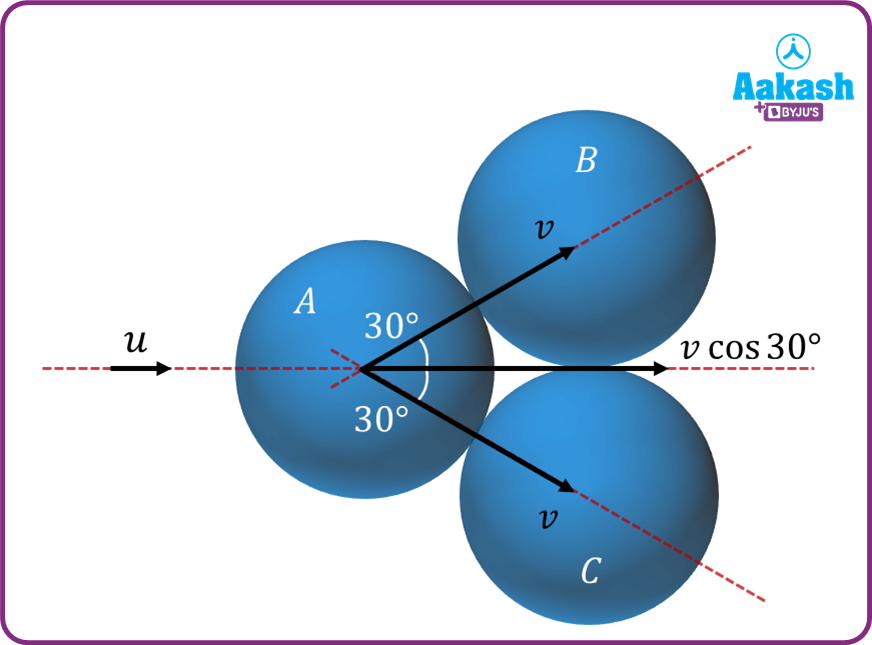
Now conserving momentum along x axis
Let vB and vA indicate the final velocities of B and A after the collision. Then the coefficient of restitution,
, since sphere A comes to rest after the collision.
;
Solving equations (i) and (ii), we get
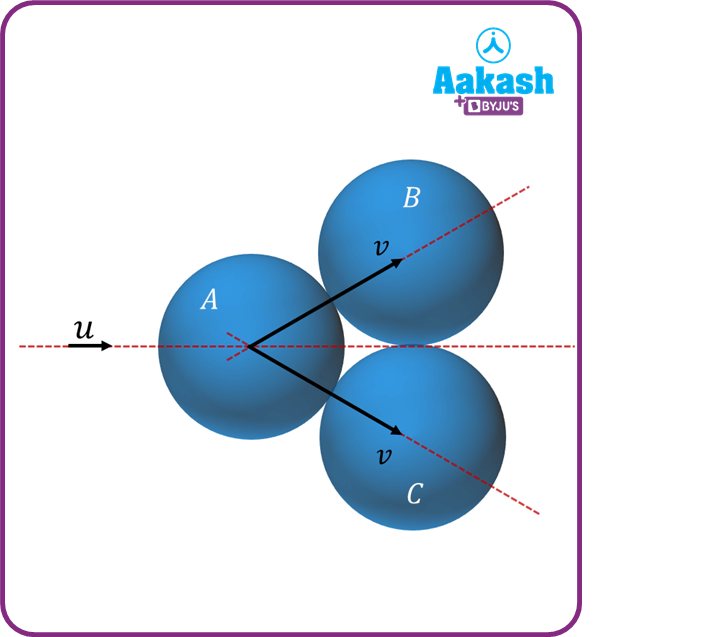
Q2)Two billiard balls, each having mass m are at rest and placed in contact with a smooth horizontal table. A third identical ball, impinges on them symmetrically, with a speed u and is brought to rest. If the collision is oblique in nature, find the loss in KE of the 3 ball system.
Answer. Given, u is the initial velocity of one billiard ball.
The final velocities of the other two balls after collision is v. Due to their symmetric nature, they would form an equilateral triangle. The velocities along x axis would be v cos 300 each.
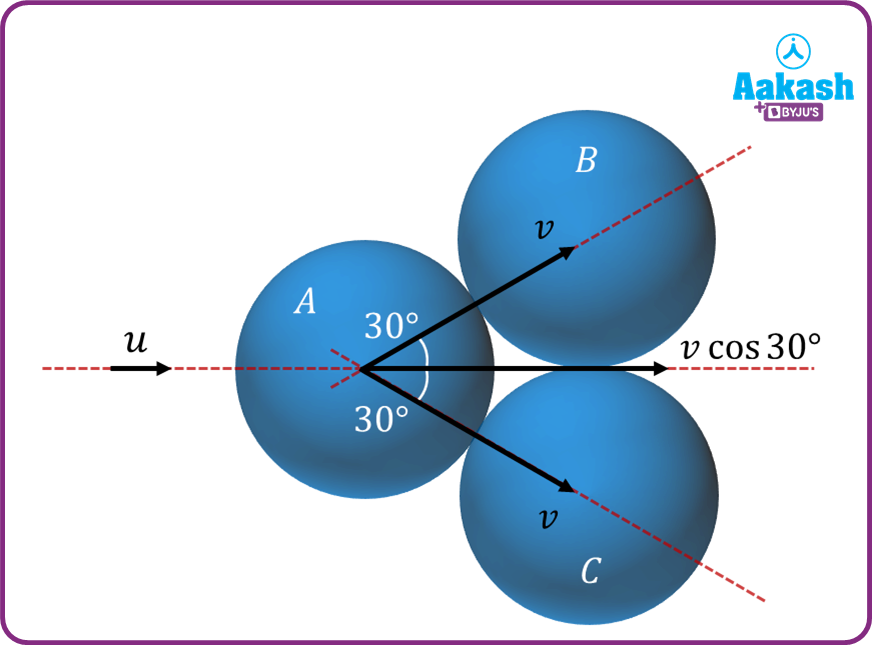
Now conserving momentum along x axis
Loss in KE
Q3)Two balls of masses 2 kg and 4 kg move towards each other with velocities and . After colliding, the 2 kg ball returns back with a velocity of . Find the velocity of the 4 kg ball after collision and value of e.
Answer.
Let v2 indicate the final velocity of the 4 kg ball.
,
Applying momentum conservation, we get
Coefficient of restitution,
Q4) A stone A moving with velocity 4 ms-1 collides with another stone B at rest. The stones have identical mass and the coefficient of restitution e=1, find the velocity of stone A after the collision. Assume that the velocity of A makes an angle of 300 with the line of impact.
Solution)
For stone A,
Along the line of impact,velocity before collision,
Along the line of impact,velocity after collision is v1.
Along the perpendicular, velocity before collision =
And, velocity after collision =
For stone B,
Along the line of impact,velocity before collision = u2=0
Along the line of impact,velocity after collision, =v2
Along the perpendicular, velocity before collision = 0
Along the perpendicular, velocity after collision =0
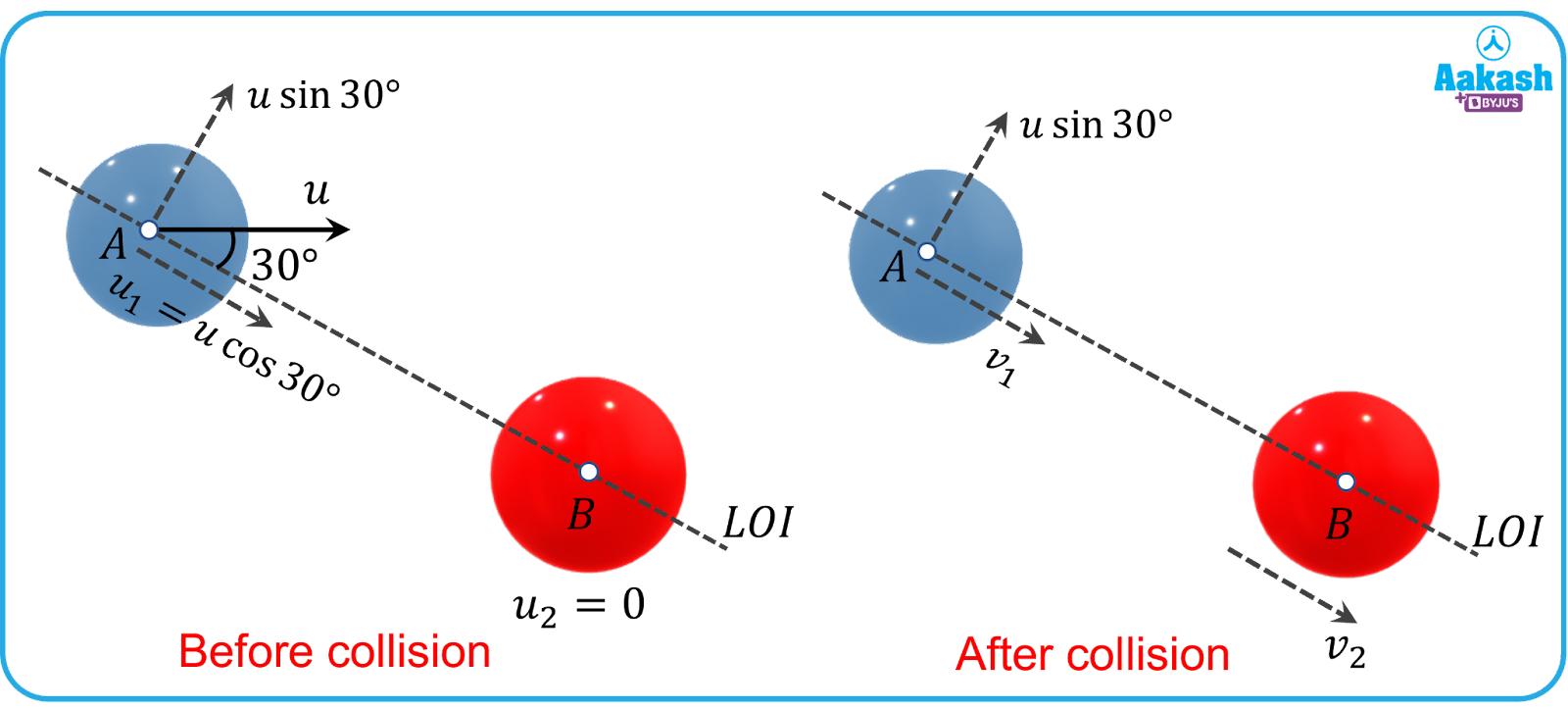
Conserving momentum along the LOI, we get
Given
Solving , we get
This implies that stone A has a component along the perpendicular direction only, with a value of 2ms-1.
FAQs:
Q1. When does oblique collision occur?
Ans) When the line joining the centers of the two bodies is not parallel to the individual velocities of the body, but instead any one or both makes an angle with the line joining the centers of the two bodies, such a case is called an oblique collision. The final velocities are calculated by resolving the velocities and conserving momentum along the line joining the centers of the two bodies and perpendicular to it.
Q2. Give an example of head on collision?
Ans) Head-on collision occurs when two bodies (having same or different masses), traveling in opposite directions or same direction crash into each other. An example would be two cars crashing. If two bodies having the same mass collide head-on and elastically, they would exchange their velocities.
Q3. How do you find the line of impact?
Ans) The line of impact during a collision can be depicted by drawing a straight line which passes exactly through the centers of the bodies. In the case of an oblique collision, this would serve as a guide for resolving the velocities of the bodies.
Q4. Is momentum conserved during oblique collision?
Ans). Yes, momentum is conserved during any kind of collision as long as the net external force acting on the system of bodies colliding is zero.

 Call Now
 Let's Chat
 Share
Share