-
Call Now
1800-102-2727


Kinematics of Rotational Motion, parameters, equations of motion, practice problems, FAQs

Have you ever wondered what kind of motion does see-saw, opening a door or turning a wrench involves. As the angle of rotation involved in such cases is often small, it might confuse you whether it is angular motion or not, but it actually is. To study such motion without considering the cause of motion, one must be aware of rotational kinematics that is analogous to translational kinematics in linear motion.
Table of contents
- Circular Vs Rotational Motion
- Rotational Parameters
- Angular kinematic equations
- Practice problems
- FAQs
Circular Vs Rotational Motion
- Circular motion is defined for a particle.
- Rotational motion is for a collection of particles that form a rigid body.
Example:
Let the particles of Earth, namely, 1, 2, 3, and 4, be moving in a circular motion individually as shown in the figure. Here, the Earth is performing a rotational motion and the individual particles are performing a circular motion.

Axis of rotation
- The loci of the centres of all the particles moving in a circular motion in a rigid body is known as the axis of rotation.
- Axis of rotation is mandatory to represent the rotational motion.
Properties of axis of rotation
- It does not have to pass through the body.
- It does not have to be fixed.
- It does not have to be perpendicular to the surface plane of the object.
Rotational Parameters
In case of a rotational motion, the rotational equivalent parameters as in linear motion are:
- Angular position
- Angular displacement
- Angular velocity
- Angular acceleration
Angular position (θ)
The angle made by the position vector with respect to the origin with the reference line is known as the angular position.
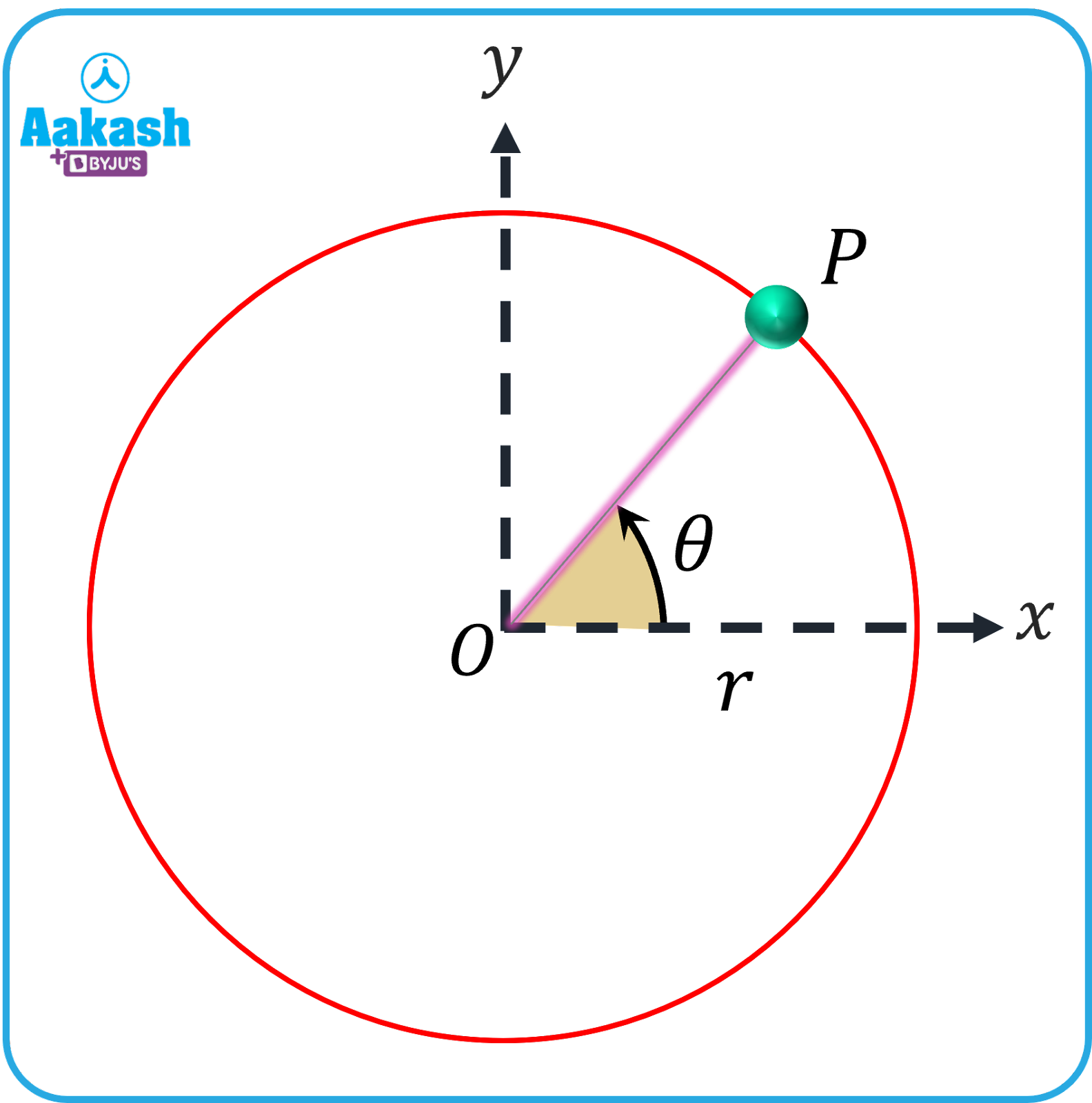
Sign convention: The angle measured in the anticlockwise direction is to be taken as positive.
Angular displacement (Δθ):
It is the angle through which the position vector of the moving particle rotates in a given time interval with respect to a specified origin and axis. The SI unit of angular displacement is radian.
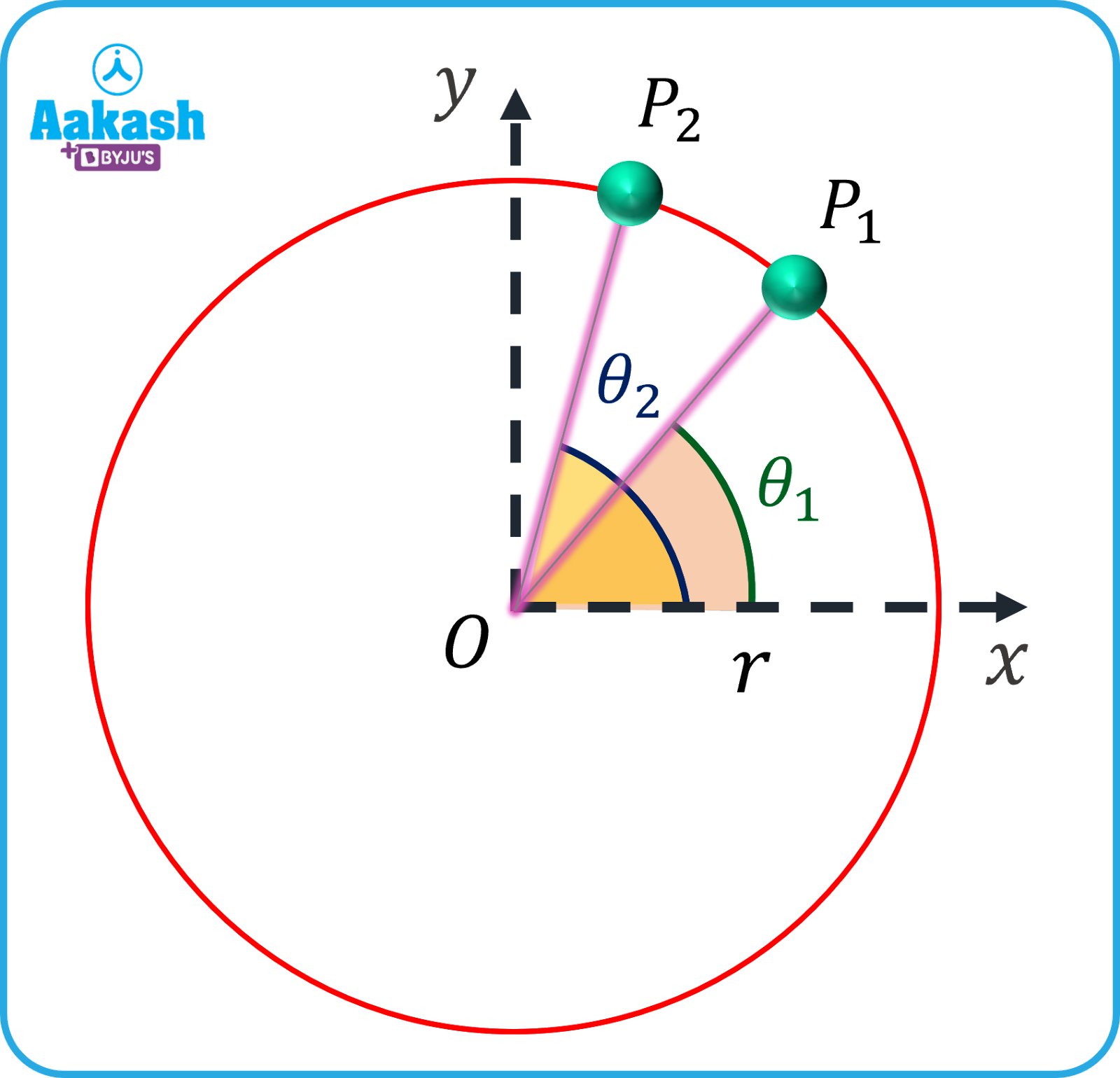
It is the difference between two angular positions/coordinates.
Angular velocity (ω):
It is defined like its linear counterpart. It is the rate of change of angular displacement of a body with respect to time.
Average angular velocity (ωavg):
Let us say that a body has covered angle θ1 in time t1 and angle θ2 in time t2.
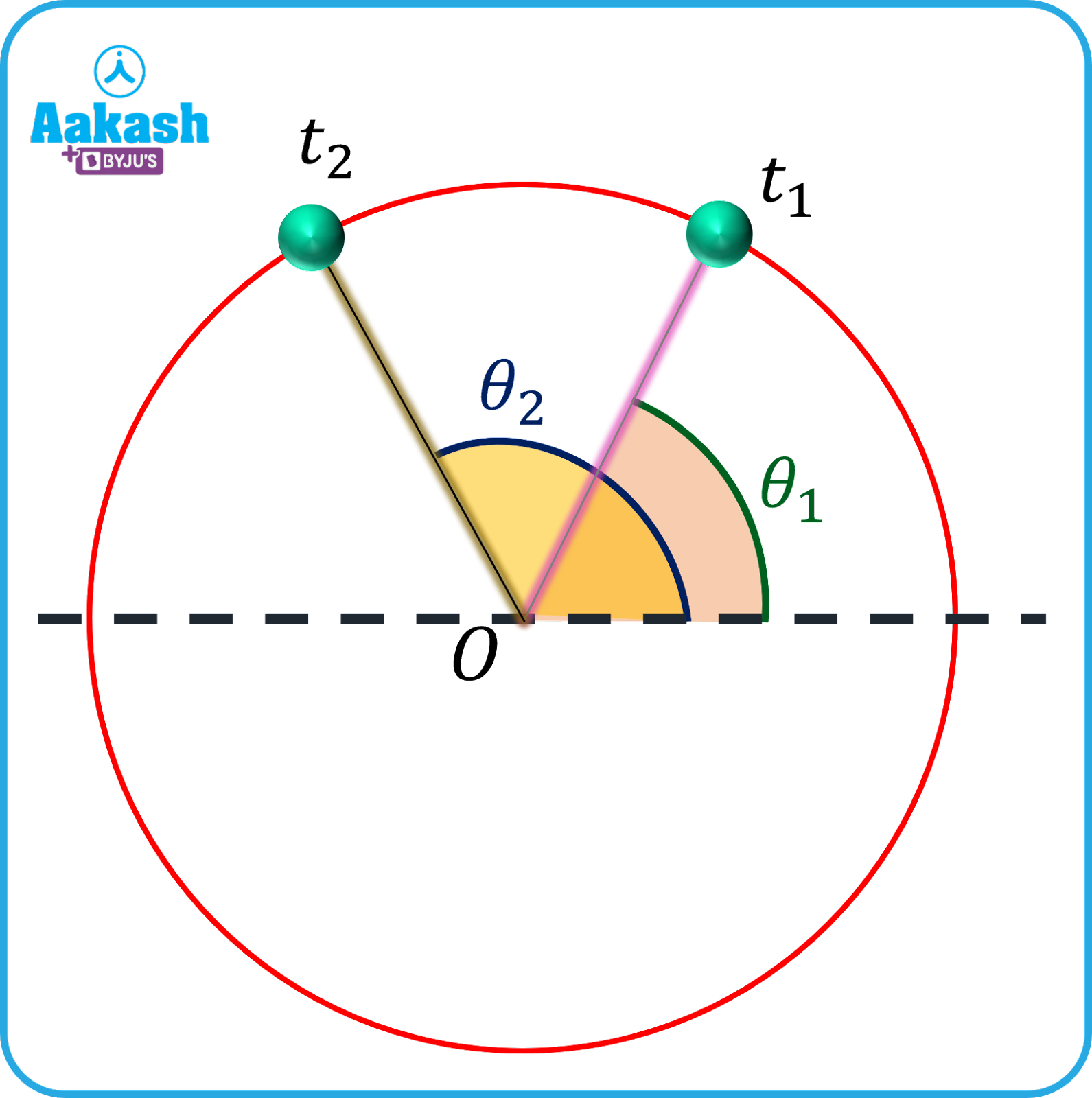
Then, the average angular velocity of the body is as follows:
Instantaneous angular velocity ():
It is defined as the rate of change of displacement over an infinitesimally small interval of time.
Let us say that a body has covered angle  in time dt, as shown in the figure.
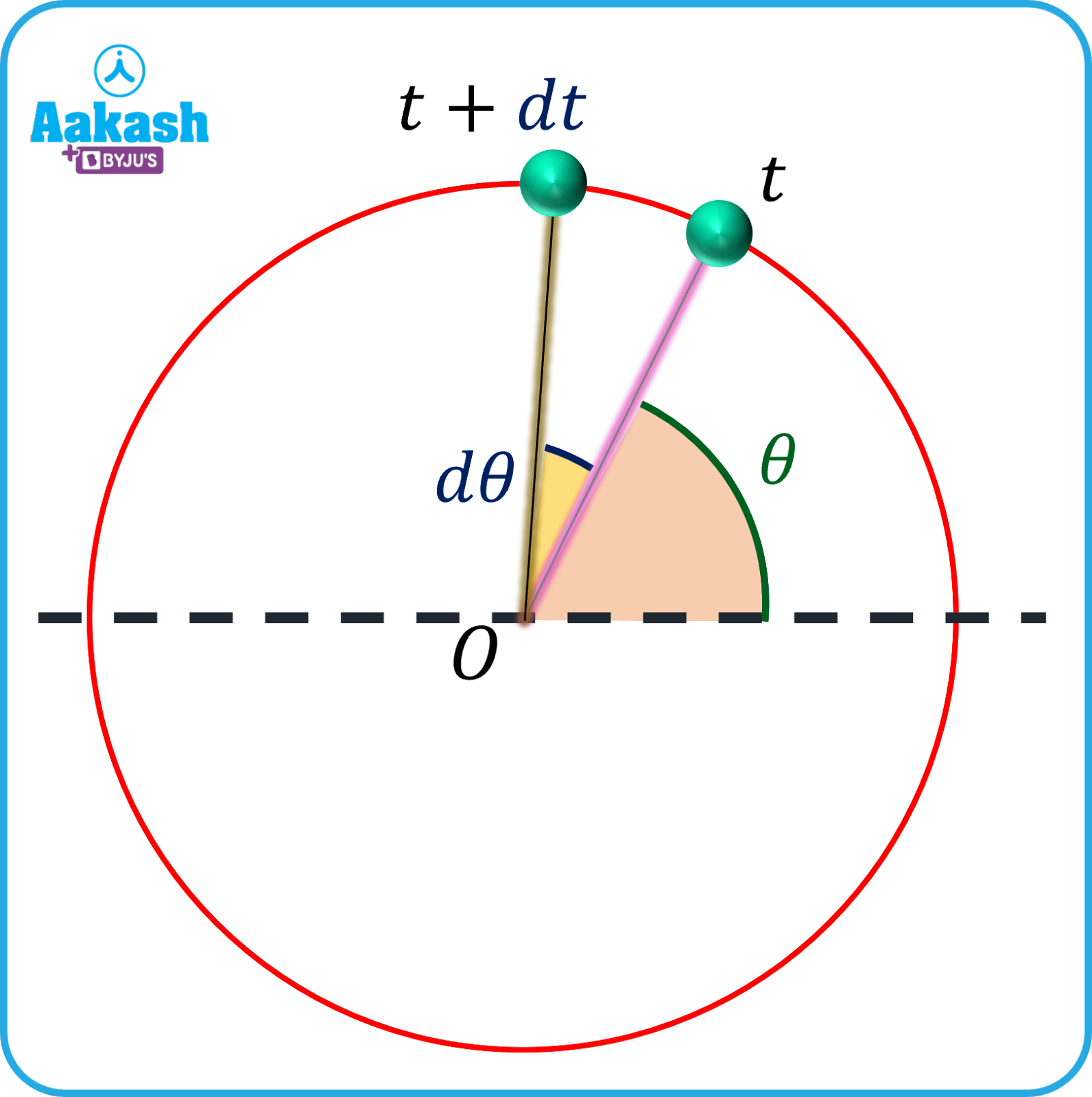
Then, the instantaneous angular velocity of the body is as follows:
Angular acceleration: It is defined as the rate of change of angular velocity with respect to time.
Average angular acceleration (avg):
Let us say that a body has angular velocity ω1 at time t1 and its angular velocity changes to ω2 at time t2.
Instantaneous angular acceleration ():
It is defined as the rate of change of angular velocity over an infinitesimally small interval of time.
The equations of motion for the rotational motion with a constant angular acceleration are similar to their linear counterparts.
Angular kinematic equations
The angular velocity of any point on the rigid body with respect to any other point on the rigid body always remains the same. Due to the same angular velocity of all the particles, we can define the angular velocity of the rigid bodies.
Following are the parameters and relations between them used in a circular motion. These terms are required in rotational motion as well.
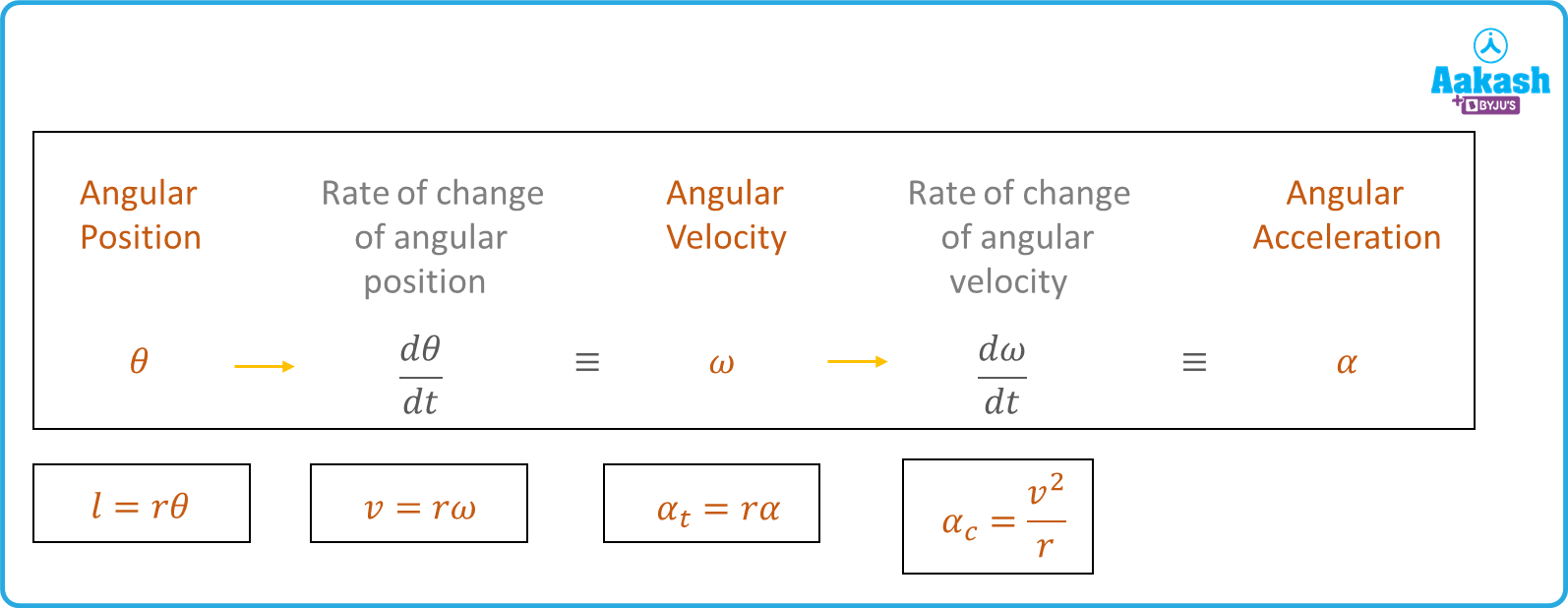
The kinematic equations for constant magnitude of tangential and angular acceleration are as follows:
Practice problems
Q. A rigid disc rotates with a uniform angular acceleration of 2.0 rad/s2 about its axis. How many revolutions will it make in the first 10 seconds, if the disc starts from rest?
A
Given,
Initial angular velocity, ⍵0 = 0
Angular acceleration, 𝛼 = 2.0 rad s-2
Time, t = 10 s
Let the disc make n revolutions in 10 s.
We know that,
Number of revolutions are
Thus, the disc makes 16 revolutions in the first 10 seconds.
Q. The wheel of a motor accelerates uniformly from rest and during the first second rotates through 5 radians. What will be the angle rotated during the next second?
A
Given,
Initial angular velocity, ⍵0 = 0
At time, t = 1 s, 𝜃1 = 5 radian
Let the angular acceleration be 𝛼.
We know that,
At t=2 s
Thus angle rotated from 1 sec to 2 sec is as follows
Q. A rigid block is moving downward into a well through a rope that is passing over a fixed pulley of radius 10 cm. Assume that there is no slipping between the rope and the pulley. Calculate the angular velocity and angular acceleration of the pulley at an instant when the block is going down at a speed of 20 cm/s and has an acceleration of 4.0 m s-2.
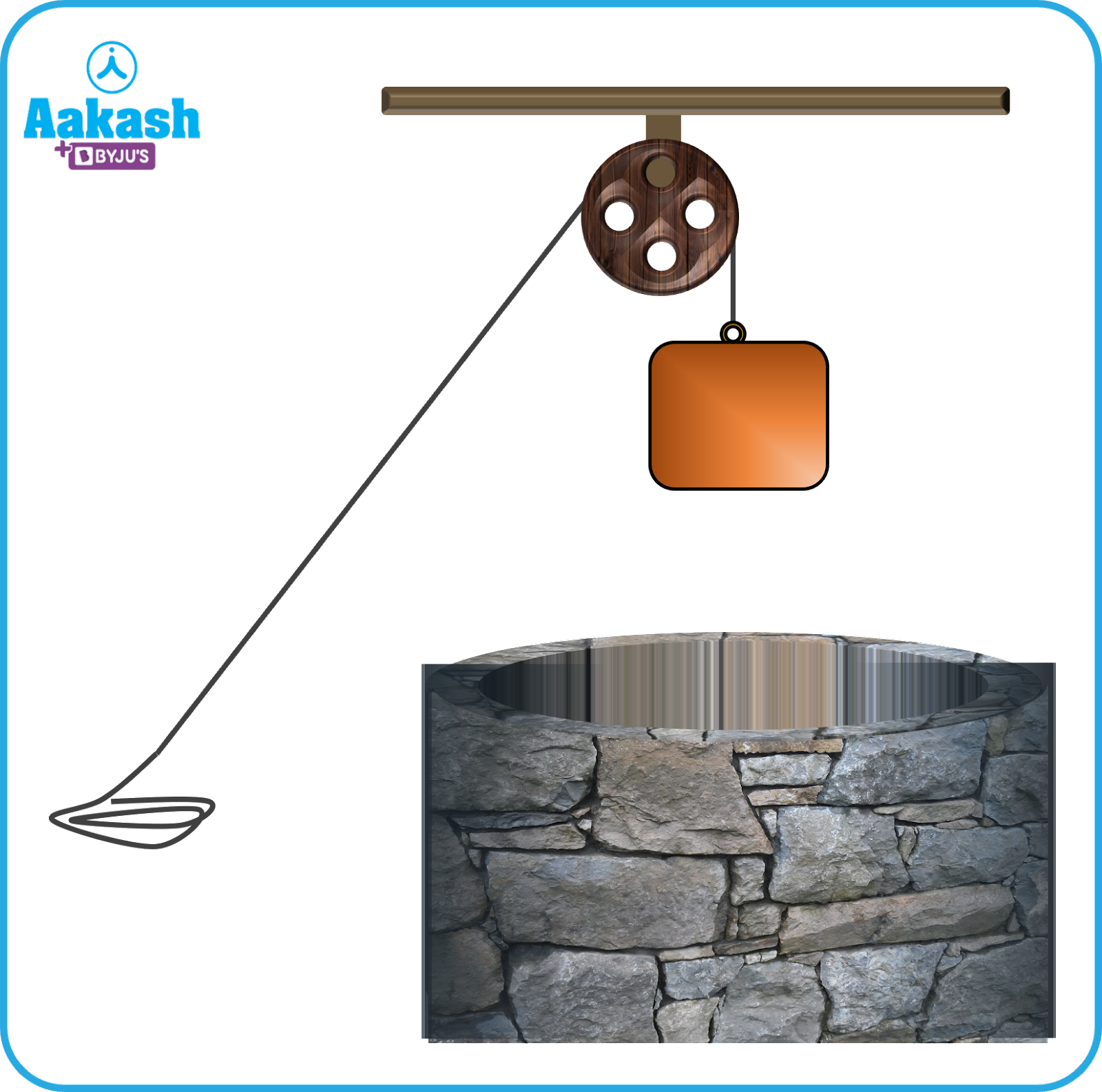
A
As there is no slipping between the rope and the pulley, velocity of the block, rope and the point of contact of pulley will be the same.
Given,
Radius of the pulley, r = 10 cm
Velocity of the block, v = 20 cm s-1
Acceleration, at = 4.0 m s-2
We know, angular velocity is as follows:
Similarly angular acceleration is:
Q. The motor of an engine is rotating with an angular velocity of 120 rpm about its axis. It comes to rest in 10 s after the engine is switched off. Find the number of revolutions made by it before coming to rest assuming uniform angular deceleration.
A.
Given,
Initial angular velocity,
Final angular velocity, =0 rad/s
Time, t=10 s
Let be the constant angular acceleration.
Using first equation of angular kinematics,
Using third equation of angular kinematics,
Let n be the number of revolutions made by the engine before stopping
Therefore, number of revolutions,
FAQs
Q. What is the instantaneous speed of the point of contact in pure rolling?
A. In pure rolling, translational speed is balanced by rotational speed at the point of contact and therefore instantaneous speed of the point of contact is zero.
Q. If torque acting on a rotating lever arm is zero, what will be the angular acceleration of the arm?
A. Newton's second law for rotational motion,
Since
Therefore the lever arm will move at zero angular acceleration or constant angular velocity.
Q. What is the dimensional formula for angular velocity and angular acceleration?
A. Angular velocity -
Angular acceleration -
Q. Do all the points on a rigid body performing pure rotational motion have the same angular velocity?
A. Yes, all the particles that constitute the rigid body performing rotational motion will have the same angular velocity. Although their tangential velocity might vary depending upon the distance from the axis of rotation.

 Call Now
 Let's Chat
 Share
Share