-
Call Now
1800-102-2727


Biot-Savart’s law, Magnetic field around a thin straight conductor, Magnetic field at the centre of a circular conductor, Magnetic field at the centre of an arc shaped conductor, Practice Problems, FAQs

Neel is a curious student in his class. In the physics lab he got to know that there is a device which comes with a dial and a pointer in it. When it detects a magnetic field the pointer deflects in the direction of the magnetic field. He took this device and placed it close to a straight current carrying wire. He was amazed watching the pointer deflect. He came to know that it is the current carrying wire which created the magnetic field.
Table of content:
- Biot-Savart’s law
- Magnetic field around a thin straight conductor
- Magnetic field at the centre of a circular conductor
- Magnetic field at the centre of an arc shaped conductor
- Practice Problems
- FAQs
Biot-Savart’s law
Biot-Savart’s law gives the magnetic field produced by a current carrying conductor segment. The segment under consideration is considered as a vector quantity. It is also known as the current element.
Let’s take a wire carrying current i in a particular direction as shown in the figure. We consider a small element of the wire of length dl. The direction of this wire element is along the direction of the current at that point. So, this forms a vector idl.
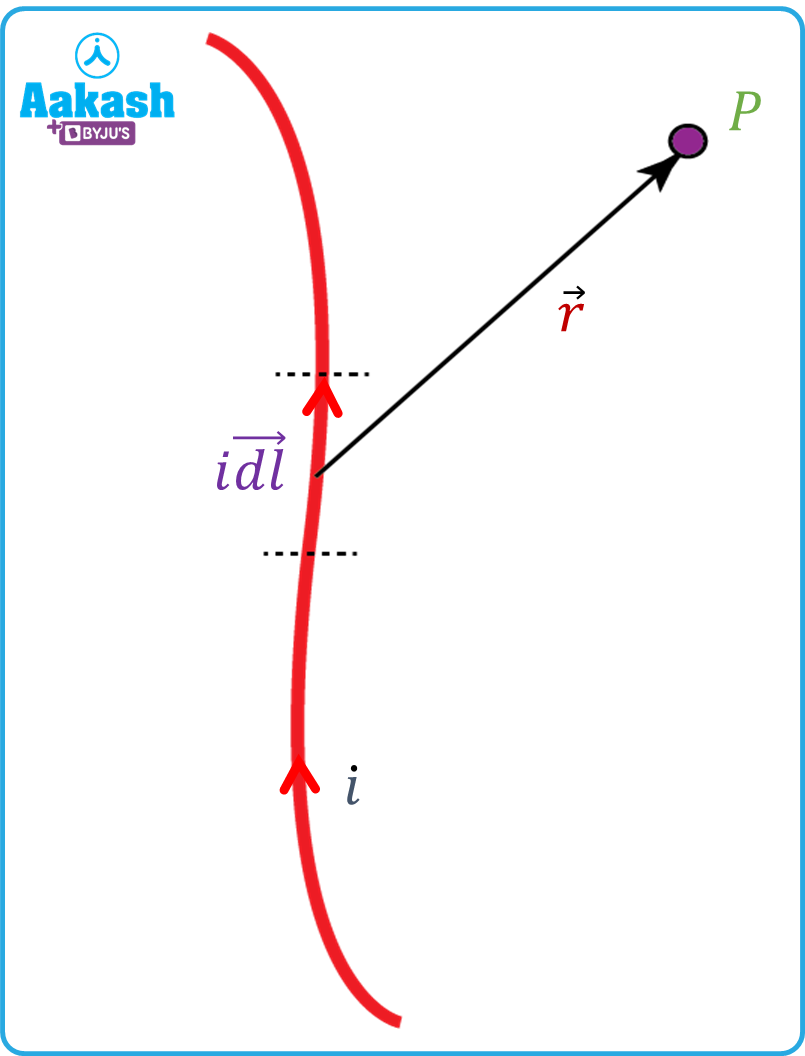
We need to derive the magnetic field produced at a point P due to the small element dl. We can apply the Biot-Savart’s Law to do that. Let’s assume, the position vector of the point under consideration from the current element dl be r and given angle between the current element and the position vector is .
The magnetic field dB produced by the current element is perpendicular to both dl and r.
The magnitude of the magnetic field dB is inversely proportional to the r2 where r is the distance of the current element from the point P
The magnitude of the magnetic field dB is proportional to the current i flowing through the current element and the length of the current element i.e., dl
The magnitude of the magnetic field dB is proportional to , where is the angle between dl and r.
Then,
So,
0 is the permeability of free space and is equal to 4π × 10-7 TmA-1.
The direction of the magnetic field dB is in a plane perpendicular to the current element dl and position vector r. It can be found by the right-hand thumb rule where the thumb points towards the direction of the magnetic field and the rest of the fingers are curled in the direction from the current element to the position vector.
Magnetic field around a thin straight conductor:
We know the Biot-Savart’s Law,
Let’s take a straight current carrying wire. Take an elemental length of dy as shown in the figure.
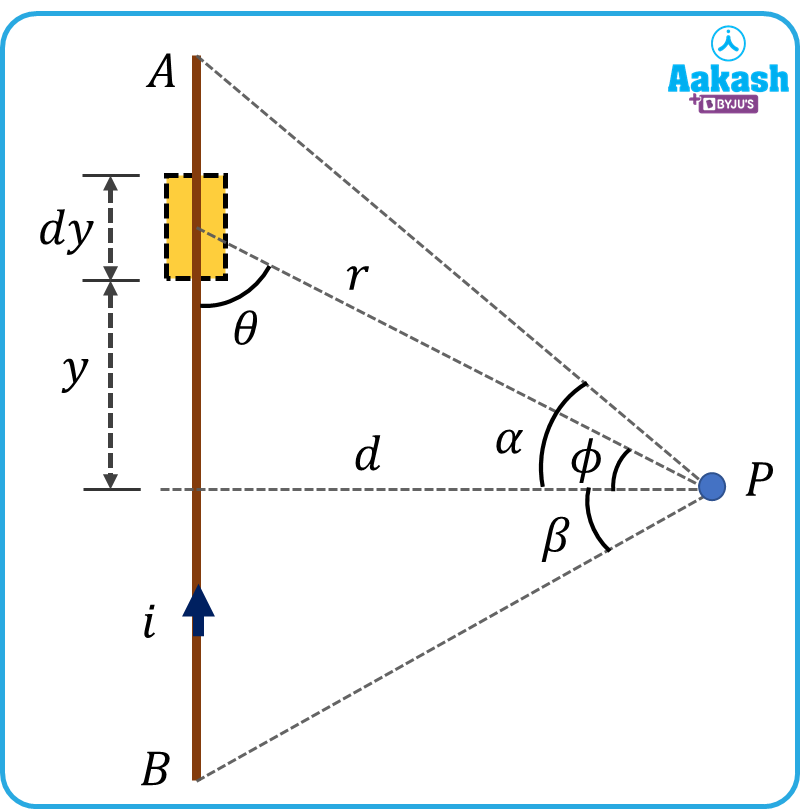
Case1: infinitely long straight wire
Here, α=+90o and β=-90o
So,
Case2: semi-infinite long straight wire
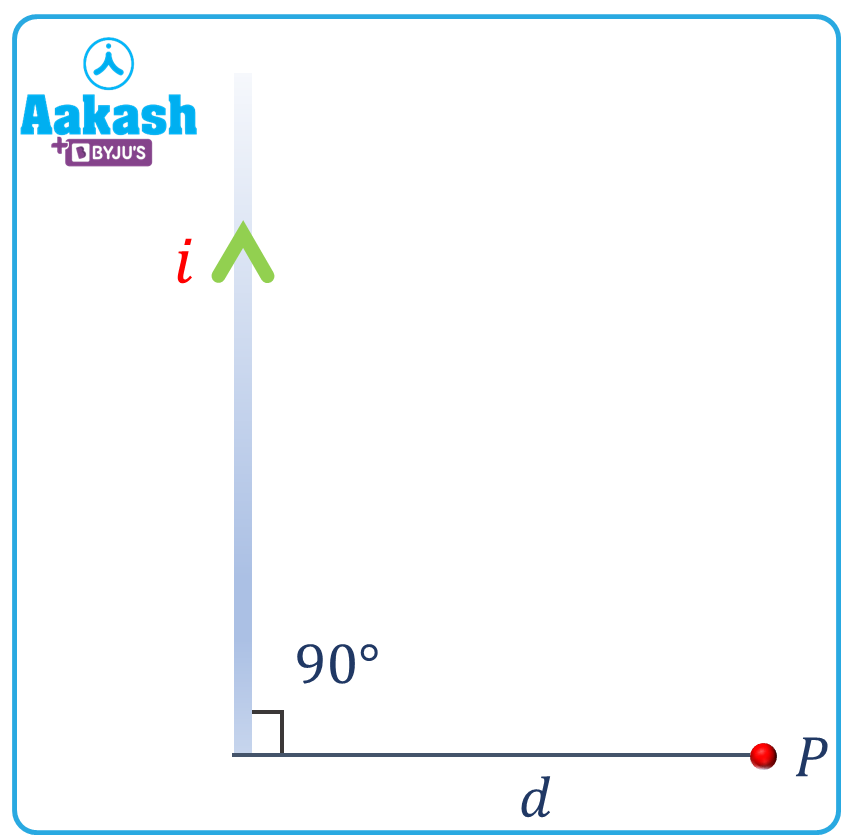
Here, α=90o and β=0o
So, B∝1d and it is half the value of the case of infinitely long straight wire.
Magnetic field at the centre of a circular conductor:
Let’s say we have a circular conductor of radius R.
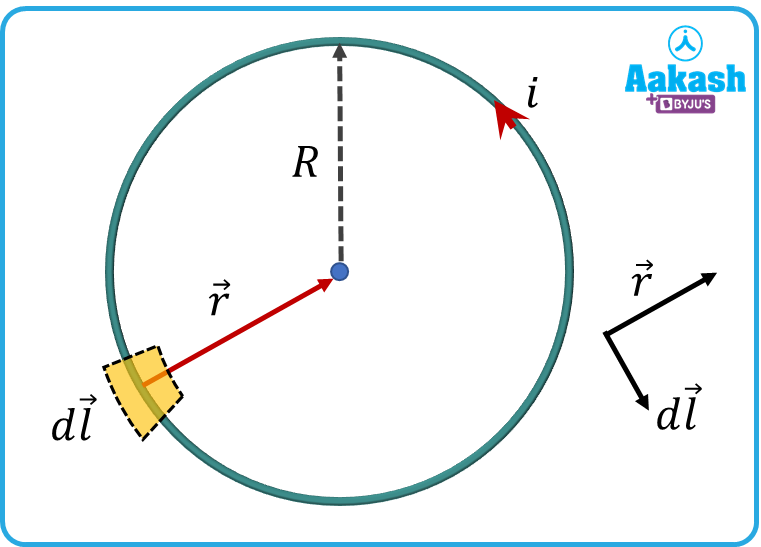
A current i flows through this. The magnetic field produced in this case at the centre of the ring can be calculated by the Biot-Savart’s Law.
The magnetic field B for this will be in the direction coming out from this plane of the circular conductor.
Magnetic field at the centre of an arc shaped conductor:
Let’s say we have a circular arc conductor of radius R.
A current i flows through this. The magnetic field produced in this case at the centre of the ring can be calculated by the Biot-Savart’s Law.
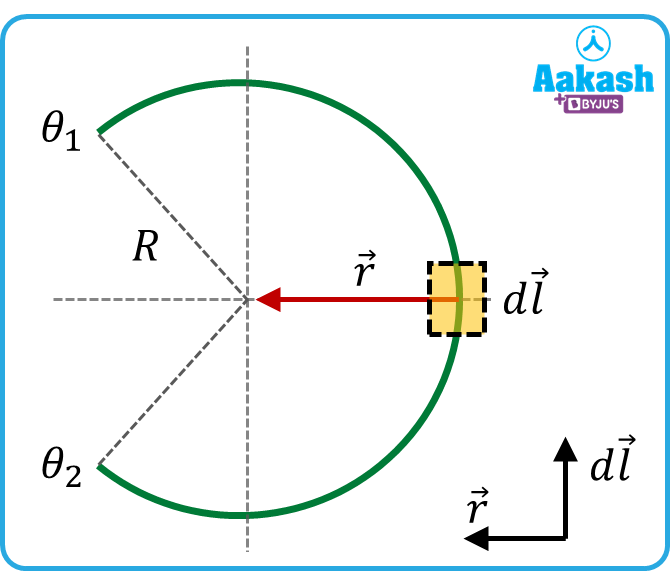
The magnetic field, B for this will be in the direction coming out from this plane of the circular conductor.
Practice Problems
Q. A conductor shaped as in the figure shown carries a current 10 A through it. The conductor arc with radius 0.5 m subtends an angle of 60oat the centre, P. What will be the magnetic field at P?
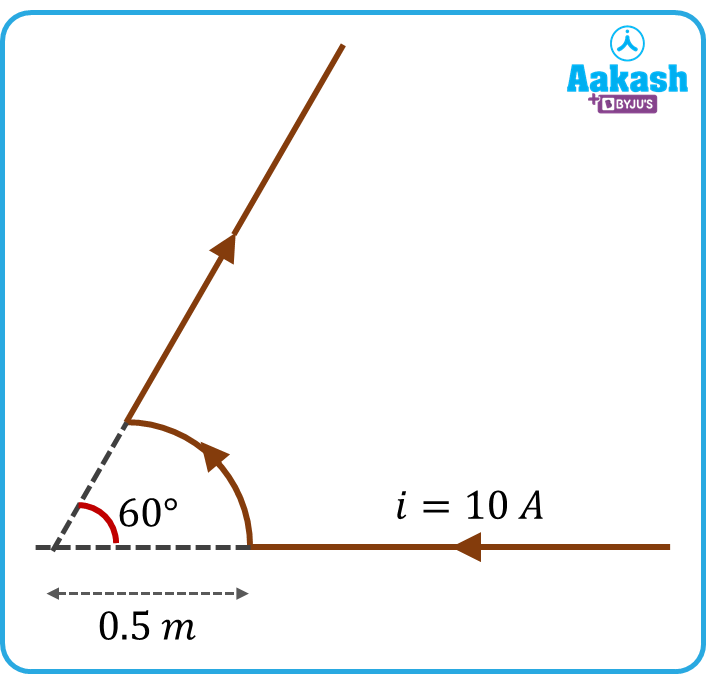
A. The magnetic field at the centre of an arc is
The dlr shows that the magnetic field will be like coming out of the plane of the paper.
The point P lies on the extension of the straight wires. So it will have no effect as a magnetic field created due to the wire.
Q. There are three wires at the three corners of a square ABCD of side length 1 m as shown in the figure. The current in I1, I3 is 1 A. The current in the I2 is 2 A. The direction of current in the wires with I1 and I3 is into the plane and with I2 is outside the plane. What is the magnetic field at the other corner?
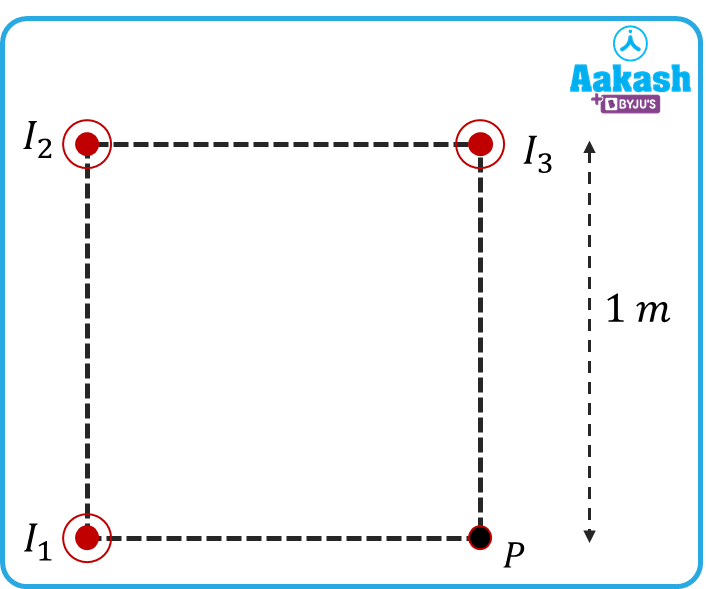
A. The magnetic field at a distance R from the infinitely long wire is 0i2πR
The magnetic field at P due to the wire I1 is in the direction of I3P
The magnetic field at P due to the wire I3 is in the direction of PI1
The magnetic field at P due to the wire I2 is in the direction as shown.
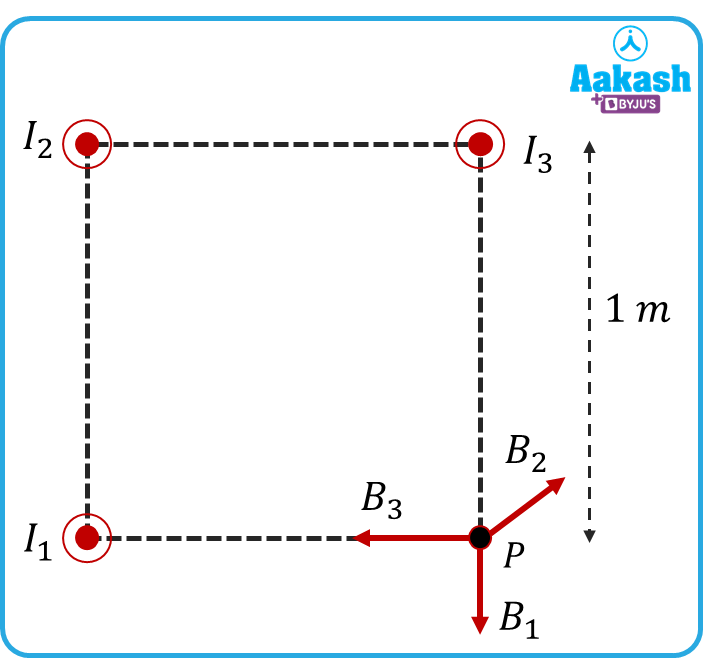
By Lammi’s theorem, these B1, B2, B3 are in equilibrium. So, the magnetic field intensity at P is zero.
Q. A current carrying wire has 2 A flowing through it. The wire is shaped into a square of side length 2 m. What will be the magnetic field at the centre of the square?
A.
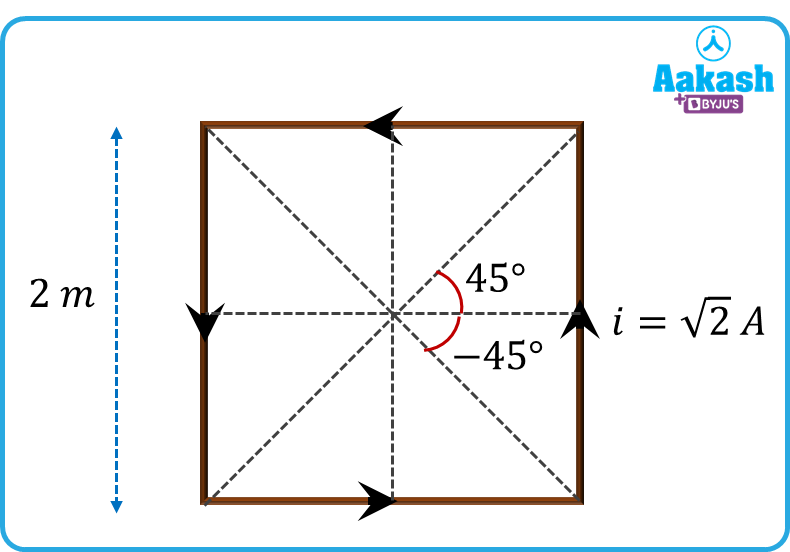
The magnetic field due to a wire of length 2 m subtending 90o at a point 1 m far from the mid of the wire is,
So, the magnetic field at the centre will be 4×2×10-7T=8×10⁻⁷T
In this case the field will be in the direction, coming out from the plane of the paper.
Q. A conductor is shaped in the form of a circular ring of radius 1 m is bent into the form as shown in the figure. Current 1 A is flowing through the wire. What will be the magnetic field at the centre of the ring?
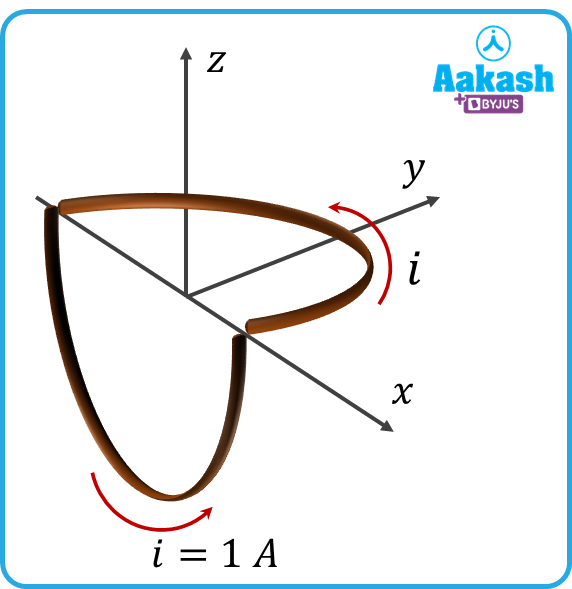
A. The magnetic field at the centre due to the semicircle in xz plane is
The magnetic field at the centre due to the semicircle in xy plane is
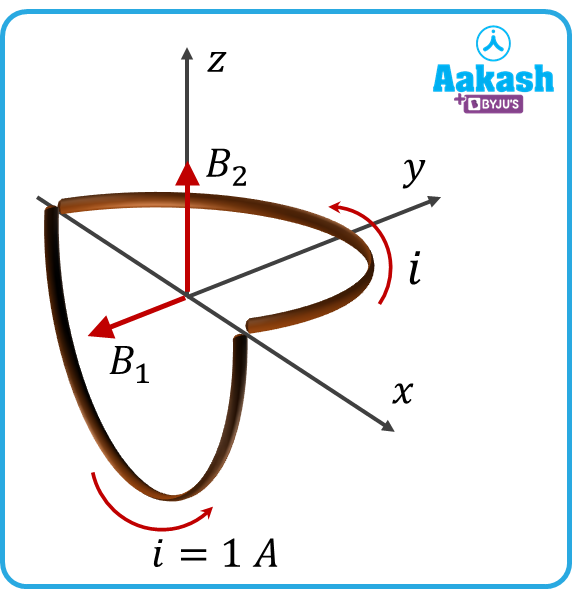
So, the resultant field will be,
FAQs
Q. Which law of electricity is analogous to the Biot-Savart law in magnetism?
A. The Biot-Savart law of magnetism is analogous to Coulomb's law of electricity.
Biot-Savart law states that the magnetic field intensity due to a current carrying conductor is,
This is quite analogous to the Coulomb’s law of electric field which tells the field intensity at a point due to a charge is
Q. Which property in electro-magnetism cannot be calculated using the Biot-Savart law?
A. Using the Biot Savart law we cannot calculate electric field intensity. Biot-Savart law is used for calculating the magnetic field intensity. This is also used in calculating the magnetic flux density and the permeability property of a medium.
The permeability of a medium can be determined using the formula B=μH
Q. What is the importance of Biot-Savart Law?
A. The importance of the Biot-Savart law is as follows:
i)Savart law is quite similar to Coulomb's law in electrostatics.
ii)Biot-Savart Law is applicable for even very small conductors when they carry current.
iii)Biot-Savart Law is applicable for both the symmetrical and unsymmetrical current distribution.
Q. What is the difference between the Biot-Savart Law and the Ampere’s circuital law?
A. The differences between the Biot-Savart Law and the Ampere’s circuital law are described below:
a. Biot-Savart Law is the basic equation that calculates the magnetic field due a any distribution whereas the Ampere’s circuital law is used for the calculation of magnetic field mainly for the current distribution with a high degree of symmetry.
b. Biot-Savart Law works well in case of unsteady current whereas the Ampere’s circuital law doesn’t work in unsteady current situations. For that specific case Maxwell’s general equation is useful.
c. The equation of Biot-Savart Law is
and the equation for the Ampere’s circuital law is

 Call Now
 Let's Chat
 Share
Share