-
Call Now
1800-102-2727


Acceleration due to gravity, derivation of g, practice problems, FAQs

Have you ever known that every object present in the universe attracts each other? Yes, that’s correct. All bodies in the universe exert a force of attraction on the other bodies and this force is known as the gravitational force.
Now, have you ever thought if we throw a ball in the air then why it will eventually come back towards the Earth? And if all the bodies in the universe are attracting each other then why is the ball in the air not able to pull the Earth towards it, as well? Or what force keeps our feet on the ground?
You have come to the right place to get all these answers.
Table of contents
- What is gravity?
- Acceleration due to gravity
- Mathematical derivation of g
- Why do we use the word “gravity” for the Earth?
- Real-World Application: Why This Matters
- Practice Problems
- FAQs
What is Gravity?
Gravity is the force of attraction of a body with which it attracts the other bodies in the universe (even in the gravitational field of the Earth). This force exerted by Earth on a body is also known as the weight of the body.
Acceleration due to gravity
The acceleration gained by any object due to gravitational force of the body is known as the acceleration due to gravity. For example, when we throw any object in the air or into space (in the range of gravity), the Earth tries to pull that object towards it with a force called gravity thus, induces an acceleration in that body and we have named this acceleration as the acceleration due to gravity. It is represented by g and the unit is m/s2.
Key Properties of ‘g’
To master this topic for your exams, keep these essential characteristics of acceleration due to gravity in mind:
• Symbol: It is represented by the letter ‘g’.
• Vector Quantity: It has both magnitude and direction, always pointing straight toward the Earth's center.
• Independent of Mass: Interestingly, ‘g’ does not depend on the mass, size, or shape of the falling object. In a vacuum, a feather and a hammer would hit the ground at the same time!
• Variable: While we use 9.8 m/s² as a standard, the value actually changes based on your altitude (height), depth, and even where you are on the planet
Mathematical derivation of g
Consider an object at a distance r from the centre of the Earth. Let the mass of the Earth is Me and the mass of the object is m.
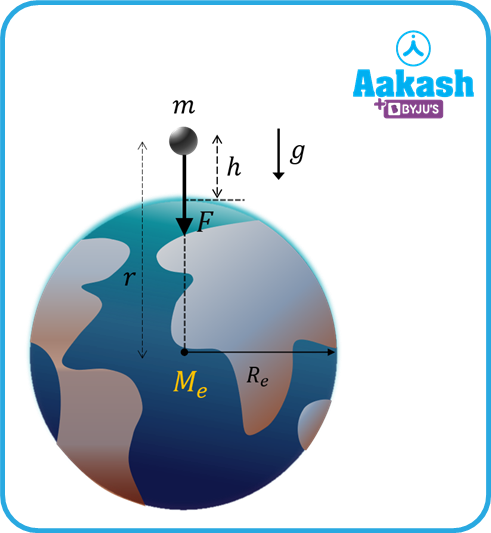
From Newton’s law of gravitation, the force of attraction between two bodies is given by,
If one of the bodies is the Earth then,
Now, from this height, the object will start to fall down due to the Earth’s gravity with acceleration g. Then from Newton’s 2nd law of motion, the force exerted on the body is
Then from the equation (i) and (ii),
Where, Universal gravitational constant).
It is acceleration. So it's a vector quantity, directed towards the centre of the Earth.
Unit of
Why do we use the word “gravity” for the Earth?
- Since the mass of the Earth is much larger than any object on the Earth, the force of attraction due to objects on the Earth will also be the same but the acceleration is negligible. It is because of the large mass of the Earth, the Earth is able to pull the object towards it and this is the reason why we are on the Earth.
- Even the gases present in the atmosphere are affected by the gravitational force of the Earth which makes the Earth a habitable planet for the living bodies on it. Therefore for studying the gravitational effect of Earth we use the word “gravity”.
Real-World Application: Why This Matters
Understanding what is acceleration due to gravity isn't just for passing tests! It affects everything:
1. Weight vs. Mass: Your mass stays the same, but your weight changes if ‘g’ changes. For example, you would get more sugar in a 1 kg bag (measured by weight) at the equator than at the North Pole because the pull of gravity is weaker at the equator.
2. Space Travel: Engineers use these formulas to calculate how much fuel a rocket needs to escape Earth's pull.
3. Athletics: High jumpers and long jumpers can actually perform slightly differently depending on their location on Earth due to these tiny variations in gravity!
Practice Problems:
Q. Calculate the value of acceleration due to gravity on the Earth's surface.
A. Let the radius of Earth is R and the mass of Earth is Me. Consider an object placed on the
Earth’s surface.
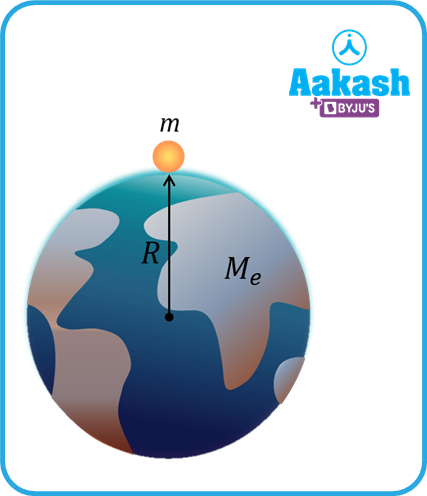
Then, the acceleration due to gravity is,
Where, (Universal gravitational constant)
r= Distance of object from Earth’s centre
Now for this case,
And mass of the Earth is,
Then, from equation (i),
Q. An object weighs 20 N on the Earth. Find the weight of the object on a planet A, having a radius one-third of the Earth’s radius and mass as half of the mass of the Earth’s mass.
Solution: Given:
Where,
mass and radius of the earth
Radius of the planet
W= Weight of the object on the Earth
Let the weight of the object on the planet A is W' and acceleration due to gravity is g'. Then,
Since the mass of the body will be the same on Earth and on the planet A.
Now we know that the acceleration due to gravity is given by,
Then for Earth,
And for planet A,
Then from equation (i),
Q. If the acceleration due to gravity on Earth is 9.8 m/s2 and the acceleration due to gravity on the Moon is. Then find the value of n. Mass of the Moon is and radius of the Moon is
A. Given: Mass of the moon,
Radius of Moon,
Then the acceleration due to gravity on the Moon is,
As given,
Then,
Hence the acceleration due to gravity on Earth is 6 time that of the Moon.
Q. The acceleration due to gravity on a planet is 4 times of the Earth. The planet radius is 7000 km. Find the mass of the planet.
A. Given,
The acceleration due to gravity is,
FAQs
Q: What is the acceleration due to gravity?
A: The acceleration gained by any object due to Earth’s gravitational force is known as the acceleration due to gravity.
Q: Name the factors which affect the acceleration due to gravity?
A: 1) Shape of Earth
2) Position of the object as height above the Earth surface
3) Position of the object as depth below the Earth surface
4) Latitude of that place because of the rotational motion of the Earth
Q: Is acceleration due to gravity a scalar quantity or a vector quantity?
A: Acceleration due to gravity is a vector quantity.
Q: Write the dimensional formula for the acceleration due to gravity?
A: The dimensional formula of the acceleration due to gravity is
Q. How does the acceleration due to gravity vary with the altitude as measured from the Earth’s surface?
A. The acceleration due to gravity is maximum at the surface of the Earth and it decreases with both altitude and depth from the Earth’s surface.
If the object is thrown upwards then the actual acceleration due to gravity is derived as,
[h= Height above the Earth’s surface]
Or,
As seen from the above equations, we can say that g decreases when we go upwards from the Earth’s surface.
Where,
G= Gravitational constant
M= Mass of the Earth
Note:
If we dig a long hole into the Earth and we drop an object in it then the actual acceleration due to gravity is derived as,
Here in the above equation, again we can see that the actual g is decreasing with the depth.
R= Radius of the Earth
d= Depth below the Earth’s surface
Q. How does the acceleration due to gravity vary with the mass of the object and the planet?
A. The acceleration due to gravity is derived as,
Where, G= Gravitational constant
M= Mass of the Earth
R= Radius of the Earth
From the above equation, we can observe that the acceleration due to gravity does not depend on the mass of the object. It depends on the mass of the planet. Therefore for different planets, g have different values.
Q. Does acceleration due to gravity depend on the mass of the object?
No, it does not. Whether you drop a heavy cricket ball or a light tennis ball, both will accelerate toward Earth at the same rate of 9.8 m/s² (ignoring air resistance). The mass, shape, or size of the object has no effect on ‘g’.
Q. Where is the value of ‘g’ highest and lowest on Earth?
The value of ‘g’ is highest at the Poles and lowest at the Equator. This happens because Earth is not a perfect circle; it bulges at the equator, placing the equator further away from the Earth's center compared to the poles.

 Call Now
 Let's Chat
 Share
Share