-
Call Now
1800-102-2727


Representation of Complex Numbers: Definition, Representation in Cartesian form, Polar form, Euler/ Exponential Form, Practice Problems and FAQs

Let us consider the equations Can you think of any real numbers that can satisfy these equations? The answer will be no because the square of any real number can’t be negative.
For example, if we try to solve the equation
We can see that there is no real number whose square is -4. Therefore, we need different types of numbers to address such cases.
Rene Descartes was the first mathematician, who introduced the symbol 'i' for the number -1 and called it iota (i). In this way, a new set of numbers were introduced to the number system known as imaginary numbers or complex numbers.
Now we can solve the above equation
In this article, we will learn more about complex numbers and its representation in various forms.
Table of Contents
- Definition of Complex Numbers
- Cartesian form of Complex numbers
- Polar form of Complex numbers
- Exponential Form/Euler Form of Complex numbers
- Practice Problems
- FAQs
Definition of Complex Numbers
If a number is expressed in the form of a+ib where a, b ∈ R and then the number is known as a complex number. It is generally denoted by z i.e., z=a+ib where 'a' is the real part of the complex number z and 'b' is the imaginary part of z.
, and
Examples of Complex numbers
Every complex number can be regarded as:
- Purely Real if Im(z)=0, as in part (d) of the above example
- Purely Imaginary if Re(z)=0, as in part (c) of above example
- Imaginary if Im(z)≠ 0, as in parts (a),(b) and (c) of the above example
Note:
- The set R of real numbers is a proper subset of the complex numbers. Hence the hierarchy order of the number system is:
- Zero is considered both purely real as well as purely imaginary.
- etc.
- The Sum of 4 consecutive powers of iota(i) is always zero.
- only if at least one of either a or b is non- negative.
Representation of a Complex Number in Various Forms
1) Cartesian Form of Complex number
Every complex number can be represented by a point on the complex plane by using the ordered pair (x,y), where x and y coordinates are real and imaginary part of Z respectively. Argand Plane or Gaussian Plane are other names of the complex plane.
Thus, the point P(x,y) represents the complex number on the argand plane.
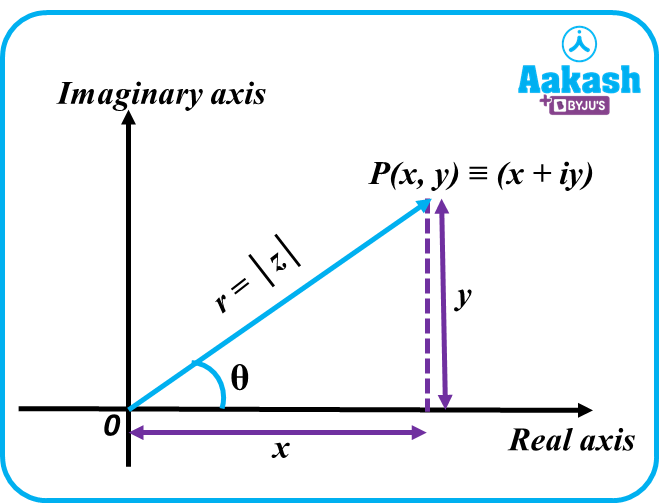
Length OP is called the modulus of the complex number denoted by |z| and is called the argument or amplitude.
Modulus of a Complex number
Length OP=|z|= modulus of complex number
From the figure we have,
Clearly, we can say that |z| 0
Note - In a set of all complex numbers, Z1>Z2 or Z1<Z2 has no meaning. But |Z1|>|Z2| or |Z1|<|Z2| has meaning because |Z1|, |Z2| are non-negative real numbers.
Argument of a Complex number()
The angle which OP makes with positive x - axis is called argument or amplitude of z. It is denoted by arg(z) or amp(z)
From the figure, we have
The angle has infinitely many values possible by adding integral multiples of 2
Principal Argument of a Complex Number:
Argument of a complex number is called Principal argument or principal amplitude when lies in the following interval:
Method for finding the Principal Argument
The argument of a complex number depends on the quadrant in which it is lying.
Let
First we will compute =-1yx ( will be the acute angle made with the X-axis)
Case 1 If x>0 and y>0, then z is lying in the first quadrant then,
Case 2 If x<0 and y>0, then z is lying in the second quadrant then,
Case 3 If x<0 and y<0, then z is lying in the third quadrant
Case 4 If x>0 and y<0, then z is lying in the fourth quadrant
2. Polar form of Complex numbers
This representation is used when the modulus and the argument of a complex number are given.
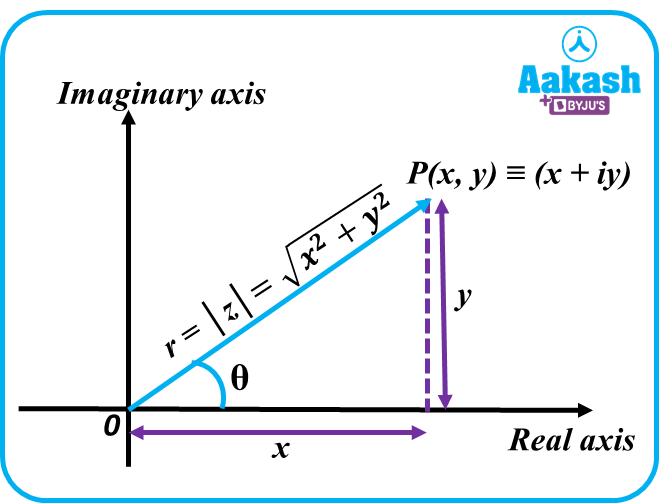
In the above figure,
We have, z=x+iy
where |z| is the modulus of z and is principal argument
For the general value of , z is expressed as:
: nintegers.
Note- cos+i sin can also be written as CiS
3. Exponential Form/Euler Form of a Complex
The formula ei=+i is known as Euler’s Formula
So, the above equation in Polar form can be written in the Euler/Exponential form as:
We know, …………..(1)
……………(2)
Adding (1) & (2) we get
Subtracting (2) from (1)
are known as Euler’s identities.
Therefore, a complex number can also be expressed as , which is known as the Euler/Exponential form of a complex number.
Practice Problems
1) Number of integral values of ‘n’ for which (n+i)4 is an integer.
Solution:
Expanding
For (n+i)4to be an integer, the imaginary part should be zero
Either
Therefore, 3 integral values are possible i.e.,
2) Write the following complex numbers in polar form
Solution: (a)
Let
Since the point is lying in second quadrant
Therefore, the principal argument is given as-
∴ Polar form of
Let
Since the point is lying in the first quadrant
Therefore, the principal argument is given as-
∴ Polar form of
3) Find the value of n=1100in=?
Solution:
Method 1:
in is forming a G.P having first term a=i and common ratio r=i
= 0
Method 2:
We know that sum of 4consecutive powers of iota(i) is always zero.
Therefore,
4) Find the real part of (1-i)-i
Solution:
Let
Hence, Real part of
FAQs
1) Are irrational numbers a subset of complex numbers?
Answer: Yes, irrational numbers are subset of complex numbers
E.g 2 can also be written as: 2+i 0
2) What is the value of ii?
Answer: i can be written as
3) What is the geometrical representation of a complex number in the argand plane?
Answer: A complex number behaves like a point ( or a position vector ) in the complex or argand plane.
4) Can a complex number have multiple arguments?
Answer: Yes, a complex number can have multiple arguments. For example, if a complex number has the principal argument 4, then the same complex number can have the following valid arguments as well:

 Call Now
 Let's Chat
 Share
Share