-
Call Now
1800-102-2727


Vapour Pressure - Characteristics, Examples, Factors Affecting Vapour Pressure, Practice Problems and FAQ

Do you like biryani?
I know that’s a lame question. Who doesn’t love biryani? Doesn't the spicy aroma instantly whet your appetite?
We usually prepare biryani in a pressure cooker, don’t we?
Speaking of pressure cookers, have you ever wondered how a pressure cooker works?
A pressure cooker's entire operation is based on the pressure exerted by the vapours of water. Water vapours start to form when heat is applied to the contents of the pressure cooker. This tends to raise the utensil's pressure. The pressure cooker's whistle mechanism is activated as the pressure exerted by the vapours of water gradually rises. The pressure decreases only when the source of heat is removed because the absence of heat prevents the formation of new water vapours and makes the existing vapours condense back to liquid form.
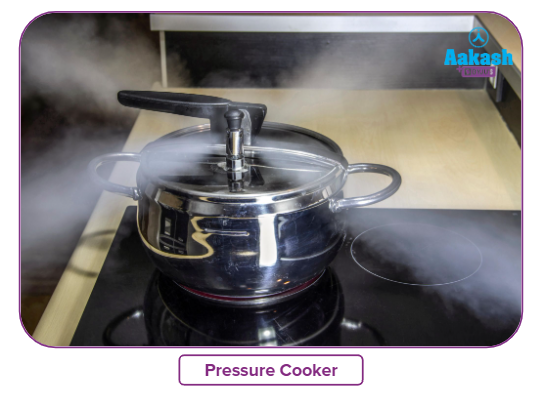
TABLE OF CONTENTS
- What is Vapour Pressure?
- Characteristics of Vapour Pressure
- Factors Affecting Vapour Pressure
- Examples of Vapour Pressure
- Practice Problems
- Frequently Asked Questions - FAQ
What is Vapour Pressure?
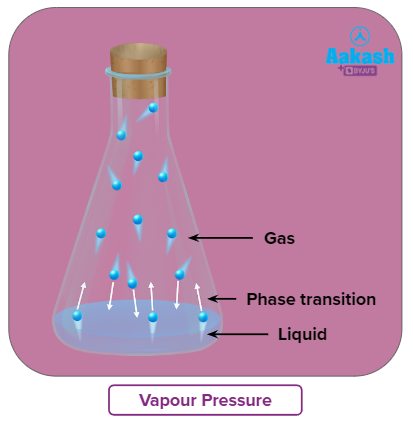
When you add a liquid to a container that is constantly heated, the molecules of the liquid move in different directions and at different speeds. This is due to the various kinetic energies of liquid molecules.
When the liquid is heated, the energy of the molecule increases. It becomes lighter and occupies the surface of the liquid. This process is called "evaporation". Molecules visible on the surface of the liquid are called "vapours".
Evaporation continues at a constant rate when the temperature of the liquid remains constant. When some molecules of the liquid in the gas phase hit the walls of the container or the surface of the liquid, they can be returned to the liquid phase. This process is called condensation.
Vapour pressure, also called vapour equilibrium pressure, can be defined as the pressure applied (in a thermodynamic equilibrium system) by vapour with a condensed phase (solid or liquid) in a closed system at a particular temperature. As is well known, equilibrium vapour pressure serves as an indicator of the rate of evaporation of a liquid. The tendency of particles to escape from liquids (or solids) is related to this. Materials with a high vapour pressure at room temperature are commonly referred to as volatile materials. Note that the pressure that the vapour exerts on the surface of a liquid is called vapour pressure.
Characteristics of Vapour Pressure
As time passes, the number of molecules in the vapour phase increases, as does the rate of condensation. It eventually reaches a point where the rate of evaporation equals the rate of condensation. This is known as the equilibrium stage.
The pressure exerted by the molecules at this location, as depicted by the manometer, is known as the liquid's vapour pressure. The pressure exerted by the vapour above the liquid is described as vapour pressure.
The vapour pressure of a liquid is independent of the volume of liquid in the container, whether one litre or thirty litres; at the same temperature, both samples will have the same vapour pressure. Temperature has an exponential relationship with vapour pressure, which indicates that as the temperature rises, so does the vapour pressure.

Factors Affecting Vapour Pressure
Vapour pressure depends on the following factors:
- Surface tension
- Temperature
- Nature of the liquid
- Mole fraction
Surface Tension
Each molecule of most of the liquids experiences forces in all directions, and thus experiences a net vector sum of forces acting on the particles. For the particles on the bulk of the solution (A), the net sum of forces will be zero.
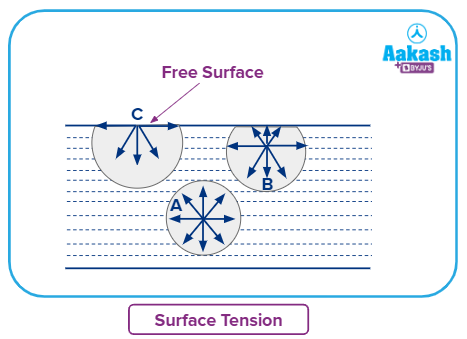
However, the particles on the surface (C) experience forces from only one direction. The net force a particle receives on a surface per unit length of the surface is known as surface tension. The higher the intramolecular force, the higher the surface tension and lower the vapour pressure.
In the bulk, all the forces acting between the particles are mutually balanced, but the particles on the surface are not surrounded by atoms or molecules on all the sides and hence, they possess residual attractive forces or unbalanced forces.
Temperature
The effect of temperature can also be understood using thermodynamics as follows:
Consider the evaporation of liquid
Liquid ⇌ Vapour
This conversion, or evaporation requires heat. So, H (or Hvap) is positive or evaporation is always endothermic.
According to Le Chatelier's principle, an increase in the temperature of a system in dynamic equilibrium promotes endothermic changes. Therefore, as the temperature rises, the amount of steam present increases. Therefore, the saturated vapour pressure rises. The effect of temperature on the vapour pressure of a liquid is as follows.
Quantitative measurement using Clausius-Clapeyron equation is as follows

Where,
△H = Enthalpy of vaporisation
P1 = Vapour pressure of the liquid at temperature T1
P2 = Vapour pressure of the liquid at temperature T2
Nature of the Liquid
One of the most important factors influencing vapour pressure is the nature of the liquid. The effect of the liquid's nature can be explained using intermolecular forces. As the magnitude of intermolecular forces increases, so does the vapour pressure. When the magnitude of intermolecular forces decreases, the liquid's vapour pressure rises. Glycerol, for example, has a lower vapour pressure than isopentane at a given temperature. This is due to the greater magnitude of the intermolecular forces in glycerol.
Mole Fraction
The effect of mole fraction on vapour pressure is best explained by Raoult’s law.
Raoult’s law can be stated as, “for a solution of volatile liquids, the partial vapour pressure of each volatile component in the solution is directly proportional to its mole fraction present in the solution.”
Mathematically, Raoult’s law can be expressed as
PSolution = PoSolvent 𝜒Solvent
PSolution = Vapour pressure of the solution
PoSolvent = Vapour pressure of the pure solvent
𝜒Solvent = Mole fraction of the solvent
Examples of Vapour Pressure
- A tea kettle is the greatest way to show vapour pressure. When the water in the kettle begins to boil, the number of water vapours inside the kettle increases. The water vapours exert pressure on the kettle's lid, pushing it upwards.
- The boiling point has a significant impact on the vapour pressure. The boiling point of a substance and its vapour pressure are inversely proportional. It means that if a liquid's boiling point is higher than another liquid's boiling point, the vapour pressure of the liquid with the higher boiling point will be lower. For example, When comparing the vapour pressures of ethyl alcohol with ether, ether has a larger vapour pressure due to its lower boiling point.
- The reason that water in large bodies of water does not evaporate easily is that low vapour pressure in such bodies of water increases the surface tension of the water, preventing water molecules from binding and evaporating quickly. In addition, water molecules that exist in huge water bodies such as lakes, ponds, and seas tend to evaporate and condense at the same time, and can maintain a certain amount of water.
Practice Problems
Q1. The lowest vapour pressure is exerted by which of the following?
- Water
- Alcohol
- Ether
- Mercury
Solution: The attractive forces existing between the individual atoms of mercury are quite strong when compared to the attractive molecular forces present in alcohols, ethers, and water, such as hydrogen bonding.
So, option D) is the correct answer.
Q2. The partial pressure of oxygen at high altitudes is lower than at ground level. This leads to:
- low oxygen concentrations in the blood and tissues
- High oxygen concentrations in the blood and tissues
- release of dissolved gases and development of nitrogen bubbles in the blood
- thickening of blood and tissues
Solution: The low atmospheric pressure causes low oxygen levels in the blood and tissues of people living in the highlands. The partial pressure of oxygen is lower at high altitudes than on the ground. This decrease in atmospheric pressure causes the blood to lose oxygen.
So, option A) is the correct answer.
Q3. Pure liquids A and B hve vapour pressure values as 400 mm of Hg and 600 mm of Hg respectively. When the two liquids are mixed, the sum of the initial volumes equals the final mixtures. Liquid B has a mole fraction of 0.5 in the mixture. The vapour pressure of the final solution is
Solution:
Ptotal = PA + PB
Ptotal = PoA XA + PoB XB
Given: PoA =400 mm of Hg
PoB =600 mm of Hg
XB = 0.5
XA = 1-0.5=0.5
Ptotal = PoA XA + PoB XB
Ptotal = 400 ✕ 0.5+600 ✕ 0.5
Ptotal = 500 mm of Hg
Q4. To the peak of Mount Everest, a volatile liquid with a vapour pressure of 85 KPa (at sea level, 25o C) is taken. Which of the following statements is correct?
- The vapour pressure of the solution decreases
- The solution will condense quickly than when at sea level
- The solution will evaporate quickly than when at sea level
- The vapour pressure of the solution increases
Solution: When the vapour pressure of a solution equals the surrounding air pressure, the solution boils. With increasing altitude, air pressure decreases. As a result, as compared to the solution at sea level, the vapour pressure equals the atmospheric pressure in a shorter amount of time. As a result, the solution will evaporate quickly because the boiling point will be reached faster.
So, option C) is the correct answer.
Frequently Asked Questions - FAQ
Question 1. How do skin cracks occur?
Answer: Low vapour pressure causes skin crevices, which are common in the winter. The air in the winter is naturally dry. The lower the vapour pressure value, the less water vapour in the air. The water in skin cells has a vapour pressure that is significantly higher than the vapour pressure in the surrounding environment. As a result, water molecules tend to move from high pressure to low pressure regions. As a result, the skin cannot retain water and cracks appear.
Question 2. Why is the vapour pressure of liquid constant at a constant temperature?
Answer: The pressure of a vapour at equilibrium when the rate of evaporation equals the rate of condensation is known as vapour pressure. Because the equilibrium constant does not change at a given temperature, the vapour pressure remains constant.
Question 3. What is the heat of vaporisation?
Answer: When we heat a liquid, its energy increases, resulting in an increase in the overall temperature. The excess heat is used up by the molecules at the boiling point to overcome the intermolecular force of attraction in the liquid and transition to the gaseous state.
The amount of heat provided by this process when 1 mole of liquid is changed into a gaseous state is known as the Heat of vaporisation.
Related Topics
|
Raoult’s Law |
Elevation in Boiling Point |
|
Steam Distillation |
Depression in Freezing Point |
|
Relative Lowering of Vapour Pressure |
Henry’s Law |

NEET Related Links
JEE MAIN Related Links
JEE Advanced Related Links
JEE Advanced Eligibility Criteria
JEE Advanced Chemistry Syllabus
JEE Advanced Registration Dates
CUET Related Links
Important Topics
Anemometer : Measurement of Wind Speed
Angular Acceleration Atomic Theory Audible and Inaudible Sound Average Speed and Average Velocity Average Velocity Avogadros Number Avogadros Hypothesis Azimuthal Quantum Number Balanced Force Bar Magnet Biconvex Lens Boyles Law Buoyancy Calorimeter Carnot Engine Celestial Bodies Centripetal And Centrifugal Force Concave and Convex Lenses Concave Convex Mirrors Contact and Non Contact Force Controlled Thermonuclear Fusion Convection Currents Convex Lens Convex Mirror Destructive Interference Difference Between Conduction Convection and Radiation Difference Between Electric Field and Magnetic Field Difference Between Heat And Temperature Difference Between Series And Parallel Circuits Differences Between Acceleration And Velocity Distance and Displacement Distance Time Graph Electrical Force : Electric Forces and Their Types Electromagnetic Waves : Definition, Equation and Properties of Electromagnetic Waves Electromagnetism Electron Spin Fluid Flow : Bernoullis Equation Derivation and Fluid Mechanics Fluid Friction : Types and Factors of Fluid Friction Frames of Reference : Inertial and Non- Inertial Frame of Reference Frequency and Wavelength Frictional Force Importance of Hydrosphere Instantaneous Speed and Velocity Introduction to Motion Kinetic and Potential Energy Difference Law Of Conservation of Energy Layers of the Earth Light Energy Light Sources List of physics scientists and Their inventionsLoudness of Sound
Magnetic Dipole Moment Magnetic Field Non - Contact Force Non - Renewable Energy Ohms Law Optics P Wave Physics Symbols Plane Mirrors Poissons Ratio Projectile Motion Properties of Water : Anomalous Expansion of Water Radius of Gyration Reflection of Light Reflection of Waves Relative Density Resonance Reverberation Rolling Friction Rotation and Revolution Screw Gauge Semiconductors and Insulators Sliding Friction Speed Time Graphs Static Friction Stefan Boltzmann Law Stress Tension Tension Force Thermometer: Clinical Laboratory Thermometer Types of Rocks Types of Waves Uniform Motion and Non Uniform Motion Unit of Voltage Uses of Convex Lens Uses Of Convex Mirror Uses of Electromagnet Uses of Optical Fibre Wave Wavelength of Light What is Scattering of Light Working of Electric Bell Conventional and Non-conventional Sources of Energy Buoyant Force Bulk Modulus of Elasticity Bernoulli’s Principle Angular Momentum Difference Between Speed And Velocity ForceUnit of Heat
Difference between Distance and Displacement Simple Microscope Derivation Of Equation Of Motion Thermometer: Clinical & Laboratory Thermometer Difference between Concave and Convex LensDerivation Of Lens Maker Formula
Unit Of Pressure Velocity Uses of Plane Mirror
Wave Theory of Light
Unit of Density Unit of Light Unit of Force Unit of Magnetic Field Unit of wavelength Unit of Viscosity Uses of Electroplating Young's Modulus
What is the Scattering of Light
Lenz Law Space Wave Propagation Schrodinger Wave Equation Relation between Fahrenheit and Celsius Refractive Index Potentiometer Working Pascal Law Oscillatory Motion Optical Instruments Newton's Laws of Motion - First Law Modulation and Demodulation Magnetic Flux Lens Formula and Magnification Kaleidoscope Faradays Law Epsilon Naught Value Energy Bands Electrostatics Electroscope AC Generator Unit of Current Lithosphere Bending Equation Derivation Difference Between Pound and Kilogram Semiconductor Devices OTEC - Ocean Thermal Energy Conversion Hall Effect Rectilinear Propagation of Light Difference Between Ammeter and Voltmeter Coefficient of Linear Expansion Ampere’s Law Cyclone and Thunderstorm Save The Environment From Pollution Particle Nature of Light Types of DC Motor Uses Of Transistor Derivation of Phase Rule Unit of Humidity

 Call Now
 Let's Chat
 Share
Share