-
Call Now
1800-102-2727


Coordination Number in Coordination Chemistry

The coordination number is an important concept in chemistry that describes the structure of coordination compounds. It refers to the number of ligand atoms or ions directly bonded to a central metal ion in a coordination complex. The coordination number usually ranges from 2 to 9, depending on factors such as the charge, electronic configuration, and size of the metal ion, as well as the size and nature of the ligands.
These interactions typically involve the s and p orbitals of the ligands and the d orbitals of the metal ion. Larger metal ions with smaller ligands generally allow higher coordination numbers, as seen in complexes like [Mo(CN)₈]⁴⁻.
Coordination Number
The coordination number of a metal ion in a coordination compound is the number of ligand donor atoms to which the metal is directly bonded. This number is crucial in determining the shape or geometry of the coordination complex. In these compounds, the central metal ion acts as a Lewis acid, accepting electrons from ligands that act as Lewis bases.
Alfred Werner was the first to explain the concept and structure of coordination compounds. Coordination compounds are known to retain their identity in solid and liquid states. In crystal structures, the coordination number can also refer to the number of nearest neighbouring atoms, ions, or molecules surrounding a particular particle.
For example, in a face-centred cubic (fcc) close-packed structure, the coordination number is 12. In this arrangement, each sphere is in contact with six spheres in the same plane, three spheres in the plane above, and three spheres in the plane below.
Coordination Number Calculation Formula
The coordination number (CN) of a metal ion can be calculated using the number of ligands attached to the metal and the denticity of each ligand:
Coordination Number (CN) = Number of Ligands × Denticity of Each Ligand
where number of ligands = total ligands bonded to the metal ion, and denticity = number of donor atoms in a ligand that bind with the metal ion.
Example: [Co(NH₃)₆]³⁺ — here, ammonia is a monodentate ligand (denticity = 1). So, CN = 6 × 1 = 6.
Example: [Ni(en)₃]²⁺ — here, ethylenediamine (en) is a bidentate ligand (denticity = 2). So, CN = 3 × 2 = 6.
Thus, the coordination number is obtained by multiplying the number of ligands by their denticity and summing the total donor atoms attached to the central metal ion.
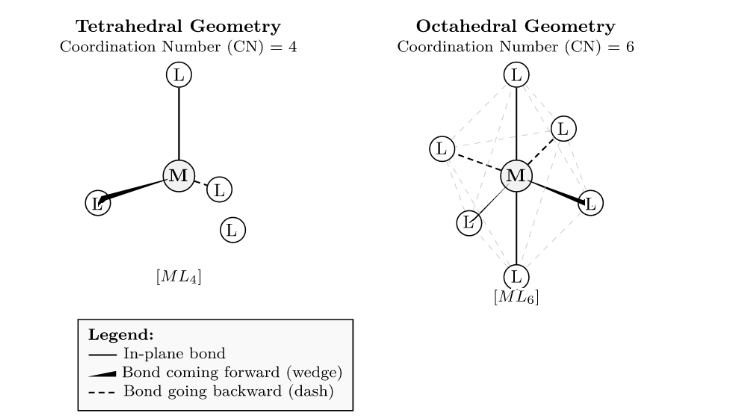
Coordination Number Geometry
In geometry, when talking about coordination number, there are always various possible configurations for each coordination number.
- Geometry is linear for coordination number 2.
- For coordination number 3, the geometry is trigonal planar, as seen in [HgI₃]⁻, and in some cases, a T-shaped geometry may also occur.
- A CN of 4 may be described as tetrahedral or square planar.
- When CN is 5, the geometries can be square pyramidal, as seen in [VO(acetylacetonate)₂], or trigonal bipyramidal, as in [Fe(CO)₅].
- For CN of 6, the geometry is octahedral, as seen in [Co(NH₃)₆]³⁺.
Ligands
Ligands are ions or neutral molecules that bind to a central metal atom or ion in a coordination complex by donating one or more pairs of electrons. Since they donate electron pairs to the metal ion, ligands act as Lewis bases, while the metal ion acts as a Lewis acid.
π-bonding Interactions: some ligands can also participate in π-bonding interactions with the metal. In such cases, ligands may behave as π-acid ligands by accepting electron density from the metal's d orbitals, or as π-donor ligands by donating electron density to the metal.
Types of Ligands
Coordination complexes can be classified based on the type of ligands present:
Homoleptic complexes: contain only one type of ligand attached to the metal ion.
Heteroleptic complexes: contain two or more different types of ligands bonded to the central metal ion.
Coordination complexes can also be classified based on the denticity of ligands:
Monodentate ligand: has only 1 donor site, such as ammonia, carbonyl, and phosphine.
Bidentate ligand: has 2 donor sites in the ligand, for example, the oxalate ion.
Polydentate ligand: has more than two donor atoms. For example, EDTA (ethylenediaminetetraacetate) is a hexadentate ligand.
Importance of Coordination Numbers
Determines Geometry
The coordination number has a direct effect on the ligand arrangement around the metal ion, which in turn determines the geometry of the complex.
Stability and Reactivity
Coordination number is also a factor in the stability of complexes. For example, an octahedral complex with six ligands may be more stable than a square planar complex with four ligands, depending on the ligands and the metal.
Influences Physical and Chemical Properties
The coordination number and geometry may influence the magnetic, optical, and reactivity characteristics of coordination compounds. Here is how:
Magnetic Properties (Example: [NiCl₄]²⁻, tetrahedral): [NiCl₄]²⁻ has a coordination number of 4 with a tetrahedral geometry and is paramagnetic in nature because of the presence of unpaired electrons. In contrast, [Ni(CN)₄]²⁻ has the same coordination number of 4 but a square planar geometry, and is diamagnetic because all electrons in the d-orbitals are paired due to the strong ligand field provided by the cyanide ions.
Optical Properties (Example: [Cr(H₂O)₆]³⁺): the octahedral complex [Cr(H₂O)₆]³⁺ absorbs light differently from the tetrahedral complex [CrCl₄]⁻, resulting in different colours for the two solutions. This is because the two complexes have different ligand field strengths and d-orbital splitting energies.
Reactivity Properties (Example: [PtCl₄]²⁻): the coordination number and geometry also influence the reactivity and stability of coordination compounds. For example, the square planar complex [PtCl₄]²⁻ undergoes substitution reactions more readily than many octahedral complexes. This is because the arrangement of ligands around the metal ion affects how easily incoming ligands can approach and replace existing ligands. Changes in coordination number and geometry can therefore alter the reaction rate and mechanism of coordination compounds.
Summing Up
Coordination compounds are chemical compounds in which a central metal atom or ion is bonded to surrounding molecules or ions called ligands through coordinate (dative) bonds. In these compounds, the metal ion acts as a Lewis acid by accepting electron pairs, while the ligands act as Lewis bases by donating electron pairs. The central metal ion, together with the attached ligands, forms a coordination entity or complex ion, which is written inside square brackets. The net charge of the complex is also indicated within the brackets. Ions present outside the brackets are called counterions, which balance the overall charge of the compound.
FAQs
What is the difference between the coordination number and the oxidation number?
Coordination number refers to the number of ligand donor atoms bonded to the metal, whereas oxidation number represents the charge on the metal ion after accounting for ligand charges.
Can a ligand contribute more than one atom to the coordination number?
Yes. Polydentate ligands such as ethylenediamine (en) or EDTA bind through multiple donor atoms and therefore contribute more than one to the coordination number.
What is the most common coordination number in transition metal complexes?
The most common coordination number is 6, which usually forms an octahedral geometry.
Can the coordination number change in chemical reactions?
Yes. During ligand substitution or redox reactions, the coordination number of the metal ion may increase or decrease depending on the ligands involved.

Last Updated: Jul 13, 2026 12:14 PM
NEET Related Links
JEE MAIN Related Links
JEE Advanced Related Links
JEE Advanced Eligibility Criteria
JEE Advanced Chemistry Syllabus
JEE Advanced Registration Dates
CUET Related Links
Important Topics
Anemometer : Measurement of Wind Speed
Angular Acceleration Atomic Theory Audible and Inaudible Sound Average Speed and Average Velocity Average Velocity Avogadros Number Avogadros Hypothesis Azimuthal Quantum Number Balanced Force Bar Magnet Biconvex Lens Boyles Law Buoyancy Calorimeter Carnot Engine Celestial Bodies Centripetal And Centrifugal Force Concave and Convex Lenses Concave Convex Mirrors Contact and Non Contact Force Controlled Thermonuclear Fusion Convection Currents Convex Lens Convex Mirror Destructive Interference Difference Between Conduction Convection and Radiation Difference Between Electric Field and Magnetic Field Difference Between Heat And Temperature Difference Between Series And Parallel Circuits Differences Between Acceleration And Velocity Distance and Displacement Distance Time Graph Electrical Force : Electric Forces and Their Types Electromagnetic Waves : Definition, Equation and Properties of Electromagnetic Waves Electromagnetism Electron Spin Fluid Flow : Bernoullis Equation Derivation and Fluid Mechanics Fluid Friction : Types and Factors of Fluid Friction Frames of Reference : Inertial and Non- Inertial Frame of Reference Frequency and Wavelength Frictional Force Importance of Hydrosphere Instantaneous Speed and Velocity Introduction to Motion Kinetic and Potential Energy Difference Law Of Conservation of Energy Layers of the Earth Light Energy Light Sources List of physics scientists and Their inventionsLoudness of Sound
Magnetic Dipole Moment Magnetic Field Non - Contact Force Non - Renewable Energy Ohms Law Optics P Wave Physics Symbols Plane Mirrors Poissons Ratio Projectile Motion Properties of Water : Anomalous Expansion of Water Radius of Gyration Reflection of Light Reflection of Waves Relative Density Resonance Reverberation Rolling Friction Rotation and Revolution Screw Gauge Semiconductors and Insulators Sliding Friction Speed Time Graphs Static Friction Stefan Boltzmann Law Stress Tension Tension Force Thermometer: Clinical Laboratory Thermometer Types of Rocks Types of Waves Uniform Motion and Non Uniform Motion Unit of Voltage Uses of Convex Lens Uses Of Convex Mirror Uses of Electromagnet Uses of Optical Fibre Wave Wavelength of Light What is Scattering of Light Working of Electric Bell Conventional and Non-conventional Sources of Energy Buoyant Force Bulk Modulus of Elasticity Bernoulli’s Principle Angular Momentum Difference Between Speed And Velocity ForceUnit of Heat
Difference between Distance and Displacement Simple Microscope Derivation Of Equation Of Motion Thermometer: Clinical & Laboratory Thermometer Difference between Concave and Convex LensDerivation Of Lens Maker Formula
Unit Of Pressure Velocity Uses of Plane Mirror
Wave Theory of Light
Unit of Density Unit of Light Unit of Force Unit of Magnetic Field Unit of wavelength Unit of Viscosity Uses of Electroplating Young's Modulus
What is the Scattering of Light
Lenz Law Space Wave Propagation Schrodinger Wave Equation Relation between Fahrenheit and Celsius Refractive Index Potentiometer Working Pascal Law Oscillatory Motion Optical Instruments Newton's Laws of Motion - First Law Modulation and Demodulation Magnetic Flux Lens Formula and Magnification Kaleidoscope Faradays Law Epsilon Naught Value Energy Bands Electrostatics Electroscope AC Generator Unit of Current Lithosphere Bending Equation Derivation Difference Between Pound and Kilogram Semiconductor Devices OTEC - Ocean Thermal Energy Conversion Hall Effect Rectilinear Propagation of Light Difference Between Ammeter and Voltmeter Coefficient of Linear Expansion Ampere’s Law Cyclone and Thunderstorm Save The Environment From Pollution Particle Nature of Light Types of DC Motor Uses Of Transistor Derivation of Phase Rule Unit of Humidity

 Call Now
 Let's Chat
 Share