-
Call Now
1800-102-2727


Types of Nucleic Acids – Nucleic Acid, Discovery, Structure, Classification, Practice Problems and FAQ

Have you ever wondered why we resemble our parents? Why do siblings have a similar appearance? Why do fingerprints and hair strands become crucial in every police investigation?
A living cell's nucleus is in charge of transmitting these inborn traits, often known as heredity.
This can be seen in relation to nucleic acid, which is in charge of intrinsic personality. The basic information-carrying components of the cell, nucleic acids, regulate the production of proteins, which in turn define the inherited features of every living thing.
We will talk about nucleic acids in this article, including how they are created, how they contribute to the transmission of traits, and what they do.
TABLE OF CONTENTS
- Nucleic Acids – Discovery
- Nucleic Acids – Introduction
- Nucleic Acids – Chemical Composition
- Nucleic Acids – Structure
- Nucleic Acids – Classification
- DNA – Structure
- DNA – Functions
- RNA – Structure
- RNA – Functions
- Practice Problems
- Frequently Asked Questions – FAQ
Nucleic Acids – Discovery
Friedrich Miescher discovered nucleic acid in 1868 and termed it nuclein after isolating it from the nuclei of white blood cells. The long-chain biomolecule nucleic acid (DNA and RNA) is made up of nucleotide monomers. It has genetic information in it.
Originally believed to only be found in the nucleus of eukaryotic cells, it is now known that all living entities contain nucleic acids. Together, DNA and RNA are referred to as nucleic acids, sometimes known as polynucleotides, as they are members of a family of biopolymers. These molecules were originally called "nucleic acids" since they were discovered inside the nucleus and had phosphate groups, which are connected to phosphoric acid.
Nucleic Acids – Introduction
The particles in the nucleus of a cell which are responsible for heredity are known as chromosomes. They are made up of proteins and another type of biomolecule known as nucleic acids.
Nucleic acids are long-chain polymeric polymers whose monomer (repeating unit) is called ‘nucleotide’. Thus, nucleic acids are frequently referred to as polynucleotides. Nucleic acids are polymers of nucleotides made up of DNA (deoxyribonucleic acid) and RNA (ribonucleic acid). It is crucial for passing down genetic information from one generation to the next.
Chromosomes are the particles in the nucleus of a cell that is responsible for genetic inheritance. They are made up of proteins and nucleic acids. Modern biological and medical research heavily relies on experimental studies of nucleic acids, which also serve as the basis for forensic and genomic science, as well as the biotechnology and pharmaceutical industries.
Nucleic Acids – Chemical Composition
The linear polymers (chains) of nucleotides are the ones that make up nucleic acids. Each nucleotide is made up of three parts: a pentose sugar (5-carbon monosaccharide), an acidic phosphate group (PO43-), and a purine or pyrimidine nucleobase (also known as a nitrogenous base or simply base).
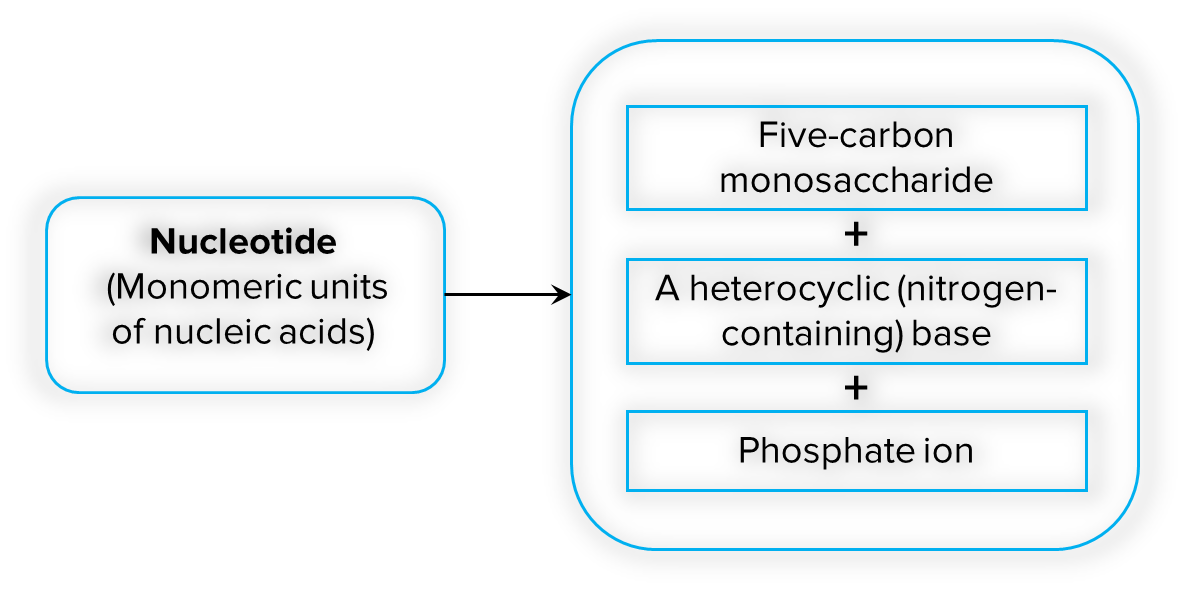
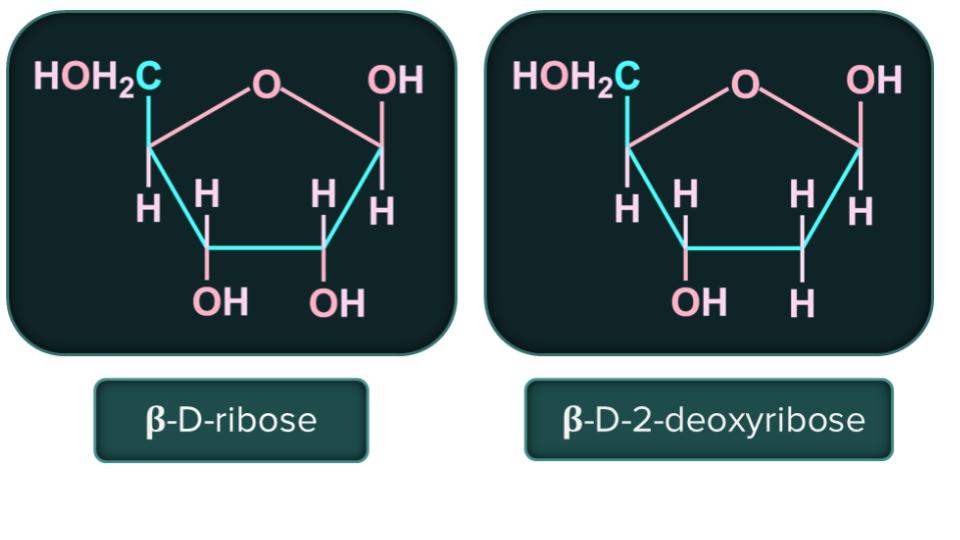
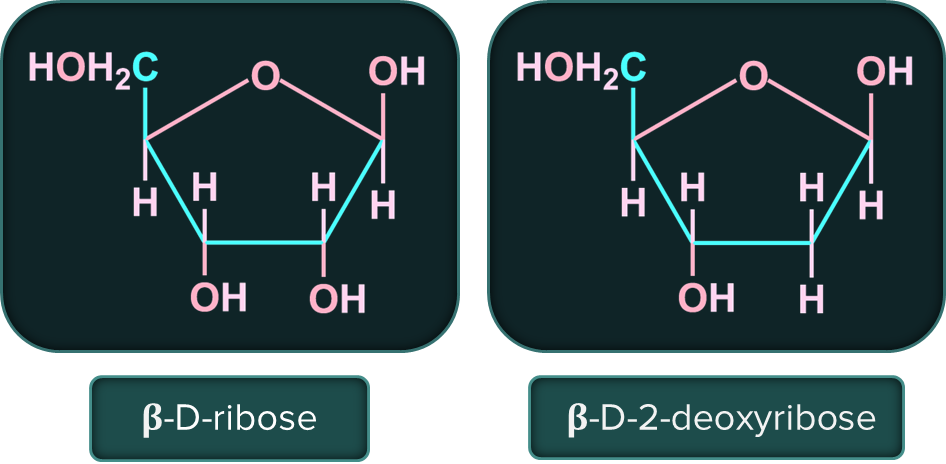
Nucleoside refers to the substructure made up of a nucleobase and sugar. Different forms of nucleic acids have different sugar structures in their nucleotides. For example, the sugar moiety in DNA is 𝛃-D-2-deoxyribose while the sugar moiety in RNA is 𝛃-D-ribose. The only difference is that 𝛃-D-ribose contains an extra hydroxyl group.
Adenine, cytosine, and guanine can be found in both RNA and DNA, however thymine is only found in DNA and uracil is found only in RNA.
Nucleic Acids – Structure
The pentose sugar's 5′ and 3′ carbon atoms form a phosphodiester bond that binds nucleotides together.
A simplified version of the nucleic acid chain is given below.
As long-chain polymers of nucleotides, nucleic acids are also referred to as polynucleotides. The information regarding the sequence of nucleotides in the chain of a nucleic acid is known as its primary structure.
Nucleic Acids – Classification
Nucleic acids come in two main categories: deoxyribonucleic acid (DNA) and ribonucleic acid (RNA). Through DNA and RNA, specific qualities are inherited and passed down from one generation to the next.
DNA – Structure
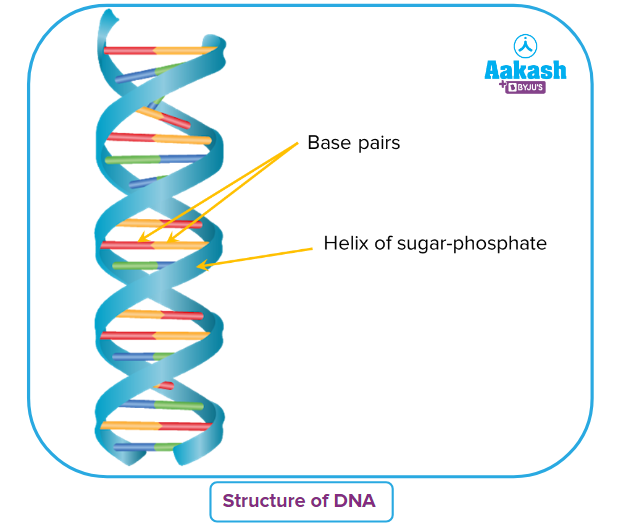
James Watson and Francis Crick postulated that DNA is organised as a double-stranded helix. Two nucleic acid strands are held together by hydrogen bonds that develop between adjacent pairs of bases. Because the two strands of the double helix are complementary and hydrogen bonds are formed between particular base pairs, the double helix is formed. Phosphoric acid, Pentose sugar and some nitrogenous cyclic bases make up DNA. DNA molecules are made up of D-2-deoxyribose, a sugar. Cyclic bases with nitrogen are adenine (A), guanine (G), cytosine (C), and thymine (T). Unlike pyrimidine bases, which only contain one ring, purine bases have two rings in their structure.
These bases, together with how they are arranged in DNA molecules, are crucial for passing on knowledge from one generation to the next. Because the hydrogen bonds are created between particular pairs of bases, the two strands are complementary to one another. Adenine (A) forms hydrogen bonds with thymine (T). Whereas, cytosine (C) forms hydrogen bonds with guanine (G).
DNA – Functions
- The nucleus of our cells contains chromosomes which are the tightly packed structures of DNA. These chromosomes are responsible for the transfer of genetic information from parent to daughter cell. This process of genetic transfer is called vertical transfer.
- DNA undergoes a process of replication to duplicate the amount of genetic material present in the cell. This replicated DNA later undergoes a process of transcription and forms complementary RNA strands. And the RNA further undergoes translation to form proteins. This implies that DNA forms the basic genetic code for the formation of proteins.
- DNA does not have a structural role in the cell, however, it can undergo breakdown with the help of nucleases to replenish the source of nucleotides and their components in the cell.
- The structure of DNA is also used to study evolution and correlation amongst species of animals.
- The minute traces of blood or hair or any fingerprint on a crime weapon, found at the crime scene contains an ample amount of DNA that can be sequenced and used to trace the culprit.
- A sequence of bases on DNA is unique for a person, and the information regarding this is known as DNA fingerprinting. It is the same for every cell and cannot be altered by any known treatment.
RNA – Structure
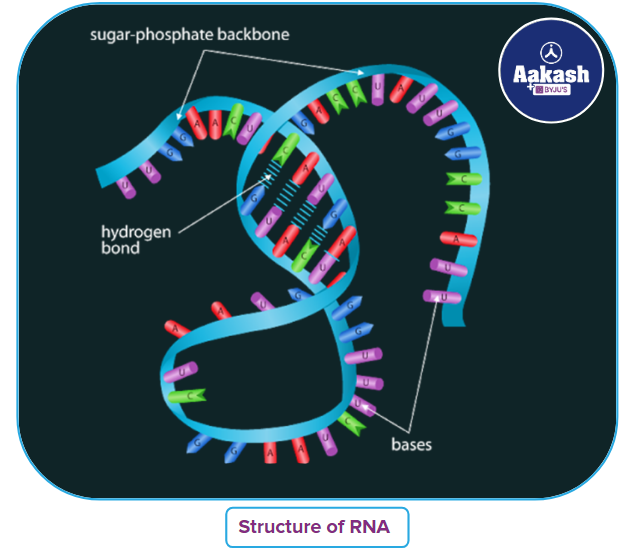
Ribonucleic acid (RNA) is a single-stranded helix with nucleotides containing a complete pentose sugar, nitrogenous bases like uracil, cytosine, adenine and guanine, and a phosphate group. In the secondary structure of RNA, helices are present which are only single stranded. They may reverse their folding pattern to generate a double helix structure. Instead of thymine, uracil serves as the nitrogen base of RNA.
There are different types of RNA present in the cell like mRNA, tRNA, rRNA performing various functions of the cell with respect to protein synthesis. Apart from this, there are other non-coding RNAs present in the cell as well.
RNA – Functions
Different types of RNA in the cell perform different functions.
- An important function of nucleic acids is the protein synthesis in the cell. The instruction for a certain protein's synthesis is present in DNA, but the proteins are synthesised by a variety of RNA molecules in the cell.
- Messenger RNA (mRNA) contains sets of triplet nucleotides (codons) that code for a specific amino acid in the protein. These mRNAs form the basis of protein synthesis.
- Ribosomal RNA (rRNA) are known to combine with proteins in order to form ribosomes. These ribosomes bind to mRNA and bring about the translation of the codon into amino acids.
- Transfer RNA (tRNA) is 70-90 nucleotides long and helps in the transfer of amino acids to the ribosomal subunit at the site of protein synthesis.
- Ribozyme, a ribosome containing catalytic enzymes, brings about certain biochemical reactions in the cell, like gene-splicing.
- RNA can also be used as a diagnostic parameter in the detection of an underlying viral infection.
In a nutshell, nucleic acids are crucial for passing down genetic information from one generation to the next. Any defect in the structure of nucleic acid leads to abnormalities and fatality. Both DNA and RNA form the core of genetic transfer and are essential for the survival and existence of humankind.
Recommended Video
Nucleic Acids Biomolecule Class 11 Biology Concepts Explained (L4) | NEET 2024 Exam Preparation
Practice Problems
1. Compare DNA and RNA.
Solution:
|
DNA |
RNA |
|
Definition |
|
|
It is a lengthy polymer. It has four bases—adenine, guanine, cytosine, and thymine—as well as a deoxyribose and phosphate backbone. |
It is a polymer made of ribose and phosphate that has four distinct bases: adenine, guanine, cytosine, and uracil. |
|
Location |
|
|
It is found in the nucleus and mitochondria of a cell. |
It is found in the ribosome, nucleus and cytoplasm. |
|
Sugar portion |
|
|
It has 2-deoxyribose. |
It has D-Ribose. |
|
Function |
|
|
The instruction for the production of a specific protein is encoded in DNA, but different RNA molecules in the cell produce the proteins. While RNA directly codes for amino acids and functions as a genetic information carrier between DNA and ribosomes to produce proteins, DNA is in charge of storing and transmitting genetic information. |
RNA transports the genetic information needed for protein synthesis from the nucleus to the ribosome. |
|
Predominant Structure |
|
|
The DNA molecule has two strands and a long sequence of nucleotides. |
RNA has a shorter chain of nucleotides than other molecules do. |
|
Replication |
|
|
DNA is self-replicating. |
RNA is incapable of self-replication. When it is required, it is formed from DNA. |
|
Nitrogenous Bases and Pairing |
|
|
The following is the base pairing in DNA: Guanine - Cytosine and Adenine - Thymine. |
The following is the base pairing in RNA: Guanine - Cytosine and Adenine - Uracil. |
2. What is the difference between DNA and RNA?
Answer: Except for the base pairs, DNA and RNA are almost identical nucleotide polymers. In DNA, thymine is present, however in RNA, it is replaced by uracil. Thymine and uracil share a lot of chemical similarities. The addition of a second methyl group to the thymine backbone is the only thing separating them.
3. Where can you find DNA and RNA?
Answer: DNA is found in the nucleus and mitochondria of a cell. In the meanwhile, RNA can be found in the cytoplasm, nucleus, and ribosomes.
4. What are the two different types of bases found in DNA?
Answer: Heterocyclic purines and pyrimidines are the two kinds of bases found in nucleic acids. Adenine and guanine are the two purines found in both DNA and RNA. Cytosine can be found in both DNA and RNA, whereas thymine is only found in DNA and Uracil is only found in RNA.
5. What is DNA fingerprinting?
Answer: Experts in forensic science utilise DNA fingerprinting to determine paternity. Criminals are also identified using this method. It has also played a significant role in biological evolution and genetics research.
6. Identify the purine base among the following.
- Cytosine
- Thymine
- Uracil
- Adenine
Answer: D
Solution: Purines have two rings in their structure, whereas pyrimidine bases only have one. The structure of adenine has two rings so we can say that it is a purine base.
So, option D is the correct answer.
Frequently Asked Questions – FAQ
1. How do DNA and RNA replicate?
Answer: The process of DNA replication is aided by a number of enzymes. By breaking the hydrogen bonds that link the two strands of DNA together, these enzymes unzip DNA molecules. Then, each strand acts as a model for the construction of a fresh complementary strand. Bases that are complementary adhere to one another (A-T and C-G).
The creation of an RNA molecule uses one of the two strands of the DNA double helix as a template. Similar to DNA replication, base pairing between incoming nucleotides and the DNA template determines the RNA chain's nucleotide sequence.
2. What are the similarities between DNA and RNA?
Answer: In DNA and RNA, 3 out of 4 nitrogenous bases are the same, namely, Adenine, Guanine and Cytosine. The bases bind to a phosphate-sugar backbone in both of them.
3. Why is DNA superior to RNA as a genetic material?
Answer: The deoxyribose sugar of DNA contains one less oxygen-containing hydroxyl group. DNA is a nucleic acid that is more stable. However, RNA is more reactive than DNA because it contains ribose sugar. As a result, DNA is a more potent genetic material than RNA.
4. Nucleic acids contain what kind of sugar?
Answer: Pentose is the sugar found in nucleotides and thus nucleic acids. The sugar in RNA and its nucleotide is Ribose, whereas the sugar in DNA and its nucleotide is Deoxyribose. Deoxy - is a prefix that indicates "without oxygen."

NEET Related Links
JEE MAIN Related Links
JEE Advanced Related Links
JEE Advanced Eligibility Criteria
JEE Advanced Chemistry Syllabus
JEE Advanced Registration Dates
CUET Related Links
Important Topics
Anemometer : Measurement of Wind Speed
Angular Acceleration Atomic Theory Audible and Inaudible Sound Average Speed and Average Velocity Average Velocity Avogadros Number Avogadros Hypothesis Azimuthal Quantum Number Balanced Force Bar Magnet Biconvex Lens Boyles Law Buoyancy Calorimeter Carnot Engine Celestial Bodies Centripetal And Centrifugal Force Concave and Convex Lenses Concave Convex Mirrors Contact and Non Contact Force Controlled Thermonuclear Fusion Convection Currents Convex Lens Convex Mirror Destructive Interference Difference Between Conduction Convection and Radiation Difference Between Electric Field and Magnetic Field Difference Between Heat And Temperature Difference Between Series And Parallel Circuits Differences Between Acceleration And Velocity Distance and Displacement Distance Time Graph Electrical Force : Electric Forces and Their Types Electromagnetic Waves : Definition, Equation and Properties of Electromagnetic Waves Electromagnetism Electron Spin Fluid Flow : Bernoullis Equation Derivation and Fluid Mechanics Fluid Friction : Types and Factors of Fluid Friction Frames of Reference : Inertial and Non- Inertial Frame of Reference Frequency and Wavelength Frictional Force Importance of Hydrosphere Instantaneous Speed and Velocity Introduction to Motion Kinetic and Potential Energy Difference Law Of Conservation of Energy Layers of the Earth Light Energy Light Sources List of physics scientists and Their inventionsLoudness of Sound
Magnetic Dipole Moment Magnetic Field Non - Contact Force Non - Renewable Energy Ohms Law Optics P Wave Physics Symbols Plane Mirrors Poissons Ratio Projectile Motion Properties of Water : Anomalous Expansion of Water Radius of Gyration Reflection of Light Reflection of Waves Relative Density Resonance Reverberation Rolling Friction Rotation and Revolution Screw Gauge Semiconductors and Insulators Sliding Friction Speed Time Graphs Static Friction Stefan Boltzmann Law Stress Tension Tension Force Thermometer: Clinical Laboratory Thermometer Types of Rocks Types of Waves Uniform Motion and Non Uniform Motion Unit of Voltage Uses of Convex Lens Uses Of Convex Mirror Uses of Electromagnet Uses of Optical Fibre Wave Wavelength of Light What is Scattering of Light Working of Electric Bell Conventional and Non-conventional Sources of Energy Buoyant Force Bulk Modulus of Elasticity Bernoulli’s Principle Angular Momentum Difference Between Speed And Velocity ForceUnit of Heat
Difference between Distance and Displacement Simple Microscope Derivation Of Equation Of Motion Thermometer: Clinical & Laboratory Thermometer Difference between Concave and Convex LensDerivation Of Lens Maker Formula
Unit Of Pressure Velocity Uses of Plane Mirror
Wave Theory of Light
Unit of Density Unit of Light Unit of Force Unit of Magnetic Field Unit of wavelength Unit of Viscosity Uses of Electroplating Young's Modulus
What is the Scattering of Light
Lenz Law Space Wave Propagation Schrodinger Wave Equation Relation between Fahrenheit and Celsius Refractive Index Potentiometer Working Pascal Law Oscillatory Motion Optical Instruments Newton's Laws of Motion - First Law Modulation and Demodulation Magnetic Flux Lens Formula and Magnification Kaleidoscope Faradays Law Epsilon Naught Value Energy Bands Electrostatics Electroscope AC Generator Unit of Current Lithosphere Bending Equation Derivation Difference Between Pound and Kilogram Semiconductor Devices OTEC - Ocean Thermal Energy Conversion Hall Effect Rectilinear Propagation of Light Difference Between Ammeter and Voltmeter Coefficient of Linear Expansion Ampere’s Law Cyclone and Thunderstorm Save The Environment From Pollution Particle Nature of Light Types of DC Motor Uses Of Transistor Derivation of Phase Rule Unit of Humidity

 Call Now
 Let's Chat
 Share
Share