-
Call Now
1800-102-2727


Titration - Important terms related to titration, Law of Equivalence, Practice Problems and FAQs

A woman goes into a supermarket with a known amount of money to buy 5 kg rice. She paid that known amount of money to the cashier and received the amount of change in return. The lady now wants to know the cost of 5 kg rice.

But how can she calculate it?
As a result, the amount of change received from the supermarket assists the lady in determining the price of rice. Right?
Now, let us relate the given analogy with Titration.
Let’s assume that you have two solutions, one is of known concentration and the other is of unknown concentration.
Titration is a quantitative technique that analyses an unknown concentration in a mixture using a solution of known concentration.
How?
Let’s discuss the titration in detail!
Table of Contents:
- Important Terms
- Titration
- Prior Preparations for titration
- What exactly is the Law of Equivalence?
- Practice Problems
- Frequently Asked Questions
Before discussing what titration is, we must know about the basic terms which are going to be used in this concept!
Important Terms:
Titrant: A known concentration and strength solution used in the titration.
Titrand: A titrand is any solution that contains the ion or species being measured as well as the titrant.
Titration curve: A plot of pH vs. millilitres of titrant demonstrating how pH varies as a function of titrant concentration during an acid-base titration.
Equivalence point: The point at which only an appropriate amount of reagent is required to completely react with the material is known as the equivalence point.
Buffer solution: A solution that resists pH changes even when a strong acid or base is added or diluted with water.
Titration:
Titration, also known as titrimetry, is a method used for determining the unknown concentration in a reaction mixture in the presence of an indicator. Titration is also known as volumetric analysis.
How will it be helpful in determining the unknown concentration?
Let's discuss this in detail.
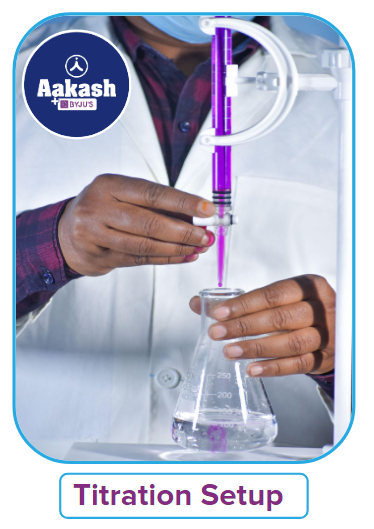
- Titration is a chemical analysis process that determines the unknown concentration of solution when added to a solution of known concentration.
- This strategy employs the law of equivalence.
- The titrant, which is a solution with a known concentration for titration, titrates the material whose concentration must be determined.
- In this process, a standard solution (solution having known concentration) is added from a burette.
- When the equivalence point is added, the addition is halted, as indicated by the indicator's colour changing indicating the end point of the titration.
Prior Preparations for titration:
A constant pH should be needed during the acid-base titrations in the majority. A buffer solution is added to the titration apparatus to maintain the pH.
For certain conditions in the reaction apparatus, a separate solution is sometimes added to eliminate the effect of the unwanted ion. To increase the rate of redox reactions, the solution must be heated and titrated while still hot.
What exactly is the Law of Equivalence?
In a neutralization reaction, the number of acid equivalents must be equal to the number of base equivalents at a point of end/equivalence.
|
Normality Volume = Number of Equivalents |
The only foundation for generic titration chemistry is this equivalency rule. During titration, an indication of colour change is typically taken. In potentiometric titrations, however, the acid-base titration is based on a pH change, and the pH change is taken into account. Because the pH change measure is based on the endpoint, no additional indicator is required.
Meanwhile, the world of chemical analysis is divided into two broad categories.
Qualitative Analysis: The process of determining the composition of a compound, i.e. which radicals are present in the salt.
Quantitative Analysis: When we want to calculate the concentration of an unknown solution. The following formula is used to calculate the concentration of the analyte using the following formula:
Ca=
Where,
Ca is the analyte concentration
Ct is the titrant concentration
Vt is the volume of the titrant used
M is the analyte/reactant mole ratio from the balanced equation.
Va is the analyte volume
Types of Titrations:
There are many different types of titrations, each with its own objectives and procedures. However, the most used titration methods in quantitative chemical analysis are redox and acid-base titration. There are various types of titrations depending on the solvent and chemical reaction.
- Simple Titrations
- Acid-Base Titrations
- Redox Titrations
I. Permanganate titrations
II. Iodometry
III. Iodimetry
- Precipitation Titrations
- Complexometric Titrations
- Back Titrations
- Double Titrations
Practice Problems:
Q1. Which of the following statements about titrant is correct?
A. A titrant is a known concentration solution used in titration.
B. Any solution containing the determined ion or species to which the titrant has been added
C. The amount of reagent that is added to completely react with a substance.
D. A method for adding a known strength solution to a specific volume of a treated sample containing an indicator.
Answer: (A)
Solution: Titrant is a known concentration solution, and titration is a procedure that involves adding a known strength solution to a specific volume of a treated sample containing indicator Titrand refers to any solution containing ions and species to which titrant is added. Hence,in light of the preceding, the correct answer is option (A).
Q2. Calculate the normality of 100 mL of base sodium nitrate when it is titrated against 100 mL of 0.4 M phosphorous acid?
A. 0.4 N
B. 0.8 N
C. 0.1 N
D. 0.6 N
Answer: (B)
Solution: At a point of end/equivalence, the number of acid equivalents must be equal to the number of base equivalents in a neutralization reaction.
Volume Normality = Number of Equivalents
Number of equivalents of acid = Number of equivalents of base
(Volume Normality)Acid = (Volume Normality)Base
Volume of acid H3PO3(V1) = 100 mL
Volume of base NaNO3 (V2) = 100 mL
Normality of acid H3PO3(N1) = Number of Molarity of acid H3PO3= = 0.8 N
Normality of base NaNO3(N2) = ?
Hence, the correct answer is option (B).
Q3. The acid-base titration method produces sodium hypochlorite as a salt after completely neutralizing 200 mL of 0.1 M sodium hydroxide (NaOH) versus 100 mL of hypochlorous acid (HClO). Determine the concentration of (HClO) used in this titration.
A. 0.2 M
B. 0.6 M
C. 0.4 M
D. 0.8 M
Answer: (A)
Solution:
Volume of
Volume of
Concentration of
Concentration of
(where n is the n-factor)
So, option A is the correct answer.
Q4. What is the relationship between the moles of acid and the moles of the base in the reaction mixture at the equivalence point?
A. They should be treated equally.
B. There are a greater number of base moles.
C. The stronger component has more moles.
D. The number of moles of acid is greater.
Answer:(A)
Solution: The number of moles of acid and base in the reaction mixture should be the same at the equivalence point. As a result, they should be treated equally.
As a result, option is the correct answer (A).
Frequently Asked Questions-FAQs:
Q1. What are some examples of titration errors?
Answer: Misreading volumes, selecting the incorrect concentrations, or using poor technique are just a few of the things that can cause titration results to be incorrect. Care must be taken when using laboratory glassware such as a burette or pipette to transfer a known concentration of solution into an unknown volume.
Q2. What are the different kinds of standard solutions?
Answer: Standard solutions are classified into two types:
Primary standard: This is created by dissolving a specified amount of solute in a specified amount of water immediately.
Secondary standard: This is made by comparing a solution to primary standard solution made of KOH, NaOH, etc, or any other substance that cannot be kept for an extended period of time.
Q3. What is the purpose of titration in chemistry?
Answer: The concentration of a simple solution can be determined by titrating it with the volume of normal acid/base solution required to neutralize it. The goal of the titration is to find the equivalence point, or the point at which chemically equivalent amounts of the reactants are combined.
Q4. What is the difference between an equivalence point and an endpoint?
Answer: The primary distinction between equivalence and endpoint is that an equivalence point is the point at which the equivalents of the acid and the equivalents of the base are equal, whereas an endpoint is the point at which the colour of a system changes.

 Call Now
 Let's Chat
 Share
Share