-
Call Now
1800-102-2727


Thomson's atomic model: Postulates, Practice problems and Frequently Asked Questions (FAQs)

The atomic model originated in the 5th century BC when Greek philosophers hypothesized that all matter was composed of indivisible particles. The modern atomic model started to take shape with the work of Lavoisier and Dalton who formulated the concept of elements as unique iterations of atoms which can be combined in multiple ways to create a variety of substances. Naturally, the inclination to understand how atoms exist was understandable.
The atomic model was developed in the fifth century BC by Greek philosophers who postulated that all substances were made up of indivisible particles. The modern atomic model began to take shape with the work of Lavoisier and Dalton, who defined elements as unique iterations of atoms that may be joined in a variety of ways to produce a wide variety of things. Naturally, the need to understand how atoms exist seemed understandable.
So who actually paved the way for a better understanding?
It is wrong to reserve all the accolades for a single person but there was a person who made a significant contribution. Would you all like to know who that was?
In 1897, the English physicist J. J. Thomson discovered that there was a particle smaller than an atom - the electron - through his work with cathode ray tubes.
Through his work with cathode ray tubes, the English physicist J. J. Thomson established the existence of a particle smaller than an atom - the electron in 1897.
So let's dive in and try to understand what was done by J. J. Thomson.

Table of contents
- Cathode-ray tube experiment
- Conclusions from the Cathode-ray experiment
- Postulates of Thomson atomic model
- Limitations of Thomson atomic model
- Practice problems
- Frequently asked questions-FAQs
Cathode-ray tube experiment
- Thomson applied a voltage to one side of a sealed glass container with two electrodes.
- Most of the air was removed from the tube, but when the voltage is applied, the remaining particles flowed from the cathode to the anode.
- Chemists called this particle flow “cathode rays,” and they were able to detect them by placing a material which would glow in the tube.
- Thomson decided to set up additional electric plates around the cathode ray to determine whether the cathode beams were charged. When the cathode ray was attracted toward the positively charged plate, he realized that the rays must be made up of negatively charged particles.
- Thomson used two electrodes to apply a voltage on one side of a sealed glass container.
- The majority of the air in the tube was evacuated, but when the voltage was applied, the remaining particles flowed from the cathode to the anode.
- Chemists called this particle flow "cathode rays," and they were able to identify it by inserting a glowing substance into the tube.
- Thomson choose to place more electric plates around the cathode ray to see if the cathode rays were charged. When the cathode ray was drawn to the positively charged plate, he recognized that the rays had to be composed of negatively charged particles.
Conclusions from the Cathode-ray experiment:
From experimental observations, Thomson concluded that
- Atoms are not indivisible, by the action of electrical forces, etc negatively charged particles (corpuscles) can be withdrawn
- All negatively charged particles generated from atoms have the same mass and same charge irrespective of the atom.
- The mass of these negative charge particles has almost 11000 of the mass of a hydrogen atom.
Postulates of Thomson atomic model
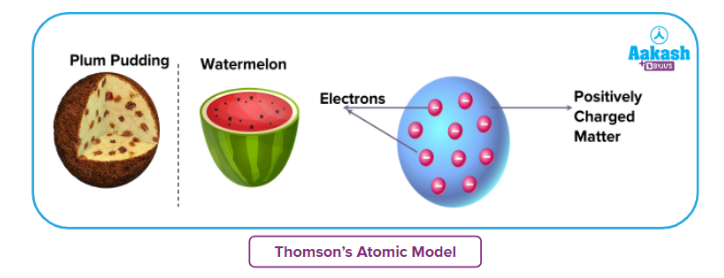
- An atom possesses a spherical shape.
- An atom consists of a positively charged sphere with electrons embedded in it
- An atom as a whole is electrically neutral because the negative and positive charges are equal in magnitude
- An atom is a positively charged sphere that contains electrons.
- Because the magnitudes of the negative and positive charges are equal, an atom as a whole is electrically neutral.
- The mass of the atom is assumed to be uniformly distributed all over it.
- The atom's mass is assumed to be equally distributed throughout.
Limitations of Thomson's atomic model
- It failed to explain how the positive charge holds the electrons inside the atom.
- It failed to explain the stability of an atom.
- This theory did not mention anything about the nucleus of an atom.
- It could not account for the results of later experiments by Rutherford about the distribution of mass.
Practice problems
Q1. Which of the following is true in J.J Thomson's atomic model of atom
A. Protons and neutrons are present inside the nucleus
B. The volume of the nucleus is very small as compared to the volume of an atom
C. The number of protons and neutrons are always equal
D. The number of negative and positive charges are always equal
Answer: (D)
Solution: According to Thomson’s atomic model, an atom as a whole is electrically neutral because the negative and positive charges are equal in magnitude.
Q2. According to Thomson’s atomic model, the positive charge of an atom is
A. spread all over the atom
B. distributed around the nucleus
C. centred in the nucleus
D. all of these
Answer: (A)
Solution: According to Thomson’s atomic model, an atom possesses a spherical shape and positively charge spread uniformly over the sphere with electrons embedded in it
Q3. Select incorrect statement regarding Thomson’s atomic model
A. The whole mass of the atom is centred in the nucleus
B. Positive charges are distributed uniformly over the atom
C. The mass of the atom is assumed to be uniformly distributed all over it.
D. None of these
Answer: (A)
Solution: According to Thomson’s atomic model, the mass of the atom is assumed to be uniformly distributed all over it.
Q4. Which of the following is true for Thomson's model of the atom
A. The velocity of an electron in an orbit can be calculated using Thomson's model.
B. The energy of an electron in an orbit can be calculated using Thomson's model.
C. The radius of an electron in an orbit can be calculated using Thomson's model.
D. The mass of the atom is assumed to be uniformly distributed all over it
Answer: (D)
Solution: According to Thomson’s atomic model, the mass of the atom is assumed to be uniformly distributed all over it. The radius of the orbit, the velocity of the electron in orbit, and energy of the orbit can be calculated by mathematical forms of Bohr’s atomic model.
Frequently asked questions-FAQs
Question 1. Is the plum pudding model correct?
Answer: While the plum pudding model was the first to suggest that atoms are made up of charged particles, the plum pudding model is not entirely correct. Instead of a sea of positive charges surrounding negatively charged particles, atoms are actually organised with positive and neutral particles at their core (the nucleus) surrounded by orbitals of electrons.
Question 2. Who coined the word electron for corpuscles.
Answer: George Stoney claimed in 1894 to have coined the term electron.
Question 3. Name the few famous students of J J Thomson
Answer: 7 students of Thomson won the Nobel prize. A few famous names are Ernest Rutherford, Lawrence Bragg, etc.
Question 4. Is J J Thomson received the Nobel prize for the plum-pudding model?
Answer: The Nobel Prize in Physics 1906 was awarded to Joseph John Thomson "in recognition of the great merits of his theoretical and experimental investigations on the conduction of electricity by gases.
Related Topics:
|
Millikan’s oil drop experiment |
Discovery of neutrons |
|
De Broglie's Hypothesis |
Thomson's atomic model |
|
Quantum numbers |
Rutherford's Atomic Model |

 Call Now
 Let's Chat
 Share
Share