-
Call Now
1800-102-2727


Purification of Organic Compounds: Methods, Crystallisation & Distillation

Purification of Organic Compounds
Organic chemistry methods for producing or retrieving compounds fail to achieve complete purity in their resulting products. Natural or synthetic organic compounds face contamination from various impurities, which include initial materials, manufacturing waste and environmental humidity. The process of purification involves extracting all unwanted materials from a substance until it reaches its most uncontaminated state. The selection process for a particular purification technique requires knowledge about the compound characteristics and the specific impurity types that exist.
Need for Purification
Research needs pure organic compounds because their purity level determines how scientists study compounds and how scientists utilise them. The presence of impurities in a substance causes its physical and chemical properties to change because they interact with the material.
- Inaccurate Results: Research activities require researchers to maintain sample purity because any impurity presence leads to erroneous findings about how substances behave.
- Toxicity: The presence of impurities in pharmaceutical products results in dangerous reactions for patients who use them.
- Reduced Efficiency: Pure reagents represent an essential requirement for industrial operations since they enable businesses to produce maximum results while generating the least environmental impact.
Types of Impurities
Impurities are generally classified into two categories:
- Soluble Impurities: Those that dissolve in the same solvent as the organic compound.
- Insoluble Impurities: Physical contaminants like dust, sand, or filter paper fibres that do not dissolve in the solvent.
Crystallisation and Recrystallisation
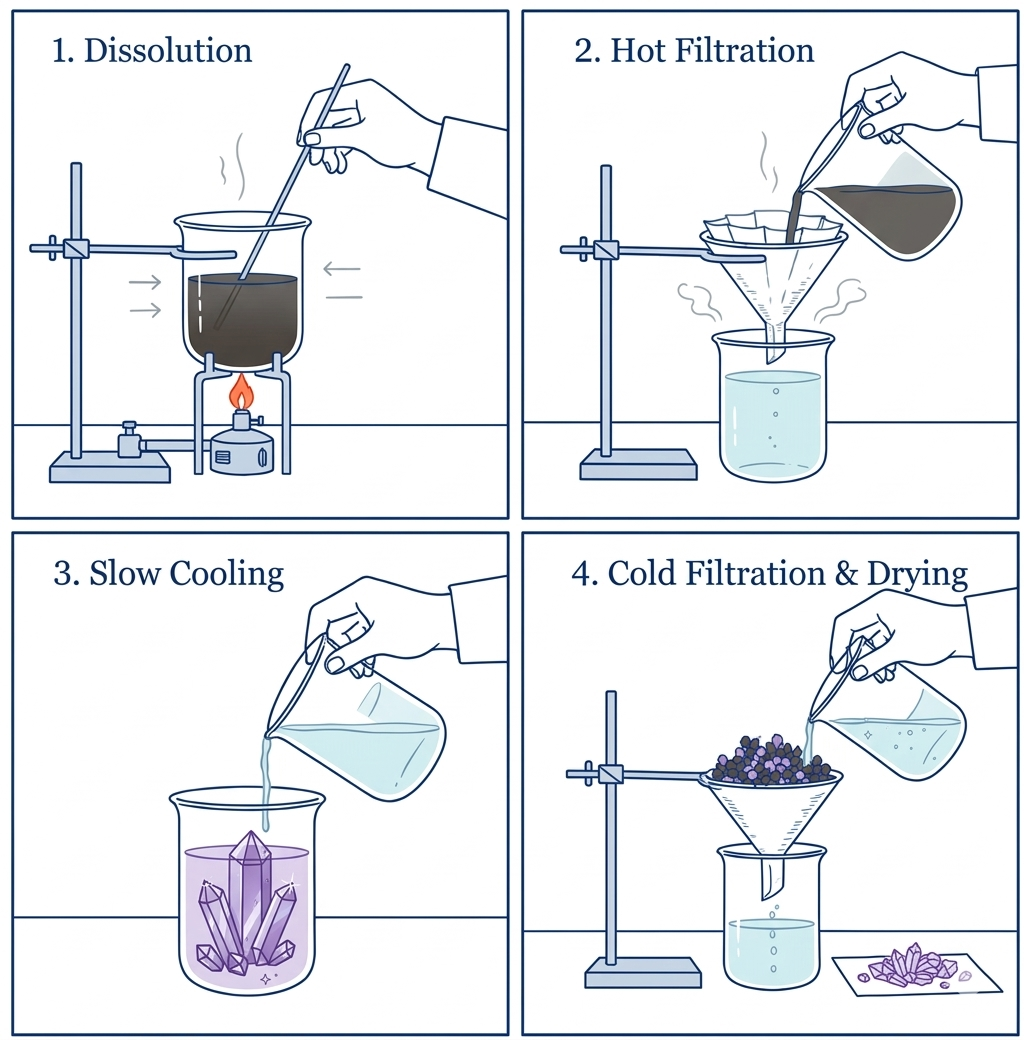
Crystallisation is one of the most common techniques used to purify solid organic compounds. It is based on the difference in the solubilities of the compound and its impurities in a suitable solvent.
Procedure:
- Selection of Solvent: A solvent is chosen in which the compound is sparingly soluble at room temperature but highly soluble at higher temperatures.
- Preparation of Solution: The solid material, which needs to be purified gets dissolved with boiling solvent until the smallest amount necessary for dissolution is achieved.
- Filtration: The process of hot solution purification begins with hot solution purification which involves passing the solution through a filter to eliminate all solid materials that cannot dissolve in the solution.
- Cooling: The clear solution is allowed to cool down at a controlled rate until its temperature reaches room temperature. Pure crystals of the compound begin to form.
- Drying: The filtration process allows for crystal separation which undergoes drying afterwards.
Selection of Solvent: The ideal solvent should not react chemically with the compound and should have a boiling point lower than the melting point of the solid. Water and ethanol and ether serve as common solvents.
Sublimation
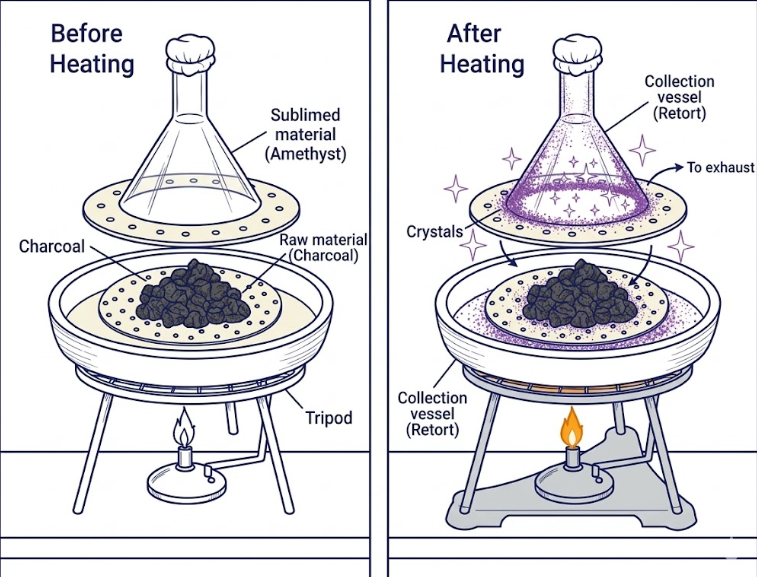
The process of sublimation enables solids to transform into a gas through heating, when they do not need to first becoming liquid. The method enables the extraction of a volatile solid while non-volatile impurities remain behind.
- Principle: The substance must have a high vapour pressure well below its melting point. The three substances which form this category include camphor, naphthalene and benzoic acid.
- Setup: The impure sample is placed inside a porcelain dish, which gets sealed with a perforated filter paper and an inverted funnel. The process of heating causes the pure compound to sublime, which forms deposits on the funnel's inner cool surfaces.
Distillation
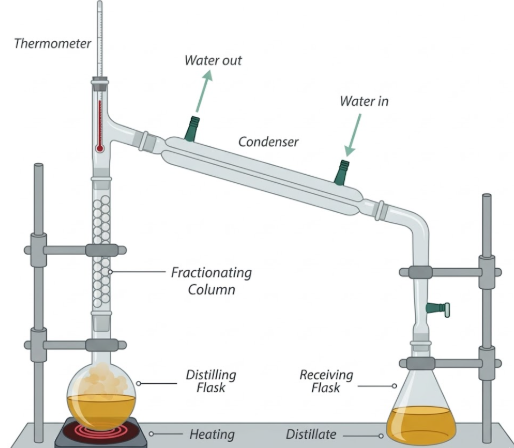
Distillation transforms a liquid into vapour through heating which results in vapour that condenses back into liquid. The technique separates volatile liquids from non-volatile impurities and separates two liquids that have different boiling points.
1. Simple Distillation
Used for liquids that are stable at their boiling points and contain non-volatile impurities.
Example: Separating benzene (B.P. 353 K) from toluene (B.P. 384 K) if the difference is significant.
2. Fractional Distillation
The process of simple distillation fails to separate two liquids whose boiling points approach each other. A fractionating column enables better separation results through its ability to perform multiple condensation and evaporation cycles.
3. Steam Distillation
This technique is used for substances that are steam-volatile and insoluble in water.
Principle: In steam distillation, the liquid boils when the sum of the vapour pressure of the organic liquid (P₁) and the vapour pressure of water (P₂) becomes equal to the atmospheric pressure (P), i.e., P = P₁ + P₂. Since P₁ is lower than P, the organic liquid vaporises at a temperature lower than its standard boiling point, which prevents thermal degradation.
4. Distillation Under Reduced Pressure (Vacuum Distillation)
Certain liquids start to undergo decomposition at boiling points that occur at or below their boiling points or lower. The implementation of a vacuum pump system allows atmospheric pressure to decrease, which results in the liquid boiling at a considerably reduced temperature.
Differential Extraction
The process involves extracting an organic compound from its water-based solution. The solution undergoes shaking with an organic solvent which operates inside a separating funnel. The organic solvent needs to be immiscible with water, while the target compound must show higher solubility in the organic solvent compared to water. The process starts with shaking which creates two separate layers, after which the organic solvent undergoes evaporation to produce a pure compound.
Chromatography
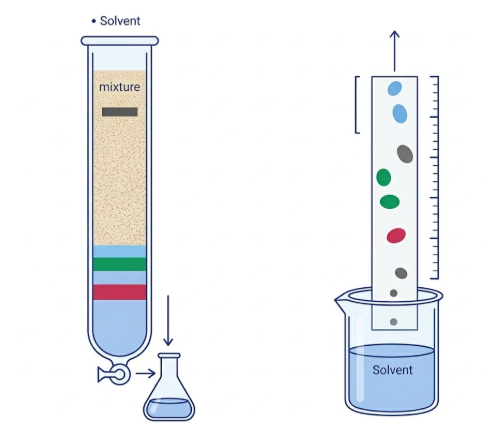
Chromatography serves as a contemporary method that enables the separation of mixture components through their distinct movements between the stationary and mobile phases.
Column Chromatography
A glass tube functions as a container which holds an adsorbent material (stationary phase) that includes alumina and silica gel. The mixture is poured at the top. The mobile phase (eluent) moves downwards through the system and causes different components to travel at different speeds, which creates separate bands based on their attraction to the adsorbent material.
Paper Chromatography
A drop of the mixture is placed on a strip of chromatography paper. The paper is dipped in a solvent. As the solvent rises by capillary action, components move up the paper at different speeds, resulting in separation.
Summary Table of Purification Methods
| Method | Physical State | Principle | Example |
|---|---|---|---|
| Crystallisation | Solid | Difference in solubility | Sugar from impurities |
| Sublimation | Solid | Vapour pressure difference | Camphor and Sand |
| Distillation | Liquid | Difference in boiling points | Acetone and Water |
| Differential Extraction | Liquid | Solubility in different solvents | Benzoic acid from water |
| Chromatography | Solid/Liquid/Gas | Differential adsorption/partition | Plant pigments |
Precautions and Safety Measures
- Flammability: The majority of organic solvents, which include ether and benzene, exhibit significant fire hazards. Water baths should replace open flames for all heating requirements.
- Ventilation: All experimental work with hazardous vapours must take place inside a fume hood.
- Apparatus Check: The vacuum distillation process requires all glassware to remain free from cracks, while stopcock grease should be applied to all joints, which will prevent any leaks.
Limitations
- Yield Loss: Some amount of the compound is always lost during filtration or transfer between vessels.
- Azeotropes: Some liquid mixtures (like 95% ethanol and 5% water) cannot be separated by distillation as they boil at a constant temperature.
Summary
The ability to purify substances represents an important fundamental ability which chemists must develop. The basic techniques of crystallisation and distillation continue to serve as primary methods for industrial separations, while chromatography provides unmatched accuracy when handling complicated mixtures. The most effective purification method selection requires knowledge of the target compound's physical attributes, which include its solubility, volatility, and thermal stability.
FAQs
1. Why do you require a saturated solution to carry out the crystallisation?
The maximum number of solutes in a given temperature belongs to the saturated solution. As it becomes cool the solubility is low, causing more solute to settle out of the solution and exist as pure crystals.
2. What is the role of a fractionating column in distillation?
The column gives a great interface area of repeated cycles of condensation and vaporisation. This is to make sure that the more volatile part appears at the top of the column first, giving a cleaner separation of liquids that have close boiling points.
3. Which cases are better done by steam distillation rather than simple distillation?
The steam distillation is used when the organic compound is heat sensitive (decomposing at elevated temperatures) but volatile in the steam and has low solubility in water i.e. in the extraction of essential oils in plants.

 Call Now
 Let's Chat
 Share
Share