-
Call Now
1800-102-2727


Properties of a Balanced Redox Reaction - Properties, LOCM, POAC and LOCC, Practice Problems and FAQs

Let's imagine you went to the supermarket to buy 3 kg of rice. If the store employee is using a 300-gram spoon to fill a bag of 3 kg, how many spoons of rice should he add to ensure that you get the required amount of rice?
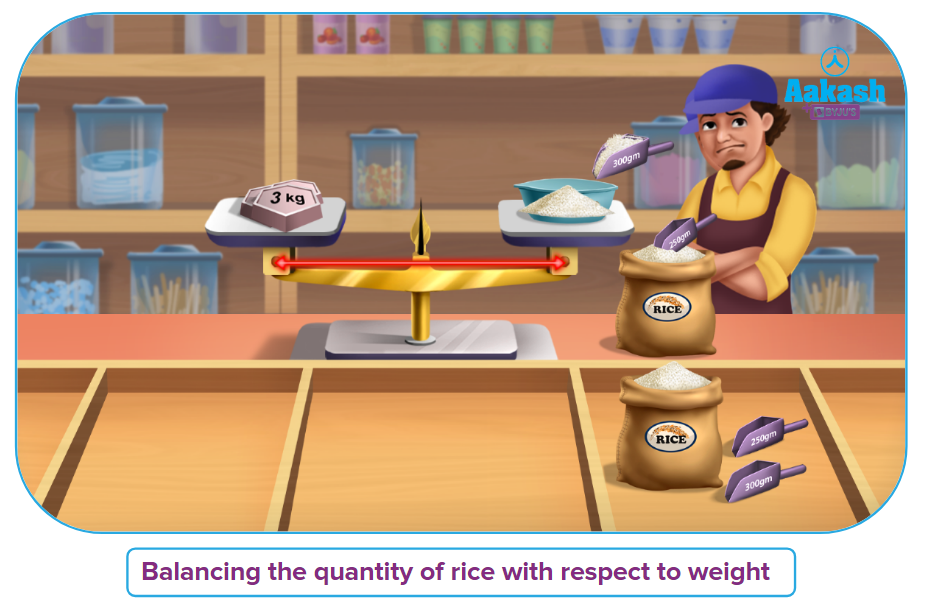
10 spoons of rice should be the response, right?
Similar to this, you may need to balance the chemical/redox equation, but before doing so, you must comprehend the properties of a balanced redox reaction.
Table of Contents
- Properties of a Balanced Redox Reaction
- LOCM (Law of Conservation of Mass)
- POAC (Principle of Atomic Conservation)
- LOCC (Law of Conservation of Charge)
- Practice Problems
- Frequently Asked Questions - FAQs
Properties of a Balanced Redox Reaction
A redox equation is split into two half-reactions using this technique, one involving oxidation and the other involving reduction. After balancing the mass and charge of each half-reaction, the two equations are recombined with the proper coefficients to cancel the electrons, i.e., the number of electrons gained should be equal to a number of electrons lost in two half-reactions.
There are three important properties of balanced redox reactions that we need to study. These are:
- LOCM ( Law of Conservation of Mass)
- POAC ( Principle of Atomic Conservation)
- LOCC ( Law of Conservation of Charge)
LOCM (Law of Conservation of Mass)
According to the law of conservation of mass, "Mass in an isolated system can be converted from one form to another but cannot be created or destroyed." So, in a balanced chemical equation, the mass of the reactants is equal to the mass of the products.
For instance:
See, in order to balance the mass on both sides, we have to balance the mass.
Mass of oxygen on left side = 216 = 32 u
Mass of oxygen on right side = 316 = 48 u
Multiply O2(g) by 3 and Al2O3(s) by 2 in order to balance the mass of oxygen on both sides.
Now, Mass of oxygen on left side = 3216 = 96 u
Mass of oxygen on right side = 2316 = 96 u
Hence, Mass of oxygen on left side = Mass of oxygen on right side = 96 u
Now, in order to balance the mass of Al on both sides,
Mass of Aluminium (Al) on left side = 27 u
Mass of Aluminium (Al) on right side = 427 = 108 u
Multiply Al(s) by 4 in order to balance the mass of Al on both sides.
Mass of Aluminium (Al) on left side = 427 = 108 u
Mass of Aluminium (Al) on right side = 427 = 108 u
Hence, Mass of Aluminium (Al) on left side = Mass of Aluminium (Al) on right side =108 u
The equation now is perfectly balanced and this shows that the balanced equation obeys the Law of conservation of mass.
POAC (Principle of Atomic Conservation)
Atoms are the smallest building block of a chemical substance. Every atom, as we all know, is composed of a nucleus and electrons that revolve around the nucleus. When different elements interact, numerous bonds break and form, and the atoms in those bonds are rearranged through various chemical processes.
This is the second property of a balanced chemical reaction and is based on the law of conservation of mass.
According to the POAC (Principle of Atomic Conservation), in order for a chemical reaction to be balanced, the number of atoms or moles of atoms on both sides of the reaction must be equal.
For instance:
In the given equation, according to POAC, the number of moles of atoms should be the same on both sides to get a balanced equation.
As there is 1 Potassium atom on the left side, then KI must be multiplied by 2 to get an equal number of moles of K.
As there are 2 Iodine atoms on the left side and 3 Iodine atoms are on the left side, then CuI must be multiplied by 2 and KI must be again multiplied by 2 to get an equal number of moles of I.
Now, in order to balance, Cu & K, CuSO4and K2SO4 must be multiplied by 2 to get an equal number of moles of respective atoms.
Hence, using POAC, we can get a balanced equation.
LOCC (Law of Conservation of Charge)
According to the principle of conservation of charge, the overall charge of an electric system does not change with time. The charge can be produced at the subatomic level, but only in pairs with equal positive and negative charges, ensuring that the overall charge is never changed.
For instance:
As the charge is not balanced on both sides
In order to have a balanced equation, first we need to balance the number of atoms on both sides.
Reduction half reaction:
In this half-reaction, Mn is balanced, O atoms are balanced by adding H2O on the right side.
Reduction half reaction:
Now, H atoms are balanced by adding H+ on both sides.
Reduction half reaction:
Now, as per the law of conservation of charge, charge should be balanced on both sides.
On the left side: -1+8= +7
On the right side: +2
So, in order to balance the charge, we can add 5 e- on the left side.
Reduction half reaction:
Similarly for oxidation half reaction: I-I2
In this half-reaction, I atoms are balanced by multiplying I- by 2 on the left side.
Oxidation half reaction: 2I-I2
Now, as per the law of conservation of charge, charge should be balanced on both sides.
On the left side: -2
On the right side: 0
So, in order to balance the charge, we can add 2 e- on the right side.
Oxidation half reaction:
Now combining oxidation and reduction half reactions.
Reduction half reaction:
Oxidation half reaction: 2I-I2+2 e-
Now, in order to get a balanced redox equation, multiply reduction half reaction with 2 and Oxidation half reaction with 5 so that the number of moles of electrons are balanced and then add them.
Hence, the equation is perfectly balanced and this shows that the balanced equation obeys the Law of conservation of charge.
Related Topic Links: Balancing Redox Reactions Class 11 | JEE Chemistry Important Topics | JEE Main & Advanced 2024 Prep
Practice Problems
Q1. Balance the given redox reaction by using the properties of the balanced redox chemical reaction.
Solution:
Using POAC (Principle of Atomic Conservation), in order for a chemical reaction to be balanced, the number of atoms or moles of atoms on both sides of the reaction must be equal.
As there are 2 Iron atoms on the left side Fe must be multiplied by 2 to get an equal number of atoms of Fe.
As there are 4 Oxygens on the left side and 2 Oxygens are on the left side, then both CO2 & CO must be multiplied by a factor 3 to get an equal number of atoms of O & C .
The charges on both sides of the reaction are already balanced.
Q2. Using the characteristics of the balanced redox chemical reaction, balance the provided redox reaction.
Solution: Using POAC (Principle of Atomic Conservation), in order for a chemical reaction to be balanced, the number of atoms on both sides of the reaction must be equal.
Let us use the Hit and Trial method for the given reaction.
On the left side, the number of atoms of K, O, Cl and H is:
K = 1, O = 1, Cl=2 and H = 1
On the right side, the number of atoms of K, O, Cl and H is:
K = 2, O = 4, Cl=2 and H = 2
By using a Hit and Trial method, the balanced equation would be:
Q3. Using the characteristics of a balanced redox chemical reaction, balance the given redox reaction.
Solution:
In order to have a balanced equation, first we need to balance the number of atoms on both sides.
Reduction half reaction:
In this half-reaction, N atoms are balanced, O atoms can be balanced by adding H2O on the right side of the reduction half reaction.
Reduction half reaction:
Now, H atoms can be balanced by adding H+ on the left side.
Reduction half reaction:
Now, as per the law of conservation of charge, charge should be balanced on both sides.
On the left side: -1
On the right side: 0
So, in order to balance the charge, we can add one e- on the left side.
Reduction half reaction:
Similarly for oxidation half reaction:
As per the law of conservation of charge, charge should be balanced on both sides.
On the left side: 0
On the right side: +2
So, in order to balance the charge, we can add 2e- on the right side.
Oxidation half reaction:
Now, in order to get a balanced redox equation, multiply reduction half reaction by 2 so that the number of moles of electrons are balanced and then add them.
Reduction half reaction:
Oxidation half reaction:
Q4. Balance the given redox reaction by using the properties of the balanced redox chemical reaction in an acidic medium.
Solution:
In order to have a balanced equation, first we need to balance the number of atoms on both sides.
Reduction half reaction:
In this half-reaction, S atoms are balanced, O atoms can be balanced by adding H2O on the left side.
Reduction half reaction:
Now, H atoms are balanced by adding H+ on the right side.
Reduction half reaction:
Now, as per the law of conservation of charge, charge should be balanced on both sides.
On the left side: -2
On the right side: -2+2=0
So, in order to balance the charge, we can add 2 e- on the right side.
Reduction half reaction:
Similarly for oxidation half reaction:
Mn and O atoms are already balanced.
Only charges are needed to be balanced on both sides.
On the left side: -1
On the right side: -2
So, in order to balance the charge, we can add e- on the left side.
Oxidation half reaction:
Now, in order to get a balanced redox equation, multiply oxidation half reaction by 2 so that the number of moles of electrons are balanced and then add them.
Reduction half reaction:
Oxidation half reaction:
Frequently Asked Questions
Q. What does redox reaction mean?
Answer: Redox reaction is a chemical process that occurs when an oxidising material and a reducing substance interact. In these processes, the oxidising substance loses electrons through oxidation, while the reducing substance gains electrons through reduction and both processes are occurring simultaneously.
Q. Can there be simply reduction or oxidation alone in a redox reaction?
Answer: Never. Because the oxidising agent must undergo self-reduction in order for oxidation to take place. The reduction or oxidation can happen in a half-reaction as it occurs when one atom or compound is reduced or oxidised but no other atoms or compounds are oxidised or reduced.
Q. What are double displacement reactions? Is double displacement reactions redox in nature?
Answer: When two molecules are replaced for one another in a reaction, sometimes referred to as a double replacement reaction.
BaSO4+2NaClNa2SO4+BaCl2
There is simply an ion exchange between the two reactants and neither of the reactants undergoes oxidation or reduction. Double displacement reactions are therefore not redox processes.
Q. Which type of reaction does cellular respiration involve?
Answer: A series of metabolic actions and responses known as cellular respiration break down glucose and generate ATP. In this process, oxygen is reduced and glucose is oxidised to produce water molecules.
As a result, it is often referred to as the oxidation-reduction or redox reaction.

 Call Now
 Let's Chat
 Share
Share