-
Call Now
1800-102-2727


Primary and Secondary Cell: Definition of Battery, Primary Cell: Dry Cell, Mercury Cell, Secondary Cell: Lead Storage Battery, Nickel-Cadmium Storage cell (or Nicad Cell), Practice problems and FAQs:

Clocks, remotes, watches and many electronic gadgets you use need differently sized but so called batteries. Your parents also use batteries for their two wheeler or four wheelers. How much you know about them. Are they same or different? If so what makes them different, size, prize or technology?


Even though every spontaneous redox reaction can be used to make a galvanic cell, not all galvanic cells are acceptable for commercial usage. This is due to two factors: 1) Galvanic cells with salt bridges have high internal resistance, and 2) Galvanic cells without salt bridges have low internal resistance. As a result, attempting to draw a big current from them causes their voltage to decrease abruptly.
Because of their lack of compactness and durability, they are not portable (hard handling). To be employed as a commercial cell, a galvanic cell must meet the following two requirements:
It should be portable due to its compactness, lightness, and toughness. Its voltage should not drop significantly during operation, i.e., the voltage drop should be insignificant for the short period of time it is in use.
Table of content
- Definition of Battery
- Dry cell
- Mercury cell
- Lead storage battery
- Nickel-Cadmium storage cell (or Nicad Cell)
- Practice problems
- Frequently asked questions (FAQs):
Definition of Battery
A 'battery' is an arrangement in which a number of cells are connected in series. Even a single cell is sometimes referred to as a battery. In a strict sense, such a usage is incorrect. The various batteries or cells may be classified mainly into the following two types :
(A) Primary batteries or cells
(B) Secondary batteries or cells

Primary cells
Primary cells are those in which the redox reaction occurs just once, and the cell dies after a period of time, preventing it from being used again. Dry cell and mercury cell are two examples of this type..
Secondary cells
Secondary cells can be recharged by running an electric current through them, allowing them to be used repeatedly. Lead storage batteries and nickel cadmium storage cells are two well-known examples of this type.
Primary Batteries or Cell
Dry cell
The dry cell is a tiny version of the Leclanche cell that is often used in transistors and clocks. It is made up of an anode, which is a zinc container that is cylindrical. The cathode is a graphite rod inserted in the centre (but not touching the base). The space between the anode and the cathode is so densely packed that the zinc container comes into contact with the NH4Cl and ZnCl, and the graphite rod is surrounded by powdered MnO2) and carbon. A metal cap is attached to the graphite rod, and the cylinder is sealed at the top with pitch. To keep it safe from the elements, the zinc container is covered in cardboard.

The processes that occur at the electrodes are highly intricate. They can, however, be described in a straightforward fashion as follows:
(MnO₂ has been reduced from oxidation state +4 to +3).
The NH3 formed is not liberated as gas but combines immediately with the Zn2+ ions and the Cl- ions to form complex salt. [Zn(NH3)2Cl2] (diamminedichlorido zinc).
The voltage of these cells is between 1.25 and 1.50 volts. However, they do not have a long life because the acidic NH4Cl corrodes the zinc container even when the cell is not in use.
Mercury cell
(Button cell or Ruben Mallory cell) This is a more recent sort of dry cell that has found applications in low-current devices like hearing aids and timepieces. The anode is a zinc container, the cathode is a carbon rod, and the electrolyte is a paste of mercuric oxide mixed with KOH. The electrolyte is kept apart from the zinc anode by a porous paper liner.

The cell produces electrical energy by the following reactions :
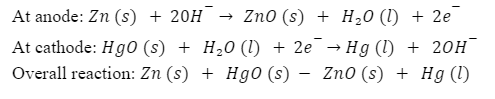
This cell gives a constant potential of 1.35 V throughout its life because the overall cell process does not involve any ion whose concentration may change. The wasted cells, on the other hand, should be reprocessed for mercury recovery or treated to prevent mercury or mercury compounds from entering the atmosphere and polluting the environment. The above cell is also known as a button cell since it is made of pellets, is flat, and has a button-like form.
Secondary Batteries or Cells
Lead storage battery
This is one of the most commonly used batteries in cars and inverters. In most cases, a 12 V lead storage battery is employed, which is made up of 6 cells that individually provide 2 V. A lead anode (or a grid of lead filled with finely split spongy lead as the anode) and a lead cathode are present in each cell (or a grid of lead packed with lead dioxide). These electrodes are stacked alternately, separated by thin wooden or fibre glass sheets, and suspended in a dilute sulphuric acid electrolyte (38 % by mass or density of 1.30 g cm-1).

The cathode plates and anode plates are coupled together to improve the current output of each cell (while retaining them in alternate places, of course), i.e., The cells are linked in a parallel manner (anode to anode and cathode to cathode). Six batteries are connected in series to provide a 12 V output voltage.
Reactions that occur during the discharge and recharge of batteries
The electrode reactions that occur during discharge, i.e., when the battery is in use are as follows: 
It is clear from the foregoing calculations that H2SO4 is consumed during the discharge. As a result, H2SO4density decreases. The battery needs to be recharged when it goes below 1.20 g cm-1.
During recharging, the cell functions as an electrolytic cell, meaning that it receives electrical energy from an external source.
The electrode reactions are the polar opposite of the discharge reactions:



Because the PbSO4generated during discharge is a solid and adheres to the electrodes, such an operation is conceivable. As a result, it has the ability to receive or give up electrons during electrolysis. It's vital to remember that the anode is the electrode where oxidation takes place, i.e., electrons are lost, and the cathode is the electrode where reduction takes place, i.e., electrons are gained. In addition, the electrode that serves as an anode during discharge also serves as a cathode when charging and vice versa.
Nickel-Cadmium storage cell (or Nicad Cell)
This is yet another rechargeable battery that is becoming increasingly popular, particularly in calculators. It has a longer life span than a lead storage cell, but it is more costly. It is made up of a cadmium electrode (as anode) and a metal grid containing nickel (IV) oxide (as cathode) that are both immersed in KOH solution. The following are the electrode responses that occur during discharge:
At anode: Cd (s) + 2OH(aq) →Cd (OH)₂ (s) + 2 e
At cathode: NiO₂ (s) + 2H₂O +2e → Ni(OH)₂ (s) + 2 OH- (aq)

The reaction products attach to the electrodes in the same way as they do in the lead storage cell. As a result, while charging, the responses can be reversed. The battery can also be sealed because no gases are created during discharging or recharging. Each Ni-Cd cell has a voltage of about 1.4 volts. The cell resembles a dry cell.
Practice problems
Q1. Which of the following is not an example of primary cell
A. Dry cell
B. Mercury cell
C. Nicad cell
D. All of the above
Answer: (C)
Solution: Primary cells are those in which the redox reaction occurs only once and the cell becomes dead after some time, and cannot be used again. Two common examples of this type are dry cell and mercury cell. Secondary cells are those which can be recharged by passing an electric current through them and hence can be used over and again. Two well-known examples of this type are lead storage battery and nickel cadmium storage cell.
Q2. In a lead storage battery, the electrolyte H2SO4 is
A. 38%
B. 62%
C. 80%
D. 48%
Answer: (A)
Solution: The cathode of a lead-storage battery is made of lead dioxide, while the anode is made of metallic lead. An electrolyte of sulfuric acid separates the two electrodes. The sulfuric acid reacts with the lead in the anode and cathode to produce lead sulphate as the battery charges. 38 % of sulphuric acid is used in the lead storage batteries.
Q3. In the lead storage battery during charging, the cathode reaction is
A. Formation of PbO2
B. Formation of PbSO4
C. Reduction of Pb2+ to Pb
D. Decomposition of Pb at anode.
Answer: (C)
Solution: During recharging, the cell is operated like an electrolytic cell, i.e., now electrical energy is supplied to it from an external source.
The electrode reactions are the reverse of those that occur during discharge :
Q4. 0.05 F charge is passed through a lead storage battery. In the anodic half cell, the amount of lead sulphate precipitated is:
(Hint : molar mass of PbSO4=303 g mol-1)
A. 22.8 g
B. 15.2 g
C. 7.6 g
D. 11.4 g
Answer: (C)
Solution: The anodic half cell reaction is 
Frequently asked questions (FAQs):
Q1. Which one is better primary cell or secondary cell?
Answer: An electrochemical reaction is used to construct both primary and secondary cells. The primary cell differs from the secondary cell in that it can only be used once. Secondary cells, on the other hand, can be used multiple times by passing electric current through them. Hence, it alQ4l depends upon the requirement.
Q2. Why primary batteries have higher internal resistance than secondary batteries?
Answer: It's because a primary cell's internal parts contain a lot of chemicals that provide resistance to the current. Because lead is a good conductor of electricity, secondary cells contain only lead and thus provide less resistance.
Q3. Is it possible to recharge a primary battery?
Answer: A primary cell or battery is one that cannot be easily recharged after a single use and must be discarded. Dry cells are those that use electrolytes that are contained within absorbent material or a separator (i.e. no free or liquid electrolyte).
Q4.The storage battery commonly used in motor vehicles is-
A. Nickel-cadmium battery
B. Zinc carbon battery
C. Lead-acid battery
D. None of the above
Answer Option C.
Related Topics
|
Nernst equation |
Fuel cell |
|
Galvanic cell |
Concentration cell |
|
Electrochemical cell |
electrolysis |

 Call Now
 Let's Chat
 Share
Share