-
Call Now
1800-102-2727


Polysaccharides – Introduction, Characteristics, Classification, Functions, Practice Problems and FAQ

Who wouldn't like a steaming platter of biryani for lunch? Don't we all adore Biryani?
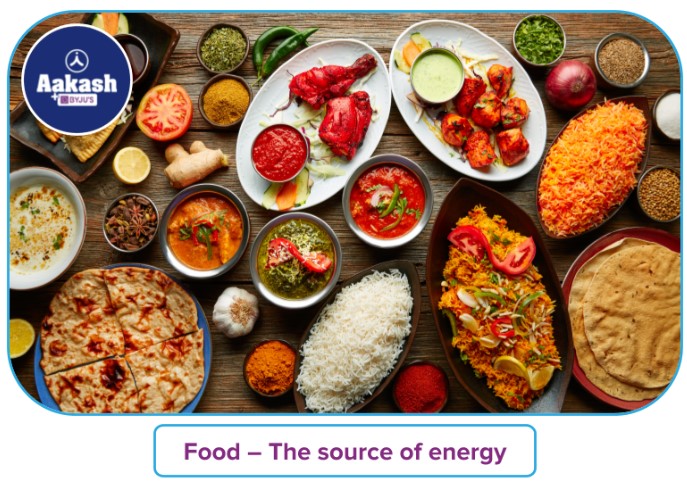
In order to maintain a healthy lifestyle, we regularly eat a range of foods. However, we do not use all of the energy that we gained from the food instantly. It is not as though "I just finished a dish of biryani and am now ready to work for four hours", am I right? Our bodies store the energy from the food we consume, which we can be drawn upon as needed.
Do you know how our bodies store the energy from the food we consume?
In animals, fungi and some bacteria, energy is stored in the form of glycogen. Glycogen is a multibranched polysaccharide of glucose which serves are the form of energy stored in the body.
“What are polysaccharides?”, a fresh query now arises.
This concept page will provide you with an answer to your query. We will learn in-depth information about polysaccharides, their classification, traits, and functions on this concept page.
TABLE OF CONTENTS
- Polysaccharides – Introduction
- Polysaccharides – Examples
- Polysaccharides – Characteristics
- Polysaccharides – Classification
- Polysaccharides – Functions
- Practice Problems
- Frequently Asked Questions – FAQ
Polysaccharides – Introduction
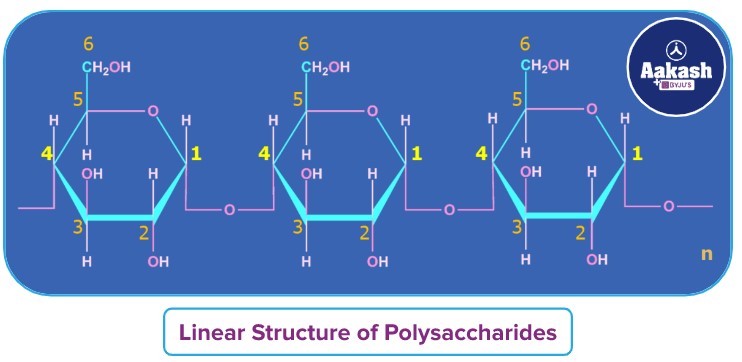
Polysaccharides consist of monosaccharides joined together by glycosidic linkage, also known as glycans. They are lengthy carbohydrate molecules made up of numerous smaller monosaccharides. These complex bio-macromolecules serve as energy storage or a source of energy in animal cells and as a structural component in plant cells. Depending on the monosaccharide type, it might be a homopolysaccharide or a heteropolysaccharide.
Polysaccharides can be either a straight chain of monosaccharides (linear polysaccharides) or branched polysaccharides.

Polysaccharides – Examples
Starch, cellulose and glycogen are the three of the most significant polysaccharides. Let’s get to know more about the invaluable polysaccharides in detail.
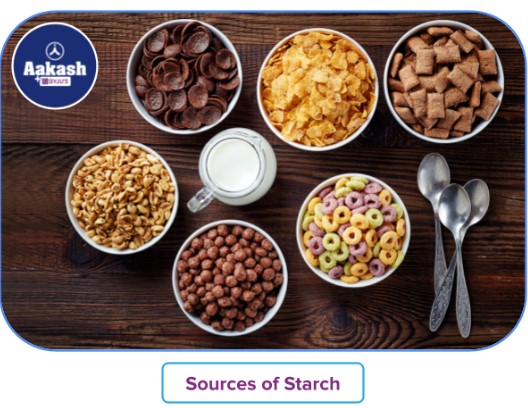
Starch – Starch is the main storage polysaccharide in plants. It is the most important dietary source for human beings.
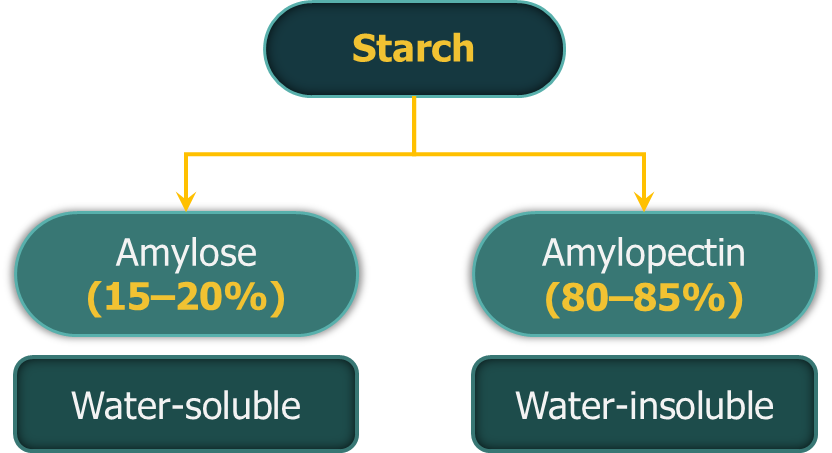
Starch is composed of 15-20% of amylose, which is water-soluble, and 80-85% of amylopectin, which is water-insoluble.
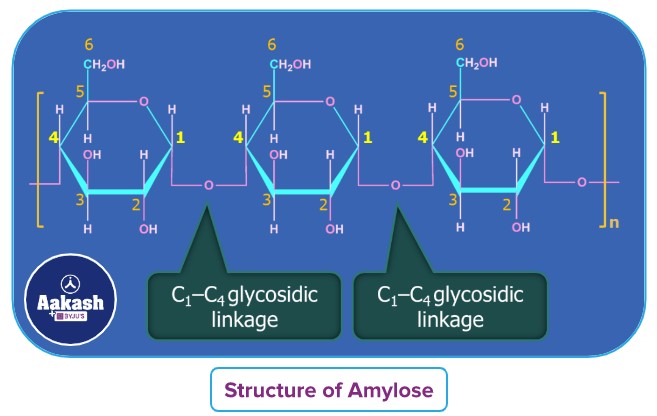
Amylose: It consists of 200-1000 𝛼-D-Glucose units joined by glycosidic linkages between C1 of one glucose unit and C4 of the next glucose unit.
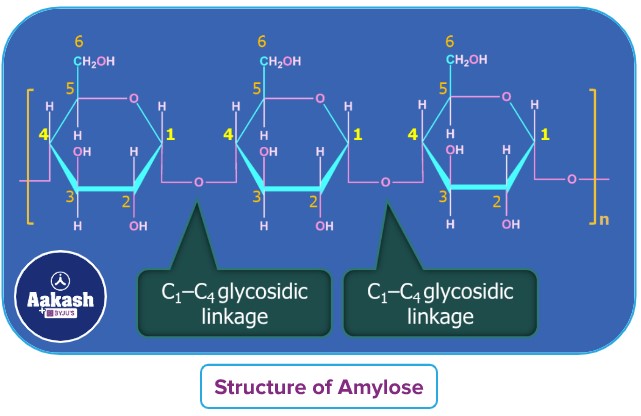
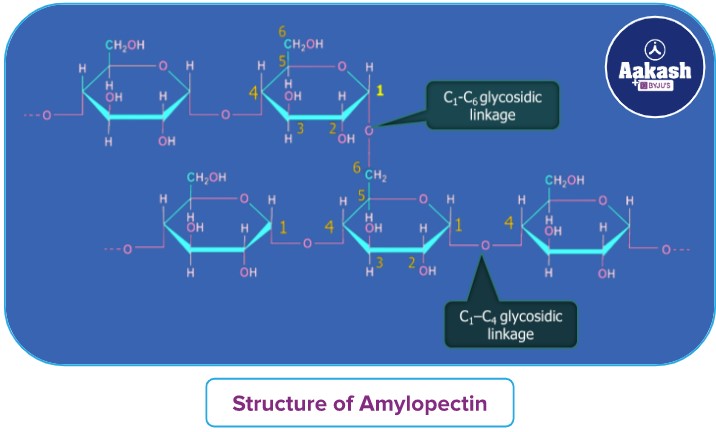
Amylopectin: It has a branched-chain structure. It is composed of chains of 25 to 30 𝛼-D-glucose units joined by glycosidic linkages between C1 of one glucose unit and C4 of the next glucose unit. These chains are in turn connected to each other by C1–C6 glycosidic linkage.

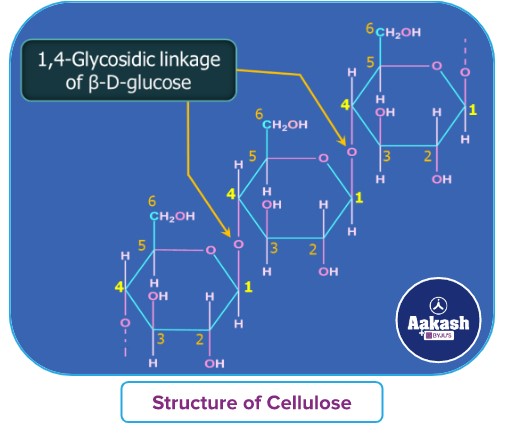
Cellulose – The primary component of plant cell walls is cellulose, which aids in the plant's ability to maintain stiffness and strength. Although cellulose cannot be digested by humans, it is an important source of fibre in the diet. Clothes and paper are made from cellulose. It is a kind of polysaccharides. Linear chain natural polymers of 𝛽-D-glucose units joined by 1,4-Glycosidic linkage.
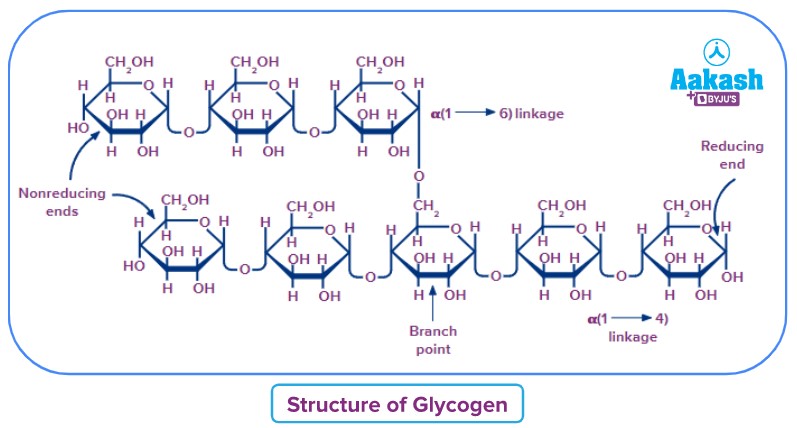
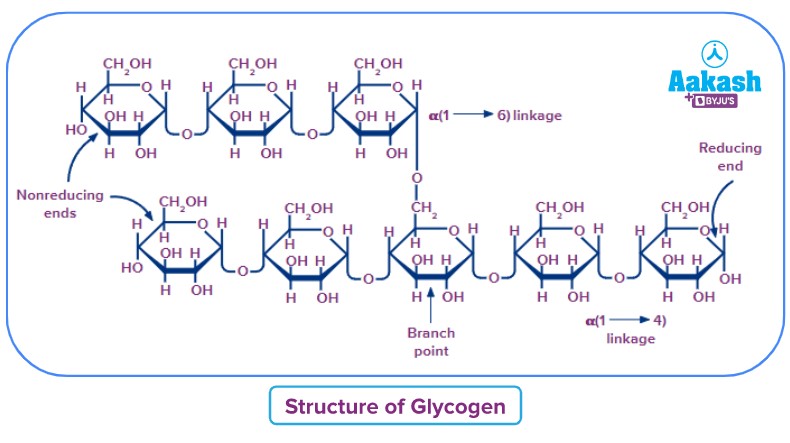
Glycogen – The carbohydrates are stored in an animal body as glycogen. It is a large multi-branched polymer of glucose. Animals, fungi, and bacteria all use the multibranched polysaccharide of glucose known as glycogen to store energy. The primary form of glucose storage in the body is represented by the polysaccharide structure. When the body needs glucose, enzymes break the glycogen down to glucose. The structure is similar to amylopectin, but branching takes place after every 5-6 glucose units.
Polysaccharides – Characteristics
The properties of polysaccharides are as follows:
- They do not have a sweet flavour.
- Many are water insoluble.
- They are naturally hydrophobic.
- Desiccation does not cause them to form crystals.
- It is possible to extract a white powder from it.
- They are carbohydrates with a high molecular weight.
- They are compact and osmotically inactive inside the cells.
- Hydrogen, carbon, and oxygen make up these molecules. The ratio of hydrogen to oxygen is 2:1.
Polysaccharides – Classification
Polysaccharides are divided into two categories:
- Homopolysaccharides
- Heteropolysaccharides
Homopolysaccharides – A homopolysaccharide is a polysaccharide that contains monosaccharides of the same type. The following are some of the most important homopolysaccharides.
- Glycogen is a long chain of molecules made up of sugar molecules. Animals and fungus contain it.
- Cellulose is the main component of the plant's cell wall. It's made up of lengthy chains of -glycosides.
- The condensation of amylose and amylopectin produces starch. It's mostly found in plants, fruits, and seeds.
- Inulin is a fructofuranose molecule that is joined together in chains. Dahlia, artichoke, and other tubers contain it.
Heteropolysaccharides – Heteropolysaccharides are polysaccharides that contain different forms of monosaccharides. The following are some of the most important heteropolysaccharides.
- D-glucuronic acid and N-acetyl-glucosamine make up hyaluronic acid. It's present in skin and connective tissues.
- D-glucuronic acid, L-iduronic acid, and N-sulfo-D-glucosamine make up heparin, which is widely dispersed in mast cells and blood.
- D-glucuronic acid and N-acetyl-D-galactosamine-4-O-sulfate are the sugars that make up chondroitin-4-sulfate. It can be found in cartilages.
- N-acetyl-hexosamine, D-mannose, and D-galactose are the sugars that make up the polysaccharide gamma globulin. It's discovered in the blood.
Polysaccharides – Functions
The polysaccharides serve as a structural organisation in animals and plants. Polysaccharides also have the following properties:
- Organisms use them to store energy.
- Water cannot penetrate the molecules because numerous hydrogen bonds exist, making them hydrophobic.
- They allow for changes in the concentration gradient, which affects the cell's uptake of nutrients and water.
- Glycolipids and glycoproteins are formed when several polysaccharides covalently link with lipids and proteins. These glycolipids and glycoproteins communicate between and within cells.
- They help the cells by providing assistance. Plants' cell walls are made up of polysaccharide cellulose, which supports the plant's cell wall. Chitin is a key component of chitin in insects and fungus.
Recommended Videos
Biomolecules Class 12 Chemistry One-Shot (Full Chapter Revision) Concepts & Imp Ques | JEE Main 2022
Biomolecules Class 12 Chemistry One Shot | Chapter 14 Chemistry Class 12 | NEET 2022 Chemistry Exam
Practice Problems
1. Amylose and amylopectin consist of __________ units joined by glycosidic bonds.
- 𝛼-D-Glucose
- β-D-Glucose
- 𝛼-D-Fructose
- β-D-Fructose
Answer: A
Amylose: It consists of 200-1000 𝛼-D-Glucose units joined by glycosidic linkages between C1 of one glucose unit and C4 of the next glucose unit.
Amylopectin: It has a branched-chain structure. It is composed of chains of 25 to 30 𝛼-D-glucose units joined by glycosidic linkages between C1 of one glucose unit and C4 of the next glucose unit. These chains are in turn connected to each other by C1–C6 glycosidic linkage.
So, option A is the correct answer.
2. The carbohydrates are stored in an animal body as __________.
- Glucose
- Glycogen
- Starch
- Cellulose
Answer: B
Solution: The carbohydrates are stored in an animal body as glycogen. It is a large multi-branched polymer of glucose. Animals, fungi, and bacteria all use the multibranched polysaccharide of glucose known as glycogen to store energy. The primary form of glucose storage in the body is represented by the polysaccharide structure. When the body needs glucose, enzymes break the glycogen down to glucose. The structure is similar to amylopectin, but branching takes place after every 5-6 glucose units.
So, option B is the correct answer.
3. Which of the following is not a polysaccharide?
- Starch
- Cellulose
- Glycogen
- Maltose
Answer: D
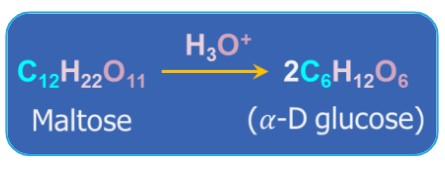
Solution: Among the compounds given in the options, scratch, cellulose and glycogen are polysaccharides. They are lengthy carbohydrate molecules made up of numerous smaller monosaccharides. Maltose is a disaccharide that when hydrolysed with dilute acids or by the enzyme maltase, maltose yields two molecules of D-(+)-glucose.
So, option D is the correct answer.
4. Which of the following is not a characteristic of polysaccharides?
- They do not have a sweet flavour
- They are carbohydrates with a high molecular weight
- They are naturally water soluble
- They are made up of carbon, hydrogen and oxygen atoms.
Answer: C
Solution: The properties of polysaccharides are as follows:
- They do not have a sweet flavour.
- Many are water insoluble.
- They are naturally hydrophobic.
- Desiccation does not cause them to form crystals.
- It is possible to extract a white powder from it.
- They are carbohydrates with a high molecular weight.
- They are compact and osmotically inactive inside the cells.
- Hydrogen, carbon, and oxygen make up these molecules. The ratio of hydrogen to oxygen is 2:1.
So, option C is the correct answer.
Frequently Asked Questions – FAQ
1. What exactly is glycogen?
Answer: Glycogen is a glucose polymer that is used to store energy in fungi and animals. The predominant storage form of glucose in the body is shown by the polysaccharide structure of glucose. Glycogen is produced and stored in liver and muscle cells that are hydrated with four parts of water. It serves as a backup long-term energy storage system. Muscle glycogen is rapidly converted to glucose by muscle cells, while liver glycogen is converted to glucose for utilisation throughout the body, including the central nervous system.
2. What role do polysaccharides play in everyday life?
Answer: Polysaccharides are used in countless products in our daily lives, such as food, clothing, paper, and pharmaceuticals. Important polysaccharides include starch, glycogen, chitin, chitosan, and cellulose.
3. Which foods contain a lot of polysaccharides?
Answer: Rice, pasta, pretzels, cornmeal, oats, quick noodles, and cereal-related goods are rich in polysaccharides. It is also present in small amounts in unripe fruit and other root vegetables.
4. Where can you find polysaccharides in the body?
Answer: Because they are kept in the liver and muscles for later conversion to energy for bodily processes, polysaccharides like starch and glycogen are referred to as storage polysaccharides. Plants contain starch, but animals contain glycogen.

 Call Now
 Let's Chat
 Share
Share