-
Call Now
1800-102-2727


Physisorption – Graphs and Factors Affecting Physisorption, Adsorption, Practice Problems and FAQ

You must have used tissue paper for wiping or cleaning while eating or at dinner.
What do you see if you sprinkle a few water drops?
You will observe that the water droplets will sink into the tissue layers. Absorption is the process in which the substance is spread throughout the bulk of the material. But have you noticed any water droplets on the leaf? You must note that drops only cover the leaf's upper surface. They don't penetrate the leaf's surface. Adsorption is the phenomenon in which the molecules of water, or any other material, simply stay on the surface and do not penetrate further into the bulk. We come across several adsorption-related activities in daily life.

The majority of us are familiar with the term "absorption," but we may not be as knowledgeable or familiar with the term "adsorption." We shall learn more about adsorption and one of its unique varieties, physisorption, on this content page.
TABLE OF CONTENTS
- Adsorption – Definition
- Physisorption – Definition
- Physisorption – Affecting Factors
- Physisorption – Characteristics
- Physisorption – Graphs
- Practice Problems
- Frequently Asked Questions – FAQ
Adsorption – Definition
- There are several instances that show how a solid's surface has a propensity to draw in and hold onto the molecules of the phase it comes into contact with. These molecules do not sink farther into the bulk, they rather simply remain on the surface. Adsorption is the word for the deposition of molecular species at the surface of a solid or liquid as compared to within its bulk.
- Adsorption is a phenomenon of the surface. Because solids, especially those that are finely split, have a large surface area, they make effective adsorbents like charcoal, silica gel, alumina gel, clay, colloids, finely divided metals, etc.
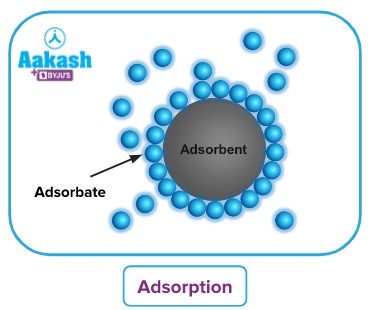
Adsorption is basically categorised into two types. These are
- Chemical adsorption or chemisorption
- Physical adsorption or physisorption
On this content page, we will discuss the second one i.e physisorption in more detail.
Physisorption – Definition
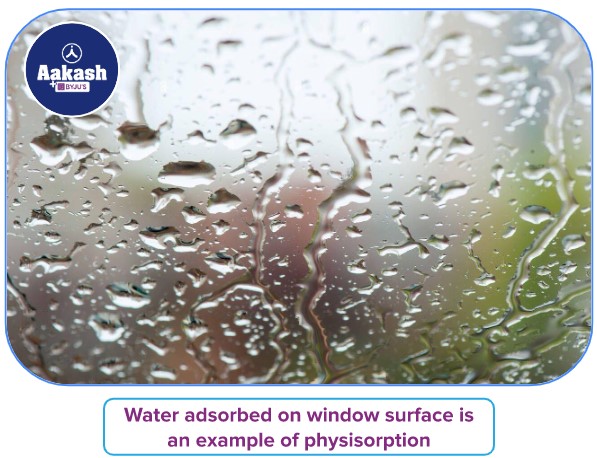
- Physical adsorption, also known as physisorption, is the term for adsorption in which the adsorbent molecules are drawn toward the adsorbate molecules by weak van der Waals forces.
- Only at very low temperatures that are below the boiling point of the adsorbate does physical adsorption become noticeable.
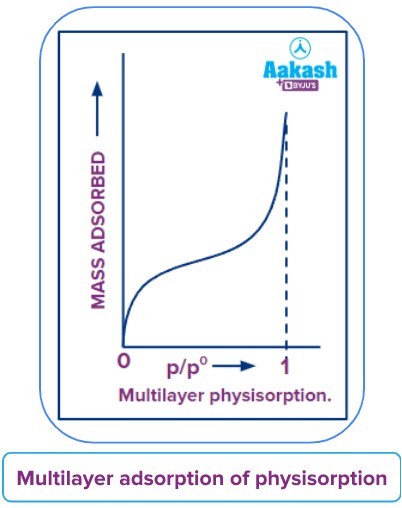
- It typically takes place at low temperatures and is a multi-layer adsorption process.
- Physisorption is reversible since the gas adsorbed may be readily retrieved from the adsorbent by reducing system pressure while maintaining the same temperature.
Physisorption – Affecting Factors
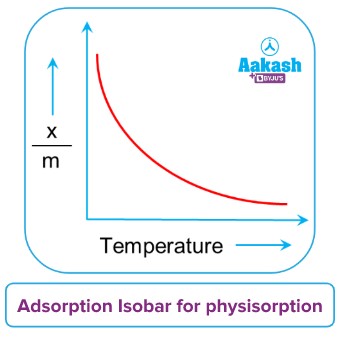
Temperature: Only at extremely low temperatures that are below the adsorbate's boiling point does physical adsorption take place significantly. Physisorption extent diminishes as temperature rises.
Pressure: Practically, physisorption is reversible because, at the same temperature and pressure, the gas adsorbed can be readily retrieved from the adsorbent.
Nature of the gas: It has been discovered that the so-called "permanent gases" like hydrogen, nitrogen, and oxygen are adsorbed less than the more quickly liquefiable and highly soluble gases like ammonia, hydrochloric acid, chlorine, and sulphur dioxide. The former category of gases has a greater predominance of van der Waals or intermolecular forces than the latter category, which is involved in adsorption.
Nature of adsorbent: Given that adsorption is a surface phenomenon, it stands to reason that the adsorbent's capacity for adsorption at the existing temperature and pressure circumstances would increase as its surface area per unit mass increases.

Physisorption – Characteristics
1. Lack of Specificity: Given that the van der Waals forces are uniform, a given surface of an adsorbent does not exhibit any preference for a certain gas.
2. Nature of the Adsorbate: The type of gas will determine how much of it a solid can absorb. The amount of gas a material can adsorb depends on the type of gas. Gases with a higher critical temperature (TC) that are easily liquefiable are easily adsorbed. For instance, because sulphur dioxide has a critical temperature (TC(SO2)= 630 K) higher than methane's (TC (CH4)= 190 K), 1 g of activated charcoal may adsorb more sulphur dioxide than methane.
Solid + Gas ⇋ Gas/solid + Heat
3. Reversible Nature: In general, physical adsorption by a solid is reversible. The physical adsorption of a gas by a material is often reversible.
Le Chateliers' principle states that as pressure rises, more gas is adsorbed since the volume of the gas decreases. By reducing pressure, the gas may be ejected. Le Chatelier's principle states that because adsorption is exothermic, it happens easily at low temperatures and becomes less effective as the temperature rises.
- Surface Area of the Adsorbent: As the surface area of the adsorbent increases, the extent of adsorption seems to increase. As a result, metals with high surface areas and finely split pores are effective adsorbents.
- Enthalpy of Adsorption: Physical adsorption is undoubtedly an exothermic process, yet it has a very modest enthalpy of adsorption (20– 40 kJ mol-1). This is true because only weak van der Waals forces are responsible for the attraction between gas molecules and solid surfaces.
Physisorption – Graphs
- For physisorption, distinct adsorption isobar plots are displayed. Physical adsorption constantly reduces as temperature increases, or the gas is eliminated from the surface.
A graphic representation of the function of temperature on the amount of adsorption at a certain pressure of the adsorbate is provided in the figure below. An adsorption isobar is a curve that depicts how temperature affects the amount of adsorption at a specific pressure.
- With a rise in pressure, the amount of adsorption keeps increasing. The development of extra layers" of physically adsorbed gas molecules is responsible for this. The second layer of gas molecules may be held by van der Waals forces from the gas molecules adsorbed in the first layer, and this second layer may hold the third layer and so on. In the below-shown graph, X-axis represents the ratio of pressure to the saturated pressure of the gas. Y-axis represents the mass of the gas adsorbed over the surface.
Recommended Videos
Adsorption - Surface Chemistry Class 12 One Shot & Mind Maps (Ep 15) | NEET 2022 Exam Strategy
Practice Problems
1. Which one of the following forces primarily contributes to physical adsorption?
a. Magnetic force
b. Gravitational force
c. Van der Waals force
d. Electromagnetic force
Answer: C
Solution: The van der Waals force, which is very weak, is what causes the molecules of the adsorbate to adhere to the surface of the adsorbent in physical adsorption.
So, option C is the correct answer.
2. Which of the below-mentioned statements is correct in regard to the extent of physisorption?
a. It decreases with an increase in surface area
b. It Increases with an increase in temperature
c. It decreases with an increase in the ability of van der Waals forces
d. It decreases with an increase in temperature
Answer: D
Solution: The process of physisorption is exothermic. Le-principle Chatelier states that a drop in temperature favours an exothermic reaction. Therefore, when the temperature rises, physisorption decreases.
So, option D is the correct answer.
3. Which of the below-mentioned statements is false in terms of physisorption?
a. It is spontaneous
b. It is reversible
c. ΔH < 0
d. ΔS > 0
Answer: D
Solution: Because only weak Van der Waals forces, which are quickly disrupted, attach the molecules of the adsorbate to the adsorbent, physical adsorption is reversible. Since physisorption produces heat, ΔH is negative. Adsorption happens on its own hence considered a spontaneous process. The mobility of the adsorbed molecule is constrained during adsorption. The entropy change (ΔS) is thus negative.
So, option D is the correct answer.
4. Enthalpy of physisorption lies in the range of ________.
a. 20– 40 kJ mol-1
b. 120– 140 kJ mol-1
c. 20– 80 kJ mol-1
d. 90– 140 kJ mol-1
Answer: A
Solution: Physical adsorption is undoubtedly an exothermic process, yet it has a very modest enthalpy of adsorption which is equal to 20– 40 kJ mol-1.
So, option A is the correct answer.
Frequently Asked Questions – FAQ
1. At high temperatures, can physisorption change into chemisorption?
Answer: At high temperatures, physisorption could change into chemisorption. In contrast to physisorption, which decreases as temperature rises, physical sorption increases. Although chemisorption is more exothermic than physisorption, it is relatively sluggish because of the larger activation energy.
2. Why there is a lack of specificity in physisorption?
Answer: Physisorption lacks specificity because the adsorbent (the surface or the material on which the process of adsorption takes place) on the given surface does not show any preference for a particular gas. It has reversible nature such that the physisorption of gas by a solid can be reversed.
3. Why is physisorption exothermic in all cases?
Answer: Adsorption is an exothermic process because the adsorbent's surface particles are unstable. As the adsorbate is adsorbed on the surface, the adsorbent's energy lowers, causing heat evolution. As a result, the adsorption is still exothermic.
4. Is there a monolayer in physisorption?
Answer: Adsorption via the van der Waals force, a weak intermolecular attraction, that occurs below the adsorbate's critical temperature and can lead to the formation of a monolayer or multilayer, is referred to as physisorption.

 Call Now
 Let's Chat
 Share
Share