-
Call Now
1800-102-2727


Ozonolysis of Alkynes- Ozonolysis, Mechanisms, Types, Practice Problems and FAQs

Cancer is the highest human killer of today and effective anticancer drugs are desperately being developed.. Taxol, from a bark of a Yew tree contains a diketone, is a highly effective anticancer medication used to treat solid tumour malignancies of the breast, ovary, lung, bladder, prostate, melanoma, oesophagus, and other organs.
Let's talk about the process known as ozonolysis, which allows us to convert an alkyne molecule into a diketone molecule.
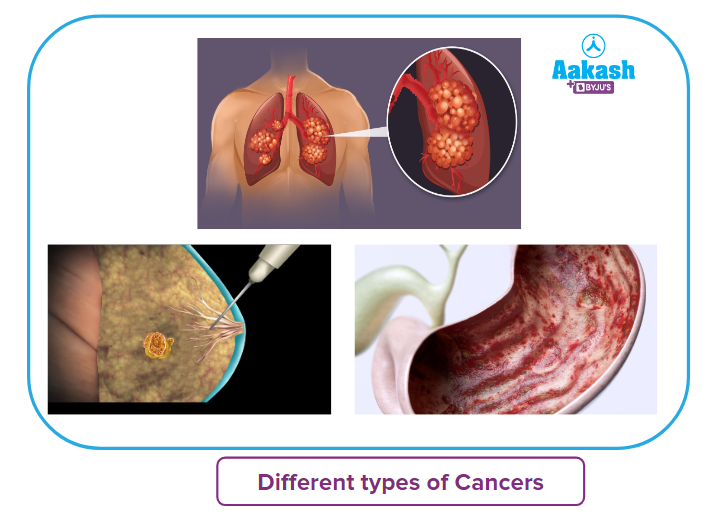
Table of Contents
- Ozonolysis Reaction
- Alkynes ozonolysis
- Mechanism
- Practice Problems
- Frequently Asked Questions
Ozonolysis Reaction
Ozone is an extremely reactive isotope of oxygen. In the presence of ozone molecules, unsaturated substances undergo oxidative cleavage. An intermediate complex known as ozonide is created when the compound's unsaturated bonds are switched out for C-O bonds. To eliminate oxygen, zinc dust is applied to the intermediate ozonide molecule in case of reductive ozonolysis. Oxygen being taken out of the ozonide causes a reductive process that creates carbonyl molecules.
Alkynes ozonolysis
Alkynes having two pi bonds are subjected to ozonolysis, with the end result being either an acid anhydride or a diketone. In this reaction, the fragmentation is not fully complete (alkenes undergo complete fragmentation). No reducing agents are needed because a straightforward aqueous workup can be used. If water is present during the reaction, the acid anhydride goes through hydrolyzation and yields two carboxylic acids. Another application of ozonolysis is to locate the triple bond in an unknown alkyne.
Let's examine the ozonolysis reaction mechanism that occurs in an alkyne.
Mechanism of ozonolysis reaction of alkyne
The reaction mechanism of ozonolysis involves three steps.
Step 1: Attack of the ozone molecule
There are three oxygen atoms in the ozone molecule. Both of the oxygen atoms change their partial charges, one becoming partially negative and the other partially positive. The triple-bonded carbon atom is attacked by the negatively charged oxygen ion. The reactant picks up the ozone molecule. Within the structure, there is a rearrangement that produces the molozonide, an intermediary structure.
Step 2: Formation of ozonide intermediate
A stable ozonide intermediate is created as a result of further self-rearrangement of the molozonide intermediate. We can observe that the triple bond is broken down into a single bond in ozonide. Later, a new carbonyl molecule is produced when the single bond between two carbon atoms also breaks.
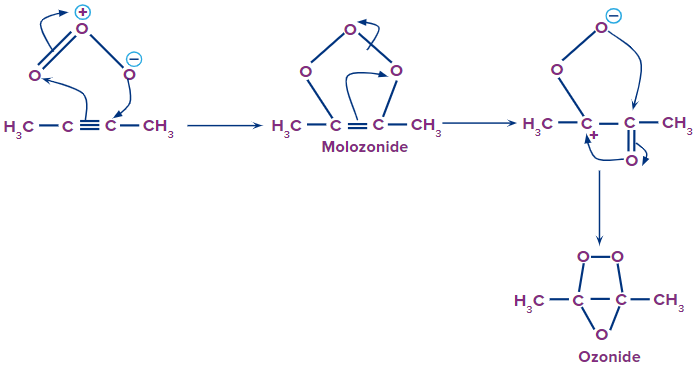

Step 3: Formation of carbonyl compounds
It can be performed by two types of mechanisms, which are given as follows:
- Reductive ozonolysis
- Oxidative ozonolysis
Reductive ozonolysis
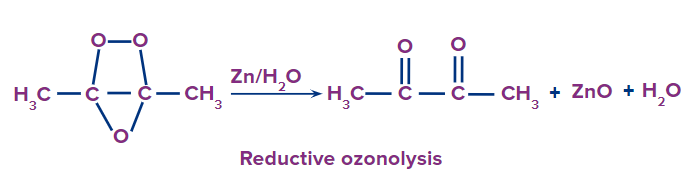
This type of ozonolysis of alkyne involves the addition of an ozone molecule to an alkyne to form an ozonide. Ozonide is unstable and decomposes easily by reduction into , -diketones. The reagent that is used in reductive ozonolysis is given as follows:
(i) Zn and H2O
(ii) (CH3)2S and H2O
(iii) CH3COOH
The formation of , -diketones can be given as:
Oxidative Ozonolysis
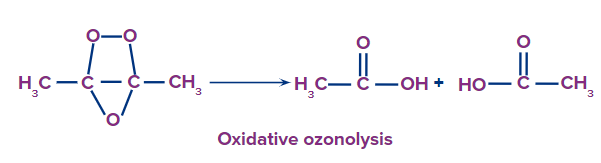
In this kind of ozonolysis, an ozone molecule is added to an alkyne to create an ozonide, which is then oxidized to produce smaller oxidized molecules like acid. The following is a list of the reagent used in oxidative ozonolysis:
(i) H2O
(ii) H2O2
The formation of carboxylic acids can be given as:
In oxidative ozonolysis, if formic acid is formed, it will further decompose into carbon dioxide and water
HCOOHCO2+H2O
Practice Problems
1. What should result from treating cyclopentyne with ozone and then treated with hydrogen peroxide and (dimethyl sulphide, and water) respectively?
- Cyclopentane-1,2-dione, Cyclopentane-1,5-dioic acid
- Cyclopentane-1,5-dioic acid, Cyclopentane-1,2-dione
- Cyclopentane-1,2-dione, Cyclopentane-1,2-dione
- Cyclopentane-1,5-dioic acid, Cyclopentane-1,5-dioic acid
Solution: When cyclopentyne is treated with ozone in the presence of Hydrogen peroxide (O3 and H2O2), this is oxidative ozonolysis which involves the addition of an ozone molecule to an alkyne to form an ozonide, followed by the oxidation to form a carboxylic acid. So, the product should be Cyclopentane-1,5-dioic acid.
When cyclopentyne is treated with ozone in the presence of dimethyl sulphide and water ((CH3)2S and H2O), this is reductive ozonolysis which involves the addition of an ozone molecule to alkyne to form an ozonide, decomposes easily by reduction into , -diketones. So, the product should be Cyclopentane-1,2-dione.
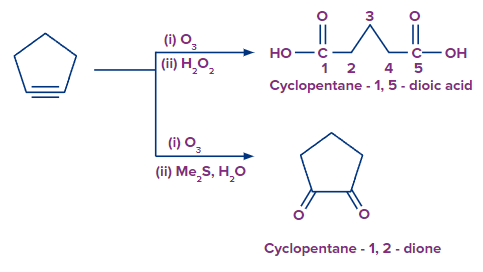
So, the correct answer should be (B).
Q2. Hexane-1,2,5,6-tetraone is formed from a reagent X treated with ozone and acetic acid. What is the possible IUPAC name of X?
- 1,3-Hexadiyne
- 1,4-Hexadiyne
- 2,4-Hexadiyne
- 1,5-Hexadiyne
Solution: This type of alkyne ozonolysis involves adding an ozone molecule to an alkyne to form an ozonide. Ozonide is unstable and quickly decomposes with acetic acid by reduction into -diketones. Here, when reagent X is treated with O3 and CH3COOH, the product formed is Hexane-1,2,5,6-tetraone. The reagent should be 1,5-Hexadiyne. Hence, the correct answer is option (D).

Q3. Compounds A, B, and C are created during the ozonolysis of a chemical in a laboratory. When sodium bicarbonate reacts with molecule A, which has the chemical formula C3H6O2 , it produces the colourless gas D with effervescence. B and D are the same compounds. Decide on the beginning reagent's IUPAC name and the type of ozonolysis.
- But-1-yne, oxidative ozonolysis
- Propa-1,2-diene, reductive ozonolysis
- Propyne, oxidative ozonolysis
- Propyne, reductive ozonolysis
Solution: A colourless gas D with effervescence is produced by treating chemical A, which has the molecular formula C3H6O2 , with sodium bicarbonate. This is a test to analyse if the carboxylic acid group is present. Therefore, propanoic acid (CH3CH2COOH) should be compound A . Carbon dioxide is the gas released during this test. Therefore, substances B and D are CO2. If the end result is a carboxylic acid, ozonolysis must be an oxidative process. Since chemical B is CO2, formic acids are required to produce it. The proposed system is 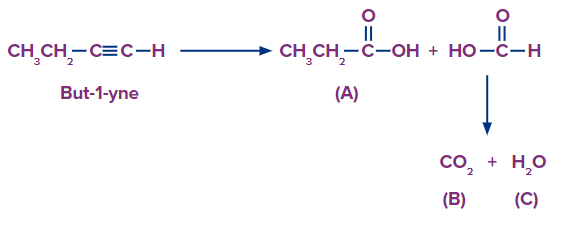
So, the correct answer is an option (A).
4. Predict the IUPAC name of starting reagent and the nature of ozonolysis while doing ozonolysis of a compound, compounds P, Q and R are formed. The compound P with molecular formula C2H4O2, when treated by basic salt gives a colourless gas, S with effervescence. The compounds Q and S are the same.
- But-1-yne, oxidative ozonolysis
- Propa-1,2-diene, reductive ozonolysis
- Propyne, oxidative ozonolysis
- Propyne, reductive ozonolysis
Solution: The compound P with molecular and formula C2H4O2 is treated by basic salt that must be sodium bicarbonate test to give a colourless gas Q with effervescence. This is a test for the presence of the carboxylic acid group. So, compound P should be Acetic acid (CH3COOH). The gas released during this test is carbon dioxide. Hence the compounds Q and Sare CO2. If the product is a carboxylic acid, then the nature of ozonolysis must be oxidative. The compound Q is CO2, then it must be formed from formic acids. The suggested mechanism is
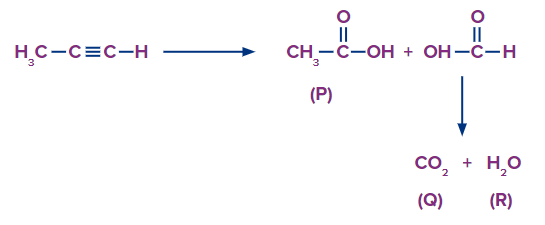
So, the correct answer is an option (C).
Frequently Asked Questions
1. What chemical uses does ozonolysis have?
Answer: The following are the applications of ozonolysis: In organic chemistry, ozonolysis is used to locate double and triple bonds in alkenes and alkynes. Long alkenes and alkynes can be structurally analysed via ozonolysis.
2. Is alkyne basic or acidic?
Answer: Alkynes are acidic because they have the ability to liberate hydrogen atoms to create alkyne ions. The alkyne is therefore employed as Brönsted-Lowry acid. Alkynes, as previously mentioned, have a sp-hybrid carbon atom, which is triple-bonded.
3. What are the industrial uses of ozonolysis?
Answer: Ozonolysis is used in bleaching. Water treatment processes employ ozonolysis. Alcohols, carboxylic acids, aldehydes, and ketones are also created through ozonolysis.
4. What function does zinc perform in ozonolysis?
Answer: In ozonolysis, zinc dust is employed to stop the compound from further oxidation. The reaction is put on hold by Zn because it stops the molecule from making more oxygen bonds.
5. What do you mean by ozone crack?
Answer: The ozone attack on the elastomer, which is present in tiny levels in the atmosphere, causes fissures. The ozone here attacks the double bond in the rubber chain. Ozone cracks appear if the rubber product is under tension. Since the cracks are placed at a right angle to the axis of strain, they can develop all the way around a bent rubber tube. When they develop in fuel pipelines and grow inward from the exposed outer surface, these cracks are quite harmful. Even gasoline leaks and fires may result from this.

NEET Related Links
JEE MAIN Related Links
JEE Advanced Related Links
JEE Advanced Eligibility Criteria
JEE Advanced Chemistry Syllabus
JEE Advanced Registration Dates
CUET Related Links
Important Topics
Anemometer : Measurement of Wind Speed
Angular Acceleration Atomic Theory Audible and Inaudible Sound Average Speed and Average Velocity Average Velocity Avogadros Number Avogadros Hypothesis Azimuthal Quantum Number Balanced Force Bar Magnet Biconvex Lens Boyles Law Buoyancy Calorimeter Carnot Engine Celestial Bodies Centripetal And Centrifugal Force Concave and Convex Lenses Concave Convex Mirrors Contact and Non Contact Force Controlled Thermonuclear Fusion Convection Currents Convex Lens Convex Mirror Destructive Interference Difference Between Conduction Convection and Radiation Difference Between Electric Field and Magnetic Field Difference Between Heat And Temperature Difference Between Series And Parallel Circuits Differences Between Acceleration And Velocity Distance and Displacement Distance Time Graph Electrical Force : Electric Forces and Their Types Electromagnetic Waves : Definition, Equation and Properties of Electromagnetic Waves Electromagnetism Electron Spin Fluid Flow : Bernoullis Equation Derivation and Fluid Mechanics Fluid Friction : Types and Factors of Fluid Friction Frames of Reference : Inertial and Non- Inertial Frame of Reference Frequency and Wavelength Frictional Force Importance of Hydrosphere Instantaneous Speed and Velocity Introduction to Motion Kinetic and Potential Energy Difference Law Of Conservation of Energy Layers of the Earth Light Energy Light Sources List of physics scientists and Their inventionsLoudness of Sound
Magnetic Dipole Moment Magnetic Field Non - Contact Force Non - Renewable Energy Ohms Law Optics P Wave Physics Symbols Plane Mirrors Poissons Ratio Projectile Motion Properties of Water : Anomalous Expansion of Water Radius of Gyration Reflection of Light Reflection of Waves Relative Density Resonance Reverberation Rolling Friction Rotation and Revolution Screw Gauge Semiconductors and Insulators Sliding Friction Speed Time Graphs Static Friction Stefan Boltzmann Law Stress Tension Tension Force Thermometer: Clinical Laboratory Thermometer Types of Rocks Types of Waves Uniform Motion and Non Uniform Motion Unit of Voltage Uses of Convex Lens Uses Of Convex Mirror Uses of Electromagnet Uses of Optical Fibre Wave Wavelength of Light What is Scattering of Light Working of Electric Bell Conventional and Non-conventional Sources of Energy Buoyant Force Bulk Modulus of Elasticity Bernoulli’s Principle Angular Momentum Difference Between Speed And Velocity ForceUnit of Heat
Difference between Distance and Displacement Simple Microscope Derivation Of Equation Of Motion Thermometer: Clinical & Laboratory Thermometer Difference between Concave and Convex LensDerivation Of Lens Maker Formula
Unit Of Pressure Velocity Uses of Plane Mirror
Wave Theory of Light
Unit of Density Unit of Light Unit of Force Unit of Magnetic Field Unit of wavelength Unit of Viscosity Uses of Electroplating Young's Modulus
What is the Scattering of Light
Lenz Law Space Wave Propagation Schrodinger Wave Equation Relation between Fahrenheit and Celsius Refractive Index Potentiometer Working Pascal Law Oscillatory Motion Optical Instruments Newton's Laws of Motion - First Law Modulation and Demodulation Magnetic Flux Lens Formula and Magnification Kaleidoscope Faradays Law Epsilon Naught Value Energy Bands Electrostatics Electroscope AC Generator Unit of Current Lithosphere Bending Equation Derivation Difference Between Pound and Kilogram Semiconductor Devices OTEC - Ocean Thermal Energy Conversion Hall Effect Rectilinear Propagation of Light Difference Between Ammeter and Voltmeter Coefficient of Linear Expansion Ampere’s Law Cyclone and Thunderstorm Save The Environment From Pollution Particle Nature of Light Types of DC Motor Uses Of Transistor Derivation of Phase Rule Unit of Humidity

 Call Now
 Let's Chat
 Share
Share