-
Call Now
1800-102-2727


Newlands’ Law of Octaves - Telluric Helix, Salient Features, Drawbacks, Practice Problems and FAQ

The most important tool for chemistry enthusiasts and students (just like you and me) is our very own Periodic Table! It has its own proclaimed root! Let’s dig in.
Let’s talk about music for a while. Have you ever crooned the beautiful musical notes of our Indian classical music?
‘’Sa Re Ga Ma Pa Dha Ni Sa’’ or even the Western musical notes ‘’Do Re Me Fa So La Ti Do’’
They have a beautiful relevance with the Law of Octaves! Notice how the first and the eighth note are just the same? In fact, the first and the eight notes of this octave family of melodies are exactly the same. So was the case with elements, as stated by Newlands’ Law of Octaves.
Let’s now dig deeper into this concept and take a musical dive into the ocean of chemistry!
TABLE OF CONTENTS
- Telluric Helix by de Chancourtois
- Newlands’ Law of Octaves
- Salient Features of Newlands’ Law of Octaves
- Drawbacks of Newland’s Law of Octaves
- Practice Problems
- Frequently Asked Questions - FAQ
Telluric Helix by de Chancourtois
- In 1862, two years prior to the Newlands’ law of octaves, Alexandre-Émile Béguyer de Chancourtois created a fully functioning and unique system of systematically organising elements.
- He proposed the classification of elements based on the freshly obtained values of atomic masses, given by Stanislao Cannizzaro in 1858.
- de Chancourtois plotted the atomic weights, in a continuous spiral form, on the surface of a cylinder with a circumference of 16 units, considering the atomic weight of oxygen as 16 which was taken as a standard. And against this, all other elements were compared.
- Tellurium came at the centre, prompting the name- telluric helix or vis tellurique, or telluric screw. The resultant helical curve brought out similar elements onto corresponding points above or below one another on the cylinder.
- His work was discarded due to less attention from chemists around the world. The reason is that de Chancourtois's original helical diagram was left out of the publication, thereby making the paper difficult to understand. The paper also dealt with geological concepts and did not suit the interests of chemistry experts.
Newlands’ Law of Octaves
- In 1865, after the failure of Dobereiner’s Law of Triads, and when the telluric helix started to lose its importance, an English chemist, John Alexander Newlands, proposed the law of octaves.
- He called this ‘The Law of Octaves’, drawing a comparison with the octaves of music.
Salient Features of Newlands’ Law of Octaves
- The elements can be arranged in the increasing order of their atomic weights.
- In this kind of arrangement, every eighth element of a row had chemical and physical properties similar to that of the first element of the same row, depicting the octaves of music.
- This was the first to be logically based on similarities of elements based on their atomic weights.
- The given table of elements shows that it is applicable up to calcium.
- This method worked well for lighter elements like lithium, sodium and potassium and was combined to have shown similar properties.
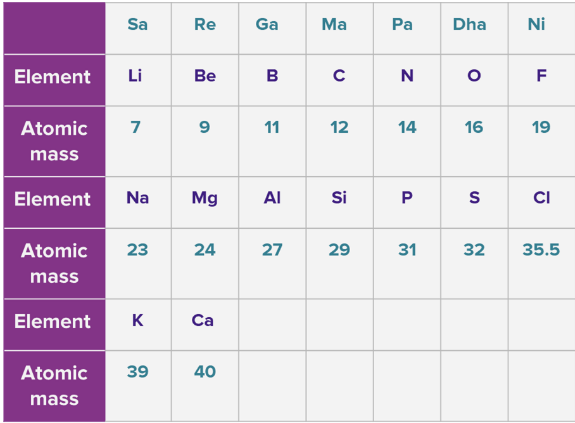
FIG: Elements Added as per Newlands’ Law of Octaves
Drawbacks of Newlands’ Law of Octaves
- Out of the 56 elements known at that time, the arrangement of elements only up to calcium was possible based on the law of octaves.
- After calcium, every eighth element didn’t show similarity in properties to the first element.
- New elements were added afterwards, for which no specific provisions were made by Newlands.
- To adjust the existing order, Newlands has even placed two elements with different chemical and physical properties in the same position.
- This arrangement had no provision for noble gases either, as they weren’t discovered yet.
- This arrangement had no provision for the future discoveries of elements.
Practice Problems
Q1. What were the advantages of Newlands’ law of octaves?
Answer:
- This law provided a framework for the classification of elements with similar properties in the same groups.
- This law was the first to be based on the atomic weight of elements, thereby linking atomic weight to the elemental features.
- This method performed well for lighter elements, for example, combining lithium, sodium and potassium in the same group.
Q2. Based on Newlands’ classification, the properties of sulphur are similar to those of oxygen because sulphur is the ______ element starting from oxygen.
A. 7th
B. 8th
C. 3rd
D. 6th
Answer: Newlands’ law states similarity in first and its corresponding 8th element. Hence, the answer is option B.
Q3. A and B are two elements having similar properties which obey the law of octaves. How many elements are there in between A and B?
A. 6
B. 5
C. 8
D. 7
Answer: Since the first and the eighth elements have similarities, there will be 6 elements between A and B. Hence, the answer is option A.
Q4. Which of the given pairs follows Newlands’ law of octaves?
A. Boron and Sodium
B. Lithium and Sodium
C. Calcium and Potassium
D. Calcium and Nitrogen
Answer: Newlands’ law stated that every eighth element had similar properties when they were arranged in the increasing order of their atomic masses. Following this rule, lithium and sodium; sodium and potassium; chlorine and fluorine have similarities. So the answer is Option B.
Frequently Asked Questions - FAQ
Question: How many elements could be covered with Dobereiner’s law of Triads?
Answer: Newlands’ law of octaves was applicable for elements till calcium. Elements with higher atomic masses could not be accommodated into the law of octaves.
Question: What pattern of similarity forms the basis of Newland’s law of Octaves?
Answer: Newlands observed a pattern of similarity or periodicity in the chemical properties of the elements at a regular interval such that every eight elements had some analogy to the first.
Question: Why was Newlands’ law of octaves discarded?
Answer: It was discarded as it did not prove to be effective for elements of higher atomic weights, beyond calcium. In fact, cobalt and nickel were placed in the same column as chlorine, bromine and fluorine. Out of the then evident 56 elements, elements only till calcium could be justified by this law.
Question: What followed Newlands’ law of octaves?
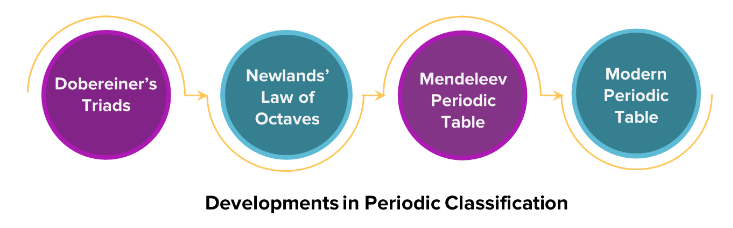
Answer: Mendeleev’s periodic law and his classification of the elements in a periodic table followed Newlands’ octave theory. He also considered atomic weight to be the basis of classification, but still, there was some speciality about Mendeleev’s classification that made it more acceptable.
Related Topics
|
Modern Periodic Table |
Atomic Radii |
|
Electronegativity |
Anomalous Properties of Second Group Elements |
|
Ionic radii |
Factors affecting Ionization Enthalpy |

 Call Now
 Let's Chat
 Share
Share