-
Call Now
1800-102-2727


Nernst Equation-Electrode Potential, EMF, Temperature and Concentration Dependence of Cell Potential, Derivation of Nernst Equation, Reaction Quotient, Practice problems and FAQs:

You are well aware of gas equations that say volume, pressure, and temperature of a gas are related. Volume changes with change in pressure or temperature or both. For comparison, we are fixing 1 atm as pressure and temperature as 298K.


Similarly the electromotive force(EMF) from two chemical reactions in a galvanic cell that drives electrical current depends on temperatures and concentrations. The relationship between the emf and {M} and T are given by Nernst Equation.
Table of content
- EMF
- Nernst Equation
- Reaction Quotient
- Practice Problems
- Frequently asked questions (FAQs)
EMF
A metal(electrode) in contact with its salt solution looses electron (oxidized) to become an ion and gets into the solution. At the same time the metal ion from solution receives the electrons to become the metal and get deposited on the electrode. These two processes do not continue forever but stopped due to the development of a potential on the electrode which stops the electrode loosing electron to become an ion. The potential is called oxidation electrode potential.
You may have an another metal having lesser oxidation potential(getting reduced) in contact with its salt solution. When the these solutions are connected by a salt bridge, the two metal electrode for a galvanic cell and have a potential developed across them. This net potential of the cell is called EMF of the cell.
When the cell externally connected to electrical bulb, the cell potential can make the two chemical reactions to go ahead, produce electrons, force them the electrons through the circuit such that the electrical bulb now glows.
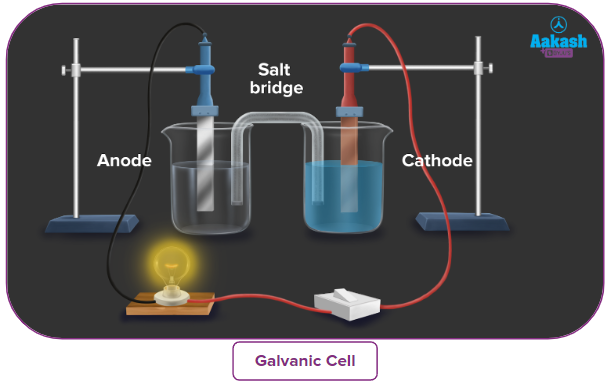
The factors affecting cell potential are as follows:
- Temperature
- Composition of the reaction mixtures
- Concentration of the solutes
- The partial pressure of the gas
Standard electrode potential is the electrode potential measured at standard conditions of one molar concentration of the salt solution or one bar pressure of the gas at 298 K, as with standard conditions of temperature and pressure.in the case of a gas.
Nernst Equation
Electrode and hence the cell potential changes with conditions and since it is not possible to measure the cell potential at every possible condition, we require a relation so that we can calculate cell potential (E) related to the standard electrode or cell potential (E0) of that cell. Such a relationship is the Nernst equation.
The thermodynamic force responsible for changes is given by the Gibbs free energy changes as-
ΔG = ΔG0 + RT ln Q: where ΔG is the free energy change accompanying a process at any conditions,
ΔG0is the free energy change accompanying a process at standard conditions,
and Q is the Reaction quotient.
ΔG = -nFE, and ΔG0 = -nFE0
−nFEcell = −nFE0cell + 2.303 RT log Q
Reaction Quotient
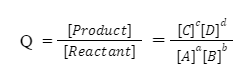
Reaction quotient is defined as the ratio of the activity of the products raised to the power of their stoichiometry to the activity of reactants raised to the power of their stoichiometry.
Reaction Quotient For a general electrochemical reaction, aA + bB + ne- ⇌ cC + dD
Derivation of Nernst Equation for single electrode potential:
Consider a metal that comes into contact with its own aqueous salt solution.
Let’s consider the following reduction of metal ion reaction
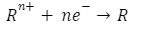
- To move this electron a certain work has to be done. Hence,
Work done for reduction = nFEred
F= faraday which is 96487 C
Remember that, during calculation, we can take 96500 C value of F to solve numerical easily
- The change in Gibbs free energy is a measure of spontaneity, as well as the maximum useful work (apart from volume expansion) done in a process.
By relating work done and Gibbs free energy change we get,
Wred = nFEred = – ∆G or ∆G = – nFEred
- At standard condition that is at 298 K, one molar concentration of ions and at 1 atm pressure
∆G° = – nFE°red
E°red= standard reduction potential
- The concentration changes during the reaction, and the potential decreases as the reaction progresses. The concentrations must be kept constant to achieve the maximum work or free energy change. Only a reversible equilibrium state allows for this.
According to Vant Hoff isotherm, ∆G for a reversible reaction is
∆G=∆G°+RT ln K
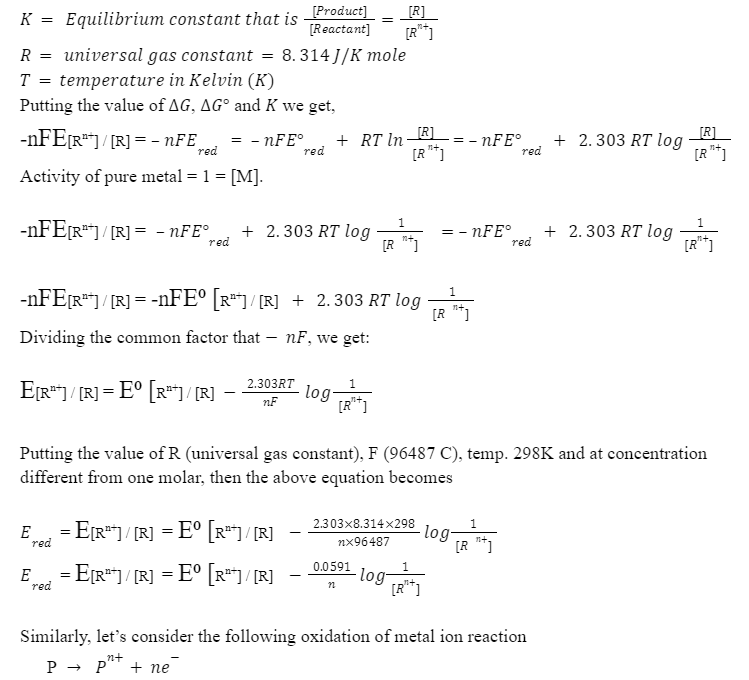
- To move this electron a certain work has to be done. Hence,
Work done for reduction = nFEoxid
F= faraday which is 96487 C
Remember that, during calculation, we can take 96500 C value of F to solve numerical easily
- The change in Gibbs free energy is a measure of spontaneity, as well as the maximum useful work (apart from volume expansion) done in a process.
By relating work done and Gibbs free energy change we get,
Woxid = nFEoxid = – ∆G or ∆G = – nFEoxid
- At standard condition that is at 298 K, one molar concentration of ions and at 1 atm pressure
∆G° = – nFE°oxid
E°oxid= standard oxidation potential
- The reaction is carried out in a reversible equilibrium state.
According to Vant Hoff isotherm, ∆G for a reversible reaction is:
Derivation of Nernst Equation for emf of a cell:
Consider a redox reaction in two half cell as-
At cathode (reduction) Rn++ne- R

As metals have unit activity concentrations of the product and reactants are Pn+ and Rn+respectively.
The emf of a cell redox couple half-reactions in two different cells connected by a salt bridge is given by-
Ecell = Ecathode + Eanode
Ina galvanic cell oxidation occurs at anode and reduction occurs at cathode. And Ered = - Eoxid
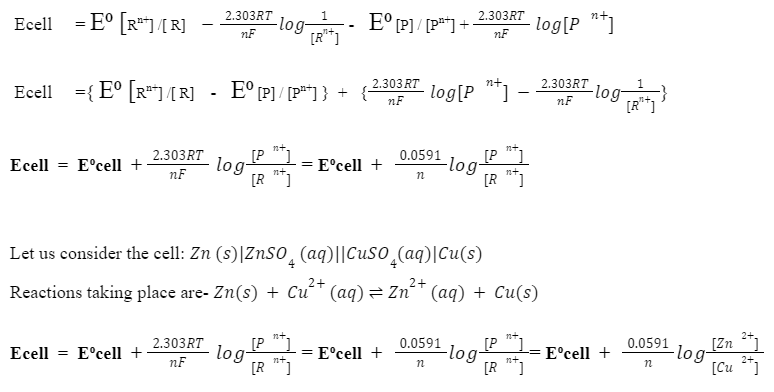
At standard conditions of 298 K and one molar solutions, Ecell = E⁰cell
In this cell, electrons flow from zinc to copper in the internal circuit with the following processes take place :
- Zinc from the zinc rod passes into the solution as Zn2+ions.
- Cu2+ ions from CuSO4 solution are deposited on the Cu plate.
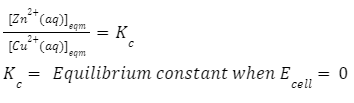
As a result, the concentration of CuSO4 solution decreases whereas that of ZnSO4 solution increases. Since electrode potentials depend upon the concentrations of the solutions, therefore, electrode potentials of the two electrodes involved keep on changing.. Ultimately, a stage comes when The current in the circuit stops flowing and the two electrodes are equal, i.e. the cell's EMF is zero. (This is because the EMF is the difference of the two electrode potentials). The cell reaction is said to have reached equilibrium at these conditions.
Thus the concentration of Cu2+ and Zn2+ ions at this stage are the equilibrium concentrations so that we have
Putting these values in Nernst equation, we get
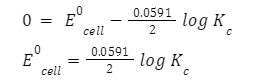
Thus, knowing the standard EMF of the cell, the equilibrium constant Kc can be calculated
Significance of Kc . The value of Kc tells about the extent of reaction. For example, the value of Kc for the Zn-Cu cell at 298 K is found to be very large i,e. , about  which shows that the reaction goes almost to completion.
Practice Problems
Q1. Determine the equilibrium constant for the reaction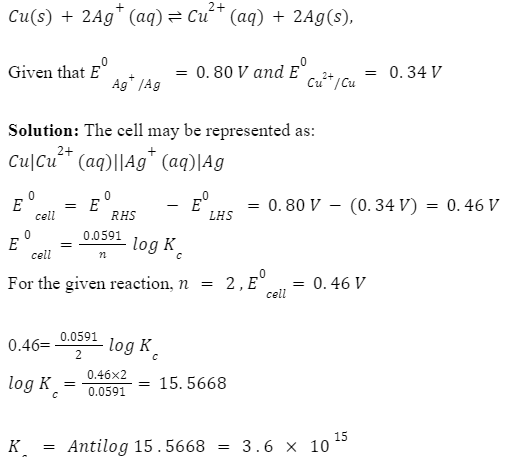
Q2. The Nernst equation for electrode potential at any concentration measured with respect to a standard hydrogen electrode is expressed as for a cell reaction: Mn+(aq)+ne- M (s)
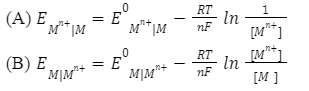
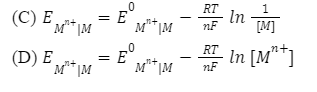
Answer: (A)
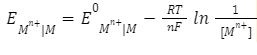
Solution: Nernst equation for the above reaction is

As the activity of pure metal is 1
Hence, the above equation can be written as
Q3. Cell reaction is spontaneous when:
A. G0 = -ve
B. G0 = +ve
C. E0red= +ve
D. E0red= -ve
Answer: (A)
Solution: A reaction with a negative G0 value can usually occur without requiring any energy input. As a result, reactions with a negative G0 will be spontaneous because energy will be released. At any temperature, the reaction will be spontaneous.
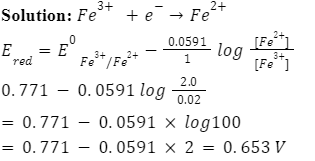
Q4. Calculate the reduction potential of a half-cell consisting of platinum electrode immersed in 2.0 M Fe2+ and 0.02 M Fe3+

A. 0.889 V
B. 0.683 V
C. 2.771 V
D. 0.653 V
Answer: (D)
Frequently asked questions (FAQs)
Question 1. Why activity of metal is one?
Answer: We consider concentration equivalent to active mass. The molar concentration is proportional to the density. The density of a solid or liquid reactant does not change during a reaction. Although mass and volume change, the ratio between the two remains constant. The active mass is 1 because the density of the solid or liquid remains constant. Gasses take up the volume of their container, and removing some gasses changes the concentration.
The ratio of product to reactant concentration is the equilibrium constant K. The active mass of solids and liquids is always unity as there are no other terms on the LHS side.
Question 2. Does the concentration of ions affect the electrode potential or cell potential?
Answer: The electrodes in a concentration cell are made of the same material, and the half-cells only differ in concentration. Because one or both compartments are not standard, the cell potentials will be unequal; thus, a potential difference will exist, which can be calculated using the Nernst equation.
Question 3. Are the theoretical potential calculated from the Nernst equation is equal to the practical potential?
Answer: No, the theoretical potential is always higher than the practical value because during the theoretical calculation we only consider standard conditions that are at 298K, 1 molar concentration, and 1 atm pressure but in the laboratory, it is not possible to maintain standard conditions always. Along with this, we don’t consider the fact that after several usage metal can be lost from the electrode.
Related Topics
|
Types of Electrodes |
Faraday's Laws |
|---|---|
|
Metallurgy |
Electrolysis |
|
Standard Electrode Potential |
Fuel cell |

NEET Related Links
JEE MAIN Related Links
JEE Advanced Related Links
JEE Advanced Eligibility Criteria
JEE Advanced Chemistry Syllabus
JEE Advanced Registration Dates
CUET Related Links
Important Topics
Anemometer : Measurement of Wind Speed
Angular Acceleration Atomic Theory Audible and Inaudible Sound Average Speed and Average Velocity Average Velocity Avogadros Number Avogadros Hypothesis Azimuthal Quantum Number Balanced Force Bar Magnet Biconvex Lens Boyles Law Buoyancy Calorimeter Carnot Engine Celestial Bodies Centripetal And Centrifugal Force Concave and Convex Lenses Concave Convex Mirrors Contact and Non Contact Force Controlled Thermonuclear Fusion Convection Currents Convex Lens Convex Mirror Destructive Interference Difference Between Conduction Convection and Radiation Difference Between Electric Field and Magnetic Field Difference Between Heat And Temperature Difference Between Series And Parallel Circuits Differences Between Acceleration And Velocity Distance and Displacement Distance Time Graph Electrical Force : Electric Forces and Their Types Electromagnetic Waves : Definition, Equation and Properties of Electromagnetic Waves Electromagnetism Electron Spin Fluid Flow : Bernoullis Equation Derivation and Fluid Mechanics Fluid Friction : Types and Factors of Fluid Friction Frames of Reference : Inertial and Non- Inertial Frame of Reference Frequency and Wavelength Frictional Force Importance of Hydrosphere Instantaneous Speed and Velocity Introduction to Motion Kinetic and Potential Energy Difference Law Of Conservation of Energy Layers of the Earth Light Energy Light Sources List of physics scientists and Their inventionsLoudness of Sound
Magnetic Dipole Moment Magnetic Field Non - Contact Force Non - Renewable Energy Ohms Law Optics P Wave Physics Symbols Plane Mirrors Poissons Ratio Projectile Motion Properties of Water : Anomalous Expansion of Water Radius of Gyration Reflection of Light Reflection of Waves Relative Density Resonance Reverberation Rolling Friction Rotation and Revolution Screw Gauge Semiconductors and Insulators Sliding Friction Speed Time Graphs Static Friction Stefan Boltzmann Law Stress Tension Tension Force Thermometer: Clinical Laboratory Thermometer Types of Rocks Types of Waves Uniform Motion and Non Uniform Motion Unit of Voltage Uses of Convex Lens Uses Of Convex Mirror Uses of Electromagnet Uses of Optical Fibre Wave Wavelength of Light What is Scattering of Light Working of Electric Bell Conventional and Non-conventional Sources of Energy Buoyant Force Bulk Modulus of Elasticity Bernoulli’s Principle Angular Momentum Difference Between Speed And Velocity ForceUnit of Heat
Difference between Distance and Displacement Simple Microscope Derivation Of Equation Of Motion Thermometer: Clinical & Laboratory Thermometer Difference between Concave and Convex LensDerivation Of Lens Maker Formula
Unit Of Pressure Velocity Uses of Plane Mirror
Wave Theory of Light
Unit of Density Unit of Light Unit of Force Unit of Magnetic Field Unit of wavelength Unit of Viscosity Uses of Electroplating Young's Modulus
What is the Scattering of Light
Lenz Law Space Wave Propagation Schrodinger Wave Equation Relation between Fahrenheit and Celsius Refractive Index Potentiometer Working Pascal Law Oscillatory Motion Optical Instruments Newton's Laws of Motion - First Law Modulation and Demodulation Magnetic Flux Lens Formula and Magnification Kaleidoscope Faradays Law Epsilon Naught Value Energy Bands Electrostatics Electroscope AC Generator Unit of Current Lithosphere Bending Equation Derivation Difference Between Pound and Kilogram Semiconductor Devices OTEC - Ocean Thermal Energy Conversion Hall Effect Rectilinear Propagation of Light Difference Between Ammeter and Voltmeter Coefficient of Linear Expansion Ampere’s Law Cyclone and Thunderstorm Save The Environment From Pollution Particle Nature of Light Types of DC Motor Uses Of Transistor Derivation of Phase Rule Unit of Humidity

 Call Now
 Let's Chat
 Share
Share