-
Call Now
1800-102-2727


Molar Conductivity and Equivalent Conductivity: Definitions, Relationship Between Molar Conductivity and Equivalent Conductivity, Practice Problems and FAQs:

Are we not calculative and quantitative in our actions? That to, the health conscious people in what and how much they consume per day in terms of calories, proteins vitamins….Don’t you think by tracking the number of calories you take, it will be easier to stay healthy?
Yes, definitely you will remain fit and energetic. There are charts giving these details and packets containing consumables exhibit them on the cover.

In electrolysis also the quantity of electrons or charges (electricity) flowing across electrodes is decided by the nature of the electrolyte. .
If we can find out how much amount of current is carried by a unit volume of electrolyte, it will definitely help us to plan the process in terms of either current needed to get a particular product quantity or vice versa..
So let’s understand some important terms that helps us to calculate electrical flow through the electrolyte and it’s relationship with different variables.
Table of content
- Electrical resistance and conductance
- Conductance (G)
- Conductivity/ Specific conductance
- Molar conductivity
- Equivalent conductivity
- Relationship between molar conductivity and equivalent conductivity
- Practice problems
- Frequently asked questions (FAQs)
Electrical resistance and conductance
Every substance offers resistance to the flow of electricity to a small or large extent. The law that gives the exact value of the resistance is known as Ohm's law. It states that
If to the ends of a conductor is applied a voltage 'E' and a current 'I' flows through it, then the
resistance 'R' of the conductor is E/I. Current is generally measured in amperes, whereas voltage is measured in volts. If one ampere current flows through a conductor when a voltage of one volt is applied to it, the resistance of the conductor is taken as I ohm .
Thus, according to Ohm's law,
V=IR
Where I = current flowing through the conductor
V = potential difference across the conductor
R = resistance offered by the conductor
Conductance (G)
It represents the ease by which current can flow through the conductor.
It is a measure of degree through which conductor can conduct electricity.
Greater the value of conductance, greater the conduction.
It is generally reverse of resistance.
Mathematically, we can write,
Unit of conductance is simen (S)
1 simen (S) = 1 ohm-1 or 1-1 or 1 mho
Resistivity
electrical resistance of a conductor with a unit length and cross-sectional area. Resistivity is a distinctive attribute of any material that may be used to compare different materials based on how well they conduct electric currents. Poor conductors are identified by high resistance.
Where R= resistance of the conductor
A=area of cross section
l= length of the conductor
Conductivity/ Specific conductance
Mathematically
Where
G = conductance of 1 (unit)3 of conductors or 1 (unit)3 of solution.
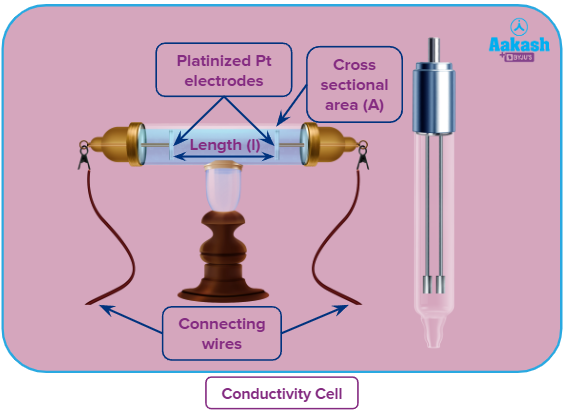
l = distance between electrodes
A = area of cross section of electrodes
S.I unit of
1 Sm-1 = 1 ohm-1 m-1 = 1 mho cm-1
Common unit : 1 Scm-1 = 1 ohm-1 cm-1 = 1 mho cm-1
Molar conductivity
It is the conductivity of 1 mole of solution of electrolyte dissolved in V volume of solution.
1 (unit)3 = k
V (unit)3 = k.V = Am
As we know
Molarity =
Since n = 1
Hence,
If the unit of is in Sm-1
If the unit of is in S cm-1
S.I unit of molar conductivity
Common unit of molar conductivity
Equivalent conductivity
Conductance of 1g eq. of conductors/electrolyte dissolved in V volume of solution,
1g eq. = amount of substance deposited/liberated by 1 mole of electrons/ 1F
As we know,
Normality
Hence,
Valence factor (Z) for ionic solids
Number of electrons released or accepted in 1 mole of compound is the valance factor of that respective compound.
For example:
S.I Unit of equivalent conductivity
Common unit
Relationship between molar conductivity and equivalent conductivity
Practice problems
Q1. If specific conductivity of N/40 KCl solution at 250 C is 0.0013825 ohm-1 cm-1 and resistance of a cell containing this solution is 300 ohms. calculate the cell constant.
- 0.41475 cm-1
- 4.1475 cm-1
- 41.475 cm-1
- 0.041475 cm-1
Answer: (A)
Solution: We know that
Q2. 1 normal solution of a salt placed between two platinum electrodes 4.0 cm. Apart and of area of cross-section 8.0 sq. cm. has a resistance of 12.5 ohms. calculate the equivalent conductivity of solution.
- 4.0 S cm2 eq-1
- 400 S cm2 eq-1
- 20 S cm2 eq-1
- 40 S cm2 eq-1
Answer: (D)
Solution:
First we need to calculate the specific conductivity.
Given date :
l = 4.0 cm, a = 8.0 cm2 and R = 12.5 ohms
Conductance
Cell constant
Now we can calculate equivalent conductivity
Here c = 1 N, k = 0.04 ohm-1 cm-1
Q3. The electrical resistance of a column of 0.025 M NaOH solution of diameter 10 cm and length
100 cm is 1.11 x 10³ ohm. Calculate the molar conductivity of the solution.
- 45.90 S cm2 mol-1
- 4590 S cm2 mol-1
- 4.590 S cm2 mol-1
- 0.4590 S cm2 mol-1
Answer: (A)
Solution: (a) calculation of resistivity
Electrical resistance of the solution, R=1.11 x 10³ ohm
Area of cross section of the column
Length of the column (l)=100 cm
Applying the formula
Q4. What will be the valence factor (Z) of KCl solution?
- 2
- 3
- 1
- 5
Answer: (C)
Solution:
Valence factor is defined as the number of electrons released or accepted in 1 mole of compound is the valance factor of that respective compound.
KCl --> K+ + Cl- here Z = 1
Frequently asked questions (FAQs)
Q1. Is the term molar conductivity refers to a constant term?
Answer: Molar conductivity is the conductance property of a solution containing one mole of electrolyte or a function of a solution's ionic strength or salt concentration. Since concentration of the solution can change, conductivity of the solution also will change and will not be a constant.
Q2. Whenever there’s a dilution in the solution, conductivity decreases. Why?
Answer: The conductance of ions present in a unit volume of a solution is called conductivity. The number of ions per unit volume decreases with dilution. As a result, the conductivity drops.
Q3. Why does solutions conduct electricity?
Answer: Because current is carried forward by the ions, the conductivity of a solution is directly proportional to the number of ions present in a unit volume of the solution.
Q4. What impact does temperature have on the molar conductivity?
Answer: The molar conductivity of an electrolyte rises along with the interaction of the ions as the temperature rises.

NEET Related Links
JEE MAIN Related Links
JEE Advanced Related Links
JEE Advanced Eligibility Criteria
JEE Advanced Chemistry Syllabus
JEE Advanced Registration Dates
CUET Related Links
Important Topics
Anemometer : Measurement of Wind Speed
Angular Acceleration Atomic Theory Audible and Inaudible Sound Average Speed and Average Velocity Average Velocity Avogadros Number Avogadros Hypothesis Azimuthal Quantum Number Balanced Force Bar Magnet Biconvex Lens Boyles Law Buoyancy Calorimeter Carnot Engine Celestial Bodies Centripetal And Centrifugal Force Concave and Convex Lenses Concave Convex Mirrors Contact and Non Contact Force Controlled Thermonuclear Fusion Convection Currents Convex Lens Convex Mirror Destructive Interference Difference Between Conduction Convection and Radiation Difference Between Electric Field and Magnetic Field Difference Between Heat And Temperature Difference Between Series And Parallel Circuits Differences Between Acceleration And Velocity Distance and Displacement Distance Time Graph Electrical Force : Electric Forces and Their Types Electromagnetic Waves : Definition, Equation and Properties of Electromagnetic Waves Electromagnetism Electron Spin Fluid Flow : Bernoullis Equation Derivation and Fluid Mechanics Fluid Friction : Types and Factors of Fluid Friction Frames of Reference : Inertial and Non- Inertial Frame of Reference Frequency and Wavelength Frictional Force Importance of Hydrosphere Instantaneous Speed and Velocity Introduction to Motion Kinetic and Potential Energy Difference Law Of Conservation of Energy Layers of the Earth Light Energy Light Sources List of physics scientists and Their inventionsLoudness of Sound
Magnetic Dipole Moment Magnetic Field Non - Contact Force Non - Renewable Energy Ohms Law Optics P Wave Physics Symbols Plane Mirrors Poissons Ratio Projectile Motion Properties of Water : Anomalous Expansion of Water Radius of Gyration Reflection of Light Reflection of Waves Relative Density Resonance Reverberation Rolling Friction Rotation and Revolution Screw Gauge Semiconductors and Insulators Sliding Friction Speed Time Graphs Static Friction Stefan Boltzmann Law Stress Tension Tension Force Thermometer: Clinical Laboratory Thermometer Types of Rocks Types of Waves Uniform Motion and Non Uniform Motion Unit of Voltage Uses of Convex Lens Uses Of Convex Mirror Uses of Electromagnet Uses of Optical Fibre Wave Wavelength of Light What is Scattering of Light Working of Electric Bell Conventional and Non-conventional Sources of Energy Buoyant Force Bulk Modulus of Elasticity Bernoulli’s Principle Angular Momentum Difference Between Speed And Velocity ForceUnit of Heat
Difference between Distance and Displacement Simple Microscope Derivation Of Equation Of Motion Thermometer: Clinical & Laboratory Thermometer Difference between Concave and Convex LensDerivation Of Lens Maker Formula
Unit Of Pressure Velocity Uses of Plane Mirror
Wave Theory of Light
Unit of Density Unit of Light Unit of Force Unit of Magnetic Field Unit of wavelength Unit of Viscosity Uses of Electroplating Young's Modulus
What is the Scattering of Light
Lenz Law Space Wave Propagation Schrodinger Wave Equation Relation between Fahrenheit and Celsius Refractive Index Potentiometer Working Pascal Law Oscillatory Motion Optical Instruments Newton's Laws of Motion - First Law Modulation and Demodulation Magnetic Flux Lens Formula and Magnification Kaleidoscope Faradays Law Epsilon Naught Value Energy Bands Electrostatics Electroscope AC Generator Unit of Current Lithosphere Bending Equation Derivation Difference Between Pound and Kilogram Semiconductor Devices OTEC - Ocean Thermal Energy Conversion Hall Effect Rectilinear Propagation of Light Difference Between Ammeter and Voltmeter Coefficient of Linear Expansion Ampere’s Law Cyclone and Thunderstorm Save The Environment From Pollution Particle Nature of Light Types of DC Motor Uses Of Transistor Derivation of Phase Rule Unit of Humidity

 Call Now
 Let's Chat
 Share
Share