-
Call Now
1800-102-2727


Molality – Definition, Formula, Unit, Calculation, Examples & Applications

When talking about how concentrated a solution is, we really want to know how much solute is contained in it as opposed to how much solvent is present. Concentration expressed as molality is just one way of talking about how concentrated a solution is. It is purely based on mass, not volume, and hence does not depend on temperature. Thus, it is particularly helpful when expressing concentrations involving heat.
What is Molality?
Molality is defined as the moles of solute substances dissolved in one kilogram of solvent. Its symbol is m. The units of molality are moles per kilogram (mol/kg). Molality is independent of the volume of a solution. Since mass is not affected by changes in temperatures and pressures, molality does not change even when changes in the mentioned variables occur.
Molality has special significance when considering solution characteristics that involve a temperature dependency, that is, boiling point elevation and freezing point depression.
Expression for Molality
Molality can be calculated using the following equation:
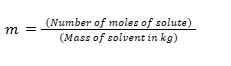
Where:
- m = molality
- Solute is the substance being dissolved
- Solvent is the substance that does the dissolving
Only the mass of the solvent is considered, not the mass of the solution.
The number of moles is further obtained by:
number of moles of solute = Mass / Molar mass
Understanding Molality with an Example
Now, let’s assume that 1 mole of sugar is dissolved in 1 kg of water.
Then the molality of the solution is:
m = 1 / 1 = 1m
This implies that the formed solution will be a one molal solution. Although there may be expansion and contraction due to temperature changes in the solution, the molality of the solution will remain constant.
Why is Molality Important?
Molality has the preference here in physical chemistry calculations since it does not depend on the temperature. Molality has applications in the colligative properties part since colligative properties are dependent on the amount of substance, not the type.
Examples of properties that are better expressed in relation to molality than molarity are boiling-point elevation, freezing-point depression, and osmotic pressure.
Comparison Between Molality and Molarity
This comparison shows why molality is often chosen when precision is required.
| Feature | Molality | Molarity |
|---|---|---|
| Symbol | m | M |
| Based on | Mass of solvent | Volume of solution |
| Temperature dependent | No | Yes |
| Common use | Thermodynamics | Laboratory solutions |
Use of Molality in Colligative Properties
Molality plays a key role in equations like:
- ΔTb = Kbm
- ΔTf = Kfm
Here, ΔTb is the boiling point elevation, and ΔTf is the freezing point depression. As molality is not affected by temperature, it performs better in these calculations.
Real Life Applications
- Molality is applicable in the formulation of antifreeze solutions as a means of determining the freezing point.
- Used to prepare precise drug solutions where temperature changes could affect concentration if volume-based units were used
- helps in designing processes like crystallisation and distillation, where temperature varies widely
- Used in controlling concentrations in solutions during processes like freezing or cooking, where temperature changes matter
- Helps in measuring pollutant concentrations in natural waters under varying temperature conditions
Summary
Molality is a unit of concentration that is defined as the number of moles of solute present per kilogram of solvent. This is a quantity that relies solely on the mass and is independent of both the temperature and the pressure. This is one of the reasons why it is a very useful quantity in the study of thermodynamics and the colligative properties of solutions.
FAQs
What are the factors that influence molality?
Ans: Molality depends on the moles of solute and the mass of solvent. It is unaffected by temperature or pressure changes, making it constant even when the solution volume varies.
What is the effect of adding more solvent on the molality?
Ans: Adding more solvent decreases the molality because molality is moles of solute per kilogram of solvent. Increasing solvent mass lowers the concentration, even though the amount of solute stays the same, resulting in a dilute and less concentrated solution.
Can molality be used for gas solutions?
Ans: Molality is mainly for liquid solvents. Gas solutions usually use other concentration units due to gas compressibility.

NEET Related Links
JEE MAIN Related Links
JEE Advanced Related Links
JEE Advanced Eligibility Criteria
JEE Advanced Chemistry Syllabus
JEE Advanced Registration Dates
CUET Related Links
Important Topics
Anemometer : Measurement of Wind Speed
Angular Acceleration Atomic Theory Audible and Inaudible Sound Average Speed and Average Velocity Average Velocity Avogadros Number Avogadros Hypothesis Azimuthal Quantum Number Balanced Force Bar Magnet Biconvex Lens Boyles Law Buoyancy Calorimeter Carnot Engine Celestial Bodies Centripetal And Centrifugal Force Concave and Convex Lenses Concave Convex Mirrors Contact and Non Contact Force Controlled Thermonuclear Fusion Convection Currents Convex Lens Convex Mirror Destructive Interference Difference Between Conduction Convection and Radiation Difference Between Electric Field and Magnetic Field Difference Between Heat And Temperature Difference Between Series And Parallel Circuits Differences Between Acceleration And Velocity Distance and Displacement Distance Time Graph Electrical Force : Electric Forces and Their Types Electromagnetic Waves : Definition, Equation and Properties of Electromagnetic Waves Electromagnetism Electron Spin Fluid Flow : Bernoullis Equation Derivation and Fluid Mechanics Fluid Friction : Types and Factors of Fluid Friction Frames of Reference : Inertial and Non- Inertial Frame of Reference Frequency and Wavelength Frictional Force Importance of Hydrosphere Instantaneous Speed and Velocity Introduction to Motion Kinetic and Potential Energy Difference Law Of Conservation of Energy Layers of the Earth Light Energy Light Sources List of physics scientists and Their inventionsLoudness of Sound
Magnetic Dipole Moment Magnetic Field Non - Contact Force Non - Renewable Energy Ohms Law Optics P Wave Physics Symbols Plane Mirrors Poissons Ratio Projectile Motion Properties of Water : Anomalous Expansion of Water Radius of Gyration Reflection of Light Reflection of Waves Relative Density Resonance Reverberation Rolling Friction Rotation and Revolution Screw Gauge Semiconductors and Insulators Sliding Friction Speed Time Graphs Static Friction Stefan Boltzmann Law Stress Tension Tension Force Thermometer: Clinical Laboratory Thermometer Types of Rocks Types of Waves Uniform Motion and Non Uniform Motion Unit of Voltage Uses of Convex Lens Uses Of Convex Mirror Uses of Electromagnet Uses of Optical Fibre Wave Wavelength of Light What is Scattering of Light Working of Electric Bell Conventional and Non-conventional Sources of Energy Buoyant Force Bulk Modulus of Elasticity Bernoulli’s Principle Angular Momentum Difference Between Speed And Velocity ForceUnit of Heat
Difference between Distance and Displacement Simple Microscope Derivation Of Equation Of Motion Thermometer: Clinical & Laboratory Thermometer Difference between Concave and Convex LensDerivation Of Lens Maker Formula
Unit Of Pressure Velocity Uses of Plane Mirror
Wave Theory of Light
Unit of Density Unit of Light Unit of Force Unit of Magnetic Field Unit of wavelength Unit of Viscosity Uses of Electroplating Young's Modulus
What is the Scattering of Light
Lenz Law Space Wave Propagation Schrodinger Wave Equation Relation between Fahrenheit and Celsius Refractive Index Potentiometer Working Pascal Law Oscillatory Motion Optical Instruments Newton's Laws of Motion - First Law Modulation and Demodulation Magnetic Flux Lens Formula and Magnification Kaleidoscope Faradays Law Epsilon Naught Value Energy Bands Electrostatics Electroscope AC Generator Unit of Current Lithosphere Bending Equation Derivation Difference Between Pound and Kilogram Semiconductor Devices OTEC - Ocean Thermal Energy Conversion Hall Effect Rectilinear Propagation of Light Difference Between Ammeter and Voltmeter Coefficient of Linear Expansion Ampere’s Law Cyclone and Thunderstorm Save The Environment From Pollution Particle Nature of Light Types of DC Motor Uses Of Transistor Derivation of Phase Rule Unit of Humidity

 Call Now
 Let's Chat
 Share
Share