-
Call Now
1800-102-2727


Mendeleev’s Classification - Mendeleev’s Periodic Table, Its Significance and Drawbacks, Lother-Meyer Curve, Moseley’s Experiment and Frequency Equation, Practice Problems and FAQ

Did you know that the periodic table that you get to see too very often while flipping through your chemistry textbooks has a long history of its own? Scientists from all across the globe tried out their own versions of it!
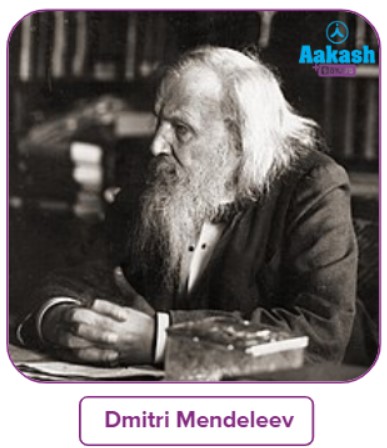
Dmitri Ivanovich Mendeléev, a Russian chemist, was the most significant contributor to the early development of the periodic table.
Interesting Fact:
UNESCO named 2019, the International Year of the Periodic Table to mark the 150th anniversary of Mendeleev’s publication. On account of this celebration, UNESCO wrote,
“The Periodic Table of Chemical Elements is more than just a guide or catalogue of the entire known atoms in the universe; it is essentially a window on the universe, helping to expand our understanding of the world around us.”
TABLE OF CONTENTS
- Mendeleev’s Periodic Table
- Features of Mendeleev’s Periodic Table
- Achievements of Mendeleev’s Periodic Table
- Drawbacks of Mendeleev’s Periodic Table
- Lothar Meyer’s Curve
- Moseley’s Experiment
- Practice Problems
- Frequently Asked Questions - FAQ
Mendeleev’s Periodic Table
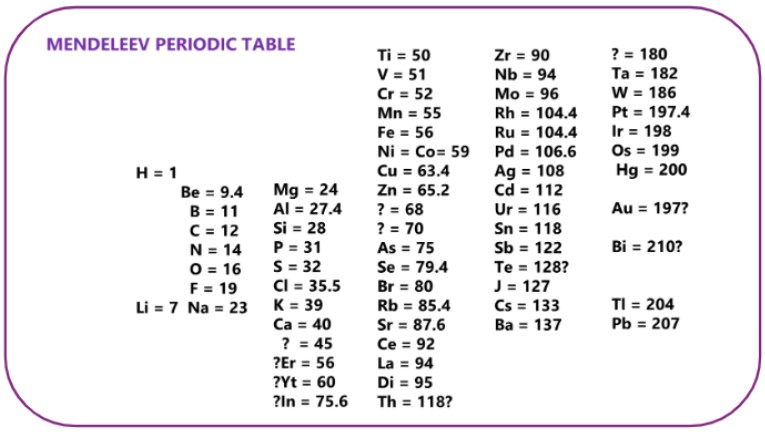
Mendeleev created the framework that became the modern periodic table, leaving gaps for elements that were yet to be discovered. During Mendeleev’s work, only 63 elements were known. He arranged them in a systematic manner in terms of increasing atomic masses. This was known as Mendeleev’s classification of periodic elements.
Features of Mendeleev’s Periodic Table
- The 63 known elements were arranged in the increasing order of their atomic masses.
- The physical and chemical properties of an element were said to be the periodic functions of its atomic mass.
- Mendeleev arranged elements in periods (horizontal rows) and groups (vertical columns, having similar properties) in the increasing order of atomic mass.
- Mendeleev treated the formulae of hydrides and oxides (among chemical properties) as one of the basic criteria for categorisation.

The Periodic Law
According to this observation, Mendeleev formulated a periodic law which stated that
“The properties of elements are the periodic function of their atomic weights.”
Achievements of Mendeleev’s Periodic Table
- Mendeleev arranged the elements in such a way that the elements with similar properties fell into the same vertical column in his periodic table.
- Some gaps were left for the elements yet to be discovered. Thus, if a certain new element is discovered, it can be placed in an existing group depending on similar properties.
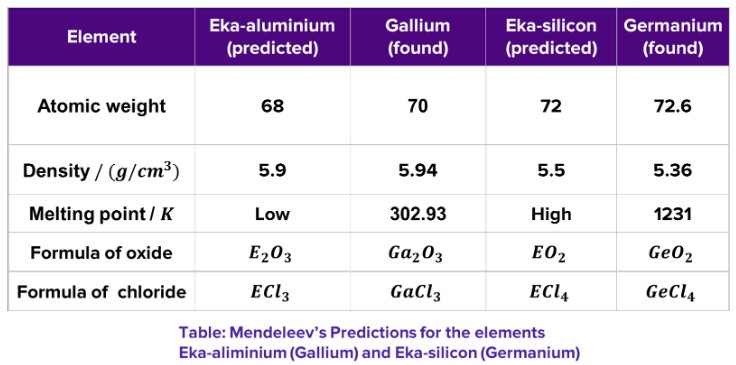
- For instance, he left a space under aluminium and a gap under silicon, and named these elements Eka-Aluminium and Eka-Silicon. Mendeleev predicted the existence of gallium and germanium, as well as some of their general physical properties. Later on, these elements were discovered. The table below lists some of Mendeleev's expected and experimentally discovered properties for these elements.
Drawbacks of Mendeleev’s Periodic Table
- Hydrogen did not have a fixed position, because it resembles alkali metals by forming positive ions, and it resembles halogens by forming diatomic molecules. Hydrogen also forms hydride ions, a uni-negative ion just like halogens.
- There was no regular trend in the increasing order of atomic mass while moving along the elements.
- The concept of isotopes was found later that failed to comply with Mendeleev’s periodic table.
- The discovery of new elements and their subsequent addition to the periodic table kept on revealing new dimensions in periodicity, which was not explainable by Mendeleev.
Lothar Meyer’s Curve
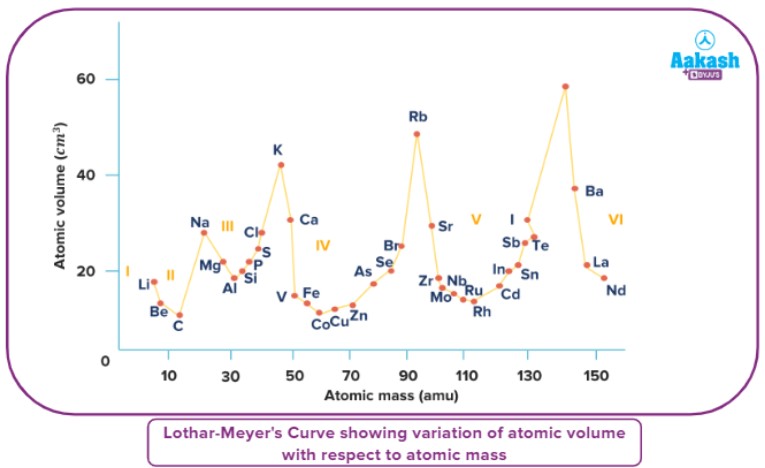
German chemist Lothar Meyer produced a version of the periodic table similar to Mendeleev’s in 1870. Meyer published his table, a graph relating atomic volume and atomic mass.
Features:
- Meyer considered the volume taken up by fixed masses of the various elements.
- The masses taken had the same number of atoms of its particular element (i.e., Avogadro's number).
- This meant that the ratio of the volumes of the various elements was equal to the ratio of the volumes of single atoms of the various elements.
- When the atomic volumes of the elements were plotted against the atomic masses, a series of peaks were obtained.
- Elements with similar physical properties occupied a similar position in the curve.
Moseley’s Experiment
- In 1913, English physicist Henry Moseley bombarded high-speed electrons on different metal surfaces to produce characteristic X-rays to finally link periodic properties to atomic numbers.
- Moseley’s frequency equation
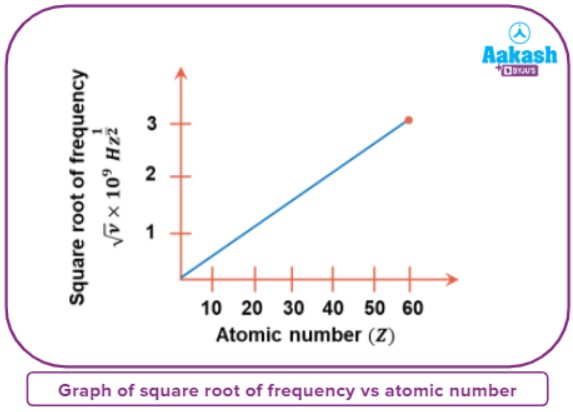
Moseley observed regularities in the characteristic X-ray spectra of elements where he found that a plot of ν (where ν is the frequency of X-rays emitted) against the atomic number (Z) gave a straight line and not the plot against atomic mass.
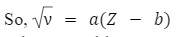
Where a and b are X-ray constant. He then rearranged the elements in the periodic table based on atomic numbers.
Practice Problems
Q 1. What was Dmitri Mendeleev's greatest contribution to the history of the periodic table?
a. He arranged all of the known elements by their atomic number
b. He realised that there was a pattern of reactivity that repeated every 8 elements
c. He predicted the existence (and properties) of certain unknown elements yet to be discovered.
d. He identified the "law of triads" which became the groups
Answer: Dmitri Mendeleev's greatest contribution to the history of the periodic table is that he predicted the existence and properties of eka-aluminium, eka-silicon etc.
So, option C) is the correct answer.
Q 2. Who first found a connection between characteristic X-ray spectra of elements with the atomic number?
a. Mendeleev
b. Moseley
c. Dalton
d. Lothar Meyer
Answer: Moseley observed regularities in the characteristic X-ray spectra of elements and stated the modification involving atomic numbers instead of atomic masses.
So, option B) is the correct answer.
Q 3. Eka-aluminium is which element?
a. Gallium
b. Scandium
c. Germanium
d. Magnesium
Answer: Eka-aluminium later was discovered to be gallium and eka-silicon to be germanium.
So, option A) is the correct answer.
Q 4. The statement “the properties of elements are the periodic function of their atomic weights’’ was known as?
a. The Mendeleev's Rule
b. Law of Octaves
c. The Periodic Law
d. The Periodic table
Answer: The periodic law as stated by Mendeleev is that “the properties of elements are the periodic function of their atomic weights’’
So, option C) is the correct answer.
Frequently Asked Questions - FAQ
Q 1. What is the law of Mendeleev's periodic table?
Answer: Mendeleev devised the famous periodic law that stated “The properties of elements are a periodic function of their atomic weight.” Mendeleev placed elements in the order of their atomic weights in the form of a table known as Mendeleev’s periodic table.
Q 2. What is the difference between Mendeleev’s periodic table and the modern periodic table?
Answer: The main difference between the two is that Mendeleev’s periodic table is based on atomic mass, unlike the modern periodic table which is based on atomic number.
Noble gases (as they are not found at that time) were not included in Mendeleev’s periodic table. Mendeleev made his chart with only 63 elements that were discovered at his time. In the modern periodic table, noble gases are in a separate group called group 18.
Q 3. What are atomic mass and atomic number?
Answer: Atomic mass of the atom of an element is defined as the average mass of the atom, as compared to 112th the mass of one carbon-12 atom. The atomic number is equal to the number of protons or the number of electrons of an atom.
Related Topics
|
Dobereiner’s Law of Triads |
Electron Gain Enthalpy |
|
Ionic Radii |
Metallic and Non-metallic Character of Elements |
|
Atomic Radii |
Oxygen |

NEET Related Links
JEE MAIN Related Links
JEE Advanced Related Links
JEE Advanced Eligibility Criteria
JEE Advanced Chemistry Syllabus
JEE Advanced Registration Dates
CUET Related Links
Important Topics
Anemometer : Measurement of Wind Speed
Angular Acceleration Atomic Theory Audible and Inaudible Sound Average Speed and Average Velocity Average Velocity Avogadros Number Avogadros Hypothesis Azimuthal Quantum Number Balanced Force Bar Magnet Biconvex Lens Boyles Law Buoyancy Calorimeter Carnot Engine Celestial Bodies Centripetal And Centrifugal Force Concave and Convex Lenses Concave Convex Mirrors Contact and Non Contact Force Controlled Thermonuclear Fusion Convection Currents Convex Lens Convex Mirror Destructive Interference Difference Between Conduction Convection and Radiation Difference Between Electric Field and Magnetic Field Difference Between Heat And Temperature Difference Between Series And Parallel Circuits Differences Between Acceleration And Velocity Distance and Displacement Distance Time Graph Electrical Force : Electric Forces and Their Types Electromagnetic Waves : Definition, Equation and Properties of Electromagnetic Waves Electromagnetism Electron Spin Fluid Flow : Bernoullis Equation Derivation and Fluid Mechanics Fluid Friction : Types and Factors of Fluid Friction Frames of Reference : Inertial and Non- Inertial Frame of Reference Frequency and Wavelength Frictional Force Importance of Hydrosphere Instantaneous Speed and Velocity Introduction to Motion Kinetic and Potential Energy Difference Law Of Conservation of Energy Layers of the Earth Light Energy Light Sources List of physics scientists and Their inventionsLoudness of Sound
Magnetic Dipole Moment Magnetic Field Non - Contact Force Non - Renewable Energy Ohms Law Optics P Wave Physics Symbols Plane Mirrors Poissons Ratio Projectile Motion Properties of Water : Anomalous Expansion of Water Radius of Gyration Reflection of Light Reflection of Waves Relative Density Resonance Reverberation Rolling Friction Rotation and Revolution Screw Gauge Semiconductors and Insulators Sliding Friction Speed Time Graphs Static Friction Stefan Boltzmann Law Stress Tension Tension Force Thermometer: Clinical Laboratory Thermometer Types of Rocks Types of Waves Uniform Motion and Non Uniform Motion Unit of Voltage Uses of Convex Lens Uses Of Convex Mirror Uses of Electromagnet Uses of Optical Fibre Wave Wavelength of Light What is Scattering of Light Working of Electric Bell Conventional and Non-conventional Sources of Energy Buoyant Force Bulk Modulus of Elasticity Bernoulli’s Principle Angular Momentum Difference Between Speed And Velocity ForceUnit of Heat
Difference between Distance and Displacement Simple Microscope Derivation Of Equation Of Motion Thermometer: Clinical & Laboratory Thermometer Difference between Concave and Convex LensDerivation Of Lens Maker Formula
Unit Of Pressure Velocity Uses of Plane Mirror
Wave Theory of Light
Unit of Density Unit of Light Unit of Force Unit of Magnetic Field Unit of wavelength Unit of Viscosity Uses of Electroplating Young's Modulus
What is the Scattering of Light
Lenz Law Space Wave Propagation Schrodinger Wave Equation Relation between Fahrenheit and Celsius Refractive Index Potentiometer Working Pascal Law Oscillatory Motion Optical Instruments Newton's Laws of Motion - First Law Modulation and Demodulation Magnetic Flux Lens Formula and Magnification Kaleidoscope Faradays Law Epsilon Naught Value Energy Bands Electrostatics Electroscope AC Generator Unit of Current Lithosphere Bending Equation Derivation Difference Between Pound and Kilogram Semiconductor Devices OTEC - Ocean Thermal Energy Conversion Hall Effect Rectilinear Propagation of Light Difference Between Ammeter and Voltmeter Coefficient of Linear Expansion Ampere’s Law Cyclone and Thunderstorm Save The Environment From Pollution Particle Nature of Light Types of DC Motor Uses Of Transistor Derivation of Phase Rule Unit of Humidity

 Call Now
 Let's Chat
 Share
Share