-
Call Now
1800-102-2727


Manganese-Definition, Occurrence, Properties, Chemical Reactions, Uses, Biological Significance, Practice Problems, FAQs

When you entered your chemistry lab, you may have seen beakers with a dark purple liquid solution. It looks so beautiful, teachers ask you to do titrations using this purple solution. This compound has long fascinated researchers in regards to its versatility and its potential applications.
Have you asked your teacher about the major element present in this compound? Have you ever wondered what is mixed with iron to make the railway tracks strong? You will be surprised when you find that manganese played an important role in making railway tracks stronger.
Manganese steel has a manganese content of around 13%. This is a very robust material that is utilised for railway tracks. We will study more about this important element to see how useful is this in chemistry. Let’s start!
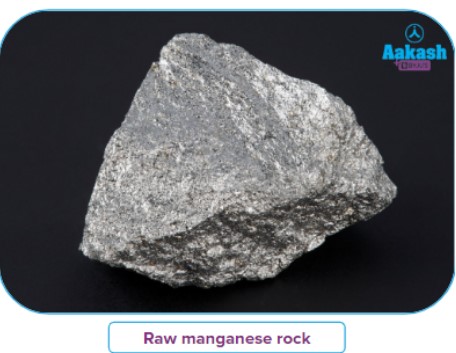
Table of content:
- Definition
- Occurrence
- Properties of Manganese
- Chemical reactions of Manganese
- Uses of Manganese
- Important ores of manganese
- Biological Significance
- Practice problems
- Frequently asked questions-FAQs
Definition:
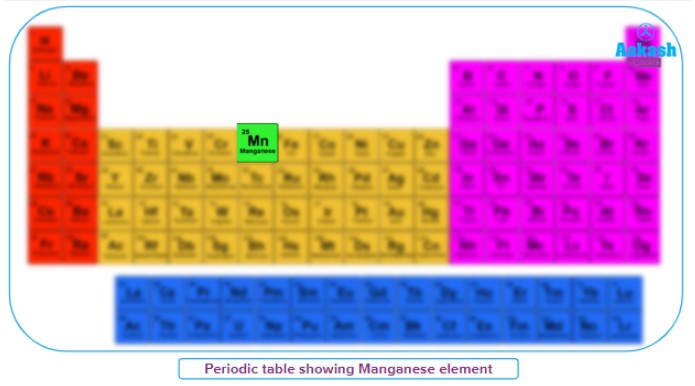
Manganese is one of the chemical elements. The element manganese belongs to the “d” block of the periodic table. Manganese belongs to group number 7 and period number 4. The atomic number of manganese is 25.
Occurrence of Manganese:
- Manganese is one of the naturally occurring chemical elements. This element is found in trace amounts in the environment. Among the most abundant element present in the earth’s crust, manganese is the 5th one.
- It is commonly found in rocks, food, soil, and water. However, manganese is not available in its pure form. It is usually available in combination with other substances such as oxides, silicates, and carbonates.
- The minerals of manganese are widely distributed in nature. Rhodochrosite MnCO3 (manganese carbonate) and pyrolusite MnO (manganese dioxide) are the most commonly found minerals of manganese.
- China, Gabon, Australia, and Africa are the primary areas for manganese mining.
Properties of Manganese:
The physical properties of manganese are as follows.
- The electronic configuration of Manganese is [Ar]3d54s2
- The oxidation states of Manganese are 7, 6, 4, 3, 2, 0, and -1
- The atomic mass of this substance is 54.938 g mol-1.
- The colour of manganese is usually pinkish to grey.
- At 20°C, it exists in the solid state.
- Manganese is generally brittle and hard.
- Pure manganese reacts easily.
- Manganese is hard to melt. Its melting point is 1246°C. The boiling point of manganese is 2061°C.
- It has a density of 7 g cm-3 at STP.
- In presence of air, manganese tarnishes.
- In presence of heat, it gets oxidized.
- Manganese gets diluted in acids easily.
- In presence of water, it forms rust similar to iron.
- The most common isotope of manganese is the . The atomic mass of this isotope is 54.938 g mol-1 with 100% natural abundance.
- The first ionization energy of manganese is 716 kJ mol-1whereas the second ionization energy is 1489 kJ mol-1.
- The electronegativity of manganese is 1.5 at Pauling scale.
Chemical reactions of Manganese:
Free manganese is very much reactive. Therefore, it exists in combination with other substances such as oxides, carbonates, and silicates. Pure manganese can be obtained from its oxide MnO2 either electrolytically or chemically. It has 7 oxidates states i.e; 7, 6, 4, 3, 2, 0, and -1. Hence, it is seen with a wide range of other chemical elements.
Here are a few important chemical reactions of manganese.
- Burning of manganese: In the presence of oxygen, pure manganese burns to form tri manganese tetraoxide.
3Mn(s)+2O2(g)Mn3O4(s)
- Dilution of manganese: Manganese dilutes in acidic solutions very easily. It absorbs hydrogen from water and forms manganese(II) salts when dissolved in dilute aqueous acids.
Mn(s)+dil.H2SO4(aq)MnSO4(s)+H2(g)
- The reaction of manganese with nitrogen: Manganese reacts with nitrogen to form Mn3N2
3Mn(s)+N2(g)Mn3N2(s)
- The reaction of manganese with water: Under normal circumstances, manganese does not react with water.
- The reaction of manganese with halogens: Manganese readily reacts with halogens such as chlorine, bromine, iodine, and fluorine. Compared to all halogens, it is highly reactive with chlorine.
The reaction of manganese with halogens is represented below.
Mn(s)+Cl2(g)MnCl2(s)
Mn(s)+Br2(g)MnBr2(s)
Mn(s)+I2(g)MnI2(s)
Uses of manganese:
The uses of manganese in our day-to-day life are as follows.
- Manganese is widely used in the production of iron and steel.
- Manganese is a critical part of economical stainless steel and many broadly utilized aluminium alloys.
- Manganese dioxide is additionally utilized as a catalyzing agent.
- Manganese is additionally utilized to decolourize glass and make violet-shaded glass.
- Potassium permanganate is a powerful oxidizer and is utilized as a sanitiser.
- The other significant manganese-containing compounds are manganese carbonate and manganese oxide.
- Manganese carbonate is used as a starting material for many other chemical compounds.
- Manganese oxide is widely used in ceramics and the preparation of fertilizers.
- Manganese oxide is used in the quantitative analysis of various chemical compounds.
Important ores of manganese:
The following are the most important manganese ores:
1. Pyrolusite, MnO2
2. Braunite, Mn2O3
3. Hausmannite, Mn3O4
Manganese is extracted from pyrolusite, a manganese oxide mineral or hausmannite as a result of carbon or aluminium reduction. Because MnO2 reacts explosively with aluminium, it must first be transformed to Manganomanganic oxides, Mn3O4.heating to the point of redness This is then reduced with aluminium in a sand-filled fire-clay crucible.
3MnO2(s)Mn3O4(s)+O2(g)
3Mn3O4(s)+8Al(s)9Mn(s)+4Al2O3(s)
Manganese is refined by vacuum distillation.
Steel is the most common application for manganese. The steel industry uses 95% of the manganese ores mined to make alloys. Iron and manganese mixed oxides are reduced by heating with carbon in a blast furnace. Ferromanganese (80% Mn, 20% Fe) and spiegeleisen (80% Mn, 20% Fe ) are two significant alloys (20- 30 % Mn, 5% C and rest Fe).
The biological significance of manganese:
Manganese is an essential component in most living organisms. The average amount of manganese present in humans is 12 mg. Manganese is a vital component of bones, enzymes, ligaments, and other connective tissues. Manganese deficiency makes bones less flexible and may lead to frequent bone fractures. On the other hand, manganese is crucial for Vitamin B1 utilization.
Practice Problem:
Q1. The oxidation state of 'Mn' in MnO3 is
A. +3
B. +2
C. +6
D. +7
Answer: C
Let x be the oxidation state of Mn. The oxidation state of oxygen in MnO3 is -2
Calculating the value of x, we get,
x+(-2)3=0
x-6=0
∴ x=+6
Hence, the oxidation state of 'Mn' in MnO3 comes out to be +6.
Q2. _____________ is refers to alkaline potassium permanganate.
A. Jone’s reagent
B. Baeyer's reagent
C. Tollens reagent
D. Fenton’s reagent
Answer: B
Baeyer's reagent is alkaline potassium permanganate. In organic chemistry, this reagent is used to check for unsaturation.
Q3.__________ is a mixed oxide of manganese.
A. MnO3
B. MnO2
C. Mn3O4
D. MnO
Answer: C
Manganese can produce Mn3O4, which is a mixed oxide of MnO and Mn2O3 in combination. Manganomanganic oxide is the name for it.
Q4. What is the charge present on Manganese ion when MnO4- treated in an acidic medium with the loss of 5 electrons?
A. +2
B. +3
C. +5
D. 0
Answer: A
The following equation can be used to represent the oxidising activity of KMnO4 in an acidic medium with the loss of 5 electrons.

Frequently asked questions-FAQ
Q1. What are the topmost sources of manganese found in diet?
Answer: Grain products, tea, and leafy vegetables are the major sources of manganese in the diets of adults. Manganese is also present in a wide variety of foods, including clams, oysters, mussels, nuts, soybeans and other legumes, rice, coffee and spices such as black pepper
Q2. Is magnesium an important cofactor for a variety of enzymes?
Answer: Yes, magnesium is an important cofactor for a variety of enzymes. Low manganese intakes may raise the risk of sickness due to manganese's involvement as a coenzyme for various enzymes. This section focuses on two areas of health where manganese may play a role: bone health and diabetes.
Q3. Is manganese hazardous for nature?
Answer: Exposure to manganese through the inhalation of manganese fumes or dust can cause injury to workers working in industries. The lungs, liver, and kidneys can all be harmed by prolonged exposure. Manganism is a neurological disorder caused by exposure to manganese dust or fumes.
Q4. What role does manganese play in plants?
Answer: Manganese (Mn) is an essential micronutrient for plant growth and development, as well as for maintaining metabolic functions in many plant cell compartments.
Related topics
|
Iron |
Potassium Permanganate |
|
lanthanide contraction |
important compounds of silver |
|
Hydrogen |
Important compounds of Copper |

 Call Now
 Let's Chat
 Share
Share