-
Call Now
1800-102-2727


Law of Mass Action- Law, Equilibrium constant, Characteristics, Applications. Practice Problems and FAQs

You know well that hydrogen (colourless) combines with iodine (violet) to form hydrogen iodide (colourless). Initially, the jar is violet-coloured as observed from the gif. But after some time, the violet colour of the first jar decreases. What do you infer from this?
You are right, that the violet colour indicates that there is iodine present in it. So hydrogen iodine can combine to a certain extent to form HI but not completely. Why not?
Because HI also will decompose back to its elements partially, whatever may be the reactants you start with, finally there will be reactants and products at certain fixed concentrations. This constancy due to the simultaneous existence of opposing changes is called equilibrium. Then you may ask what will be the concentration of them? How it is fixed?
The answer is given by the Law of Mass Action. Come let us learn about it.


Table of Content
- Law of Mass Action
- Equilibrium Constant
- Characteristics of Equilibrium Constant
- Dependence of Equilibrium constant on temperature
- Application of Equilibrium Constant
- Practice Problems
- Frequently Asked Questions
Law of Mass Action
Law of Mass Action says that higher the mass of the reactants larger the number of molecules reacting to form the product.
“The rate of a chemical reaction is proportional to the product of the active masses of reactants raised to the powers of their stoichiometric coefficients at a given temperature, according to this law.”
The active mass of a reaction is defined as the effective number of reacting species participating in the process.
Equilibrium Constant
Consider a chemical reaction

According to the law of mass action
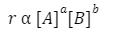
Where [A] and [B] are the concentrations of reactants A and B, respectively, and r is the reaction rate.
When the proportionality sign is removed,
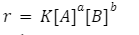
Where K = Rate Constant
Consider a chemical reaction
aA+bB⇌cC+dD
According to the law of mass action,
For forward reaction; rf=Kf[A]a[B]b
Where Kf = rate constant for forward reaction
For backward reaction; rb=Kb[C]c[D]d
Where Kb = rate constant for backward reaction
At equilibrium, the rate of the forward reaction = the rate of backward reaction
rf=rb
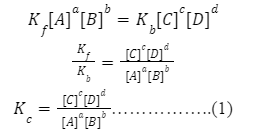
Kc is the equilibrium constant.
Note: A pure solid or pure liquid has a constant concentration.
Equilibrium Constant in terms of Partial Pressure
Consider partial pressures of A, B, C, and D as pA, pB, pC, and pD, respectively.
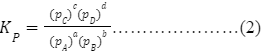
KP is the equilibrium constant.
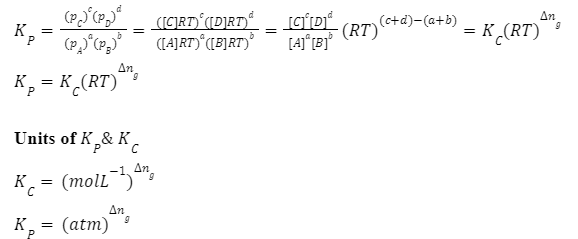
Relationship between KP& KC
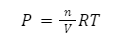
From the ideal gas equation, PV=nRT
Characteristics of Equilibrium Constant for a related equilibrium
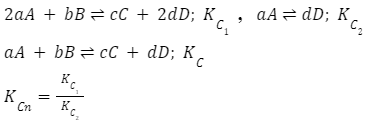
Consider a reaction: aA+bB ⇌ cC+dD with; KC
|
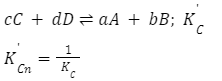
When a reaction is reversible, the new equilibrium constant KCn' is the reciprocal of the old one. |
|
|
The value of the KCn'' equals the KC raised to the power n when a reaction is multiplied by a factor 'n'. |
naA+nbB ⇌ ncC+ndD; KC' KCn'=(KC)n |
|
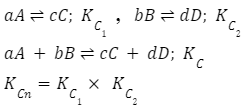
The KCn' is the product of the KCs when two or more equilibrium reactions are added |
|
|
The KCn' is the ratio of the KC when two or more equilibrium reactions are subtracted. |
|
Dependence of Equilibrium constant on temperature
The value of the equilibrium constant KC, for a particular process has been demonstrated experimentally to be solely dependent on temperature. The addition of reactants or products, changes in pressure, or the application of catalysts has no effect on it.
- In exothermic processes, the value of KC drops as temperature rises.
- In endothermic reactions, the value of KC rises as temperature rises.
(explained by using Le Chatelier’s Principle)
Application of Equilibrium Constant
1. It aids in the computation of reactant and product equilibrium concentrations.
Consider a reaction in which initial concentrations of reactant A are given [Ao] and volume V. We have to calculate the concentration of reactant A and product B at equilibrium
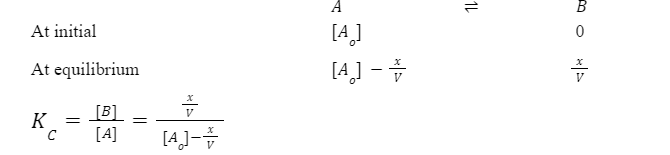
We can calculate x using the values of KC, V, and [Ao]. As a result, the equilibrium constant can be used to compute the reactant and product equilibrium concentrations.
2. The equilibrium constant can be used to estimate the extent of the reaction.
Consider a reaction; R ⇌ P

Case 1: When KC>103
Hence, [P]>>>[R]
It signifies that virtually all of the reactant has been transformed to product, indicating that the reaction is nearing conclusion.


Case 2: When KC<10-3
Hence, [P]<<<[R]
This indicates that only a small amount of reactant has been converted to product, implying that the reaction is barely proceeding.


Case 3: When 10-3<KC<103
The concentration of both the reactant and the product is appreciable, indicating that the reaction has progressed to a significant degree.


3. The equilibrium constant can also be used to determine the reaction's direction.
Reaction Quotient (Qc)
The reaction quotient is the ratio of the concentration or pressure of the products to the reactants at any stage during the reaction (whether the reaction is at equilibrium or not).
Consider a reaction: aA+bB ⇌ cC+dD
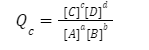
Case-1: Qc>Kc then, to attain equilibrium, Qc will need to be reduced. In other words, the concentration of the reactants should rise while the concentration of the products falls. As a result, the equilibrium moves in the backward direction.
Case-2: Qc=Kc the reaction is already at equilibrium.
Case-3: Qc<Kc then, in order to attain equilibrium, Qc will need to be increased. In other words, the concentration of the reactants should drop while the concentration of the products should rise. As a result, the equilibrium shifts in the forward direction.


Practice Problems
Q1. Why is the concentration of a pure solid or pure liquid assumed to be constant?
Consider density (p) (in gmL-1) as the pure solid and liquid density. Then,

Mass = m=V
The number of moles in a pure solid or liquid is calculated as follows:

Volume of the solution = volume of the solvent (for pure liquid).
The molarity of the solution is calculated as

- The molar mass of any pure solid or liquid is always constant.
- The density of any pure solid or liquid is always constant.
As a result, for any pure solid or liquid, the molarity or concentration is always constant.
Q2. Can KP be equal to KC?

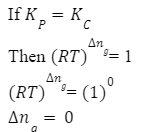
Hence, if  ; the number of moles of reactant is equalled to several moles of products then KP can be equals to KC
Q3. At 298 K, A +2 B ⇌ C. KC= 18. In a 3 L jar, there are 2, 1, and 4 mol of A, B, and C respectively. At the same temperature, what will happen to the reaction?
(A) Moves in the forward direction.
(B) Moves in the backward direction.
(C) Maintain a state of balance
(D) Impossible to anticipate
Solution:
(i) Finding concentrations:
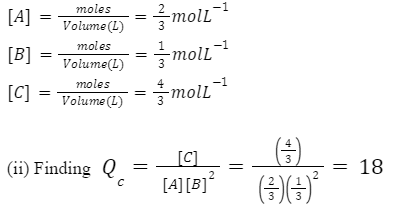
Qc=Kc the reaction is already at equilibrium or maintains a state of balance.
Hence, the correct option is (C).
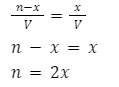
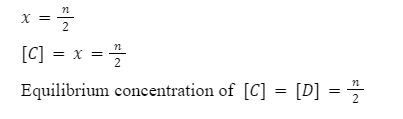
Q4. In a one-litre tank at 250°C, the reaction A(g) + B(g) ⇌C(g) + D(g) is investigated. The starting concentrations of A and B were 3n and n, respectively. The equilibrium concentration of C was found to be identical to the equilibrium concentration of B when equilibrium was reached. What is the equilibrium concentration of D?
was determined to be equal to B's equilibrium concentration, as given.
[B]=[C]
Frequently Asked Questions
Question 1. In chemistry, what is an effective concentration?
Answer: Effective concentration means the concentration which is actually participating in the reaction. For example, if the reactant has 8 moles at initial and at equilibrium only 3 moles are remaining. That means the effective concentration is with respect to 3 moles.
Question 2. Why do we always use square brackets to represent the concentration at equilibrium?
Answer: The square bracket represents the effective concentration or active mass of a reactant which is actually participating in the reaction. This is the reason to put the square brackets.
Question 3. What is the application of the Law of mass action in science?
Answer: This law also applies to semiconductors; it has several major consequences in the domains of electronics and semiconductor physics. When the semiconductor system is in thermal equilibrium, the law of mass action gives a link between the concentrations of electron holes and free electrons.
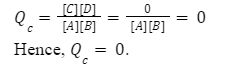
Question 4. What is the reaction quotient Q at the beginning of the reaction when two reactants A and B are combined to produce products C and D?
Answer: Initially, the concentration of products C and D are zero as the reaction has not started yet.
Related Topics
|
Le Chatelier's Principle |
Physical equilibrium-Solid Liquid Equilibrium, Liquid-Vapour Equilibrium, Solid-Vapour Equilibrium |
|
Chemical Equilibrium-Types of Equilibrium |
Reversible and Irreversible reactions |
|
Vant Hoff's Equation |

NEET Related Links
JEE MAIN Related Links
JEE Advanced Related Links
JEE Advanced Eligibility Criteria
JEE Advanced Chemistry Syllabus
JEE Advanced Registration Dates
CUET Related Links
Important Topics
Anemometer : Measurement of Wind Speed
Angular Acceleration Atomic Theory Audible and Inaudible Sound Average Speed and Average Velocity Average Velocity Avogadros Number Avogadros Hypothesis Azimuthal Quantum Number Balanced Force Bar Magnet Biconvex Lens Boyles Law Buoyancy Calorimeter Carnot Engine Celestial Bodies Centripetal And Centrifugal Force Concave and Convex Lenses Concave Convex Mirrors Contact and Non Contact Force Controlled Thermonuclear Fusion Convection Currents Convex Lens Convex Mirror Destructive Interference Difference Between Conduction Convection and Radiation Difference Between Electric Field and Magnetic Field Difference Between Heat And Temperature Difference Between Series And Parallel Circuits Differences Between Acceleration And Velocity Distance and Displacement Distance Time Graph Electrical Force : Electric Forces and Their Types Electromagnetic Waves : Definition, Equation and Properties of Electromagnetic Waves Electromagnetism Electron Spin Fluid Flow : Bernoullis Equation Derivation and Fluid Mechanics Fluid Friction : Types and Factors of Fluid Friction Frames of Reference : Inertial and Non- Inertial Frame of Reference Frequency and Wavelength Frictional Force Importance of Hydrosphere Instantaneous Speed and Velocity Introduction to Motion Kinetic and Potential Energy Difference Law Of Conservation of Energy Layers of the Earth Light Energy Light Sources List of physics scientists and Their inventionsLoudness of Sound
Magnetic Dipole Moment Magnetic Field Non - Contact Force Non - Renewable Energy Ohms Law Optics P Wave Physics Symbols Plane Mirrors Poissons Ratio Projectile Motion Properties of Water : Anomalous Expansion of Water Radius of Gyration Reflection of Light Reflection of Waves Relative Density Resonance Reverberation Rolling Friction Rotation and Revolution Screw Gauge Semiconductors and Insulators Sliding Friction Speed Time Graphs Static Friction Stefan Boltzmann Law Stress Tension Tension Force Thermometer: Clinical Laboratory Thermometer Types of Rocks Types of Waves Uniform Motion and Non Uniform Motion Unit of Voltage Uses of Convex Lens Uses Of Convex Mirror Uses of Electromagnet Uses of Optical Fibre Wave Wavelength of Light What is Scattering of Light Working of Electric Bell Conventional and Non-conventional Sources of Energy Buoyant Force Bulk Modulus of Elasticity Bernoulli’s Principle Angular Momentum Difference Between Speed And Velocity ForceUnit of Heat
Difference between Distance and Displacement Simple Microscope Derivation Of Equation Of Motion Thermometer: Clinical & Laboratory Thermometer Difference between Concave and Convex LensDerivation Of Lens Maker Formula
Unit Of Pressure Velocity Uses of Plane Mirror
Wave Theory of Light
Unit of Density Unit of Light Unit of Force Unit of Magnetic Field Unit of wavelength Unit of Viscosity Uses of Electroplating Young's Modulus
What is the Scattering of Light
Lenz Law Space Wave Propagation Schrodinger Wave Equation Relation between Fahrenheit and Celsius Refractive Index Potentiometer Working Pascal Law Oscillatory Motion Optical Instruments Newton's Laws of Motion - First Law Modulation and Demodulation Magnetic Flux Lens Formula and Magnification Kaleidoscope Faradays Law Epsilon Naught Value Energy Bands Electrostatics Electroscope AC Generator Unit of Current Lithosphere Bending Equation Derivation Difference Between Pound and Kilogram Semiconductor Devices OTEC - Ocean Thermal Energy Conversion Hall Effect Rectilinear Propagation of Light Difference Between Ammeter and Voltmeter Coefficient of Linear Expansion Ampere’s Law Cyclone and Thunderstorm Save The Environment From Pollution Particle Nature of Light Types of DC Motor Uses Of Transistor Derivation of Phase Rule Unit of Humidity

 Call Now
 Let's Chat
 Share
Share