-
Call Now
1800-102-2727


Law of Conservation of Mass- Definition, Practice Problems and Frequently Asked Questions (FAQs)

Picture a regular candle, with wax and a wick. Once the candle completely burns down, though, you can see that there is definitely far less wax than there was before you lit it. This means that some of the wax (not all of it, as you’ve likely noticed with candles you’ve lit in real life!) has been transformed into gases—namely, water vapour and carbon dioxide.
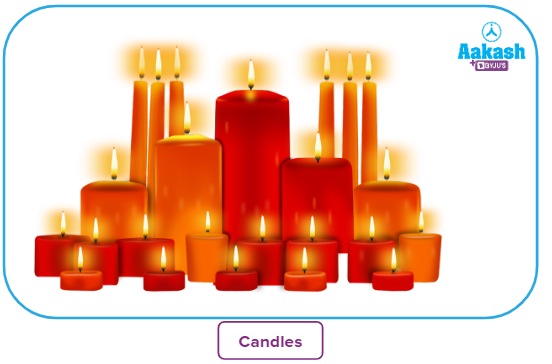
No matter (and therefore no mass) is lost through the process of burning.
Though many ancient Greeks have laid the scientific foundation of necessary for the law of conservation of mass, it was French chemist Antoine Lavoisier who is credited with its discovery. That is why it's also sometimes referred to as “Lavoisier’s Law”
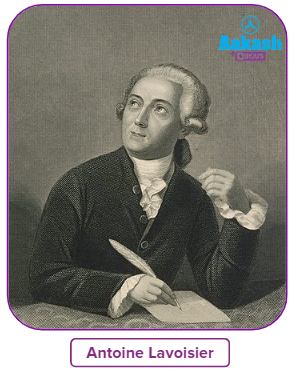
Table of contents
- Law of mass conservation
- Example
- Practice problems
- Frequently asked questions-FAQs
Law of mass conservation
Matter can neither be created nor be destroyed during a chemical reaction (during a chemical reaction, the total mass remains conserved).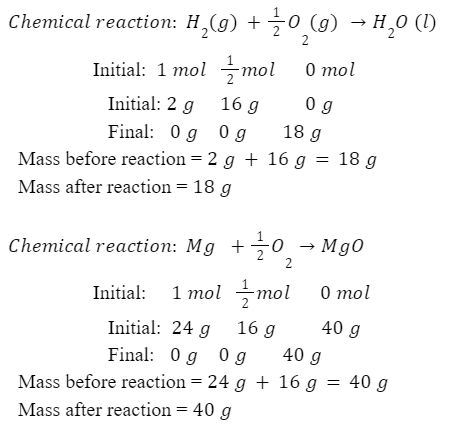
Examples:
Question:- 0.34 g of a hydrocarbon on complete combustion with atmospheric oxygen produce 0.54 g H2O and 0.103 g of CO2. Proof these experimental results are in accordance with the law of conservation of mass.
Answer: Let us assume that the hydrocarbon is CxHy
The general combustion reaction of any hydrocarbon can be represented as

Molar mass of CO2 = 44 g mol-1
Molar mass of H2O = 18 g mol-1
We know,
44 g CO2 contains 12 g of Carbon
1 g CO2 contains  g of carbon
0.103g CO2 contains  g of carbon
And, 18 g H2O contains 2 g of hydrogen
1 g H2O contains  g of carbon
0.54 g CO2 contains 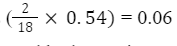 g hydrogen
Total mass of carbon and hydrogen in product = 0.028 + 0.06 = 0.34 g
Initial mass of hydrocarbon (only composed of hydrogen and carbon) = 0.34 g
Yes, these experimental results are in accordance with the law of conservation of mass.
Practice problems
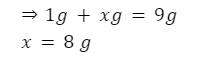
Q 1. 1 gram of hydrogen reacts with the required amount of oxygen to make 9 grams of water. Calculate the amount of oxygen used during a chemical reaction, applying the law of conservation of mass?
A. 4 g
B. 6 g
C. 8 g
D. 16 g
Answer: (C)
Let, X g of oxygen is used during the reaction.
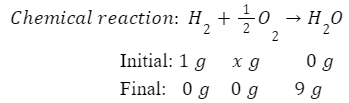
According to law of mass conservation,
Mass before reaction = Mass after reaction
Q 2. Antoine Lavoisier is known for
A. Law of conservation of mass
B. Air is a mixture of oxygen and nitrogen not an element
C. Both of these
D. None of these
Answer: (C)
Antonie Lavoisier experimentally concluded that air was not an element but a mixture of two gases oxygen (support life) and azote (nitrogen - not favourable for life) and the total weight of substances before and after an experiment was constant (law of conservation of mass).
Q 3. 200 g of CaCO3 on decomposition produce 88 g of CO2, calculate mass of CaO applying the law of mass conservation
A. 44 g
B. 56 g
C. 112 g
D. None of these
Answer: (C)

Initial weight of CaCO3= 200 g
Final weight of product = 
According to the law of mass conservation;

Q 4. Which of the following statements is the best example of the law of conservation of mass?
(A) 12 g of carbon combines with 32 g of oxygen to form 44 g of CO2.
(B) When 12 g of carbon is heated in a vacuum there is no change in mass.
(C) A sample of air increases in volume when heated at constant pressure but its mass remains unaltered.
(D) The weight of a piece of platinum used as a catalyst in Habers Process is different before and after the reaction.
Answer: (A)
According to the law of mass conservation;
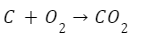
initial weight of Carbon+ initial weight of Oxygen = final weight of the product (CO2)
Frequently asked questions-FAQs
Question 1. Why is there no change in mass during chemical reactions?
Answer: We know, atoms are neither created nor destroyed during a chemical reaction. The atoms of the reactants are just rearranged to form products (old bonds are broken and new bonds are formed). Hence, due to the conservation of atoms conservation of mass takes place.
Mass after reaction = 18 g
Mass before reaction  Mass after reaction
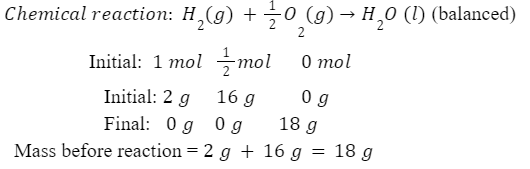
Mass after reaction = 18 g
Mass before reaction = Mass after reaction
Question 2. Why do we balance the chemical reaction?
Answer: We balance any chemical reaction to conserve the number of atoms in reactants and products. After balancing the chemical reaction mass conversation also takes place.
Question 3. Mass of burned residue of any substance according to old combustion theory should increase or decrease?
Answer: According to this phlogiston theory, all combustible substances are composed of phlogiston which escapes into the atmosphere when the substance was burnt. So, according to this theory phlogiston escapes from the body so the mass of burned residue should always be less.
Question 4. Does the law of mass conservation depend on the physical state of the substance?
Answer: No, the Law of mass conservation can be applicable to all types of physical states of substances involved in reactions.
Related Links:
| Law of chemical combination | Law of definite proportions |
| Law of reciprocal proportion | Law of multiple proportions |
| Vapour Density | Avogadro's Hypothesis |

 Call Now
 Let's Chat
 Share
Share