-
Call Now
1800-102-2727


Ketones Preparation Methods: Ketones and Their Structure, Preparations of Ketones, Uses of Ketones, Practice Problems & FAQs

Water is a universal solvent. True, it dissolves most of the substances. But, organic compounds are all almost insoluble in water. We too use many such organic compounds in our daily life, for example, cosmetic substances, like nail polish. If so, then, what is the solvent used in such organic cosmetics?
One of the widely used solvents is acetone which belongs to the family of ketones
Acetone is not only a necessary ingredient in nail polish remover, but it is also used in the production of a variety of other cosmetics.
In the cosmetics industry, it is widely used as a solvent and denaturant. Acetone is a common chemical used in the manufacturing process of everything from wet wipes to hair dyes.
A mixture of acetone and dry ice is used in some countries as a dermatological treatment called "slush facial," which promises to heal common skin problems such as acne, chloasma, and eczema, rosacea, and sunburn. Acetone is absorbed through the skin and enters the bloodstream in trace amounts, but it is usually harmless.
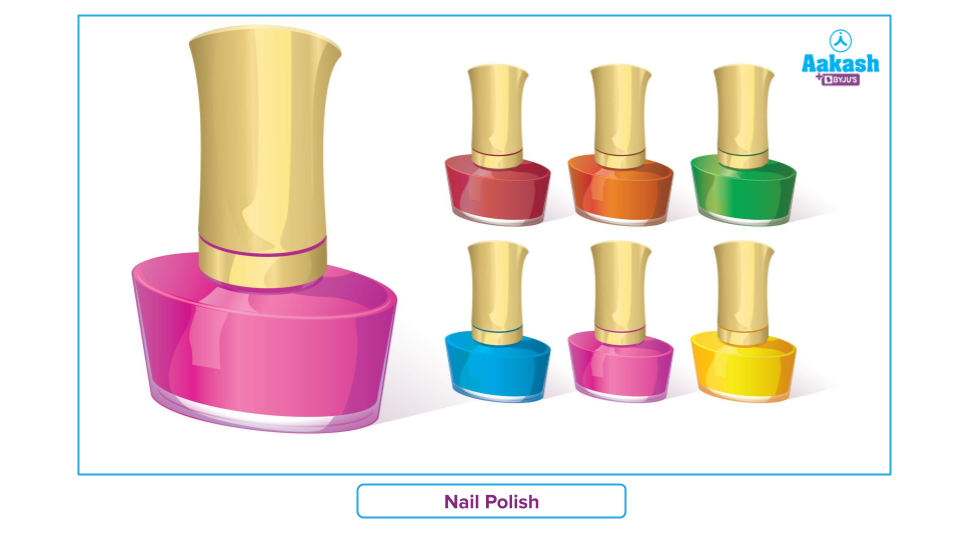
Table of Contents:
- Ketones and their Structure
- Preparations of Ketones
- Uses of Ketones
- Practice Problems
- Frequently Asked Questions(FAQs)
Ketones and their Structure
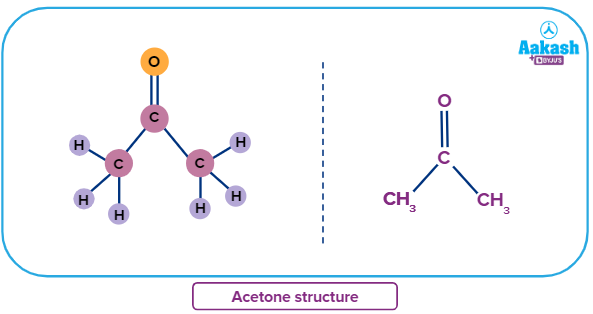
Ketones are organic compounds that have the functional group -C=O and the structural formula, is R (C=O) R'. R and R' can be alkyl or aryl groups in this case. Carbon-containing substituents are present on both sides of the carbon-oxygen double bond in these carbonyl compounds. The ketone group's carbonyl carbon has a sp2 hybrid orbital. The ketone has a triangular planar structure. This structure's bond angle is approximate, 120o. Ketones are nucleophilic at the oxygen atom and electrophilic at the carbon atom because carbon-oxygen bonds polarise carbonyl groups (oxygen is more electron-withdrawing than carbon).

The simplest organic ketone substance with the chemical formula (CH3)2CO is acetone (propanone). There may be a colourless, repulsive odour when using nail polish remover. Acetone is crucial in chemistry due to its composition and molecular structure. Lone oxygen atom pairs in acetone have the potential to attract hydrogen atoms and create hydrogen bonds. Acetone is the preferred solvent in the industry as a result of this characteristic. Acetone, for example, is preferred to water in chromatography because it can dissolve both polar and nonpolar dyes during analysis.
It is important to understand that when acetone molecules are mixed with water, they do not separate into ions. However, they are thoroughly combined to create a non-uniform mixture. The carbonyl group in the middle of the acetone molecule is polar and dissolves polar compounds while the two methyl groups in the molecule are nonpolar and dissolve nonpolar compounds.
Acetone's miscibility with other polar molecules, particularly water and other organic compounds, is another quality that makes it a good solvent. Depending on the use, this enables you to produce a variety of industrial, domestic, and experimental solvents. Acetone is a potent, non-toxic organic chemical that mixes with other substances with ease. Despite the fact that acetone is present in many everyday items, it is an essential component in the chemical industry.
Preparations of Ketones:
Ketones are organic compounds that contain a carbonyl (-C=O) group. The general formula for ketones is, R (C=O) R'. R and R' can be alkyl or aryl groups. They are classified into two types based on their substituents. Symmetric ketones (when two identical groups are attached to a carbonyl group) and asymmetric ketones (if two different groups are attached to a carbonyl group). On an industrial scale and in the laboratory, there are numerous methods for producing ketones. Standard methods include oxidation of secondary alcohols, hydrocarbons, and so on.
The following sections describe some common methods for producing ketones.
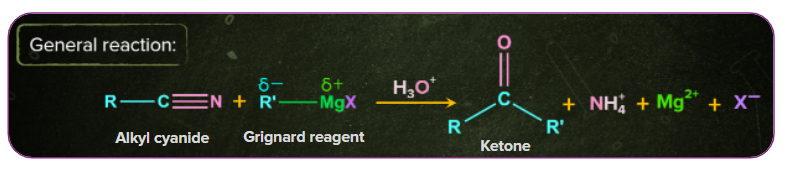
1. From Nitriles:
Nitriles on reaction with Grignard reagent and upon further hydrolysis yields ketones.
2. From Acyl Chloride:
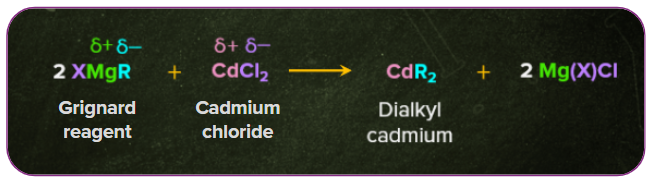
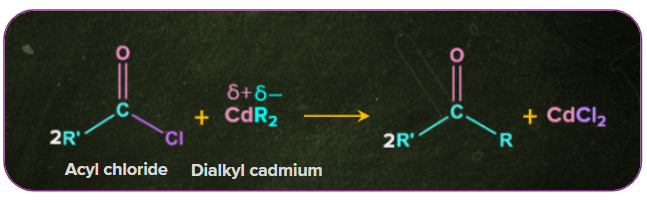
When acyl chlorides are treated with dialkyl cadmium, ketones are formed. When cadmium chloride reacts with Grignard reagents, dialkyl cadmium is formed. The dialkyl cadmium then reacts with the acyl chloride to form a ketone.
3. From Benzene:
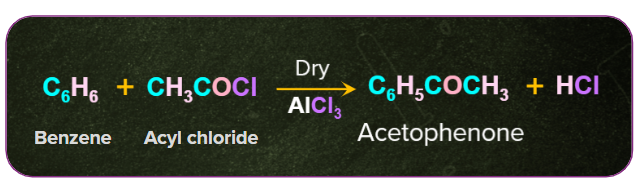
In the presence of Lewis acids like aluminium chloride (AlCl3) electrophilic aromatic substitution of the benzene ring with acid chloride results in the formation of ketones. The Friedel-Crafts acylation reaction is the name given to this reaction.
4. Dehydrogenation of Alcohol:
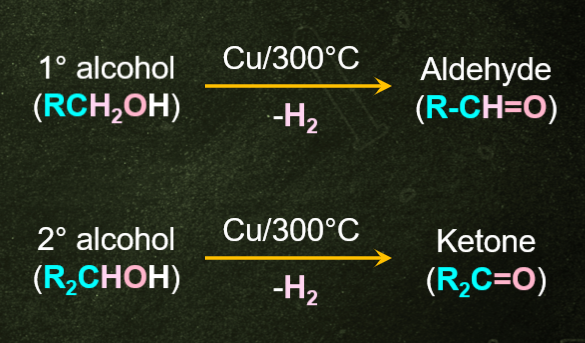
When one hydrogen molecule is taken out of one alcohol molecule during the process of oxidation, the reaction is known as the dehydrogenation of alcohol. Both the CO and OH bonds break down to form -C=O bonds during the oxidation of alcohol. Strong oxidants dehydrate secondary alcohols, resulting in the production of ketones.
For instance, ketones are produced when the vapour of secondary alcohol passes through copper that has been heated to 573 K. Tertiary alcohol will go through dehydrogenation but not dehydration during oxidation. Alkenes are thus created in the case of a tertiary alcohol.
5. Ozonolysis:
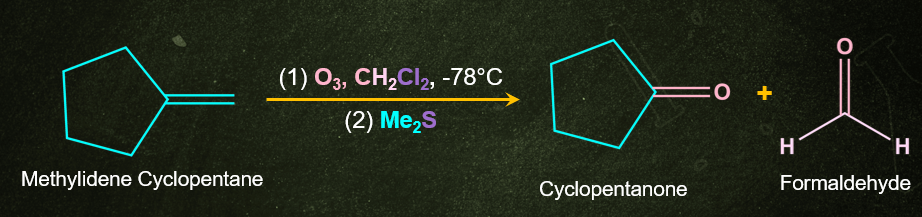
The ozonolysis of substituted alkenes is followed by the reaction of the ozonolysis products with dimethyl sulphide at -78oC to produce ketones. Depending on the structure of the the hydrocarbon, a mixture of aldehydes and ketones is obtained.
Uses of ketones:
- For some synthetic fibres and polymers, the ketone is a great solvent.
- Acetone can be used to remove nail polish and thin paint.
- Additionally, it is employed in medicine to treat conditions like acne and chemical peels.
- Butanone is a typical solvent, also referred to as methyl ethyl ketone. It is employed in the production of plastics, paint thinners, paraffin wax, textiles, varnishes, and other products.
- Cyclohexanone, which is used to make nylon, is another significant ketone.
- Polymers like plexiglass are produced using propanone (acetone).
- In addition to being a starting point for the synthesis of many organic compounds, ketones are used as a solvent.
- Acetone and ethyl methyl ketone are mainly used as industrial solvents.
Practice problems:
Q1. What is the common name of pentan-3-one?
(A) Diethyl ketone
(B) Ethyl Methyl Ketone
(C) Acetone
(D) Isopropyl methyl ketone
Answer: (A)
Solution: The parent alkane with the suffix "one" is the source of the name ketone. When naming a ketone, a number is used to denote the position of the carbonyl group. For instance, 2-propanone is the name given to CH3(CO)CH3. However, acetone is the name given to this substance most frequently. The name of each individual alkyl group attached to the carbonyl carbon is written first, followed by the word "ketone" as the third word in the name. For instance, ethyl methyl ketone can be used to represent butan-2-one.
|
Formula |
Common name |
IUPAC name |
|
CH3(CO)CH3 |
Acetone |
Propan-2-one |
|
CH3(CO)CH2CH3 |
Ethyl Methyl Ketone |
Butan-2-one |
|
CH3CH2(CO)CH2CH3 |
Diethyl ketone |
Pentan-3-one |
|
CH3CH(CH3)(CO)CH3 |
Isopropyl methyl ketone |
3-Methylbutan-2-one |
Q2. Ketones are
(A) Polar
(B) Non-polar
(C) Both A and B
(D) None of the above
Answer: (A)
Solution: A carbon atom is double-bonded to an oxygen atom to form the functional group known as the carbonyl (>C=O). Because oxygen has a greater tendency to attract electrons in a carbon-oxygen bond to itself than does carbon, oxygen is more electronegative than carbon. Due to this, dipoles are formed, with the carbon atom having a slight positive charge and the oxygen atom has a slight negative charge. The result is an extremely polar double bond between carbon and oxygen. While electrophiles attack the slightly negative oxygen atom in the carbonyl group, nucleophiles can target the slightly positive carbon atom.
Q3. Among the following which is least reactive in nucleophilic addition reaction?
(A) CH3(CO) CH3
(B) C6H5 (CO) C6H5
(C) Both A and B
(D) None of the above
Answer : (C)
Solution: In terms of structure, the presence of relatively large substituents in ketones prevents a nucleophile from approaching the carbonyl carbon. The two alkyl groups in acetone are small, making nucleophilic addition reactions easier than in the other two compounds. Additionally, in the other compound, the carbonyl group's electrophilicity will be lower because of the presence of the phenyl rings.
Q4. What is the hybridization of carbonyl carbon in ketone?
(A) sp2
(B) sp3
(C) sp
(D) None of the above
Answer: (A)
Solution: The carbonyl group is located at the centre of the ketone molecule. The carbonyl group's carbon is planar-trigonal and has three sigma bonds and one pi bond as a result of sp2 hybridization.
Frequently Asked Questions(FAQs):
Q1. What are ketone bodies?
Answer: When the body breaks down fat, the liver produces ketones, also known as "ketone bodies." In response to starvation, protracted intense exercise, and low-carbohydrate diets like the "ketogenic diet," these molecules are produced. The body has the ability to use ketones as an energy source in the absence of carbohydrates (sugars).
Q2. Are Ketones acidic or Basic?
Answer: Ketones are acidic molecules, an increase in their concentration can make the blood more acidic, which interferes with the body's normal metabolic processes. DKA (diabetic ketoacidosis) is characterised by excessively high ketone levels that result in dangerously acidic blood.
Q3. Why do hydrocarbons of comparable size have lower boiling points than ketones?
Answer: Aldehydes and ketones generally have higher boiling points as their molecular weights increase. The strength of the intramolecular force affects the boiling point.
- Van der Waals dispersion Forces: As the length of a molecule and the number of atoms increase, so the forces of attraction between them also increase. For both aldehydes and ketones, the boiling point rises as the number of carbon atoms increases.
- Van der Waals Dipole-Dipole attractions: Due to the presence of carbon-oxygen double bonds, both aldehydes and ketones are inherently polar. There is an attractive force between a permanent dipole and a molecule close to it. This is why aldehydes and ketones have higher boiling points than hydrocarbons of similar size.
Q4. Why do ketones solubility decrease with increasing the length of the alkyl chain?
Answer: Ketones (containing up to four carbon atoms) are miscible in water. While ketones are unable to form hydrogen bonds with other ketones, they can do so with water molecules. When one of the lone pairs on the oxygen atom of a ketone attracts one of the slightly positive hydrogen atoms in a water molecule, a hydrogen bond is formed. Ketone solubility in water is caused by the presence of a hydrogen bond between the polar carbonyl group and water molecules.
However, as the alkyl chain (carbon chain) length increases, the solubility of ketones in water significantly decreases. Due to an increase in the size of a non-polar component in the molecule, the solubility rapidly decreases as the size of the alkyl group increases.
The higher members, or those with more than four carbon atoms, are therefore insoluble in water. Conversely, ketones can dissolve in organic solvents like benzene, ether, chloroform, and alcohol (like dissolves like).

 Call Now
 Let's Chat
 Share
Share