-
Call Now
1800-102-2727


Isodiaphers – Definition, Examples, Applications, Alpha Decay, Practice Problems and FAQ

Raushani and Rupali are two young aspiring women cricketers. Both are good middle-order batsmen, and bat at the number 5 position for their respective teams. After the completion of the domestic tournament, selectors decided to choose one of the players for the national team.

Which criteria will the selectors prioritise more during the selection process?
Obviously based on the number of runs they have scored. But it doesn’t give the full picture. If you look closely at the data below, you will observe that the averages of both players are the same. This means both players have the same kind of impact.
|
Players name |
Number of matches played |
Number of innings |
Runs |
Average |
|
Raushani |
29 |
22 |
1100 |
50 |
|
Rupali |
22 |
18 |
900 |
50 |
Similarly, some radioactive elements have the same number of neutron excess (which is the difference between the number of neutrons and the atomic number of an element) even though their mass number and number of protons are different from one another. This data becomes useful for choosing alternative options for nuclear reactors. The number of neutrons in an element plays an important role in a nuclear reactor.
In this article, we will discuss more on isodiaphers, the role of alpha decay in producing isodiaphers, and how isodiaphers are different from isotopes, isobars and isotones.
TABLE OF CONTENTS
- Isodiaphers – Definition
- Isodiaphers – Examples
- Isodiaphers – Applications
- Alpha Decay
- Difference between Isobars, Isotones, Isobars and Isodiaphers
- Practice Problems
- Frequently Asked Questions – FAQ
Isodiaphers – Definition
In chemistry, isodiaphers are referred to as groups of two or more nuclei that share the same neutron excess. To put it another way, isodiaphers have the same difference between neutrons and protons.
The protons and neutrons in nuclei, make up nuclides. While the number of protons (P) is simply the atomic number (Z), the number of neutrons is frequently represented by the letter (N).
Isodiaphers – Examples
|
Nucleus |
Mass Number (A) |
Number of Protons (P) |
Number of Neutrons (N=A-P) |
Neutron Excess (N-Z) |
|
234 |
90 |
144 |
54 |
|
|
238 |
92 |
146 |
54 |
|
Nucleus |
Mass Number (A) |
Number of Protons (P) |
Number of Neutrons (N=A-P) |
Neutron Excess (N-Z) |
|
228 |
90 |
138 |
48 |
|
|
224 |
88 |
136 |
48 |
|
|
220 |
86 |
134 |
48 |
|
|
216 |
84 |
132 |
48 |
Isodiaphers – Applications
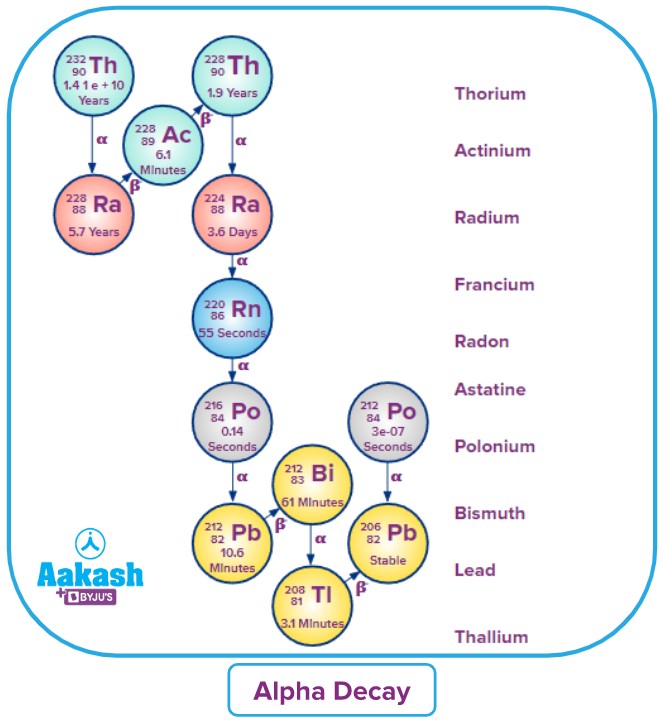
It is helpful to refer to nuclei that maintain the same (N-Z) value as isodiaphers. When an alpha decay occurs, the parent nucleus loses two neutrons and two protons, leaving the daughter nucleus with the same (N-Z) value.
Alpha Decay
Radioactivity is the phenomenon through which unstable nuclei become stable by emitting a particle or particle. Sometimes, electromagnetic radiations called gamma () rays are produced. A - particle is essentially a positron e+ or an electron e-.
Radioactivity is a nuclear phenomenon. The phenomenon of , or radiation depends upon the size of the nucleus undergoing decay and not on other factors like temperature, pressure or other physical conditions.
The behaviour of radioactive nuclei is different from that of normal nuclei. Let’s suppose you take two weighing pans; you put carbon in one and radioactive uranium in another in suitable conditions. After some time has passed, you would notice that the mass of the carbon remains unchanged, but the mass of uranium has reduced. Now, why does this happen? This is due to a phenomenon called radioactive decay or radioactivity; a phenomenon which was intensively experimented upon by scientists like Madam Curie and Henry Becquerel. Due to radioactivity, uranium will slowly decay; when you bring a Geiger-Counter near it (a device used to detect radioactivity), the counter shows deflection, meaning that radiation is emitted from the Uranium. Radioactive decay is of many types. It mainly depends upon the parent nucleus undergoing decay.
An alpha particle is an energetic He- nucleus (2He4) with atomic number 2 and mass number 4. It carries a positive charge of +2. Alpha particles are emitted when heavy elements like Uranium U-235 undergo radioactive decay.
During decay, the atomic number decreases by 2 and the mass number decreases by 4. Consider an elementZXA whose atomic number is Z and mass number is A. Upon undergoing - decay, it transforms to a daughter nucleus Y. The reaction can be represented as:
Mass of the parent nucleus,
Mass of the daughter nucleus,
Mass of the alpha particle
Where, me- mass of the electron in amu.
Example of - decay: 92U238 decays to 90Th234 emitting a - particle.
All the isodiaphers are obtained from the -decay of 90Th232.
Difference between Isobars, Isotones, Isobars and Isodiaphers
|
Parameters |
Isotopes |
Isobars |
Isotones |
Isodiaphers |
|
Definition |
Isotopes are the elements that have the same atomic number (number of protons) but a different mass number (number of nucleons). |
Elements that have the same mass number (number of nucleons) but different atomic numbers (number of protons). |
Isotones are elements that have the same number of neutrons but can have different atomic numbers (number of protons) and mass numbers (number of nucleons). |
Species have different numbers of protons and neutrons, but the difference between the neutrons and protons is the same (same neutron excess) are called isodiaphers. |
|
Examples |
C612 , C613 & C614 are isotopes. |
K1940 & Ca2040 are isobars. |
O816 & C614 are isotones. |
Th90234 & U92238 are isodiaphers. |
Practice Problems
1. Isodiaphers have the same value of
a.
b.
c. (N-Z)
d. Z/N
Answer: C
Solution: Isodiaphers are the atoms of two elements that have the same value of (N-Z). For example, Th90234 and U92238 are isodiaphers.
|
Nucleus |
Mass Number (A) |
Number of Protons (P) |
Number of Neutrons (N=A-P) |
Neutron Excess (N-Z) |
|
234 |
90 |
144 |
54 |
|
|
238 |
92 |
146 |
54 |
So, option C is the correct answer.
2. The total number of protons present in one CO32- ion is:
a. 30
b. 32
c. 64
d. 45
Answer: A
Number of protons in one atom of
Number of protons in one atom of
Total number of protons in 1 molecule of
So, option A is the correct answer.
3. Neutron excess of an element is 48 and the number of neutrons is 132. Which of the following nucleus has this configuration?
a.
b.
c.
d.
Answer: A
Neutron Excess
Number of neutrons
Atomic number
Mass number
The nucleus is
So, option A is the correct answer.
4. Which pair represents isodiaphers?
a. O816 & C614
b. Th90234 & U92238
c. C612 & C614
d. None of these
Answer: B
Solution: Species that have different numbers of protons and neutrons, but the difference between the neutrons and protons is the same (same neutron excess) are called isodiaphers.
|
Nucleus |
Mass Number (A) |
Number of Protons (P) |
Number of Neutrons (N=A-P) |
Neutron Excess (N-Z) |
|
234 |
90 |
144 |
54 |
|
|
238 |
92 |
146 |
54 |
|
|
16 |
8 |
8 |
0 |
|
|
14 |
6 |
8 |
2 |
|
|
12 |
6 |
6 |
0 |
O816 & C614 are isotones & C612 & C614 are isotopes.
So, option B is the correct answer.
5. The pair of nuclei that is isotonic is
a. N715 & F917
b. C612 & F919
c. C614 & F919
d. N715 & F919
Answer: A
Solution: Isotones are the elements having the same number of neutrons.
So, option A is the correct answer.
Frequently Asked Questions – FAQ
1. Are isodiaphers and isotones the same?
Answer: Isodiaphers and isotones are not the same. Isotones are elements that have the same number of neutrons but can have different atomic numbers (number of protons) and mass numbers (number of nucleons). Species having a different numbers of protons and neutrons, but the difference between the neutrons and protons is the same (same neutron excess) are called isodiaphers.
O816 & C614 are examples of isotones.
Th90234 & U92238 are examples of isodiaphers.
2. What is the use of isodiaphers?
Answer: Isodiaphers do not have many applications as compared to isotopes and isobars but the information on iso neutron excess (which is the difference between the number of neutrons and an atomic number of an element) species is very helpful in nuclear chemistry research.
3. Are nucleons and nuclides the same?
Answer: Nucleons are the protons and neutrons that make up the nucleus. An atom with a certain number of neutrons and protons is referred to as a nuclide. For instance, the six-proton and seven-neutron in C13.

 Call Now
 Let's Chat
 Share
Share