-
Call Now
1800-102-2727


Hybridization (s and p): sp, sp², sp³ Explained

Hybridization is a major concept in chemical bonding. It explains the geometry and shape of molecules. It was introduced to overcome the limitations of valence bond theory in explaining molecular structures. Hybridization involves the mixing of atomic orbitals of similar energies, like s and p orbitals within an atom, to form a new set of equivalent orbitals called hybrid orbitals. These hybrid orbitals participate in bond formation and help explain bond angles, molecular shapes, and bond strengths.
This document focuses on hybridization involving s and p orbitals — namely sp, sp², and sp³ hybridization.
What is Hybridization?
Hybridization is the intermixing of atomic orbitals of nearly equal energy on the same atom to produce an equal number of new orbitals called hybrid orbitals. These hybrid orbitals have the same energy, shape, and orientation.
Important points:
- It occurs before bond formation.
- Hybrid orbitals are more directional.
- It explains molecular geometry accurately.
Need for Hybridization
Hybridization was proposed to explain:
- Equivalent bond lengths in molecules
- Specific bond angles
- Observed molecular shapes
For example, carbon forms four identical C–H bonds in methane, which cannot be explained using pure s and p orbitals alone. Hybridization provides a clear explanation.
Conditions for Hybridization
Hybridization occurs when:
- Orbitals belong to the same atom
- Orbitals have nearly equal energy
- The number of hybrid orbitals equals the number of atomic orbitals mixed
- Hybrid orbitals form stronger bonds than pure orbitals
Types of Hybridization (s and p)
Based on the number of s and p orbitals involved, hybridization can be classified into:
- sp hybridization
- sp² hybridization
- sp³ hybridization
sp Hybridization
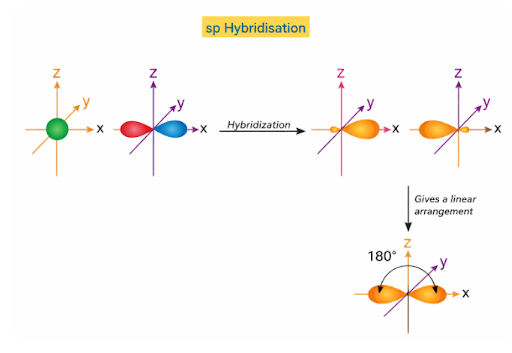
Formation
In sp hybridization, one s orbital mixes with one p orbital to form two equal sp hybrid orbitals:
1s + 1p → 2 sp
Geometry
Shape: Linear. Bond angle: 180°. The two sp hybrid orbitals orient themselves opposite to each other to minimize repulsion.
Characteristics
- Each sp orbital has 50% s-character and 50% p-character
- The remaining two p orbitals stay unhybridized
- It is suitable for forming triple bonds or two double bonds
Examples
BeCl₂, CO₂, Ethyne (C₂H₂). In ethyne, each carbon atom is sp hybridized. It forms one σ bond and two π bonds with the other carbon.
sp² Hybridization
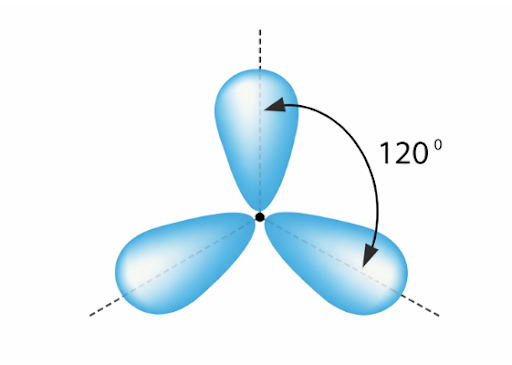
Formation
In sp² hybridization, one s orbital and two p orbitals mix together to form three equivalent sp² hybrid orbitals:
1s + 2p → 3 sp²
Geometry
Shape: Trigonal planar. Bond angle: 120°. The three sp² orbitals lie in one plane and are spaced equally.
Characteristics
- Each sp² orbital has 33% s-character and 67% p-character
- One p orbital remains unhybridized
- It is used in the formation of double bonds
Examples
BF₃, Ethene (C₂H₄), SO₃. In ethene, the carbon atoms are sp² hybridized, forming one σ bond and one π bond between the carbons.
sp³ Hybridization
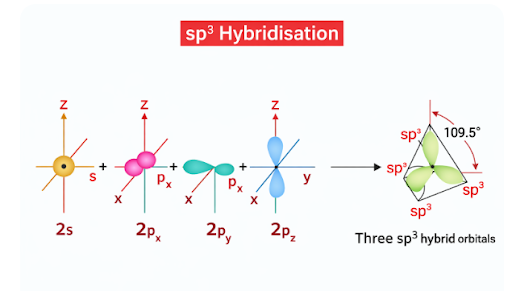
Formation
In sp³ hybridization, one s orbital mixes with three p orbitals to form four equal sp³ hybrid orbitals:
1s + 3p → 4 sp³
Geometry
Shape: Tetrahedral. Bond angle: 109.5°. The four sp³ orbitals arrange themselves in space to minimize electron repulsion.
Characteristics
- Each sp³ orbital has 25% s-character and 75% p-character
- No unhybridized p orbitals remain
- It is common in single-bonded molecules
Examples
CH₄ (Methane), NH₃, H₂O. In methane, carbon is sp³ hybridized and forms four identical C–H σ bonds.
Effect of Lone Pairs on Shape
Even though hybridization determines the electron geometry, the presence of lone pairs changes the molecular shape:
- NH₃: trigonal pyramidal (one lone pair)
- H₂O: bent shape (two lone pairs)
Comparison of sp, sp², and sp³ Hybridization
| Type | Orbitals Mixed | Geometry | Bond Angle |
|---|---|---|---|
| sp | 1s + 1p | Linear | 180° |
| sp² | 1s + 2p | Trigonal planar | 120° |
| sp³ | 1s + 3p | Tetrahedral | 109.5° |
Sigma (σ) and Pi (π) Bonds
A σ bond is formed by head-on overlap of hybrid orbitals. A π bond is formed by sideways overlap of unhybridized p orbitals. Hybridization explains the formation of σ bonds, while π bonds are formed by unhybridized p orbitals.
Importance of s-character
Greater s-character gives: shorter bond length, stronger bonds, and higher electronegativity.
Order of s-character: sp > sp² > sp³
Limitations of Hybridization Theory
- It cannot explain magnetic properties
- It does not fully explain delocalized bonding
- It assumes orbitals mix completely
Despite these limitations, hybridization is a powerful explanatory tool.
Applications of Hybridization
- Predicting molecular shapes: it indicates the spatial arrangement of hybrid orbitals to determine 3-D shapes
- Explaining bond angles: it explains characteristic bond angles based on orbital orientation
- Understanding bond strength: it explains variations in bond strength and length through differences in s-character of hybrid orbitals
- It explains the geometry of organic molecules
Summary
Hybridization involving s and p orbitals explains the geometry, bond angles, and stability of molecules. By mixing s and p orbitals, atoms form hybrid orbitals oriented in specific directions, resulting in linear, trigonal planar, or tetrahedral geometries. The concepts of sp, sp², and sp³ hybridization are important for understanding molecular structure and chemical bonding in organic chemistry.
FAQs
Is there a possibility for hybridization to change during a chemical reaction?
Yes, hybridization can adjust as bond formation or breaking changes the number of electron domains around an atom.
Is hybridization an actual physical process?
No, hybridization is a theoretical model used to explain observed molecular shapes and bonding.
Can any atom other than carbon display sp, sp², and sp³ hybridization?
Yes, elements like boron, nitrogen, oxygen, and beryllium also show s–p hybridization.
Does hybridization affect bond length?
Yes, greater s-character leads to shorter and stronger bonds.
Can a molecule have different hybridizations on different atoms?
Yes, different atoms in the same molecule can have different hybridizations, depending on their bonding.

Last Updated: Jul 27, 2026 01:14 PM
NEET Related Links
JEE MAIN Related Links
JEE Advanced Related Links
JEE Advanced Eligibility Criteria
JEE Advanced Chemistry Syllabus
JEE Advanced Registration Dates
CUET Related Links
Important Topics
Anemometer : Measurement of Wind Speed
Angular Acceleration Atomic Theory Audible and Inaudible Sound Average Speed and Average Velocity Average Velocity Avogadros Number Avogadros Hypothesis Azimuthal Quantum Number Balanced Force Bar Magnet Biconvex Lens Boyles Law Buoyancy Calorimeter Carnot Engine Celestial Bodies Centripetal And Centrifugal Force Concave and Convex Lenses Concave Convex Mirrors Contact and Non Contact Force Controlled Thermonuclear Fusion Convection Currents Convex Lens Convex Mirror Destructive Interference Difference Between Conduction Convection and Radiation Difference Between Electric Field and Magnetic Field Difference Between Heat And Temperature Difference Between Series And Parallel Circuits Differences Between Acceleration And Velocity Distance and Displacement Distance Time Graph Electrical Force : Electric Forces and Their Types Electromagnetic Waves : Definition, Equation and Properties of Electromagnetic Waves Electromagnetism Electron Spin Fluid Flow : Bernoullis Equation Derivation and Fluid Mechanics Fluid Friction : Types and Factors of Fluid Friction Frames of Reference : Inertial and Non- Inertial Frame of Reference Frequency and Wavelength Frictional Force Importance of Hydrosphere Instantaneous Speed and Velocity Introduction to Motion Kinetic and Potential Energy Difference Law Of Conservation of Energy Layers of the Earth Light Energy Light Sources List of physics scientists and Their inventionsLoudness of Sound
Magnetic Dipole Moment Magnetic Field Non - Contact Force Non - Renewable Energy Ohms Law Optics P Wave Physics Symbols Plane Mirrors Poissons Ratio Projectile Motion Properties of Water : Anomalous Expansion of Water Radius of Gyration Reflection of Light Reflection of Waves Relative Density Resonance Reverberation Rolling Friction Rotation and Revolution Screw Gauge Semiconductors and Insulators Sliding Friction Speed Time Graphs Static Friction Stefan Boltzmann Law Stress Tension Tension Force Thermometer: Clinical Laboratory Thermometer Types of Rocks Types of Waves Uniform Motion and Non Uniform Motion Unit of Voltage Uses of Convex Lens Uses Of Convex Mirror Uses of Electromagnet Uses of Optical Fibre Wave Wavelength of Light What is Scattering of Light Working of Electric Bell Conventional and Non-conventional Sources of Energy Buoyant Force Bulk Modulus of Elasticity Bernoulli’s Principle Angular Momentum Difference Between Speed And Velocity ForceUnit of Heat
Difference between Distance and Displacement Simple Microscope Derivation Of Equation Of Motion Thermometer: Clinical & Laboratory Thermometer Difference between Concave and Convex LensDerivation Of Lens Maker Formula
Unit Of Pressure Velocity Uses of Plane Mirror
Wave Theory of Light
Unit of Density Unit of Light Unit of Force Unit of Magnetic Field Unit of wavelength Unit of Viscosity Uses of Electroplating Young's Modulus
What is the Scattering of Light
Lenz Law Space Wave Propagation Schrodinger Wave Equation Relation between Fahrenheit and Celsius Refractive Index Potentiometer Working Pascal Law Oscillatory Motion Optical Instruments Newton's Laws of Motion - First Law Modulation and Demodulation Magnetic Flux Lens Formula and Magnification Kaleidoscope Faradays Law Epsilon Naught Value Energy Bands Electrostatics Electroscope AC Generator Unit of Current Lithosphere Bending Equation Derivation Difference Between Pound and Kilogram Semiconductor Devices OTEC - Ocean Thermal Energy Conversion Hall Effect Rectilinear Propagation of Light Difference Between Ammeter and Voltmeter Coefficient of Linear Expansion Ampere’s Law Cyclone and Thunderstorm Save The Environment From Pollution Particle Nature of Light Types of DC Motor Uses Of Transistor Derivation of Phase Rule Unit of Humidity

 Call Now
 Let's Chat
 Share