-
Call Now
1800-102-2727


Homologous series: Definition of Homologous series, Characteristic of a homologous series, Functional Groups, Practice problems, FAQs:

Which is your favorite chocolate?
We all love chocolates right? Have you ever tried buying chocolate from a supermarket. If you have done so then you know how everything is well organized there. All the chocolates are kept at a certain place so that you can pick and choose easily. So also of other consumables there.

What would happen if everything in supermarket is messed up?
It will be a nightmare for you to find even a single product. That’s why they arrange everything in a set. You will see set of pulses arranged in one corner whereas set of soaps are arranged in different corners.
Similarly in organic chemistry you know that there are millions of organic compounds that exists.a few of which have yet to be found. It is almost impossible to study chemical and physical properties of each and every organic compound. Hence, these compounds are classified into several families or homologous series based on properties shown by the compounds.
Let’s understand how these classifications are done and how it will be help you to understand organic chemistry in a much better way.
Table of content
- Definition of Homologous series
- Characteristic of a homologous series
- Functional Groups
- Practice problems
- Frequently asked questions
Definition of Homologous series
- A homologous series is group or family or structurally comparable organic compounds with a general formula.
- All the members of which include the same functional group. And show a gradation in physical and similarity in chemical properties of any two adjacent members.
- Individual members of such a sequence are known as homologues, and the phenomenon is known as homology.
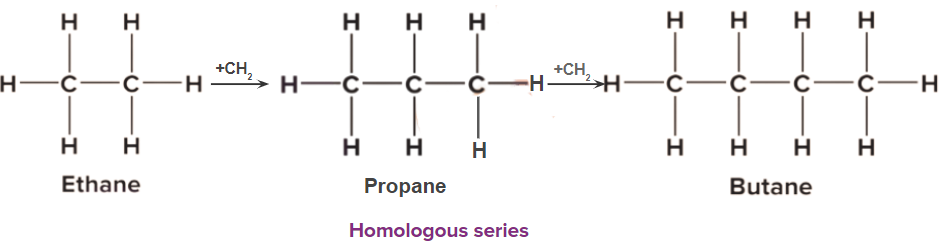
- Successive homologues differ from each other in the molecular formula by -CH2 only.and so differ by 14 u
Examples:
CH3-CH3 (Ethane), CH3-CH2-CH3 (Propane), and CH3-CH2-CH2-CH3 (Butane).
CH3-CH3 + (-CH2) → CH3-CH2-CH3 + (-CH2) → CH3-CH2-CH2-CH3
Characteristic of a homologous series
- A general formula can be used to express any homologous series.
- The same functional group is shared by every member of a given homologous series.
All the members of a given homologous series possess the same functional group.
For Example:The hydroxyl group, often known as the -OH group, is the functional group of alcohols.
The aldehydic group, or -CHO group, is the functional group of an aldehyde.
The ketonic group, or -CO group, is the functional group of ketones.
- A -CH2 group distinguishes each consecutive member of a homologous series.
- The general preparatory techniques created for a homologous series can be applied to each individual member.
- The members of homologous series exhibit a predictable gradation in their physical characteristics, such as, melting point, boiling point, and density as the molecular mass increases.
- Although the first member of a homologous series may differ significantly from the other members, they always share comparable chemical characteristics.
Functional Groups
An atom or group of atoms that define the properties and unique chemical reactions of an organic compound is called a functional group.
A functional group is a group of atoms or bonds in the substance that is responsible for the substance’s unique chemical reactions in organic chemistry. The same functional group will behave consistently and undergo similar reactions regardless of the chemical in which it is present.
The general formula and functional groups for many classes of organic compounds, including halides, alcohols, aldehydes, ketones, and organic carboxylic acids, are included in the table below.

Hydrocarbons
- The letter R stands for alkanes, alkenes, and alkynes and occasionally benzene derivatives. Since they exclusively contain carbon and hydrogen atoms, these groups are also known as hydrocarbyl groups. They might differ, though, in the number of double or triple bonds that are between the two carbon atoms.
- The nature of the carbon-carbon bond affects these groups' reactivity in different ways. Some groups have particular names because they contain an alkane that is long and branched or has a ring structure. Names like cyclohexyl and bornyl are examples.
- It's possible for the hydrocarbon functional groups to have an ionic charge. Carbocations are the name given to positively charged compounds, whereas carbanions are the name given to negatively charged hydrocarbons.
Haloalkanes
- The functional groups that have a bond between a carbon atom and a halogen are known as haloalkanes, sometimes known as alkyl halides. "Halo-" is the prefix used to indicate a halogen. For instance, the prefix fluoro can be used to refer to the compound as fluoromethane.
- A halogen is identified by the suffix "halide." For instance, the suffix fluoride can be used to refer to the same substance, fluoromethane , as methyl fluoride.
- Depending on the halogen, the carbon-halogen bond has varying degrees of stability and strength. Alkyl iodides, for instance, have a weak carbon-iodine bond while alkyl fluorides have a strong and stable carbon-fluorine bond.
- All the alkyl halides, with the exception of these alkyl fluorides, are easily subject to elimination reactions or nucleophilic substitution reactions.
Oxygen-containing functional groups
- The hybridization of the carbon-oxygen bond determines all of the features of functional groups that contain this bond.
- This can be explained by the electron donating effect of the sp3 hybridization of oxygen which can be observed in alcohols in sharp contrast with the electron withdrawing effect of the sp2 hybridized oxygen which can be observed in the carbonyl groups which contain a carbon-oxygen double bond.
Practice problems
Q. 1. belongs to which of the following homologous series?
- Alkene
- Alkane
- Alkyne
- alcohol
Answer: (B)
Solution: It is defined as a series of similarly constituted compounds in which the members possess the same functional group, have similar chemical characteristics, and have a regular gradation in their physical properties.
To decide the homologous series of the above compound, we need to find out the general constitution formula of this compound. All the homologous series whether it is alkane, alkane or alkyne are assigned some general molecular formula. If a compound satisfies the general molecular formula then it will be considered as the homologous series of the respective functional group.
Step 1
Look at the number of carbon atom present in the compound.
Here it is 4
Step 2
Divide the number of hydrogen atoms by the number of carbon atoms.(which is 4 in this case)
Step 3
Check for the remainder and add it with the multiple
Hence,
C4H10 belongs to alkane.
Q.2. What is the mass difference between two consecutive members of an alkene group?
- 34
- 36
- 14
- 12
Answer: (C)
Solution:
An alkene's standard chemical formula is CnH2n.
Where n= 2,3,4,5,6.........
Putting n=2
We get
C2H22=C2H4
Molecular mass of C2H4
Atomic mass of carbon atom =12 amu
Atomic mass of hydrogen atom =1 amu
2Atomic mass of carbon atom+4Atomic mass of hydrogen atom
212+41=24+4=28
Now
Putting n=3
We get
Molecular mass of
Atomic mass of carbon atom =12 amu
Atomic mass of hydrogen atom =1 amu
3Atomic mass of carbon atom+6Atomic mass of hydrogen atom
312+61=36+6=42
Difference of molecular masses between these two compounds is 42-28=14 amu.
Q.3. belongs to which homologous series?
a. Alkane
b. Alkene
c. Alkyne
d. aldehyde
Answer: (C)
Solution:
It is defined as a series of similarly constituted compounds in which the members possess the same functional group, have similar chemical characteristics, and have a regular gradation in their physical properties.
To decide the homologous series of the above compound, we need to find out the general constitution formula of this compound. All the homologous series whether it is alkane, alkane or alkyne are assigned some general molecular formula. If a compound satisfies the general molecular formula then it will be considered as the homologous series of the respective functional group.
Step 1
Look at the number of carbon atom present in the compound.
Here it is 6
Step 2
Divide the number of hydrogen atoms by the number of carbon atoms.(which is 4 in this case)
Step 3
Check for the remainder and add/substract accordingly it with the multiple
Hence,
belongs to alkyne.
Q.4. two successive homologous series differ by
a.
b.
c.
d.
Answer: (A)
Solution:
A homologous series is a series of organic compounds, each of which contains a distinctive functional group.
Successive homologues differ from each other in the molecular formula by -CH2 only.
Examples:
(Butane).
Q.5. Which of the following belongs to an alternative homologous series?
a.
b.
c.
d.
Answer: (C)
Solution:
all belongs to same homologous series.
All have the general formula of CnH2n+2 which is for alkane. Whereas C7H14is an alkex`ne because it satisfies the general formula of alkene which is CnH2n.
Frequently asked questions
Q.1. Do all the homologous series posses similar physical properties?
Answer: Because they share a functional group, homologous series have comparable chemical characteristics. However, due to stronger London dispersion forces, homologues' physical characteristics are different. In addition to organic molecules, other substances can also have homologous series.
Q.2. Why is it necessary to group compounds into homologous series?
Answer: A homologous series of compounds often share comparable chemical and physical properties because they have a fixed set of functional groups. Hence, it becomes easier to predict the property of an organic compound by determining its homologous series. Otherwise it would have been too difficult for us to individual study all the chemical and physical properties of every organic compound. As you know there are millions of organic compounds that exist.
Q.3. Is there any homologous series for inorganic compounds?
Answer: The phosphoric acids, silicic acids, and phosphonitrilic chlorides are homologous series of inorganic chemicals. The chemical properties of the compounds are basically identical within a given homologous series, whereas the physical qualities fluctuate continuously and predictably.
Q.4. Are paraffines and alkanes same thing?
Answer: Alkanes are known as paraffins because of their little affinity for a common reagent. Alkanes are therefore inactive compounds. Under harsh circumstances, they experience reactions.

NEET Related Links
JEE MAIN Related Links
JEE Advanced Related Links
JEE Advanced Eligibility Criteria
JEE Advanced Chemistry Syllabus
JEE Advanced Registration Dates
CUET Related Links
Important Topics
Anemometer : Measurement of Wind Speed
Angular Acceleration Atomic Theory Audible and Inaudible Sound Average Speed and Average Velocity Average Velocity Avogadros Number Avogadros Hypothesis Azimuthal Quantum Number Balanced Force Bar Magnet Biconvex Lens Boyles Law Buoyancy Calorimeter Carnot Engine Celestial Bodies Centripetal And Centrifugal Force Concave and Convex Lenses Concave Convex Mirrors Contact and Non Contact Force Controlled Thermonuclear Fusion Convection Currents Convex Lens Convex Mirror Destructive Interference Difference Between Conduction Convection and Radiation Difference Between Electric Field and Magnetic Field Difference Between Heat And Temperature Difference Between Series And Parallel Circuits Differences Between Acceleration And Velocity Distance and Displacement Distance Time Graph Electrical Force : Electric Forces and Their Types Electromagnetic Waves : Definition, Equation and Properties of Electromagnetic Waves Electromagnetism Electron Spin Fluid Flow : Bernoullis Equation Derivation and Fluid Mechanics Fluid Friction : Types and Factors of Fluid Friction Frames of Reference : Inertial and Non- Inertial Frame of Reference Frequency and Wavelength Frictional Force Importance of Hydrosphere Instantaneous Speed and Velocity Introduction to Motion Kinetic and Potential Energy Difference Law Of Conservation of Energy Layers of the Earth Light Energy Light Sources List of physics scientists and Their inventionsLoudness of Sound
Magnetic Dipole Moment Magnetic Field Non - Contact Force Non - Renewable Energy Ohms Law Optics P Wave Physics Symbols Plane Mirrors Poissons Ratio Projectile Motion Properties of Water : Anomalous Expansion of Water Radius of Gyration Reflection of Light Reflection of Waves Relative Density Resonance Reverberation Rolling Friction Rotation and Revolution Screw Gauge Semiconductors and Insulators Sliding Friction Speed Time Graphs Static Friction Stefan Boltzmann Law Stress Tension Tension Force Thermometer: Clinical Laboratory Thermometer Types of Rocks Types of Waves Uniform Motion and Non Uniform Motion Unit of Voltage Uses of Convex Lens Uses Of Convex Mirror Uses of Electromagnet Uses of Optical Fibre Wave Wavelength of Light What is Scattering of Light Working of Electric Bell Conventional and Non-conventional Sources of Energy Buoyant Force Bulk Modulus of Elasticity Bernoulli’s Principle Angular Momentum Difference Between Speed And Velocity ForceUnit of Heat
Difference between Distance and Displacement Simple Microscope Derivation Of Equation Of Motion Thermometer: Clinical & Laboratory Thermometer Difference between Concave and Convex LensDerivation Of Lens Maker Formula
Unit Of Pressure Velocity Uses of Plane Mirror
Wave Theory of Light
Unit of Density Unit of Light Unit of Force Unit of Magnetic Field Unit of wavelength Unit of Viscosity Uses of Electroplating Young's Modulus
What is the Scattering of Light
Lenz Law Space Wave Propagation Schrodinger Wave Equation Relation between Fahrenheit and Celsius Refractive Index Potentiometer Working Pascal Law Oscillatory Motion Optical Instruments Newton's Laws of Motion - First Law Modulation and Demodulation Magnetic Flux Lens Formula and Magnification Kaleidoscope Faradays Law Epsilon Naught Value Energy Bands Electrostatics Electroscope AC Generator Unit of Current Lithosphere Bending Equation Derivation Difference Between Pound and Kilogram Semiconductor Devices OTEC - Ocean Thermal Energy Conversion Hall Effect Rectilinear Propagation of Light Difference Between Ammeter and Voltmeter Coefficient of Linear Expansion Ampere’s Law Cyclone and Thunderstorm Save The Environment From Pollution Particle Nature of Light Types of DC Motor Uses Of Transistor Derivation of Phase Rule Unit of Humidity

 Call Now
 Let's Chat
 Share
Share