-
Call Now
1800-102-2727


Factors Affecting Electronegativity - General Trends of Electronegativity, Difference Between Electronegativity and Electron Gain Enthalpy, Practice Problems and FAQ

Best pals, Ron and Harry! They must embark on a rock-climbing adventure. That's not all! The first person to reach the summit will be rewarded. Several factors may now play a role in determining the eventual winner.
For example, the one who has more stamina, is physically fitter, does not have a fear of heights, and so on, would likely have an advantage over the other.

Similarly, for understanding the trends in the electronegativity of an element, it is important to note that there are multiple factors that can influence the electronegativity of an atom.
For example, in HF, the electron pair is attracted more towards fluorine that makes F attain a partial negative charge (represented by 𝛅-) and H, a partial positive charge (represented by 𝛅+).
TABLE OF CONTENTS
- Understanding Electronegativity
- Factors Affecting Electronegativity
- General trends of Electronegativity
- Non-Metallic Nature and Electronegativity
- Difference between Electronegativity and Electron gain enthalpy
- Practice Problems
- Frequently Asked Questions - FAQ
Understanding Electronegativity
Electronegativity is the tendency of an atom to attract the shared pair of electrons more towards itself in a covalently bonded molecule.
In case of a non-polar covalent bond, i.e., the bond between two identical atoms, the bonded pair of electrons is shared equally by the two atoms. However, in case of a polar covalent bond, i.e., the bond between two different atoms, the bonded pair of electrons is not shared equally by the two atoms. The atom that has a greater tendency to attract the shared pair of electrons towards itself acquires a partial negative charge, while the other atom acquires a partial positive charge. This relative tendency of an atom to attract the shared pair of electrons towards itself in a covalently bonded molecule was termed the electronegativity of the atom by Pauling.
Factors Affecting Electronegativity
- Atomic radii: As the distance between the nucleus and the valence electrons increases, the force of attraction between the nucleus and the valence shell electrons decreases. Hence, the electronegativity value decreases.
- Effective nuclear charge: Greater the effective nuclear charge (Zeff) of an atom, the force of attraction between the nucleus and the valence shell electrons is greater, and more is the power of an atom to attract the shared pair of electrons. Hence, more is the electronegativity value.
- Shielding effect: This is responsible for the decrease in the nuclear pull or force of attraction faced by the valence electrons. The greater the shielding effect, the lesser will be the electronegativity
- Magnitude of positive charge: As the size of the atom decreases with the increase in the magnitude of positive charge on an atom, the tendency of a cation to attract an electron is more than a neutral atom. Higher the magnitude of delta positive charge on an atom in a given covalent compound, greater will be its electronegativity as compared to the neutral atom.
For example: In H-F, F being more electronegative, starts to attract the shared pair of electrons, and attains δ- charge, while H attains δ+ charge. Now, this H with a partial positive charge is more electronegative as compared to the neutral H.
- Hybridisation: The electronegativity of an atom increases with an increase in s-character of its hybrid orbitals because the s-orbital is the most penetrating towards the nucleus. Thus, the electronegativity of a carbon atom increases with the change in hybridization state as:
(sp) > (sp2) > (sp3)
The s-character in sp is 50%, sp2 is 33.33%, and sp3 is 25%.
- Effect of substituent: The electronegativity of an atom depends upon the nature of the substituent attached to that atom. For example, the carbon atom in CF3I acquires a greater positive charge than CH3I. Therefore, C-atom in CF3I is more electronegative than in CH3I. The difference in electronegativity of an atom caused by substituents results in different chemical behaviour of that atom.
- Bond multiplicity: Considering single, double and triple covalent bonds, the electronegativity value will be in the order:
single bond < double bond < triple bond
Hence, with an increase in a number of bonds, the bond length decreases which leads to greater electronegativity value.
General Trends of Electronegativity
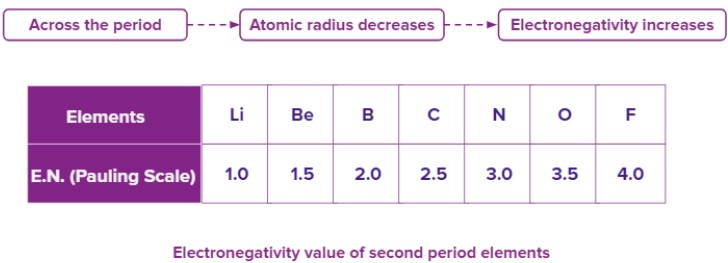
- Electronegativity across a period: In general, as we move across a period from left to right, the atomic size decreases and the electronegativity increases.
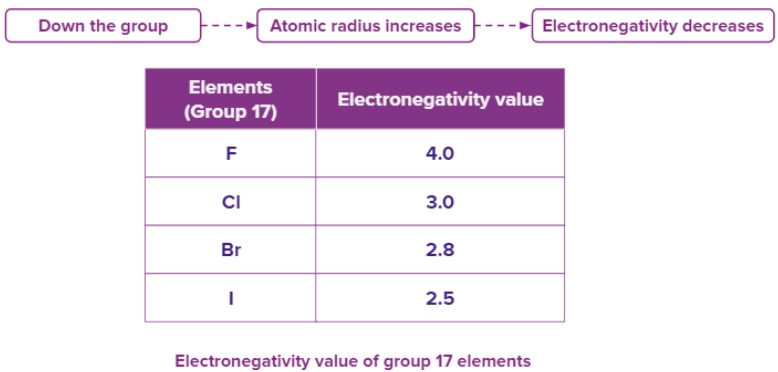
- Electronegativity down the group: In general, as we move down a group, the atomic size increases and the electronegativity decreases.
- Exceptions/Irregularities in trends of electronegativity: Exceptions are seen majorly in group 13 and group 14 elements. In group 13, electronegativity increases down the group moving from aluminium to thallium. On going from Al to Tl, electrons start filling into the d-orbitals. As these intervening electrons are not able to screen the nuclear charge owing to their diffused shape, the electrons in Ga experience more force of attraction than in Al which leads to a decrease in atomic radii and an increase in electronegativity.
Also for group 14 elements, it mostly remains the same from silicon to lead for similar reasons.
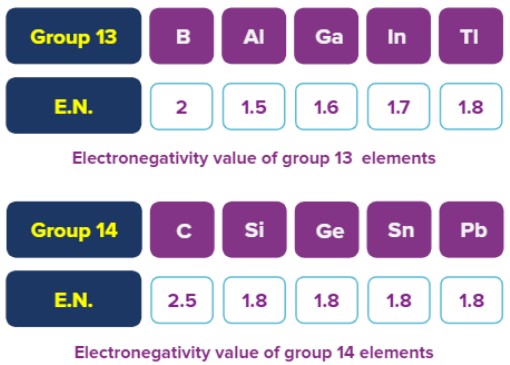
These electronegativity values will not vary much due to the poor shielding of the inner d-orbital electron.
Poor screening effect of d-electrons in Ga and In, and even poorer shielding of f -electrons in thallium makes the atomic sizes of gallium, indium and thallium similar to each other. This is the case with Si, Ge,Sn, and Pb as well. Also, Sn and Pb experiences the inert pair effect.
Non-Metallic Nature and Electronegativity
Non-metallic elements have a strong tendency to gain electrons. Therefore, electronegativity is directly related to the non-metallic nature of elements.
- As we move down a group, the metallic character increases, the non-metallic character decreases, and the electronegativity decreases.
- In the periodic table, alkali metals are strong metals and halogens are strong non-metals.
- As we move along the period, the non-metallic character increases, the metallic character decreases, and the electronegativity increases.

Difference between Electronegativity and Electron Gain Enthalpy
|
Electron gain enthalpy |
Electronegativity |
|
The amount of energy released when an electron is added to an isolated neutral gaseous atom to convert it into a uni-negative ion is known as electron gain enthalpy |
It is the tendency of an atom in a molecule to attract a shared pair of electrons. |
|
It is the property of isolated gaseous atoms. |
It is the property of bonded atoms. |
|
It can be measured experimentally. |
It cannot be measured experimentally |
|
It is a constant quantity for a particular element. |
The electronegativity of an element is not constant. It depends on a number of factors such as hybridisation, oxidation state, etc. |
Practice Problems
Q 1. With respect to chlorine, hydrogen will be
a. Electropositive
b. Electronegative
c. Neutral
d. Oxidising agent
Answer: A)
Referring to the electronegativity values of chlorine (3.0) and hydrogen (2.1), hydrogen is electropositive compared to chlorine. This can be justified by their respective positions in the periodic table also. Chlorine lies on the extreme right of its period and so has a greater effective nuclear charge and is thus more electronegative. Hence, option (A) is the correct answer.
Q 2. Which among the following is the correct order of the electropositive nature of Li, Na, and K?
a. Li > Na > K
b. Li > K > Na
c. Na > K > Li
d. K > Na > Li
Answer: D)
The given elements (Lithium [Z = 3], Sodium [Z = 11] and Potassium [Z = 19]) are of the same group. So, the electropositive character increases down the group due to the decrease in the ionisation energy. Therefore, it follows the order, K > Na > Li . Hence, option (D) is the correct answer.
Q 3. Which among the following is the correct order of increasing electronegativities?
a. C < N < Si < P
b. N < Si < C < P
c. Si < P < C < N
d. P < Si < N < C
Answer: C)
Electronegativity increases along a period and decreases down the group. Carbon (C) and silicon (Si) are members of the 14th group, whereas nitrogen (N) and phosphorus (P) are members of the 15th group. Carbon and silicon are placed before nitrogen and phosphorus in their respective periods. So, taking all the factors into account, the order will be nitrogen having the highest electronegativity followed by carbon then phosphorus and silicon. Hence, option (C) is the correct answer.
Q 4. Why is the electronegativity of thallium greater than that of indium?
Answer: The effective nuclear charge increases in thallium due to the poor shielding of the inner d- and f-orbital electrons. This leads to an increase in the electronegativity of Tl.
Frequently Asked Questions - FAQ
Q 1. Which element has the highest and which element has the lowest electronegativity values?
Answer: Electronegativity decreases down the groups, and increases from left to right across a period. Thus, fluorine is the most electronegative element, while francium is one of the least electronegative elements. This is in accordance with the Pauling’s scale of electronegativity.
Q 2. Which metal has the highest electronegativity value?
Answer: Gold has the highest electronegativity value among metals. Its electronegativity value in the Pauling’s scale is 2.54.
Q 3. What are the factors affecting electron affinity?
Answer: The major factors affecting the electron affinity of a molecule are effective nuclear charge, atomic radii, and electronic configuration. The greater the nuclear charge, the greater will be the attraction of the incoming electron. Hence, larger will be the value of electron affinity
Q 4. Are electron affinity and electronegativity the same?
Answer: No, they are different. Firstly, electron affinity is the energy released when an isolated neutral atom accepts an electron. Hence, it is a property of an isolated atom. Whereas, electronegativity is the tendency of an atom present in a molecule, to attract the bonded electron pair towards itself.
Related Topics
|
Atomic Radii |
Ionic Radii |
|
Oxygen |
Ionization Enthalpy |
|
Successive electron gain enthalpy |
Factors affecting Ionization Enthalpy |

 Call Now
 Let's Chat
 Share
Share