-
Call Now
1800-102-2727


Enthalpy of Ionisation - Definition, General Trends, Applications, Practice problems, FAQ

Tiku, a tiny toddler, loves his lollipop! He is very critical about not sharing it with anyone else. So if you want to get it from him, you will have to forcefully take it out of his fist. Tiki, his elder brother, however, is quite a grown-up young boy and he easily gives his lollipop to Tiku if Tiku asks for it.
Atoms are just like Tiku and Tiki. And lollipops are just like electrons! Some atoms, just like Tiki, easily give away their electrons (or lollipops) without requiring a lot of energy (or enthalpy), while others are reluctant to do so and need to be supplied with greater enthalpy to facilitate the process of giving away electrons.
Ionisation Enthalpy is the enthalpy needed to be given to an atom to pull out an electron from its outermost enthalpy level.
TABLE OF CONTENTS
- What is Ionisation Enthalpy?
- General Trends in Ionisation Enthalpy
- The First Ionisation Enthalpy of the First 60 Elements in the Periodic Table
- Metallic Character and its Relation with Ionisation Enthalpy
- Applications of Ionisation Enthalpy
- Practice Problems
- Frequently Asked Questions - FAQ
What is Ionisation Enthalpy?
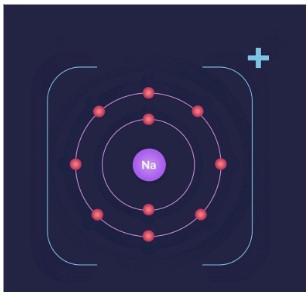
- Ionisation enthalpy corresponds to the enthalpy required to remove an electron from an isolated gaseous atom (X) in its ground state.
- The quantitative measure of the tendency of an element to lose an electron is given by its ionisation enthalpy.
- Smaller the ionisation enthalpy, the easier it is for the neutral atom to lose an electron and become a positive ion.
 [Unit =
  ]
]
General Trends in Ionisation Enthalpy
Variation of Ionisation Enthalpy Across a Period
- On going from left to right across a period, the atomic radius decreases as the number of electrons increases with no increase in the number of shells.
- Hence, if atomic size decreases, the attractive force between the nucleus and the valence electrons increases.
- On account of this, ionisation enthalpy generally increases from left to right of a period.
Example:
The first ionisation enthalpy of the second period elements increases as we move from  to
to  . As we move from to
  , the size decreases and the nuclear force of attraction between the nucleus and the valence electron increases.
Variation of Ionisation Enthalpy Down the Group
- On going down a group, ionisation enthalpy of elements decreases due to an increase in atomic size down the group.
- With an increase in the number of shells, the outermost electrons move far away from the nucleus, and the effective nuclear charge gets reduced.
- Additionally, the shielding effect increases down the group, which leads to a decrease in ionisation enthalpy.

The First Ionisation Enthalpy of First 60 Elements in the Periodic Table

On analysing the given graph we get,
Noble gases (He, Ne, Ar, Kr, Xe)
- Noble gases have the highest ionisation enthalpy in their respective periods because of their fully filled orbitals. This stability of noble gases is compromised to a great extent when the outermost electron is removed. Therefore, noble gases have high ionisation enthalpy.
- Down the group (Group 18), ionisation enthalpy values of noble gases decrease (visible from the graph) due to the increase in the size of the atom.
Alkali metals (Li, Na, K, Rb, Cs)
- In a given period, alkali metals have the lowest ionisation enthalpy. This is because alkali metals on losing one electron would attain a stable noble gas configuration.
- Down the group (Group 1), there is a decrease in ionisation enthalpy of alkali metals. Caesium (Cs) has a very low ionisation enthalpy. Hence, it is used in photovoltaic cells.
Metallic Character and its Relationship with Ionisation Enthalpy
The metallic character refers to the level of reactivity of a metal. Metals tend to lose electrons in chemical reactions.
- Across a period, the metallic character decreases as ionisation enthalpy increases.
- Down the group, metallic character increases (as indicated by the upward arrow) as ionisation enthalpy decreases (as indicated by the downward arrow).
- In the long form of the periodic table, alkali metals have the least ionisation enthalpies and noble gases have the highest ionisation enthalpies. Caesium (Cs) has the least ionisation enthalpy and Helium (He) has the highest ionisation enthalpy.
- Non-metallic character indicates the tendency of an element to accept electrons. They are generally high in electronegativity.

Applications of Ionisation Enthalpy
The trends of the metallic and non-metallic character of an element can be explained by the
ionisation enthalpy.
For example, metals have low ionisation enthalpy and are more ready to form cations while non-metals have high ionisation enthalpy and prefer forming anions.
- The knowledge of ionisation enthalpy can be used to find the number of valence electrons in an atom.
- For example, in the case of , the value of I.E.1 and I.E.2 = 5.4 eV and 75.6 eV respectively. This indicates that the first electron can be more readily removed than the other electrons. Thus, there is only one electron in the valence shell of a lithium atom.
- Reducing power of an element: Lower the value of the ionisation enthalpy of an element, the greater is its reducing power. This is because a low value of ionisation enthalpy means easier removal of electrons from the element which then can be used to reduce an oxidising agent.
- Basic strength of an element: Lower the value of ionisation enthalpy, the easier it is to remove the electrons and greater will be the donor properties of the element. Thus, the basic strength of the elements increases considerably as a base is an electron donor.
Practice Problems
Q 1. What is the general trend of ionisation enthalpy across a period and down the group?
Answer: On going down a group, ionisation enthalpy decreases due to the increase in atomic radii, whereas, across a period, atomic radii decreases and effective nuclear charge is increased, thus ionisation enthalpy increases from left to right.
Q 2. Which of the following ionisation enthalpies will be the greatest for scandium?
a. 1st ionisation enthalpy
b. 2nd ionisation enthalpy
c. 3rd ionisation enthalpy
d. 4th ionisation enthalpy
Answer: Option D
The electronic configuration of scandium is  . Hence, it can release up to three electrons in in order to attain the stable configuration of the nearest noble gas. So, the fourth ionisation enthalpy would be considerably high as it would have to break the stable noble gas configuration to knock out the fourth electron.
Q 3. Which of the following has the lowest ionisation enthalpy?
a. Boron
b. Beryllium
c. Carbon
d. Oxygen
Answer: Option A
We know that on going from left to right across a period, ionisation enthalpy increases. But Boron will have the lowest ionisation enthalpy among the given four (which belongs to the 2nd period).
Electronic configuration of  =
= 
Electronic configuration of  =
= 
Since the 2s orbital is totally filled in beryllium, it is difficult to extract an electron from this orbital and hence its ionisation enthalpy will be greater than boron. 2s orbitals are much more strongly held by the nucleus than 2p. Hence, boron with 1 electron in 2p will have lesser ionisation energy.
Q 4. Which element is expected to have the highest first ionisation potential?
a. Sulphur
b. Oxygen
c. Tellurium
d. Selenium
Answer: Option B
Down the group ionisation enthalpy decreases owing to the decrease in effective nuclear charge. Hence, oxygen is supposed to have the highest ionisation potential among the other members of its group.
Q 5. The ionisation enthalpies of an element are stated as follows: Which group would you expect it to be in?
a. Group 2
b. Group 4
c. Group 3
d. Group 5
Answer: Option C
We notice that there is a gradual increase in the ionisation enthalpy values till the third electron. For the fourth electron removal, the ionisation enthalpy increases drastically. Hence, the element should be present in Group 3, having 3 valence electrons.
Q 6. Cations and anions forming ionic compounds should have respectively
a. Higher Ionisation Enthalpy, Lower Electron Affinity
b. Lower Ionisation Enthalpy, Higher Electron Affinity
c. Lower Ionisation Enthalpy, Lower Electron Affinity
d. Higher Ionisation Enthalpy, Higher Electron Affinity
Answer: Option B
Metals should readily lose electrons to form cations and hence they should have lower ionisation enthalpy. And anions should readily accept electrons and so should have higher electron affinity. In this way, the two oppositely charged species would form an ionic bond by the electrostatic force of attraction.
Frequently Asked Questions - FAQ
Question 1. Are ionisation enthalpy and ionisation energy the same?
Answer: Apparently the two terms are used interchangeably, but to be more precise energy is expressed in terms of Joules, whereas enthalpy is expressed in terms of Joules per mole.
Energy is the state of matter and enthalpy is a form of energy change between two states. Hence ionisation enthalpy is the energy needed to transform a neutral gaseous atom to its corresponding ion by losing an electron.
Question 2. Which element has the highest first ionisation enthalpy?
Answer: Helium has the highest first ionisation enthalpy ( ). Ionisation enthalpy increases from left to right of a period and decreases down the group.
Related Topics
| Factors affecting Ionisation Enthalpy | Electron gain Enthalpy |
| Electron gain enthalpy | Successive Electron gain Enthalpy |
| Ionic Radii | S-block elements |

NEET Related Links
JEE MAIN Related Links
JEE Advanced Related Links
JEE Advanced Eligibility Criteria
JEE Advanced Chemistry Syllabus
JEE Advanced Registration Dates
CUET Related Links
Important Topics
Anemometer : Measurement of Wind Speed
Angular Acceleration Atomic Theory Audible and Inaudible Sound Average Speed and Average Velocity Average Velocity Avogadros Number Avogadros Hypothesis Azimuthal Quantum Number Balanced Force Bar Magnet Biconvex Lens Boyles Law Buoyancy Calorimeter Carnot Engine Celestial Bodies Centripetal And Centrifugal Force Concave and Convex Lenses Concave Convex Mirrors Contact and Non Contact Force Controlled Thermonuclear Fusion Convection Currents Convex Lens Convex Mirror Destructive Interference Difference Between Conduction Convection and Radiation Difference Between Electric Field and Magnetic Field Difference Between Heat And Temperature Difference Between Series And Parallel Circuits Differences Between Acceleration And Velocity Distance and Displacement Distance Time Graph Electrical Force : Electric Forces and Their Types Electromagnetic Waves : Definition, Equation and Properties of Electromagnetic Waves Electromagnetism Electron Spin Fluid Flow : Bernoullis Equation Derivation and Fluid Mechanics Fluid Friction : Types and Factors of Fluid Friction Frames of Reference : Inertial and Non- Inertial Frame of Reference Frequency and Wavelength Frictional Force Importance of Hydrosphere Instantaneous Speed and Velocity Introduction to Motion Kinetic and Potential Energy Difference Law Of Conservation of Energy Layers of the Earth Light Energy Light Sources List of physics scientists and Their inventionsLoudness of Sound
Magnetic Dipole Moment Magnetic Field Non - Contact Force Non - Renewable Energy Ohms Law Optics P Wave Physics Symbols Plane Mirrors Poissons Ratio Projectile Motion Properties of Water : Anomalous Expansion of Water Radius of Gyration Reflection of Light Reflection of Waves Relative Density Resonance Reverberation Rolling Friction Rotation and Revolution Screw Gauge Semiconductors and Insulators Sliding Friction Speed Time Graphs Static Friction Stefan Boltzmann Law Stress Tension Tension Force Thermometer: Clinical Laboratory Thermometer Types of Rocks Types of Waves Uniform Motion and Non Uniform Motion Unit of Voltage Uses of Convex Lens Uses Of Convex Mirror Uses of Electromagnet Uses of Optical Fibre Wave Wavelength of Light What is Scattering of Light Working of Electric Bell Conventional and Non-conventional Sources of Energy Buoyant Force Bulk Modulus of Elasticity Bernoulli’s Principle Angular Momentum Difference Between Speed And Velocity ForceUnit of Heat
Difference between Distance and Displacement Simple Microscope Derivation Of Equation Of Motion Thermometer: Clinical & Laboratory Thermometer Difference between Concave and Convex LensDerivation Of Lens Maker Formula
Unit Of Pressure Velocity Uses of Plane Mirror
Wave Theory of Light
Unit of Density Unit of Light Unit of Force Unit of Magnetic Field Unit of wavelength Unit of Viscosity Uses of Electroplating Young's Modulus
What is the Scattering of Light
Lenz Law Space Wave Propagation Schrodinger Wave Equation Relation between Fahrenheit and Celsius Refractive Index Potentiometer Working Pascal Law Oscillatory Motion Optical Instruments Newton's Laws of Motion - First Law Modulation and Demodulation Magnetic Flux Lens Formula and Magnification Kaleidoscope Faradays Law Epsilon Naught Value Energy Bands Electrostatics Electroscope AC Generator Unit of Current Lithosphere Bending Equation Derivation Difference Between Pound and Kilogram Semiconductor Devices OTEC - Ocean Thermal Energy Conversion Hall Effect Rectilinear Propagation of Light Difference Between Ammeter and Voltmeter Coefficient of Linear Expansion Ampere’s Law Cyclone and Thunderstorm Save The Environment From Pollution Particle Nature of Light Types of DC Motor Uses Of Transistor Derivation of Phase Rule Unit of Humidity

 Call Now
 Let's Chat
 Share
Share